
 Russia
 Belarus
 Georgia
 Kazakhstan
 Kyrgyzstan
 Uzbekistan
 China
China Nepal
Nepal Bangladesh
 Poland
 Romania
 Slovakia
 Hungary
 N. Macedonia
 Vietnam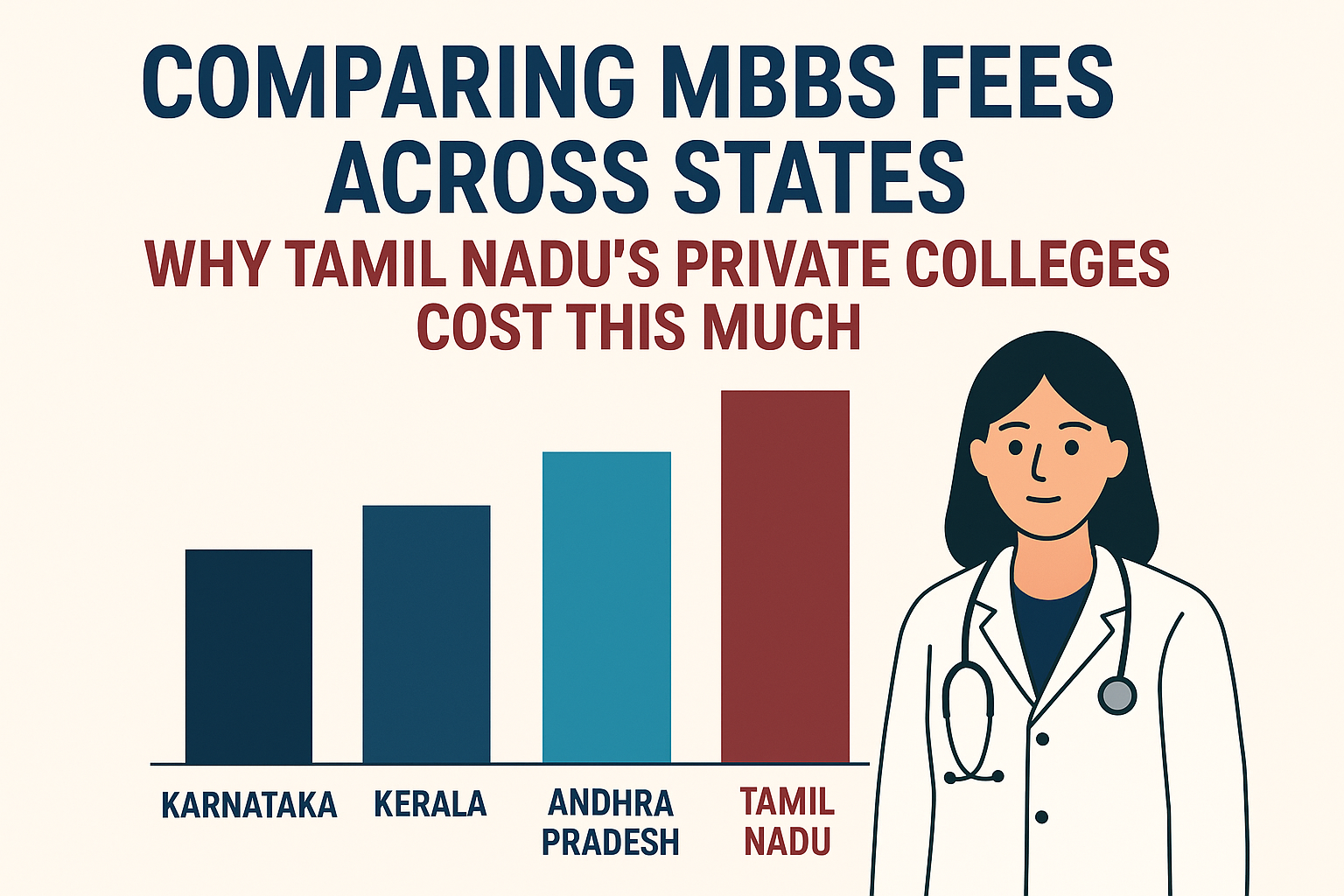
Pursuing an MBBS degree in India has always been a dream for thousands of students, but it’s no secret that the cost of medical education varies widely from one state to another. While some states offer relatively affordable government or private college fees, others—like Tamil Nadu—are witnessing a sharp rise in tuition charges, especially under management and NRI quotas.As the 2025-26 academic session approaches, understanding why Tamil Nadu’s private colleges cost what they do—and how this compares with other states—can help aspiring doctors and their families make informed financial decisions.
1. MBBS Fee Comparison Across Indian States
MBBS fees in India are determined by state fee fixation committees, the National Medical Commission (NMC) guidelines, and institutional policies. Here’s how Tamil Nadu stacks up against other key states:
|
State |
Avg. Annual Fee (Private Colleges) |
NRI Quota (Approx.) |
|
Tamil Nadu |
?14 – ?16 lakh |
?25 – ?30 lakh |
|
Karnataka |
?10 – ?12 lakh |
?22 – ?28 lakh |
|
Maharashtra |
?8 – ?10 lakh |
?20 – ?25 lakh |
|
Kerala |
?7 – ?9 lakh |
?18 – ?22 lakh |
|
Telangana / Andhra Pradesh |
?12 – ?15 lakh |
?25 – ?28 lakh |
|
Uttar Pradesh |
?12 – ?17 lakh |
?22 – ?30 lakh |
Tamil Nadu consistently appears on the higher end of the spectrum, especially for management quota admissions. But unlike some other states, Tamil Nadu also maintains strong academic quality and patient exposure, which justifies part of the higher cost.
2. Why Tamil Nadu’s Private Colleges Charge More
Several factors contribute to the higher fee structure in Tamil Nadu’s private medical institutions:
a. Infrastructure Investments
Most Tamil Nadu private medical colleges have heavily invested in modern teaching hospitals, digital classrooms, and clinical laboratories to meet evolving NMC norms. These upgrades increase annual operational costs, which are reflected in tuition fees.
b. Faculty Standards
The state mandates stringent recruitment standards for professors and clinicians. To retain top medical educators, colleges must offer competitive salaries, which raises overall expenses.
c. Regulatory Compliance
Complying with updated NMC standards (see National Medical Commission) requires frequent audits, accreditation renewals, and new facilities such as skill labs—all adding to the cost.
d. Limited Seat Availability
The ratio of applicants to available MBBS seats in Tamil Nadu is one of the highest in India. This strong demand gives private institutions limited scope to reduce fees, especially for management quota seats.
e. Location and Operational Costs
Urban colleges, particularly in Chennai, Coimbatore, and Madurai, face higher maintenance and staff costs compared to colleges in other states, influencing the final tuition structure.
3. What Students and Parents Should Know
While the numbers may appear daunting, planning early and comparing colleges wisely can make a big difference. Many students underestimate the variation in non-tuition costs—such as hostel, mess, and development fees—which can add ?2–?4 lakh annually.For those navigating this process, expert guidance platforms like MBBS Advisor have become indispensable. The site offers college-wise fee comparisons, quota-based counselling support, and latest updates on both government and private medical colleges across India. By using such tools, families can identify states or colleges that balance affordability with educational quality.
4. Tamil Nadu vs. Other States: The Value Perspective
Despite the higher tuition, Tamil Nadu maintains an edge in several key areas:
- Academic Excellence: The state’s private medical colleges consistently rank high for academic results and postgraduate success rates.
- Patient Footfall: High patient volume in teaching hospitals ensures robust clinical training.
- Transparent Admissions: Tamil Nadu’s counselling system is known for its structured and transparent approach.
- Postgraduate Pathways: Graduates from Tamil Nadu often perform strongly in NEET-PG and pursue global opportunities.
Thus, while Tamil Nadu’s private MBBS education costs more, many view it as a value-for-money investment given the return in academic reputation and training quality.
5. Planning Ahead for 2025-26 Admissions
To make the most of the 2025-26 admission season, here are key steps for aspirants:
- Assess Financial Capacity Early: Estimate full 5-year expenses, not just annual tuition.
- Compare Across States: Consider states like Kerala or Maharashtra if affordability is the top priority.
- Seek Expert Guidance: Visit MBBS Advisor to compare institutions, explore scholarships, and receive one-on-one counselling.
- Stay Updated: Fee structures may be revised biannually, so verify official notices before finalizing a college.
6. Conclusion
Tamil Nadu’s private medical colleges may charge higher fees than many other states, but these costs are tied closely to quality, compliance, and opportunity. The state’s focus on maintaining top-tier medical education ensures that the investment delivers strong long-term value.For students aspiring to become doctors, success starts with knowledge — and using trusted guidance platforms like MBBS Advisor helps ensure every rupee spent aligns with your goals. comparing MBBS fees across states and planning strategically, you can balance affordability with excellence — turning your medical dream into a well-planned reality.