 Russia
 Belarus
 Georgia
 Kazakhstan
 Kyrgyzstan
 Uzbekistan
 China
China Nepal
Nepal Bangladesh
 Poland
 Romania
 Slovakia
 Hungary
 N. Macedonia
 Vietnam
 Canada
 Armenia
 UK
UK Australia
 USA
USA Ireland
 Germany
 New Zealand
 Italy
Italy France
 Singapore
 Netherlands
 Sweden
 Switzerland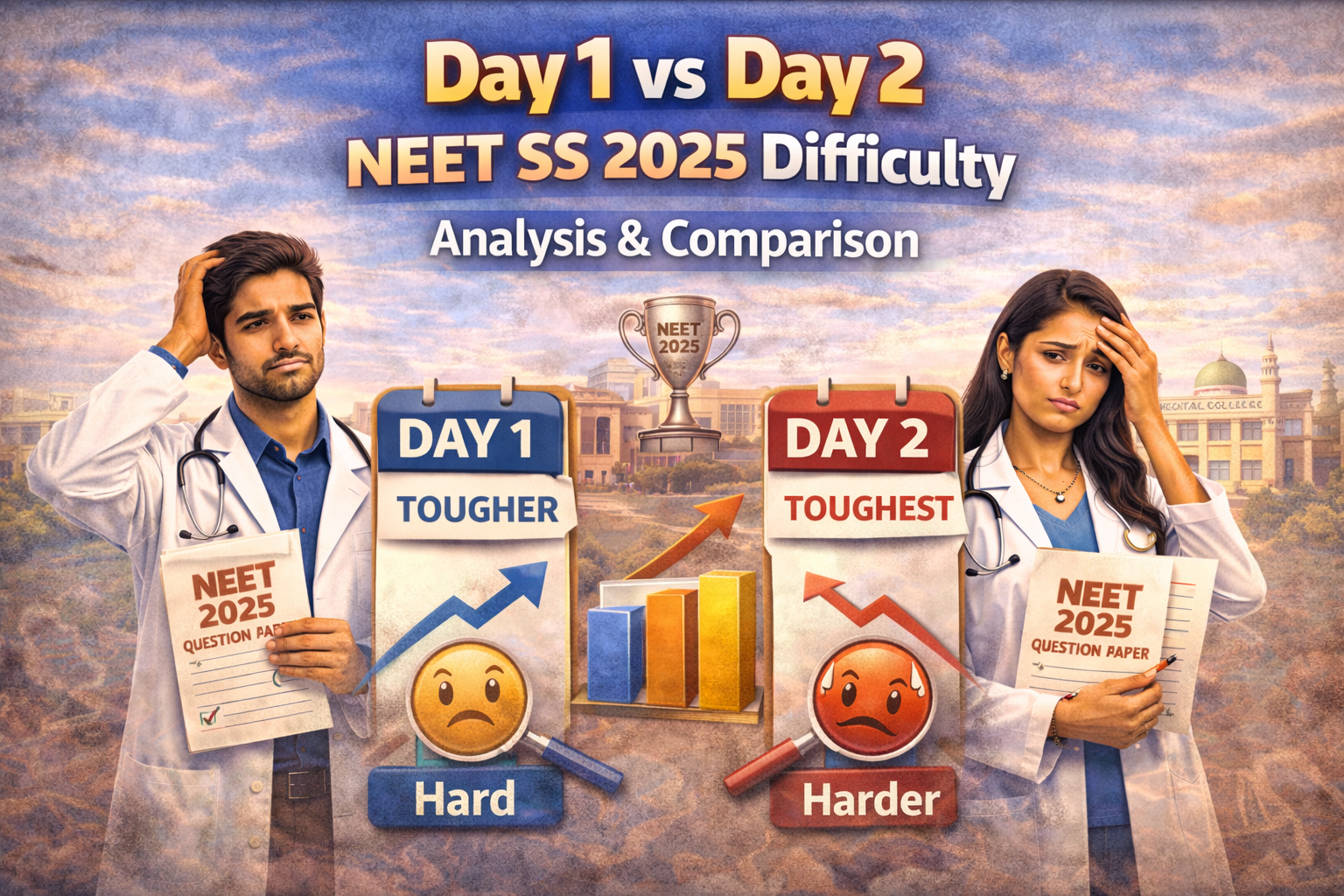
NEET-SS 2025 is an entrance examination for seeking admission to DM/MCh super-speciality courses in India, conducted by the National Board of Examinations (NBE). The computer-based test was administered on the 26th and 27th of December 2025 in order to judge the candidates both clinically and practically. Although both days had an identical pattern, aspirants & experts described some slight variations in difficulty level, question theme and time management strategy tests.
Day 1: The opening match (26th December 2025)
Specialities like ENT, O&G.Orthopaedics, Respiratory medicine, critical care & Medical Oncology were predominantly being tested on Day 1. Based on candidate feedback, the difficulty was moderate, and most questions were aimed at testing clinical reasoning, not just recall.
Key observations from Day 1:
- Predominant clinical scenario: Case-based questions that demanded use of guidelines and algorithms within clinical contexts.
- CCM was difficult because of the multi-step ICU issues, changes in ventilator settings, and emergency protocols.
- The orthopaedic and ENT questions were predominantly related to the decision-making process in surgery and imaging interpretation, assessing logical abilities.
- Time pressure: Sectional timing of 50 questions to be attempted in 50 minutes forced them to plan their attempts accordingly.
Day 1 was certainly knowledge-focused, assessing the ability of candidates to make rapid and correct clinical judgements.
Day 2 Review (27th December 2025)
Medical, Surgical, Anaesthesiology, Radiodiagnosis, Microbiology and Pathology are explained on Day 2. The level of the overall difficulty was moderate to difficult when compared to Day 1, especially due to the number of image-based questions and the multi-step reasoning applied.
Highlights of Day 2:
- Medical Specialities: Strong emphasis on Cardiology, Neurology, Gastroenterology and Nephrology with a lot of questions based on scenarios that need guideline-directed approach.
- Surgical Specialities: Case scenarios needed triage and decision-making in a simulated emergency situation.
- Pathology & Microbiology: Test questions covered laboratory interpretation, organism identification, and clinically relevant diagnostic reasoning.
- Anaesthesiology & Radiodiagnosis: Compliance with protocol and meticulousness in the interpretation of images was stringent.
On Day 2, accuracy and analytical skill were in the spotlight, so time management was arguably even more important than on Day 1.
Day 1 vs Day 2: Challenge Comparison
Aspect
Day 1
Day 2
Difficulty Level
Moderate
Moderate-to-Difficult
Question Type
Case-based scenarios, guideline application
case-based + image interpretation; multi-step reasoning
Time Pressure
Significant due to sectional timing
Higher due to analytical questions
Challenging Specialities
Respiratory Medicine, Critical Care Medicine, Orthopaedics
Medical, Surgical, Anaesthesiology, Radiodiagnosis
Candidate Feedback
Required fast clinical reasoning
Demanded accuracy and multi-step problem-solving
By comparing the two days, we can see that Day 1 was a practical application of problem-solving skills, while Day 2 was more subject-to-subject matter reasoning and techniques of interpreting the information. Candidates required a new strategy every day to score as much as they can.
Score Trends & Insights
Although official counts are still pending, the early returns indicate:
- Oral and maxillofacial surg: 295-310 /600
- ENT & Respiratory Medicine: 345–375 / 600
- Obstetrics & Gynaecology : 350–365 / 600
- Anaesthesiology & Critical Care: 275–295 / 600
- Pathology / Paediatrics: 260-300/600
These predicted scores suggest that accuracy and time distribution decided the top ranks. Testakers preparing for competitive seats need to concentrate on applied clinical knowledge, guideline-based practice, and mock test practice.
Key Takeaways
- Adjust strategy day to day: Day 1 rewards gut instincts; Day 2 needs the most thought.
- Clinical reasoning is a must: Both days are equally applied and not memorisation-based.
- The clock is ticking: It's the sectional timing that affects performance.
- Preparation needs to be visual: Image questions in Day 2 emphasise the need to interpret lab reports and X-rays.
For aspirants seeking guidance on super-speciality exam preparation, seat allocation, and counselling, MBBS Advisor provides detailed support. Additionally, official regulations and guidelines can be reviewed on the National Medical Commission website, while candidates with foreign qualifications can refer to FMGE details for licensing requirements.
Conclusion
The type of questions in the NEET SS 2025 exam was balanced for clinical reasoning and analytical challenges seen on Day1 in NEET SS 2025109 and on Day1108 BothDay1123. It is important that prospective candidates understand the nuances in degree of difficulty and nature of questions so as to affect a better preparation strategy, use their time judiciously and beat out competition from test takers who are vying for a spot towards the top.