 Russia
 Belarus
 Georgia
 Kazakhstan
 Kyrgyzstan
 Uzbekistan
 China
China Nepal
Nepal Bangladesh
 Poland
 Romania
 Slovakia
 Hungary
 N. Macedonia
 Vietnam
 Canada
 Armenia
 UK
UK Australia
 USA
USA Ireland
 Germany
 New Zealand
 Italy
Italy France
 Singapore
 Netherlands
 Sweden
 Switzerland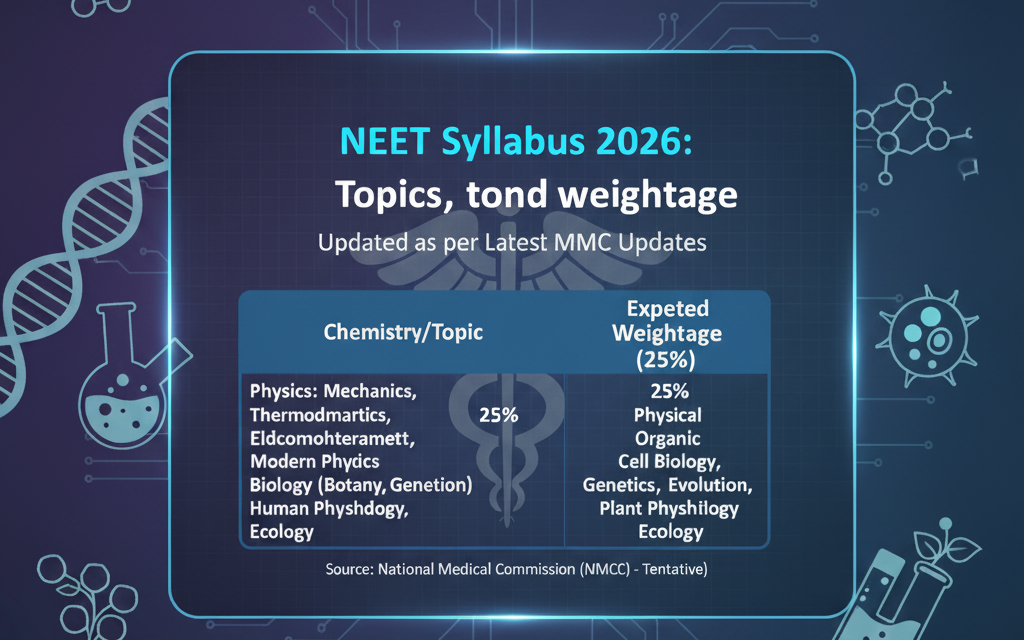
NEET UG remains the gateway to medical school in India. With NEET 2026 fast approaching, it is important that you stay up-to-date on the latest NMC exam pattern and syllabus. The National Medical Commission has slightly revised the syllabus based on last years curriculum to ensure that it is aligned with NCERT standards. This article explains the syllabus, topics and weightage expected to help students plan their preparation.
NMC Updates Recent News
According to an official NMC announcement, the NEET 2026 curriculum is largely the same as the 2025 curriculum, with some minor changes to eliminate overlaps and reduce redundant topics. Updates and changes should be sourced from the official NMC website. The syllabus includes Physics, Chemistry and Biology and is based on the NCERT textbooks for Class 11 and 12. (NMC Official Syllabus)
The following are some of the key updates to NEET 2026:
- Small topic rationalization, especially in Ecology and Plant Physiology.
- It is more important to focus on conceptual understanding, application-based questions and less on rote memorization.
- Mention experimental skills in Physics or Chemistry.
Exam Structure and Weightage
Exam pattern for NEET 2026 remains the same
- Total Questions: 180 multiple-choice questions
- Subjects: Physics 45, Chemistry 45, Biology 90
- Total marks: 720 (4 points per correct answer and -1 mark for incorrect answers)
- Duration: 3 Hours
Weight Overview
- Biology: 50% (360 marks).
- Physics: 25% (180 marks) of the exam
- Chemistry: 25% (180 marks).
1.Physics and Chemistry also contribute significantly to the overall ranking.
Subject-Wise Syllabus & Important Topics
1. Biology (Class 11 & 12)
The NEET is based on Biology, which includes Botany and Zoology. Chapters that are high-priority for scoring include:
Class 11
- Diversity of the Living World
- Structural Organization in Animals and Plants
- Cell Structure and Function
- Plant Physiology
- Human Physiology
Class 12
- Reproduction and Genetics
- Evolution and Biology for Human Welfare
- Biotechnology & Its Applications
- Ecology and Environment
Topics with high impact: Genetics. Human Physiology. Plant Physiology. Ecology. Biotechnology. Each year, these chapters contribute a high number of questions.
2. Physics (Classes 11 & 12).
Questions on physics are based on problem-solving and conceptual understanding. The key chapters include:
Class 11
- Mechanics & Laws of Motion
- Work, Energy & Power
- Gravitation
- Thermodynamics and Kinetic Theory
- Waves & Oscillations
Class 12
- Electrostatics & Current Electricity
- Magnetic Effects of Current & Electromagnetic induction
- Optics
- Dual Nature of Matter and Radiation
- Atomic & Nuclear Physics
- Electronics
Topics of high importance: Thermodynamics and Optics. It is important to practice numerical problems from the chapters.
3. Chemistry (Classes 11 & 12).
Physical, Organic and Inorganic chemistry are the three main divisions of Chemistry.
Class 11
- Basic Concepts of Chemistry
- Atomic Structure & Periodicity
- Chemical Bonding
- Thermodynamics
- Equilibrium
Class 12
- Solid State & Solutions
- Electrochemistry & Chemical Kinetics
- Coordination Compounds
- Organic Chemistry: Ketones and Carboxylic acids, Alcohols, Aldehydes
- The Polymers and Chemistry of Everyday Life
Topics of high importance: Chemical Bonding (Thermodynamics), Equilibrium (Coordination Compounds), Organic Reactions and Thermodynamics.
Prepare Yourself
- Prioritize topics that are important: First, focus on Genetics and Human Physiology. Then, move onto Thermodynamics and Electrostatics.
- It is helpful to familiarize yourself with previous NEET papers.
- For last-minute revision, use flashcards and short notes.
- Regular mock tests will build confidence and help identify weak areas.
For those seeking expert advice, offers comprehensive NEET preparation tips, updates on the syllabus, and guidance for medical admissions to India. MBBS Advisor also allows students to explore preparation strategies for MBBS options abroad, such as Georgia, Nepal, or Bangladesh.
References & Official Links
Aspirants can maximize their NEET 2020 scores by staying up-to-date with the syllabus and focusing only on topics that are high yield. Success is achieved by combining strategic planning with consistent preparation.