
 Russia
 Belarus
 Georgia
 Kazakhstan
 Kyrgyzstan
 Uzbekistan
 China
China Nepal
Nepal Bangladesh
 Poland
 Romania
 Slovakia
 Hungary
 N. Macedonia
 Vietnam
 Canada
 Armenia
 UK
UK Australia
 USA
USA Ireland
 Germany
 New Zealand
 Italy
Italy France
 Singapore
 Netherlands
 Sweden
 Switzerland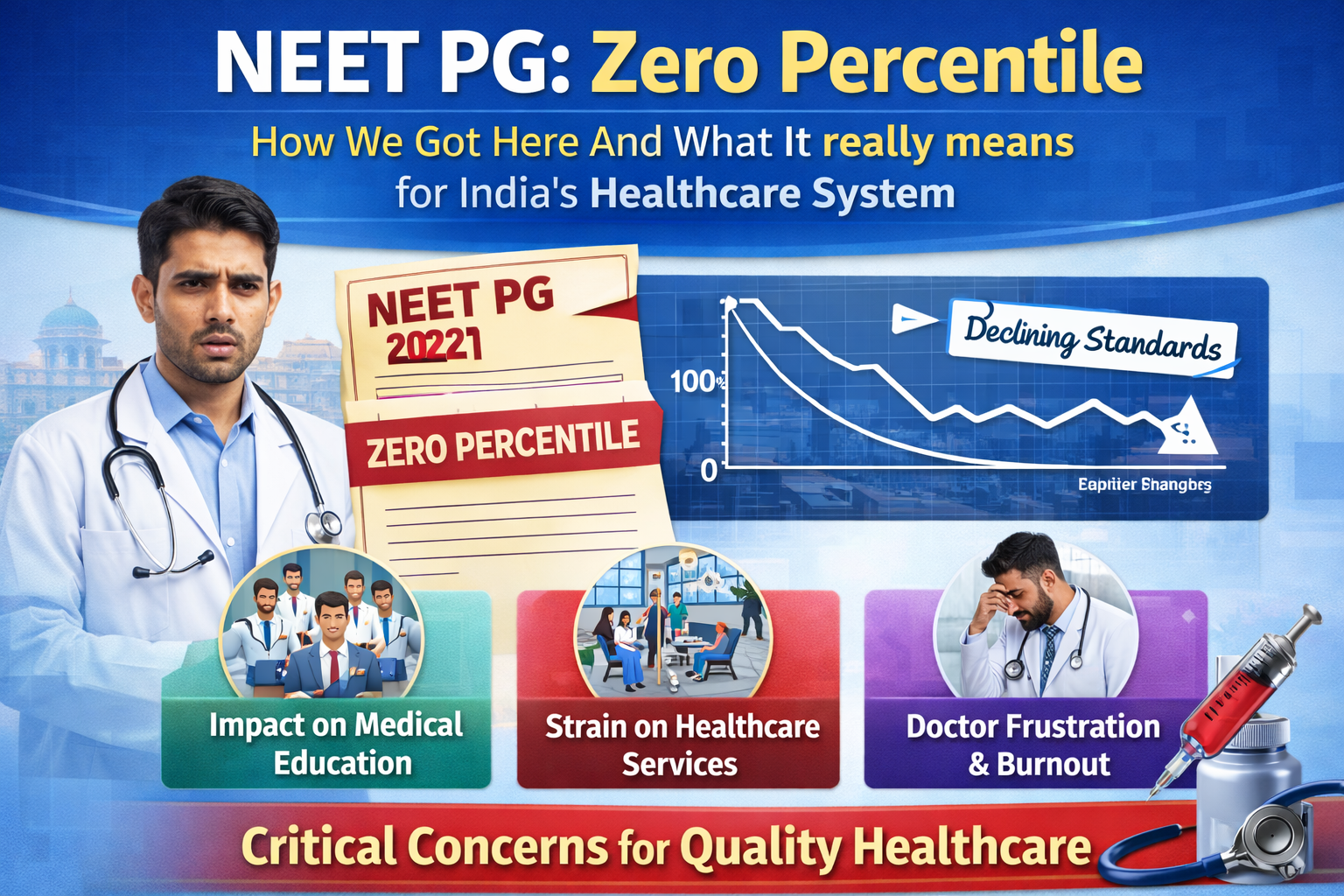
IntroductionThe news about inclusion of zero percentile qualifying score NEET-PG created an uproar among medical students, educators and policy-makers across India. NEET-PG: The national-level entrance exam for MD, MS & PG Diploma courses. Any dilution of its qualifying standards will impact directly on the quality of specialist doctors trained under the regulatory framework of the nmc and public-health principles advocated by the who.
This controversial step begat a question: Where did India arrive at a point that candidates with the lowest relative performative average to become requisite for PG admission and consequently what is in store for the health system in the country?
What Was the Path to Zero Percentile?
Persistent Vacant PG Seats
Over the last few years, there are been thousands of postgraduate medical seats that have not been filled up particularly in:
- Pre-clinical and para-clinical subjects
- Remote or less preferred location of Medical colleges
- Certain private institutions
Demand for PG branches, however, remained concentrated in high-income specialties like Radiology, Dermatology and Orthopedics even though the number of MBBS graduates increased dramatically. The subjects such as Anatomy, Microbiology and Community medicine have also continued to low preference leaving seats empty.
- Fixed Cut-Off System
- NEET-PG: (had qualifying cut-offs traditionally:)
- 50th percentile for General category
- Eligible General category 50th percentile, SC, ST and OBC 40th percentile
- They were academic standards from which at least the minimum had to be met. But even multiple rounds of counselling failed to fill the seats. To fix this problem, the authorities started lowering the qualifying percentile and eventually even allowed it to fall to zero percentile in certain categories.
- Policy to Prevent Seat Wastage
Post-graduate medical seats that require heavy investments were :
- Teaching hospitals
- Faculty salaries
- Infrastructure and equipment
- It was viewed as a waste of national resources and an obstacle to expanding the workforce of specialists to leave these seats empty. In order to prevent this, policymakers favored the utilization of seats over stringent academic cut-offs.
- Legal and Ethical Concerns
- The decision triggered legal challenges and ethical debate. Critics argued that:
- Merit-based selection was diluted
- NEET-PG academic credibility comes to pieces
- Patient safety could be compromised
- Surgeries, ICU patients and complex diagnostics are handled by specialist doctors. The training quality impacts the treatments they perform. nmc are now present to govern standards of education, and those who stress that healthcare will only be as good as the professionals to provide it.
- What Does Zero Percentile Mean Anyway?
For a zero percentile, marks are not zero. It means:
- The candidate performed worse than nearly all the test takers
- They fall at the bottom of their cohort in relative rank.
- Admitting such candidates to PG training creates the concern that:
- Foundational knowledge gaps will increase
- Remedial teaching will take up faculty ???? with students
- Academic competition will decline
Supporters argue that:
- A MBBS degree already means basic competence
- Graduate school (PG) training is a supervised, mentored and organized process.
- India urgently needs more specialists
- Impact on Medical Education
- Faculty Burden
- Teachers may need to:
- Re-teach undergraduate concepts
- Provide extra supervision
- Place less emphasis on research and innovation
- Student Morale
- High-scoring candidates may feel:
- Their effort has lost value
- Merit no longer defines success
- This may be changing the preparation behaviour of future NEET-PG aspirants.
- Implications for India’s Healthcare System
India already faces:
A shortage of specialist doctors
Uneven rural-urban distribution
2 High patient load in public hospitals
Raising domain's academic thresholds may mean more doctors in the short term but dangers on the long run include:
- Reduced trust in specialist quality
- Higher chances of medical errors
- Greater dependence on senior consultants
- The who, which emphasizes that a — it uses the phrase — that the number of doctors should never be at the expense of competence. We need both quantity and quality of strong health systems.
Why This Sparked a National Controversy
This issue exposes deeper structural problems:
- The PG seats available do not match with students wants
- Pressure to use medical infrastructure
- The tension between access and academic excellence
- Because medical education is centrally regulated by the nmc, such policy decisions have an impact on hospitals, universities and millions of patients across the country.
What Should Aspirants Do?
- Serious aspirants should: without paying attention to percentile changes.
- Prepare for merit-based competition
- Focus on strong conceptual learning
- Not depend on policy relaxation
- members advisor (Structured Medical-Admission Guidance): It is used for the alerted counselling updates, admission strategy, and regulations related to the medical field.
- Way Forward
Experts suggest:
- Adequate allocation of PG spots
- Incentives for unpopular specialties
- Stronger entrance benchmarks
- Curriculum modernization
- Improved rural posting benefits
- Temporary relief should be the exception, not the rule.
Conclusion
The zero percentile incident in NEET-PG brings to the forefront a fundamental flaw in India’s medical education system — balancing accessibility with excellence. Although it can temporarily help fill empty seats, it has serious implications for the future quality of specialists in addition to patient safety.
Medical education should continue to align with the professional standards of nmc and global healthcare values fostered by who. The lesson for both aspirants and policymakers is simple — reforms should strengthen both numbers and standards, not sacrifice one for another.
Students can check mbbs advisor for counselling guidance and official updates.
NEET PG: Zero Percentile — How We Got Here And What It really means India’ Healthcare System
IntroductionThe news about inclusion of zero percentile qualifying score NEET-PG created an uproar among medical students, educators and policy-makers across India. NEET-PG: The national-level entrance exam for MD, MS & PG Diploma courses. Any dilution of its qualifying standards will impact directly on the quality of specialist doctors trained under the regulatory framework of the nmc and public-health principles advocated by the who.
This controversial step begat a question: Where did India arrive at a point that candidates with the lowest relative performative average to become requisite for PG admission and consequently what is in store for the health system in the country?
What Was the Path to Zero Percentile?
Persistent Vacant PG Seats
Over the last few years, there are been thousands of postgraduate medical seats that have not been filled up particularly in:
- Pre-clinical and para-clinical subjects
- Remote or less preferred location of Medical colleges
- Certain private institutions
Demand for PG branches, however, remained concentrated in high-income specialties like Radiology, Dermatology and Orthopedics even though the number of MBBS graduates increased dramatically. The subjects such as Anatomy, Microbiology and Community medicine have also continued to low preference leaving seats empty.
- Fixed Cut-Off System
- NEET-PG: (had qualifying cut-offs traditionally:)
- 50th percentile for General category
- Eligible General category 50th percentile, SC, ST and OBC 40th percentile
- They were academic standards from which at least the minimum had to be met. But even multiple rounds of counselling failed to fill the seats. To fix this problem, the authorities started lowering the qualifying percentile and eventually even allowed it to fall to zero percentile in certain categories.
- Policy to Prevent Seat Wastage
Post-graduate medical seats that require heavy investments were :
- Teaching hospitals
- Faculty salaries
- Infrastructure and equipment
- It was viewed as a waste of national resources and an obstacle to expanding the workforce of specialists to leave these seats empty. In order to prevent this, policymakers favored the utilization of seats over stringent academic cut-offs.
- Legal and Ethical Concerns
- The decision triggered legal challenges and ethical debate. Critics argued that:
- Merit-based selection was diluted
- NEET-PG academic credibility comes to pieces
- Patient safety could be compromised
- Surgeries, ICU patients and complex diagnostics are handled by specialist doctors. The training quality impacts the treatments they perform. nmc are now present to govern standards of education, and those who stress that healthcare will only be as good as the professionals to provide it.
- What Does Zero Percentile Mean Anyway?
For a zero percentile, marks are not zero. It means:
- The candidate performed worse than nearly all the test takers
- They fall at the bottom of their cohort in relative rank.
- Admitting such candidates to PG training creates the concern that:
- Foundational knowledge gaps will increase
- Remedial teaching will take up faculty ???? with students
- Academic competition will decline
Supporters argue that:
- A MBBS degree already means basic competence
- Graduate school (PG) training is a supervised, mentored and organized process.
- India urgently needs more specialists
- Impact on Medical Education
- Faculty Burden
- Teachers may need to:
- Re-teach undergraduate concepts
- Provide extra supervision
- Place less emphasis on research and innovation
- Student Morale
- High-scoring candidates may feel:
- Their effort has lost value
- Merit no longer defines success
- This may be changing the preparation behaviour of future NEET-PG aspirants.
- Implications for India’s Healthcare System
India already faces:
A shortage of specialist doctors
Uneven rural-urban distribution
2 High patient load in public hospitals
Raising domain's academic thresholds may mean more doctors in the short term but dangers on the long run include:
- Reduced trust in specialist quality
- Higher chances of medical errors
- Greater dependence on senior consultants
- The who, which emphasizes that a — it uses the phrase — that the number of doctors should never be at the expense of competence. We need both quantity and quality of strong health systems.
Why This Sparked a National Controversy
This issue exposes deeper structural problems:
- The PG seats available do not match with students wants
- Pressure to use medical infrastructure
- The tension between access and academic excellence
- Because medical education is centrally regulated by the nmc, such policy decisions have an impact on hospitals, universities and millions of patients across the country.
What Should Aspirants Do?
- Serious aspirants should: without paying attention to percentile changes.
- Prepare for merit-based competition
- Focus on strong conceptual learning
- Not depend on policy relaxation
- members advisor (Structured Medical-Admission Guidance): It is used for the alerted counselling updates, admission strategy, and regulations related to the medical field.
- Way Forward
Experts suggest:
- Adequate allocation of PG spots
- Incentives for unpopular specialties
- Stronger entrance benchmarks
- Curriculum modernization
- Improved rural posting benefits
- Temporary relief should be the exception, not the rule.
Conclusion
The zero percentile incident in NEET-PG brings to the forefront a fundamental flaw in India’s medical education system — balancing accessibility with excellence. Although it can temporarily help fill empty seats, it has serious implications for the future quality of specialists in addition to patient safety.
Medical education should continue to align with the professional standards of nmc and global healthcare values fostered by who. The lesson for both aspirants and policymakers is simple — reforms should strengthen both numbers and standards, not sacrifice one for another.
Students can check mbbs advisor for counselling guidance and official updates.
NEET PG: Zero Percentile — How We Got Here And What It really means India’ Healthcare System
IntroductionThe news about inclusion of zero percentile qualifying score NEET-PG created an uproar among medical students, educators and policy-makers across India. NEET-PG: The national-level entrance exam for MD, MS & PG Diploma courses. Any dilution of its qualifying standards will impact directly on the quality of specialist doctors trained under the regulatory framework of the nmc and public-health principles advocated by the who.
This controversial step begat a question: Where did India arrive at a point that candidates with the lowest relative performative average to become requisite for PG admission and consequently what is in store for the health system in the country?
What Was the Path to Zero Percentile?
Persistent Vacant PG Seats
Over the last few years, there are been thousands of postgraduate medical seats that have not been filled up particularly in:
- Pre-clinical and para-clinical subjects
- Remote or less preferred location of Medical colleges
- Certain private institutions
Demand for PG branches, however, remained concentrated in high-income specialties like Radiology, Dermatology and Orthopedics even though the number of MBBS graduates increased dramatically. The subjects such as Anatomy, Microbiology and Community medicine have also continued to low preference leaving seats empty.
- Fixed Cut-Off System
- NEET-PG: (had qualifying cut-offs traditionally:)
- 50th percentile for General category
- Eligible General category 50th percentile, SC, ST and OBC 40th percentile
- They were academic standards from which at least the minimum had to be met. But even multiple rounds of counselling failed to fill the seats. To fix this problem, the authorities started lowering the qualifying percentile and eventually even allowed it to fall to zero percentile in certain categories.
- Policy to Prevent Seat Wastage
Post-graduate medical seats that require heavy investments were :
- Teaching hospitals
- Faculty salaries
- Infrastructure and equipment
- It was viewed as a waste of national resources and an obstacle to expanding the workforce of specialists to leave these seats empty. In order to prevent this, policymakers favored the utilization of seats over stringent academic cut-offs.
- Legal and Ethical Concerns
- The decision triggered legal challenges and ethical debate. Critics argued that:
- Merit-based selection was diluted
- NEET-PG academic credibility comes to pieces
- Patient safety could be compromised
- Surgeries, ICU patients and complex diagnostics are handled by specialist doctors. The training quality impacts the treatments they perform. nmc are now present to govern standards of education, and those who stress that healthcare will only be as good as the professionals to provide it.
- What Does Zero Percentile Mean Anyway?
For a zero percentile, marks are not zero. It means:
- The candidate performed worse than nearly all the test takers
- They fall at the bottom of their cohort in relative rank.
- Admitting such candidates to PG training creates the concern that:
- Foundational knowledge gaps will increase
- Remedial teaching will take up faculty ???? with students
- Academic competition will decline
Supporters argue that:
- A MBBS degree already means basic competence
- Graduate school (PG) training is a supervised, mentored and organized process.
- India urgently needs more specialists
- Impact on Medical Education
- Faculty Burden
- Teachers may need to:
- Re-teach undergraduate concepts
- Provide extra supervision
- Place less emphasis on research and innovation
- Student Morale
- High-scoring candidates may feel:
- Their effort has lost value
- Merit no longer defines success
- This may be changing the preparation behaviour of future NEET-PG aspirants.
- Implications for India’s Healthcare System
India already faces:
A shortage of specialist doctors
Uneven rural-urban distribution
2 High patient load in public hospitals
Raising domain's academic thresholds may mean more doctors in the short term but dangers on the long run include:
- Reduced trust in specialist quality
- Higher chances of medical errors
- Greater dependence on senior consultants
- The who, which emphasizes that a — it uses the phrase — that the number of doctors should never be at the expense of competence. We need both quantity and quality of strong health systems.
Why This Sparked a National Controversy
This issue exposes deeper structural problems:
- The PG seats available do not match with students wants
- Pressure to use medical infrastructure
- The tension between access and academic excellence
- Because medical education is centrally regulated by the nmc, such policy decisions have an impact on hospitals, universities and millions of patients across the country.
What Should Aspirants Do?
- Serious aspirants should: without paying attention to percentile changes.
- Prepare for merit-based competition
- Focus on strong conceptual learning
- Not depend on policy relaxation
- members advisor (Structured Medical-Admission Guidance): It is used for the alerted counselling updates, admission strategy, and regulations related to the medical field.
- Way Forward
Experts suggest:
- Adequate allocation of PG spots
- Incentives for unpopular specialties
- Stronger entrance benchmarks
- Curriculum modernization
- Improved rural posting benefits
- Temporary relief should be the exception, not the rule.
Conclusion
The zero percentile incident in NEET-PG brings to the forefront a fundamental flaw in India’s medical education system — balancing accessibility with excellence. Although it can temporarily help fill empty seats, it has serious implications for the future quality of specialists in addition to patient safety.
Medical education should continue to align with the professional standards of nmc and global healthcare values fostered by who. The lesson for both aspirants and policymakers is simple — reforms should strengthen both numbers and standards, not sacrifice one for another.
Students can check mbbs advisor for counselling guidance and official updates.
NEET PG: Zero Percentile — How We Got Here And What It really means India’ Healthcare System
IntroductionThe news about inclusion of zero percentile qualifying score NEET-PG created an uproar among medical students, educators and policy-makers across India. NEET-PG: The national-level entrance exam for MD, MS & PG Diploma courses. Any dilution of its qualifying standards will impact directly on the quality of specialist doctors trained under the regulatory framework of the nmc and public-health principles advocated by the who.
This controversial step begat a question: Where did India arrive at a point that candidates with the lowest relative performative average to become requisite for PG admission and consequently what is in store for the health system in the country?
What Was the Path to Zero Percentile?
Persistent Vacant PG Seats
Over the last few years, there are been thousands of postgraduate medical seats that have not been filled up particularly in:
- Pre-clinical and para-clinical subjects
- Remote or less preferred location of Medical colleges
- Certain private institutions
Demand for PG branches, however, remained concentrated in high-income specialties like Radiology, Dermatology and Orthopedics even though the number of MBBS graduates increased dramatically. The subjects such as Anatomy, Microbiology and Community medicine have also continued to low preference leaving seats empty.
- Fixed Cut-Off System
- NEET-PG: (had qualifying cut-offs traditionally:)
- 50th percentile for General category
- Eligible General category 50th percentile, SC, ST and OBC 40th percentile
- They were academic standards from which at least the minimum had to be met. But even multiple rounds of counselling failed to fill the seats. To fix this problem, the authorities started lowering the qualifying percentile and eventually even allowed it to fall to zero percentile in certain categories.
- Policy to Prevent Seat Wastage
Post-graduate medical seats that require heavy investments were :
- Teaching hospitals
- Faculty salaries
- Infrastructure and equipment
- It was viewed as a waste of national resources and an obstacle to expanding the workforce of specialists to leave these seats empty. In order to prevent this, policymakers favored the utilization of seats over stringent academic cut-offs.
- Legal and Ethical Concerns
- The decision triggered legal challenges and ethical debate. Critics argued that:
- Merit-based selection was diluted
- NEET-PG academic credibility comes to pieces
- Patient safety could be compromised
- Surgeries, ICU patients and complex diagnostics are handled by specialist doctors. The training quality impacts the treatments they perform. nmc are now present to govern standards of education, and those who stress that healthcare will only be as good as the professionals to provide it.
- What Does Zero Percentile Mean Anyway?
For a zero percentile, marks are not zero. It means:
- The candidate performed worse than nearly all the test takers
- They fall at the bottom of their cohort in relative rank.
- Admitting such candidates to PG training creates the concern that:
- Foundational knowledge gaps will increase
- Remedial teaching will take up faculty ???? with students
- Academic competition will decline
Supporters argue that:
- A MBBS degree already means basic competence
- Graduate school (PG) training is a supervised, mentored and organized process.
- India urgently needs more specialists
- Impact on Medical Education
- Faculty Burden
- Teachers may need to:
- Re-teach undergraduate concepts
- Provide extra supervision
- Place less emphasis on research and innovation
- Student Morale
- High-scoring candidates may feel:
- Their effort has lost value
- Merit no longer defines success
- This may be changing the preparation behaviour of future NEET-PG aspirants.
- Implications for India’s Healthcare System
India already faces:
A shortage of specialist doctors
Uneven rural-urban distribution
2 High patient load in public hospitals
Raising domain's academic thresholds may mean more doctors in the short term but dangers on the long run include:
- Reduced trust in specialist quality
- Higher chances of medical errors
- Greater dependence on senior consultants
- The who, which emphasizes that a — it uses the phrase — that the number of doctors should never be at the expense of competence. We need both quantity and quality of strong health systems.
Why This Sparked a National Controversy
This issue exposes deeper structural problems:
- The PG seats available do not match with students wants
- Pressure to use medical infrastructure
- The tension between access and academic excellence
- Because medical education is centrally regulated by the nmc, such policy decisions have an impact on hospitals, universities and millions of patients across the country.
What Should Aspirants Do?
- Serious aspirants should: without paying attention to percentile changes.
- Prepare for merit-based competition
- Focus on strong conceptual learning
- Not depend on policy relaxation
- members advisor (Structured Medical-Admission Guidance): It is used for the alerted counselling updates, admission strategy, and regulations related to the medical field.
- Way Forward
Experts suggest:
- Adequate allocation of PG spots
- Incentives for unpopular specialties
- Stronger entrance benchmarks
- Curriculum modernization
- Improved rural posting benefits
- Temporary relief should be the exception, not the rule.
Conclusion
The zero percentile incident in NEET-PG brings to the forefront a fundamental flaw in India’s medical education system — balancing accessibility with excellence. Although it can temporarily help fill empty seats, it has serious implications for the future quality of specialists in addition to patient safety.
Medical education should continue to align with the professional standards of nmc and global healthcare values fostered by who. The lesson for both aspirants and policymakers is simple — reforms should strengthen both numbers and standards, not sacrifice one for another.
Students can check mbbs advisor for counselling guidance and official updates.
NEET PG: Zero Percentile — How We Got Here And What It really means India’ Healthcare System
IntroductionThe news about inclusion of zero percentile qualifying score NEET-PG created an uproar among medical students, educators and policy-makers across India. NEET-PG: The national-level entrance exam for MD, MS & PG Diploma courses. Any dilution of its qualifying standards will impact directly on the quality of specialist doctors trained under the regulatory framework of the nmc and public-health principles advocated by the who.
This controversial step begat a question: Where did India arrive at a point that candidates with the lowest relative performative average to become requisite for PG admission and consequently what is in store for the health system in the country?
What Was the Path to Zero Percentile?
Persistent Vacant PG Seats
Over the last few years, there are been thousands of postgraduate medical seats that have not been filled up particularly in:
- Pre-clinical and para-clinical subjects
- Remote or less preferred location of Medical colleges
- Certain private institutions
Demand for PG branches, however, remained concentrated in high-income specialties like Radiology, Dermatology and Orthopedics even though the number of MBBS graduates increased dramatically. The subjects such as Anatomy, Microbiology and Community medicine have also continued to low preference leaving seats empty.
- Fixed Cut-Off System
- NEET-PG: (had qualifying cut-offs traditionally:)
- 50th percentile for General category
- Eligible General category 50th percentile, SC, ST and OBC 40th percentile
- They were academic standards from which at least the minimum had to be met. But even multiple rounds of counselling failed to fill the seats. To fix this problem, the authorities started lowering the qualifying percentile and eventually even allowed it to fall to zero percentile in certain categories.
- Policy to Prevent Seat Wastage
Post-graduate medical seats that require heavy investments were :
- Teaching hospitals
- Faculty salaries
- Infrastructure and equipment
- It was viewed as a waste of national resources and an obstacle to expanding the workforce of specialists to leave these seats empty. In order to prevent this, policymakers favored the utilization of seats over stringent academic cut-offs.
- Legal and Ethical Concerns
- The decision triggered legal challenges and ethical debate. Critics argued that:
- Merit-based selection was diluted
- NEET-PG academic credibility comes to pieces
- Patient safety could be compromised
- Surgeries, ICU patients and complex diagnostics are handled by specialist doctors. The training quality impacts the treatments they perform. nmc are now present to govern standards of education, and those who stress that healthcare will only be as good as the professionals to provide it.
- What Does Zero Percentile Mean Anyway?
For a zero percentile, marks are not zero. It means:
- The candidate performed worse than nearly all the test takers
- They fall at the bottom of their cohort in relative rank.
- Admitting such candidates to PG training creates the concern that:
- Foundational knowledge gaps will increase
- Remedial teaching will take up faculty ???? with students
- Academic competition will decline
Supporters argue that:
- A MBBS degree already means basic competence
- Graduate school (PG) training is a supervised, mentored and organized process.
- India urgently needs more specialists
- Impact on Medical Education
- Faculty Burden
- Teachers may need to:
- Re-teach undergraduate concepts
- Provide extra supervision
- Place less emphasis on research and innovation
- Student Morale
- High-scoring candidates may feel:
- Their effort has lost value
- Merit no longer defines success
- This may be changing the preparation behaviour of future NEET-PG aspirants.
- Implications for India’s Healthcare System
India already faces:
A shortage of specialist doctors
Uneven rural-urban distribution
2 High patient load in public hospitals
Raising domain's academic thresholds may mean more doctors in the short term but dangers on the long run include:
- Reduced trust in specialist quality
- Higher chances of medical errors
- Greater dependence on senior consultants
- The who, which emphasizes that a — it uses the phrase — that the number of doctors should never be at the expense of competence. We need both quantity and quality of strong health systems.
Why This Sparked a National Controversy
This issue exposes deeper structural problems:
- The PG seats available do not match with students wants
- Pressure to use medical infrastructure
- The tension between access and academic excellence
- Because medical education is centrally regulated by the nmc, such policy decisions have an impact on hospitals, universities and millions of patients across the country.
What Should Aspirants Do?
- Serious aspirants should: without paying attention to percentile changes.
- Prepare for merit-based competition
- Focus on strong conceptual learning
- Not depend on policy relaxation
- members advisor (Structured Medical-Admission Guidance): It is used for the alerted counselling updates, admission strategy, and regulations related to the medical field.
- Way Forward
Experts suggest:
- Adequate allocation of PG spots
- Incentives for unpopular specialties
- Stronger entrance benchmarks
- Curriculum modernization
- Improved rural posting benefits
- Temporary relief should be the exception, not the rule.
Conclusion
The zero percentile incident in NEET-PG brings to the forefront a fundamental flaw in India’s medical education system — balancing accessibility with excellence. Although it can temporarily help fill empty seats, it has serious implications for the future quality of specialists in addition to patient safety.
Medical education should continue to align with the professional standards of nmc and global healthcare values fostered by who. The lesson for both aspirants and policymakers is simple — reforms should strengthen both numbers and standards, not sacrifice one for another.
Students can check mbbs advisor for counselling guidance and official updates.
NEET PG: Zero Percentile — How We Got Here And What It really means India’ Healthcare System
IntroductionThe news about inclusion of zero percentile qualifying score NEET-PG created an uproar among medical students, educators and policy-makers across India. NEET-PG: The national-level entrance exam for MD, MS & PG Diploma courses. Any dilution of its qualifying standards will impact directly on the quality of specialist doctors trained under the regulatory framework of the nmc and public-health principles advocated by the who.
This controversial step begat a question: Where did India arrive at a point that candidates with the lowest relative performative average to become requisite for PG admission and consequently what is in store for the health system in the country?
What Was the Path to Zero Percentile?
Persistent Vacant PG Seats
Over the last few years, there are been thousands of postgraduate medical seats that have not been filled up particularly in:
- Pre-clinical and para-clinical subjects
- Remote or less preferred location of Medical colleges
- Certain private institutions
Demand for PG branches, however, remained concentrated in high-income specialties like Radiology, Dermatology and Orthopedics even though the number of MBBS graduates increased dramatically. The subjects such as Anatomy, Microbiology and Community medicine have also continued to low preference leaving seats empty.
- Fixed Cut-Off System
- NEET-PG: (had qualifying cut-offs traditionally:)
- 50th percentile for General category
- Eligible General category 50th percentile, SC, ST and OBC 40th percentile
- They were academic standards from which at least the minimum had to be met. But even multiple rounds of counselling failed to fill the seats. To fix this problem, the authorities started lowering the qualifying percentile and eventually even allowed it to fall to zero percentile in certain categories.
- Policy to Prevent Seat Wastage
Post-graduate medical seats that require heavy investments were :
- Teaching hospitals
- Faculty salaries
- Infrastructure and equipment
- It was viewed as a waste of national resources and an obstacle to expanding the workforce of specialists to leave these seats empty. In order to prevent this, policymakers favored the utilization of seats over stringent academic cut-offs.
- Legal and Ethical Concerns
- The decision triggered legal challenges and ethical debate. Critics argued that:
- Merit-based selection was diluted
- NEET-PG academic credibility comes to pieces
- Patient safety could be compromised
- Surgeries, ICU patients and complex diagnostics are handled by specialist doctors. The training quality impacts the treatments they perform. nmc are now present to govern standards of education, and those who stress that healthcare will only be as good as the professionals to provide it.
- What Does Zero Percentile Mean Anyway?
For a zero percentile, marks are not zero. It means:
- The candidate performed worse than nearly all the test takers
- They fall at the bottom of their cohort in relative rank.
- Admitting such candidates to PG training creates the concern that:
- Foundational knowledge gaps will increase
- Remedial teaching will take up faculty ???? with students
- Academic competition will decline
Supporters argue that:
- A MBBS degree already means basic competence
- Graduate school (PG) training is a supervised, mentored and organized process.
- India urgently needs more specialists
- Impact on Medical Education
- Faculty Burden
- Teachers may need to:
- Re-teach undergraduate concepts
- Provide extra supervision
- Place less emphasis on research and innovation
- Student Morale
- High-scoring candidates may feel:
- Their effort has lost value
- Merit no longer defines success
- This may be changing the preparation behaviour of future NEET-PG aspirants.
- Implications for India’s Healthcare System
India already faces:
A shortage of specialist doctors
Uneven rural-urban distribution
2 High patient load in public hospitals
Raising domain's academic thresholds may mean more doctors in the short term but dangers on the long run include:
- Reduced trust in specialist quality
- Higher chances of medical errors
- Greater dependence on senior consultants
- The who, which emphasizes that a — it uses the phrase — that the number of doctors should never be at the expense of competence. We need both quantity and quality of strong health systems.
Why This Sparked a National Controversy
This issue exposes deeper structural problems:
- The PG seats available do not match with students wants
- Pressure to use medical infrastructure
- The tension between access and academic excellence
- Because medical education is centrally regulated by the nmc, such policy decisions have an impact on hospitals, universities and millions of patients across the country.
What Should Aspirants Do?
- Serious aspirants should: without paying attention to percentile changes.
- Prepare for merit-based competition
- Focus on strong conceptual learning
- Not depend on policy relaxation
- members advisor (Structured Medical-Admission Guidance): It is used for the alerted counselling updates, admission strategy, and regulations related to the medical field.
- Way Forward
Experts suggest:
- Adequate allocation of PG spots
- Incentives for unpopular specialties
- Stronger entrance benchmarks
- Curriculum modernization
- Improved rural posting benefits
- Temporary relief should be the exception, not the rule.
Conclusion
The zero percentile incident in NEET-PG brings to the forefront a fundamental flaw in India’s medical education system — balancing accessibility with excellence. Although it can temporarily help fill empty seats, it has serious implications for the future quality of specialists in addition to patient safety.
Medical education should continue to align with the professional standards of nmc and global healthcare values fostered by who. The lesson for both aspirants and policymakers is simple — reforms should strengthen both numbers and standards, not sacrifice one for another.
Students can check mbbs advisor for counselling guidance and official updates.