
 Russia
 Belarus
 Georgia
 Kazakhstan
 Kyrgyzstan
 Uzbekistan
 China
China Nepal
Nepal Bangladesh
 Poland
 Romania
 Slovakia
 Hungary
 N. Macedonia
 Vietnam
 Canada
 Armenia
 UK
UK Australia
 USA
USA Ireland
 Germany
 New Zealand
 Italy
Italy France
 Singapore
 Netherlands
 Sweden
 Switzerland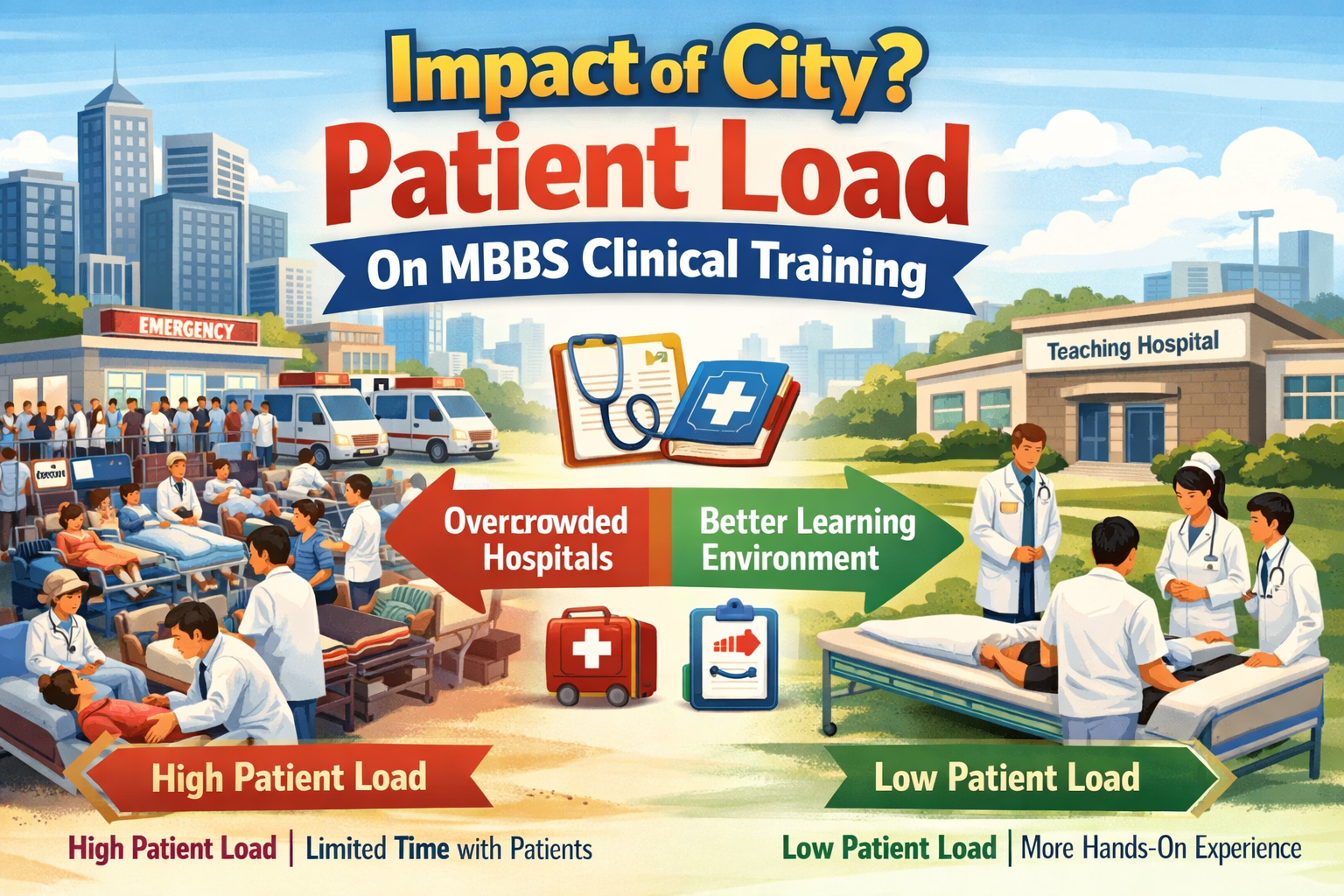
Most of the focus of students and parents when they select an MBBS college is on fees, infrastructure and rankings. But one of the most important – and least talked about factors is city patient load. The quantum and the variety of patients a city hospital gets decides directly on the quality of clinical practise, practical learning and push to treat from coming up doctors.
Knowing how patient flow impacts training guides families to make better MBBS admission choices. Experienced sources MBBS Advisor for example, regularly mentor students on selecting colleges in cities with robust clinical exposure.
Significance of Patient Load in MBBS
MBBS is not all books. It is a competency-based profession, and most learning takes place in:
OPD (Outpatient Department)
Wards
Emergency rooms
Operation theatres
A higher patient load means:
More real cases
Better hands-on experience
Stronger diagnostic skills
Greater confidence in clinical decision-making
This is why medical colleges in towns with busy government hospitals churn out better doctors.
High Volume in Certain Cities – Maximum Exposure
The former being cities with large populations, government hospitals and referral centres that see thousands of patients daily. In these cities, MBBS students get to learn the following:
Communicable and lifestyle diseases
Trauma and emergency cases
Paediatrics, obstetrics, and surgical cases
Rural and urban health issues
Clinical posting in these hospitals, where a student gets to see and assist in many cases every day, is of immense value during their training period. For those students who desire that strong clinical grounding, MBBS Advisor often suggested colleges which do its practice in high-load hospitals.
Cities with Medium Patient Load – Balanced Learning
There is usually a moderate case-mix inflow in Tier-2 cities. Not as congested as metro hospitals, those cities offer:
Decent OPD footfall
Regular inpatient admissions
Structured clinical teaching
Less overcrowding during rounds
In those cities, students typically receive more personal interaction with doctors and patients, which is better for learning. A lot of moms and dads like those cities because it’s a good stepping stone between less-pressure situations and being under the gun.
Low Load Cities – Limited Clinical Work.
Small population cities or new medical college cities have shortage of patient. This results in:
Fewer real cases for students
Limited hands-on practice
Overemphasis on the case discussions Not enough real patience
Less confidence during internship
Interns or postgraduates from cities with low patient load need more effort to overcome the lack of exposure. There are gaps which parents may not be aware of when admitting their children, MBBS Advisor makes it easier to spot those beforehand.
Effect on Internship & Future PracticeI Feel greatly Enlightened and inspired to continue the new emerging knowledge as well.
At internship, caseload becomes even more critical. High patient volume ensures:
Frequent emergency duties
Better exposure to critical care
Better procedures skills (IVs, sutures, caths etc.)
Strong preparation for real-world practice
The ones who trained in busy hospitals tend to adapt more quickly when they begin solo practice or go on for postgraduate work.
Influence of NMC Guideline on CS Training
The NMC introduced minimum patient load and hospital bed strength for medical colleges. These norms ensure:
Adequate OPD and IPD exposure
Proper clinical posting schedules
Sufficient case diversity for learning
But there are differences even in the flow of patients to colleges approved by NMC in different cities. This is why parents can’t just go by approvals but also weigh local city patient dynamics.
For MBBS Abroad Students – Clinical Exposure & FMGE Among these 12 subjects, only the following combination of subjects is allowed for students:- These courses have been replaced by the given new courses by MCI.
Those studying in foreign countries have to clear the Foreign Medical Graduate Examination (FMGE) to work as a doctor in India. Inadequate clinical exposure: A significant hurdle for FMGE seeking students is restricted hands-on experience while studying MBBS.
If an offshore based university is situated at a low patient load location students may find themselves:
Clinical reasoning
Case handling
Indian disease patterns
This directly affects FMGE performance. Making it quite clear that while opting for MBBS abroad, city and the hospital’s patient load matters as much. MBBS Advisor has some practical information about real hospital exposure in foreign universities.
How Parents Should View Patient Load
The brochures can only go so far, parents should ask:
- Is the hospital public or private?
- Is it a referral clinic?
- How many patients attend OPD per day?
- Is it a teaching facility that has actual case flow?
- Do they count rural and emergency cases there?
A college with an expansive campus and empty wards is less valuable than a modest college with a working hospital attached.
Perfect Preparation Makes Better The Difference Why Expert Instruction is the Key to Grant Success
Many admission consultants discuss fees and seats but hardly ever talk about patient load and clinical exposure. This is where MBBS Advisor makes a difference by helping families select the colleges based on quality of practical learning and not just infrastructure.
Their counseling prevents students from winding up with retrospective regrets about shoddy clinical training.
Conclusion
City workload is central in making a good doctor. There’s ample patient flow during those rotations, which brings confidence and fine-tunes skills while providing exposure to real medical challenges. Whether opting for MBBS in India or overseas, their parents should make sure that they give more importance to clinical exposure rather than the campus glam-sham.
Thanks to the guidance of experts such as MBBS Advisor, armed with the knowledge of benchmarks defined by National Medical Commission and stipulations of FMGE, parents can now take an informed decision that is best for their child’s medical future.