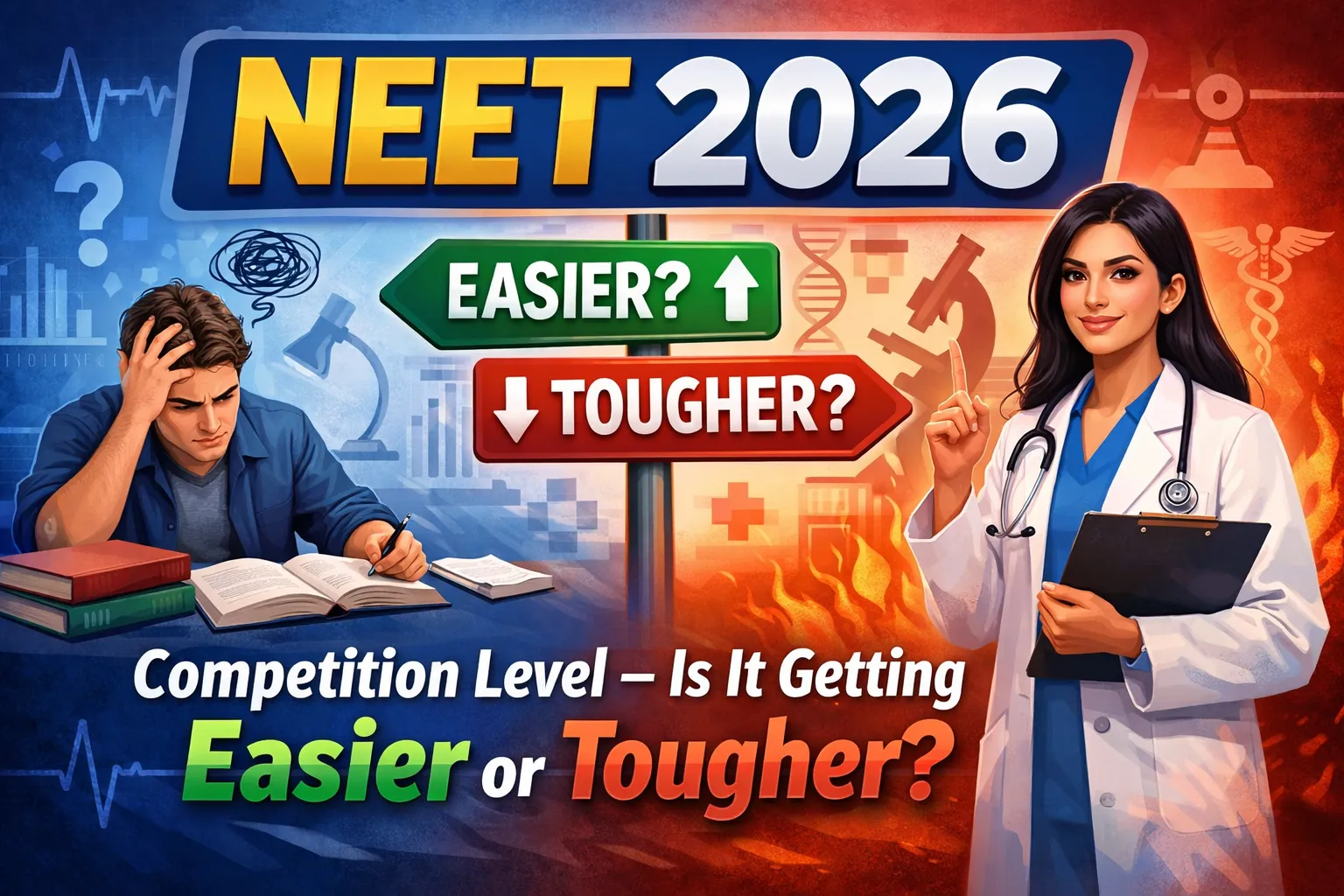
NEET Exam Pattern 2026: Marking Scheme, Number of Questions & Total Marks
NEET Exam 2026 (National Eligibility cum Entrance Test) is one of the biggest medical entrance exams in India for students who wish to get admission in MBBS, BDS and other health care courses. Run by the National Testing Agency, this exam decides the fate of more than 20 lakh aspirants annually.
As a result, comprehending the NEET exam pattern 2026, marking scheme, total number of questions and the distribution of marks in the overall paper becomes crucial amidst stiff competition and a dearth of government medical seats. Understanding the structure of the paper helps you better organize your preparation and ultimately makes cost-effective use of your final exam score.
This comprehensive article will introduce the newly updated NEET 2026 exam pattern with detailed subject-wise distribution, the marking scheme, time management strategies, and expert insights to crack NEET-UG.
NEET Exam Pattern 2026 Overview
The NEET 2026 exam pattern will be held in a standard, structured format and is expected to be more focused on the conceptual understanding of students for Physics, Chemistry and Biology according to the NCERT syllabus.
Key Highlights of NEET 2026
- Exam Mode: Offline (Pen & Paper-based)
- Questions Format: Multiple Choice Questions (MCQs)
- Total Questions: 180
- Total Marks: 720
- Duration: 3 Hours (180 Minutes)
- Wholesome Bachelors Courses: 3-Year Degree: 1.
- Scoring: +4 for correct answer, −1 for incorrect answer
The exam is available in several languages, allowing students from various Indian states to take it.
NEET 2026 Total Questions
The NEET question paper has a total of 180 mandatory questions with each subject having an equal distribution of questions.
Subject-wise Question Distribution
- Physics – 45
- Chemistry – 45
- Botany – 45
- Zoology – 45
- Total – 180
There is no choice, and therefore candidates must prepare each topic considered thoroughly because if he does not attempt questions of any one section without knowing a sufficient amount about it then he loses marks.
Subject-Wise Weightage and Importance
The understanding of subject-wise importance plays a vital role in preparing a robust preparation strategy.
Physics
- Questions: 45
- Marks: 180
With numerical problems and conceptual depth, physics is the most challenging section in JEE exam. Subjects such as Mechanics, Modern Physics and Thermodynamics are very major.
Chemistry
- Questions: 45
- Marks: 180
If you prepare well the CHEMISTRY will be usually scoring. It includes:
- Physical Chemistry
- Organic Chemistry
- Inorganic Chemistry (NCERT-based)
Biology (Botany + Zoology)
- Questions: 90
- Marks: 360
The most important subject is Biology which carries 50% of the total marks. NCERT Biology is such an important chapter for students where they can score very well.
NEET 2026 Total Marks
The marks score in NEET is determined as follows:
180 × 4 = 720 Marks
Marks Distribution
- Physics – 180
- Chemistry – 180
- Biology – 360
- Total – 720
Clearly, this distribution shows us that Biology has an impact on total performance.
NEET 2026 Marking Scheme (Detailed)
Its marking scheme is pretty straightforward but it drastically affects the ending rank.
Official Marking System
- Correct Answer → +4
- Incorrect Answer → -1
- Unattempted → 0
- Multiple Answers → -1
Key Points:
- 4 Marks for Each Correct Answer
- 1 mark will be deducted for each incorrect answer
- No penalty for skipping questions
Example of NEET Score Calculation
Know how your score is calculated:
- Total Marks: 600 marks (4 * 150 →100 marks each, for four correct answers)
- 20 marks: 1 Wrong → -20 Marks
- Unattempted: 10 → 0 marks
Final Score = 580 Marks
This shows by a long way how negative marking can impact your final score.
Importance of Negative Marking
One of the most important aspects in NEET is negative marking.
Why It Matters:
- Reduces marks due to guesswork
- Affects overall rank significantly
- Encourages accuracy-based attempts
Smart Strategy:
- Avoid blind guessing
- Attempt only when confident
- Use elimination techniques
NEET 2026 Exam Duration
The total time allotted for NEET is:
180 Minutes (3 Hours)
Ideal Time Management Strategy
- Biology – 70–80 mins
- Chemistry – 50–55 mins
- Physics – 60 mins
In order to attempt each question correctly, spend your time wisely.
Mode of Examination
Mode of NEET examination is offline means:
- Afterwards students receive a printed question paper
- The answers are filled on OMR sheet
- Use only a blue/black ballpoint pen
Regular Practice of OMR sheets help you in avoiding errors.
Type of Questions in NEET
All questions are:
Multiple Choice Questions (MCQs)
Each question contains:
- 4 options
- Only 1 correct answer
It tests not only your knowledge but also your decision-making ability.
Medium of Question Paper
The following are the available languages with NEET:
- English
- Hindi
- Tamil
- Telugu
- Marathi
- Bengali
- Gujarati
- Urdu
Students should pay attention to which language they select during registration.
News on NEET Exam Pattern: Gain insights
- No optional questions
- Fixed 180-question structure
- High focus on NCERT-based concepts
These updates have made the exam more predictable but also less forgiving.
Importance of knowing NEET Pattern
Students only study but dont bother to know exam pattern.
Benefits:
- Better time management
- Higher accuracy
- Smart question selection
- Reduced negative marking
- Improved final score
NEET 2026 Preparation Strategy as per Revised Pattern
Focus on Biology First
Bio has the highest weightage, thus try to get maximum accuracy and score.
Strengthen Weak Subjects
Physics requires consistent practice.
Practice Mock Tests
Mock tests help in:
- Improving speed
- Reducing mistakes
- Building exam confidence
Revise NCERT Thoroughly
A majority of the questions are directly derived from NCERT textbooks.
Common Mistakes to Avoid
- Ignoring Physics
- Over-attempting questions
- Not practicing OMR sheets
- Poor revision strategy
- Lack of time management
Avoiding these common mistakes can help your score immensely.
NEET Score vs Rank Insight
- 650+ → Top Government Colleges
- 600–650 → Good Medical Colleges
- 500–600 → Average Colleges
- Below 500 → Limited Options
Career Opportunities After NEET
Some courses that students can choose after NEET qualification are:
- MBBS
- BDS
- AYUSH Courses
- Veterinary Sciences
Study MBBS abroad is one of the options that students can explore if they do not get government seats. Best of all, Imbroad will assist you with university selection and provide counselingservices that offer expert guidance.
They have comprehensive information about MBBS admission processes, fee structures & Comparison between different countries, etc., which is very helpful for Indian students to get medical education in foreign.
About Medical Recognition & Accreditation
It is very important to check global recognition before selecting any medical college.
Key Organizations to Check:
- National Medical Commission
- World Health Organization
- World Directory of Medical Schools
Regarding eligibility for a medical college in India, candidates need to confirm that the college is NMC-approved.
Accredited medical degrees gain international recognition through WHO.
MEET US IN THE WORLD DIRECTORY OF MEDICAL SCHOOLS (WDOMS) WDOMS is requuired to sit international licencing exams
This ensures future career opportunities in both India and abroad.
NEET 2026 Tips: The Final Stretch to Prepare for NEET
- Focus on NCERT textbooks
- Solve previous year papers
- Attempt full-length mock tests
- Analyze mistakes regularly
- Stay consistent and disciplined
Conclusion
The NEET Exam Pattern 2026 is intended to evaluate all components of learning from your subject knowledge, speed, accuracy, and exam strategy. With 180 questions and a total of 720 marks, with +4/-score for every question the marking is very difficult where all questions gain significant importance.
Understanding the exam pattern, including:
- Question distribution
- Marking scheme
- Time management
which can greatly increase your chances of achieving a good rank.
This post will help you understand how to clear NEET 2026 with a little smart preparation, the right strategy and consistent practice.