 Belarus
 China
China Nepal
Nepal Bangladesh
 Poland
 Romania
 Slovakia
 Hungary
 N. Macedonia
 Vietnam
 Canada
 Armenia
 UK
UK Australia
 USA
USA Ireland
 Germany
 New Zealand
 Italy
Italy France
 Singapore
 Netherlands
 Sweden
 Switzerland
Your Global Journey, Simplified.
Join 5,000+ students who secured their dream university
 Russia
 Georgia
 Kazakhstan
 Kyrgyzstan
 Uzbekistan
Why Study MBBS Abroad?
- Affordable Fees – Much lower than private colleges in India
- English Medium – No language barrier
- WHO, NMC Approved Degrees
- Modern Labs & Good Clinical Exposure
Register Now for Study MBBS Abroad
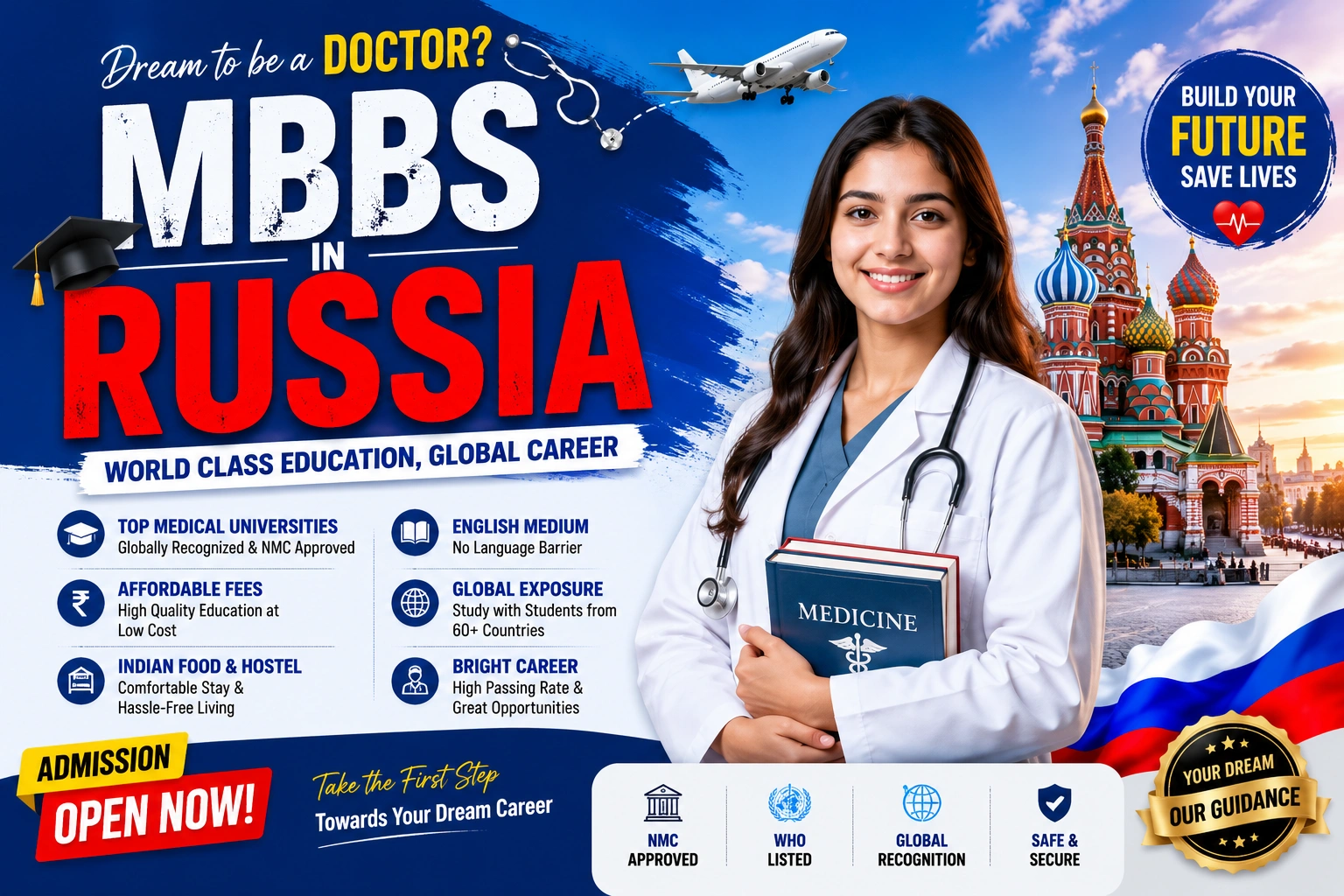
India's students go to Russia more than any other country to study medicine. Russia has the best prices for NMC/WHO-recognized medical education. Eurasia has 11 time zones, and its 60+ universities offer 6-year MD programs that are the same as MBBS programs taught entirely in English. These programs attract more than 25,000 Indian students who have proven clinical excellence and research opportunities. There are no donation or capitation fees, it's easy to get into NEET, and living costs are low (₹12,000–20,000 per month).
The structured curriculum covers preclinical, paraclinical, and clinical phases to get graduates ready for the FMGE/NExT (40–60% pass rates), USMLE, and PLAB. Sechenov University and other schools like it have world-class labs, federal hospitals, safe campuses, Indian mess halls, and a continental climate (-15 to 25°C). The total cost for six years is ₹20–45 lakhs, which is the lowest in the world for high-quality training.
The major cities of Moscow, St. Petersburg, and Kazan all have metro systems, large Indian communities, and a 90% visa success rate. With the Ministry of Health watching over it, Russia is the safest place for students to live and the best place for medical careers in the CIS.
MBBS in Russia - Key Highlights
| HIGHLIGHTS | DETAILS |
| Popular Course | MBBS |
| Intakes for MBBS in Russia | Currently Ongoing |
| Duration of MBBS | 6 years |
| Eligibility Criteria |
50% marks in PCB (General category) 40% marks in PCB (Reserved category) |
| IELTS or TOEFL Requirement | Not Required |
| Medium of Instruction | English |
| Required Exam | NEET Exam |
| Minimum Tuition Fees | 3,000 USD |
| Maximum Tuition Fees | 7,000 USD |
| NMC-Approved Medical Universities | 60+ Universities |
| Top Medical Universities in Russia | Sechenov University Moscow, Peoples' Friendship University, Kazan Federal University, Volgograd State Medical University |
Why Study MBBS in Russia? (Expanded)
Since 1959, Russia has trained more than 100,000 Indian doctors through its 60+ NMC-approved universities that offer English MD programs that are the same as MBBS. The largest number of students from around the world (over 25,000 Indians) guarantees proven systems, federal standardization, and the highest FMGE success rate (40–60%) among CIS nations.
- A Legacy of Pioneering Medical Education
Sechenov University, the first medical school in the world, came up with a method for training doctors that is now used all over the world. Its huge admission and clinical systems have been improved over the years. Unlike private systems in other places that are not connected, the Federal Ministry makes sure that the quality is the same in all 50 cities.
- Unprecedented Exposure to Clinical Volume
University hospitals have an average of more than 30,000 beds each, making them the largest in the world. Year 3 rotations expose students to more than 10,000 different cases, compared to only 2,000 in Asian programs, giving them unmatched diagnostic confidence. Nuclear medicine and organ transplant units offer unique pathology experience that is necessary for mastering the USMLE and FMGE.
- Perfecting Economies of Scale
More than 25,000 Indians use bulk Indian mess (dal-roti-paneer standardized nationwide), dedicated deans, and FMGE coaching factories that consistently produce pass rates of 40% to 60%. Kazan and Volgograd are regional cities that offer Moscow quality at half the price, giving you different levels of excellence to choose from.
- Federal Security Framework
A presidential order says that there must be biometric women's hostels, Indian police liaison officers, and embassy hotlines open 24 hours a day, seven days a week at 60 universities. Numbeo says that metro cities (Moscow Metro is the safest in the world) are safer than Delhi. The 1 lakh+ alumni network makes it impossible to feel alone.
- The Pan-Eurasian Strategic Network connects all campuses quickly through the Trans-Siberian railway and has direct flights from Delhi to 12 medical hubs. Different climates and exposures, from the subtropical Black Sea to Siberian resilience training, make doctors more adaptable. The 2.5-hour time difference is great for coordinating family activities every day.
- Integrated FMGE Success Ecosystem
Universities require 10,000+ FMGE question banks, weekly mocks, and Indian faculty tracking. 95% of graduates pass within two attempts. Alumni make up more than half of the private practice in India (50%+ CIS graduates), and guaranteed job paths make the investment completely worthwhile.
Eligibility Criteria for MBBS in Russia for Indian Students
Minimum age 17 by Dec 31, 2026.
10+2 with 50% PCB aggregate (40%
reserved).
NEET qualifying score mandatory.
No IELTS/TOEFL
required.
HIV-free medical fitness.
Admission Process
- NEET qualification verification
- Online application to 3-5 universities (June-Aug)
- Ministry invitation within 10 days
- Visa processing (15 days, 90% success)
- Direct flights; guaranteed hostel pickup
Classes: September 1st 2026
Requisite Documents for a Visa to Study in Russia for MBBS
University invitation letter.
Valid passport (18+ months).
NEET
scorecard.
10th/12th marksheets.
Birth certificate.
Medical
fitness/HIV test.
USD 5,000 bank statement.
Sponsor affidavit.
Intakes for MBBS in Russia
Primary Intake: September 2026 (95% seats)
Secondary Intake: February 2027
(limited seats)
2026 Timeline:
| Step | Date |
| NEET Results | June 2026 |
| Applications | June-August 2026 |
| Invitations | 7-15 days |
| Visa Processing | August 2026 |
| Classes Begin | September 1st 2026 |
Advantages of Studying MBBS in Russia
World's Largest Medical Training Hub
More than 25,000 Indian students study at more than 60 NMC-approved universities. This creates unmatched peer support and proven systems. The FMGE pass rates are the highest (40–60%) because of the standardized federal curriculum. With more than 30,000 beds in university hospitals, India is ready to build diagnostic confidence through a lot of clinical exposure. Government subsidies cut fees by 50%, making sure that everyone in the country can get high-quality services.
Infrastructure and research scale that can't be beat
Sechenov (QS Medicine top 100) has pioneers in nuclear medicine, robotic surgery centers, and supercomputing for drug discovery that are as good as those in the US. Federal money makes sure that all areas have access to the latest technology. English programs include FMGE coaching with over 10,000 question banks as a standard. There are many options in different parts of Russia, from luxury in Moscow to affordable in Volgograd, so you can find something that fits your budget perfectly.
The best prices in the world for real quality
The total cost over six years is ₹20–45 lakhs, compared to ₹1.5+ crore for Indian private schools. This saves 70% with no donation or capitation fees. Tuition costs between $3,000 and $7,000 per year, depending on the quality of the school and the region. Living costs between $150 and $300 per month, which includes standard Indian meals (dal-roti-paneer) across the country. Transparent pricing takes away all of the financial stress for middle-class families.
Indian Ecosystem and Federal Security
There are presidential biometric women's hostels, dedicated Indian deans/police liaisons, and embassy hotlines that are open 24 hours a day, seven days a week to make sure families are safe in 50 cities. The 1 lakh+ alumni network puts on Holi and Diwali parties and FMGE study groups to keep people from feeling alone. Global crime indices show that metro systems are safer than Delhi's. You can find Indian supermarkets and Patanjali stores everywhere.
Lifestyle and connectivity across Russia
Direct flights from Delhi to 12 medical centers; the Trans-Siberian rail network connects campuses quickly for electives. Different climates (Black Sea subtropical, Kazan moderate, Siberian resilience) and cultural immersion make doctors who can work anywhere in the world. A 2.5-hour time difference is perfect for daily family calls, and a part-time work visa (20 hours a week) is a great way to get extra money.
MBBS in Russia Fee Structure: 2026-27
| University | Tuition (USD/Yr) | Hostel (USD/Yr) | Total 6 Yrs (USD) |
| Sechenov Moscow | 7,000 | 2,000 | 54,000 |
| RUDN Moscow | 6,500 | 2,500 | 51,000 |
| Kazan Federal | 4,500 | 1,200 | 36,000 |
| Volgograd State | 4,000 | 1,000 | 30,000 |
| Crimea Federal | 3,500 | 800 | 26,000 |
Top Medical Universities in Russia (NMC Recognized)
Overview: 60+ NMC-approved; English MBBS/MD; FMGE 40-60%; USD 3-7K/year; federal hospitals nationwide.
Sechenov First Moscow State Medical University
| DETAIL | INFORMATION |
| University Name | Sechenov First Moscow State Medical University |
| Location | Moscow |
| Established | 1758 |
| Admission | Open Now |
| Tuition Fees (USD/Year) | 7,000 |
| FMGE Pass Rate | 50-60% |
| Features | World's oldest; QS Medicine top 100; nuclear medicine pioneer; largest Indian batch (2,000+). |
Peoples' Friendship University (RUDN) Moscow
| DETAIL | INFORMATION |
| University Name | Peoples' Friendship University Moscow |
| Location | Moscow |
| Established | 1960 |
| Admission | Open Now |
| Tuition Fees (USD/Year) | 6,500 |
| FMGE Pass Rate | 45-55% |
| Features | 15K+ internationals; UN-recognized; robotics leader; metro campus convenience. |
Kazan Federal University
| DETAIL | INFORMATION |
| University Name | Kazan Federal University |
| Location | Kazan (Volga Region) |
| Established | 1804 |
| Admission | Open Now |
| Tuition Fees (USD/Year) | 4,500 |
| FMGE Pass Rate | 40-50% |
| Features | Russia's 2nd oldest; safe Muslim city; affordable excellence; strong Indian support. |