 Russia
 Belarus
 Georgia
 Kazakhstan
 Kyrgyzstan
 Uzbekistan
 China
China Nepal
Nepal Bangladesh
 Poland
 Romania
 Slovakia
 Hungary
 N. Macedonia
 Vietnam
 Canada
 Armenia
 UK
UK Australia
 USA
USA Ireland
 Germany
 New Zealand
 Italy
Italy France
 Singapore
 Netherlands
 Sweden
 Switzerland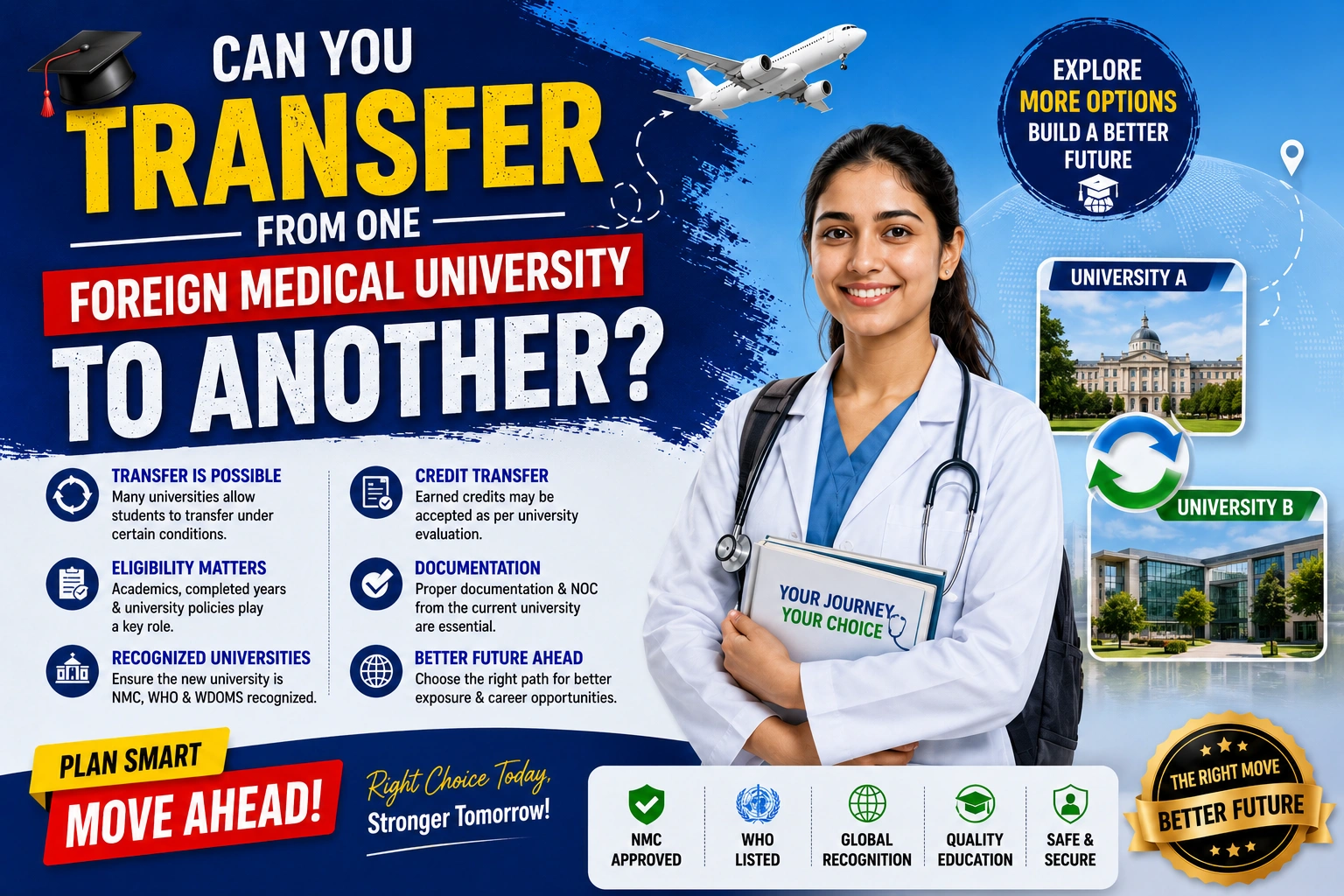
Affordable tuition, admission availability, and globally acknowledged institutions lead many Indian students to study MBBS Abroad. There are also a number of unexpected issues students face. After enrollment, many students realize their school lacks sufficient resources for their academic pursuits. Other students face language, infrastructure or clinical exposure issues. Some students may choose to leave for personal reasons. This leads many students to ask the same question. Is it possible to transfer to another foreign medical university?
The short answer is yes, but there are stipulations. Transfers to medical universities are far more complex than the transfer process in other degree programs. In addition to the regulations of the university, Indian students must also keep in mind the regulations of the National Medical Commission (NMC).
The goal of this guide is to provide the medical university transfer process, eligibility, required documents, advantages, and disadvantages and identify the most important precautions in order to help you make the most informed choice possible.
It is advisable for students to do thorough research before committing to any foreign university. Compare many universities and review eligibility criteria. It is also critical to factor in the feasibility of a future transfer later.
Are Transfers Between Foreign Medical Universities Possible?
Yes, students are able to transfer from one foreign medical university to another. This is only the case when the academic transfer is approved by both foreign universities. Many schools do not accept transfer students and not all countries employ the same education systems.
Most transfers are determined by the following factors:
- Recognition of both students’ medical degrees
- Recognition of both medical schools
- Medical education curriculum compatibility
- Completed semesters
- Vacant positions
- Approval from both institutions
- Education regulations of respective countries
Students need to know that transferring to another medical college does not ensure that practicing medicine in India is permitted. The college must follow the recent guidelines of the National Medical Commission (NMC).
Why Do Students Transfer?
Every student has a different reason for applying for a transfer. Some have to deal with academic problems, while for others the issues are of a financial or personal nature, and some face all of these.
The most common reasons are:
- Low education standards
- Language barriers during clinical schooling
- Lack of sufficient practical exposure
- High tuition fee after admission
- Unsatisfactory accommodation
- Political instability
- Safety issues
- Loss of university recognition
- Transfer to a university with better opportunities
- Relocation of family
In some cases, students find out that they selected a university without proper counseling, and this emphasizes the importance of dedicated education guidance and services such as MBBS Advisor.
Is Transferring Allowed as per NMC Guidelines?
Indian students think that if a foreign medical college allows transfers, students are automatically eligible for medical registration in India. This is not always the case.
As per the National Medical Commission (NMC), Indian students have to complete foreign medical studies with all of the requirements of the duration and curriculum, as well as the internship and clinical training.
If a transfer causes:
- Shortened duration of studies
- No internship
- No clinical training
- Academic gaps
- NMC violations
Students might face problems with the licensing and registration process in India.
For these reasons, students need to make sure to first check the compliance of NMC before transferring.
Necessary Conditions for MBBS University Transfer
While each university has individual policies, the majority of institutions stipulate the following conditions for transfers.
Academic Performance
Most universities expect a student to have a satisfactory academic record and not have failed multiple subjects in the previous institution.
Curriculum Compatibility
Both universities must have a similar syllabus. Universities check the subjects that the student has completed before considering them for transfer admission.
Recognition Status
Both universities must be recognized by the pertaining authorities and be listed in the WDOMS.
Available Seats
Transfer admission also depends on the availability of seats in the accepting university.
Official Documents
Students must have the complete official record of all the subjects from the previous education.
Meeting the requirements mentioned above improves the chances of getting transfer approval.
Necessary Documents for the Transfer of Medical University
Complete documentation for the transfer is crucial. Any missing documents can cause a delay or even lead to the rejection of the application. The following documents are usually required:
- Passport
- Previous admission letter
- Academic transcripts
- Mark sheets
- Course syllabus
- Transfer certificate
- Good conduct certificate
- Attendance record
- Medical fitness certificate
- Student visa documents
- Passport-size photographs
Some universities may require notarized translations of other language documents.
Step by Step Transfer Process
Steps for changing a foreign medical university include many administrative procedures. Students must be careful to complete each procedure.
Step 1: Check Transfer Eligibility
Check first if your current university allows you to transfer, and then check if your preferred university accepts transfer students.
Step 2: Compare the Curriculum
The accepting university assesses the subjects that have been completed to determine the transfer credits.
Step 3: Submit the Required Documents
When submitting your application, make sure to include certified copies of all your educational documents.
Step 4: Academic Evaluation
The university assesses your academic performance and the compatibility of your completed semesters and curriculum.
Step 5: Transfer Approval
Students receive the official transfer offer or admission letter after approval.
Step 6: Visa and Immigration
If the transfer is to a new country, then students are required to obtain a new student visa and complete new immigration processes.
Is it Possible for Students to Transfer to Different Countries?
Students are able to transfer to different countries, but the school transfers are significantly more difficult than transfers within the same country.
Countries differ in:
- Systems of medical education
- Models of clinical training
- Methods of credit
- Internship requirements
- Regulations for licensing
For example, a transfer from one school in Russia to another Russian school can be relatively easy, whereas a transfer from Russia to Georgia or Kazakhstan can be significantly more difficult.
Students are encouraged to check the WDOMS to see if the school is recognized before making a school choice.
What are Some Challenges Students may Experience When Transferring?
Transferring can seem like an appealing option, but students should be able to identify and understand the challenges in order to make the best decision.
Some of the challenges that students may face include:
- Lost credits
- Mandatory repeating of a semester
- Graduation delays
- Increased tuition costs
- Language challenges
- Different exam styles
- Hostel (Dorm) relocation
- Documents late
Transferring can be a challenge, but poor planning can make the challenges greater.
Do Students Still Need to Meet NEET Requirements After Transferring?
Yes, students who leave India for another foreign medical university must still meet the NEET requirements.
For students planning to return to India post-MBBS, staying informed on NEET’s eligibility criteria and updates via counselling and regulations is important. NEET remains compulsory for the registration to practice medicine in India for students transferring to another medical school.
Avoiding the hassle of having to transfer due to an unsuitable university choice is as simple as applying to the right university in the first place.
MBBS degree seekers should carefully consider the following:
- Accreditation and recognition of the university
- Tuition and costs associated with staying on campus
- Quality of clinical and internship opportunities
- Preparation resources for FMGE/NExT
- English as a medium of instruction
- Reviews by other students
- Safety and campus environment
For the safest options available for studying MBBS Abroad, students should consider reputable guidance.
Will Credit Transfer Reduce the Time Spent Studying MBBS?
A common misconception is that transferring to a new university will automatically shorten the MBBS course. This is not guaranteed.
The assessment of transferring students’ courses is the responsibility of the new university. If the new university’s course has missing subjects, students may be required to complete these subjects to continue on with the course. This also may be the case for the subjects’ syllabus as well.
A university’s academic committee has final say on the transfer of students.
Why is Recognition by WHO and WDOMS Important?
Recognition of medical universities should be at the top of the priority list when considering studying medicine abroad.
Students should check if the medical university is listed in the WDOMS and if the medical university subscribes to the WHO standards for medical education.
Recognition increases the likelihood that a degree will be accepted internationally and will ease the process of obtaining a license to practice medicine in other countries.
How NEET Rank Predictors are Assisting Students to Ensure their Future with the Right Career Options
After realizing their admission abilities, many students transfer to schools proving they were unaware of their admission abilities when selecting schools.
The NEET Rank Predictor gives NEET aspirants the ability to guess their potential rank and allows students to select universities with improved accuracy, ultimately decreasing the instances of students accepting admission offers with little to no critical thinking.
With the combination of the NEET Rank Predictor and expert counseling offered by MBBS Advisor, students have the potential to select universities that fulfill their aspirations.
Conclusion
It is possible to transfer to another foreign medical school, however no one can make guarantees about the ease of the process. It is important to remember that every transfer is dependent on the policies of the university, the availability of space, the transfer student’s performance and most importantly the recognition of the university by the regulatory bodies.
The best strategy is to perform comprehensive research before selecting a university, understand the policies of each university, and speak to qualified educational advisors. Using the services of MBBS Advisor with their tools for exploring MBBS opportunities abroad, the NEET, the NEET Rank Predictor, and other similar resources, students will be able to accurately assess universities and their admission requirements and consequently limit their transfer needs.