
 Russia
 Belarus
 Georgia
 Kazakhstan
 Kyrgyzstan
 Uzbekistan
 China
China Nepal
Nepal Bangladesh
 Poland
 Romania
 Slovakia
 Hungary
 N. Macedonia
 Vietnam
 Canada
 Armenia
 UK
UK Australia
 USA
USA Ireland
 Germany
 New Zealand
 Italy
Italy France
 Singapore
 Netherlands
 Sweden
 Switzerland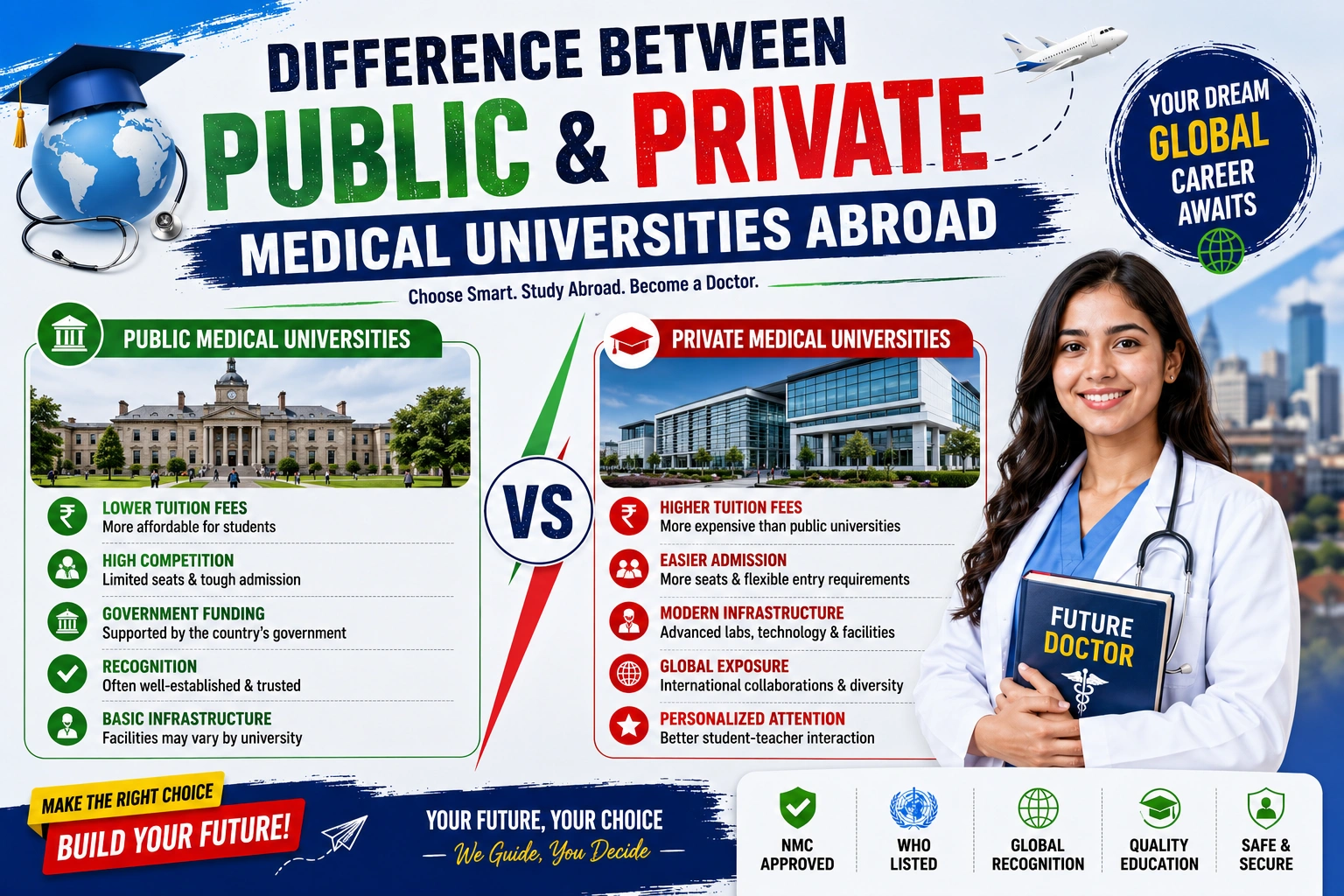
Studying MBBS abroad is a top option for Indian students post-NEET who are eager to jump into their medical careers. Students often find themselves asking if they should apply to a public or a private medical university while deciding on an international university.
It is easy to fall into the idea that private means expensive and public means better. The reality is that there is no simple answer. The diversity of students, international recognition, the level of research, clinical exposure, faculty infrastructure, and even the hostels can make a difference.
With MBBS Advisor, students are free to compare universities by their budget and career goals and select based on eligibility rather than outdated beliefs. This guide aims to help students navigate the myths and realize the important differences for public and private medical universities so they can be well informed.
What Are Public Medical Universities Abroad?
Public medical universities are those that are government funded and operated medical universities. They usually have a long standing tradition with a solid pedagogy, an experienced staff and a picked up an advanced research practice.
Countries like Uzbekistan, Russia, Kazakhstan, Kyrgyzstan, Georgia, and a number of the other European countries have government funded medical universities that even have a practice of accepting a number of international students.
Due to government funding, public medical universities can maintain a high standard of medical education while still having a lower tuition fee in comparison with private medical universities.
What Are Private Medical Universities Abroad?
Private medical universities are those universities that have been funded and are operated by trusts, private organizations or educational groups.
These universities are acknowledged by the medical organizations of their countries, while some are endorsed by global organizations.
Contemporary private universities tend to make considerable investments in intelligent classrooms, modern laboratories, advanced simulation centers, international partnerships, and various services dedicated to students.
Several private universities provide English-based MBBS programs aimed at international students.
Public vs. Private Medical Universities Abroad: Key Distinctions
Although both types of universities provide internationally acknowledged medical degrees, students should be aware of the distinctions prior to making their final decisions.
Tuition Costs
The fee structure is one of the key distinctions.
Due to public financing, tuition at public universities tends to be more affordable, which is one of the factors that attracts a significant amount of Indian students to government-funded medical universities in Russia, Kyrgyzstan, and Kazakhstan.
Since private universities must fund their campus construction, faculty wages, and other expenses through student fees, the tuition at private universities is also higher. However, the additional costs tend to come with improved services and more individualized academic assistance.
Prior to making a final admission decision, students may evaluate the most affordable universities through MBBS Abroad.
Campus Facilities and Infrastructure
Private medical universities tend to focus on modernized, digital, and fully equipped campuses.
Public universities may have older buildings due to their long history, but many possess highly developed teaching hospitals and well-established research departments.
Both public and private universities are continuously improving their services and infrastructure to satisfy the international medical education requirements.
Faculty Experience
Public universities tend to have professors with many years of teaching and clinical experience.
Many staff members participate in public government healthcare and medical research systems.
Private universities engage faculty who have relevant field experience, but tend to focus more on teaching, smaller class sizes and individualized mentoring.
It is the university that determines the quality of education, not whether it is public or private.
Comparison of the Admission Process
The formalities of the admission process can slightly differ.
Public universities typically offer clear admission schedules, eligibility criteria, and standardized requirements for submission of documents.
The admission process for private universities is more flexible in terms of deadlines and required documentation, making it easier for international students to be accepted.
However, aspiring medical practitioners in India have to qualify the NEET in order to be eligible to practice medicine in India, as per the regulations of the National Medical Commission.
Clinical Exposure
Clinical training is the most important part of medical education.
Government universities tend to have large hospitals that admit thousands of patients and students can have clinical exposure to a lot of medical cases.
Private universities may have teaching hospitals and partnerships with private healthcare institutions.
Many of these institutions provide excellent training and have modern medical equipment as well as a favorable student to patient ratio.
Potential students need to assess the quality of hospital affiliations when selecting a university.
Research Opportunities
Students who are interested in medical research need to evaluate available research opportunities in greater detail.
Government funds for research in public universities means that their research tends to be of a higher caliber.
Many private universities are improving the quality of their research by investing in international research collaborations, setting up research labs and participating in research and academic exchanges.
If your goal is to research, rather than simply look at whether a university is public or private, you should look at their publications, research centers, and collaborations.
Public vs. Private Recognition
Recognition is more valuable than ownership.
Students need to assess a university's global recognition, regardless of whether it is a public or private institution.
Before gaining admission, ensure the university is listed in the WDOMS and complies with the National Medical Commission's (NMC) eligibility criteria.
Students should also understand the global medical education standards promoted by the WHO.
Recognition has an effect on licensing examinations and postgraduate opportunities.
Student Diversity
Usually private universities have a greater influx of international students due to better marketing of their programs and international student services.
Public universities also have international students, though may have a higher number of domestic students.
Multicultural workplaces foster and advance communication skills, cultural understanding, and global networking.
Hostel and Student Support
Private universities provide better hostels and a focus on international students, with services such as airport pick-up, counseling, and language services.
Public universities also offer hostels, but the services are dependent on the university and the country.
Students should compare the safety and services of the hostels before deciding on admission.
Which Option is More Affordable?
There is a common notion that public universities have a lower cost.
This does tend to be the case, but there are a number of private universities that offer competitive pricing, scholarships, payment plans, and packages that include hostels and insurance.
The overall price will consist of many factors.
- Tuition
- Hostel Fees
- Food costs
- Medical Insurance
- Visa Fees
- Travel Expenses
- Cost of Living
- Miscellaneous
A university with cheaper tuition might actually cost more if the cost of living is higher.
What Options Are Best for Indian Students?
There is no definite answer to this question.
Public universities will generally be the best option for Indian students who:
- Prefer cheaper tuition.
- Prefer older institutions (more established).
- Prefer more research opportunities.
- Prefer government affiliated hospitals.
Private universities will be generally better for students who:
- Prefer modern campus (infrastructure).
- Prefer smaller class sizes (more personalized).
- Prefer more tech on campus.
The best option will depend on personal career goals, finances, preferred country, and personal academic expectations.
The NEET Rank Predictor will help students predict their chances of being accepted to their preferred universities.
What Is Important When Considering Medical Universities Abroad?
There are numerous factors that students will need to evaluate to determine if a public or private university is the best option for them.
- Recognition of the university.
- Clinical exposure.
- Quality of the faculty.
- Internship opportunities.
- FMGE/NExT results.
- Hostel facilities.
- Safety of the campus.
- Education in English.
- International partnerships.
Students will need to evaluate the country's health care system, climate, language, and Post Graduate opportunities.
The admission process will be easier if students utilize the services from MBBS Advisors because students will be able to compare universities based on facts rather than advertisements.
What Are The Most Common Myths About Public And Private Medical Universities?
There are many misconceptions that students will use to justify their choices.
The most common is that public universities are the only universities that are reputable.
Numerous private universities with global recognition maintain rigorous academic programs and produce highly skilled physicians.
Another myth is that private universities lack international recognition. Recognition is a function of accreditation and approval of the regulatory authorities, and not the ownership of the university.
Public universities are often presumed to be less expensive overall. In reality, the total cost of education may actually be similar in some countries when living expenses, accommodation, transportation, and other costs are considered.
With this in mind, students must evaluate the packaging costs of different universities rather than relying on the cost perceptions of public and private universities.
Conclusion
One of the biggest decisions prospective students need to make about their education is whether to go to a public or private medical university abroad. Both are equally good in their own right and are not mutually exclusive.
Public medical universities tend to have affordable tuition, a government subsidized medical school and research programs, and a highly skilled staff. Private medical universities are usually more modern with state-of-the-art equipment, offer a tailored education, and are more supportive of international students.
This ultimately comes down to your personal finances, goals, and plans as to which is the better option. Always check the world status of the medical school, the NMC’s policies, the NEET requirements, and for safe admission opportunities with MBBS Advisors and their MBBS Abroad resources when considering universities. The best medical school for you will help you reach your career goals.