 Russia
 Belarus
 Georgia
 Kazakhstan
 Kyrgyzstan
 Uzbekistan
 China
China Nepal
Nepal Bangladesh
 Poland
 Romania
 Slovakia
 Hungary
 N. Macedonia
 Vietnam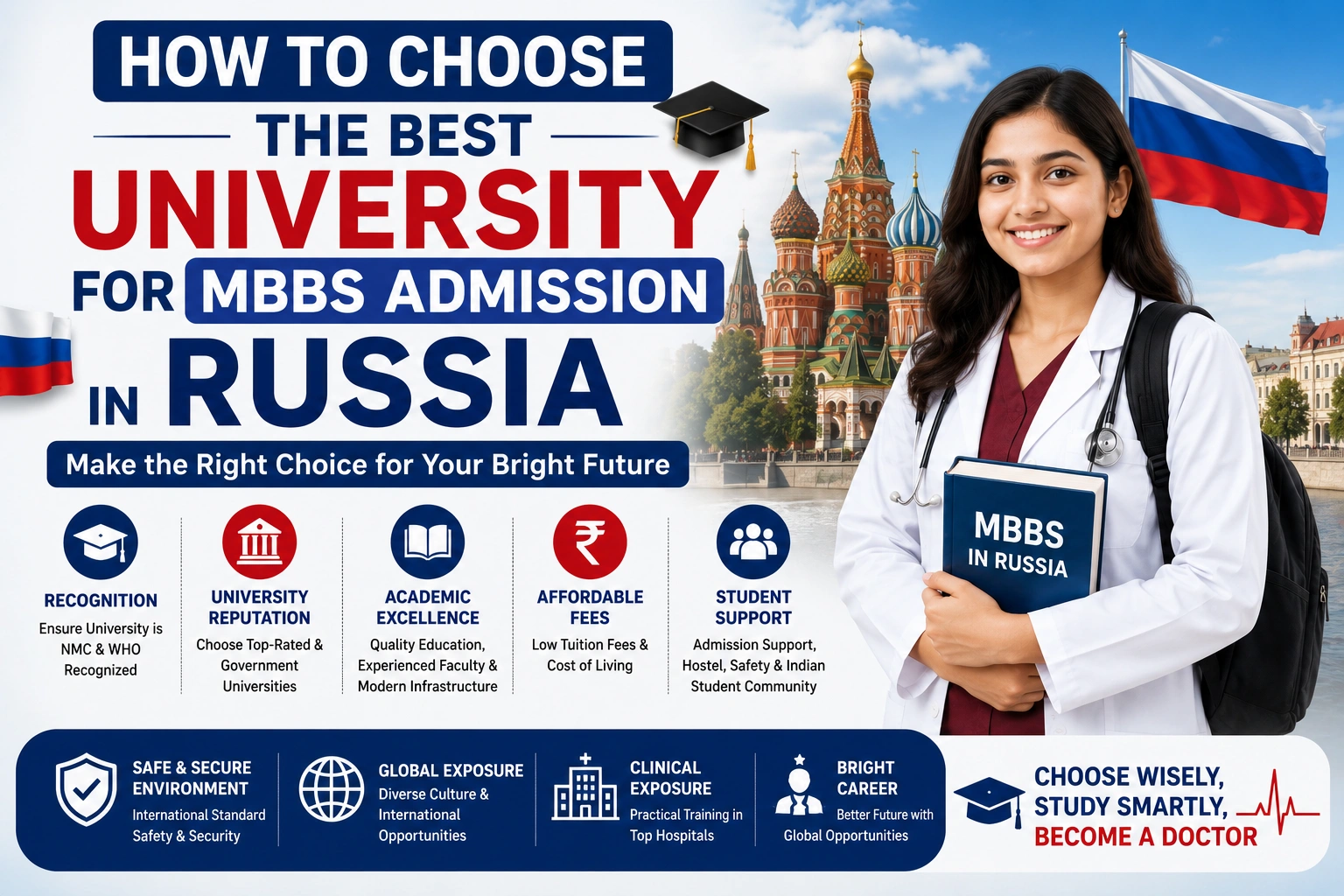
Studying at a medical university abroad has a huge impact on a student's career and lifestyle. For many Indian students, Russia is one of the most attractive destinations to study medicine. Russia has many established medical schools, has a monopoly on medical teaching, and has a large population of foreign students.
When considering MBBS options in Russia, Indian students think beyond just the tuition fees. The advantage of one institution could well be the disadvantage of another. Two universities could be at par with regard to the MBBS course content and yet provide diverse opportunities to students in the form of exposure to clinical teaching, dedicated support staff, and assistance in the overall learning process. Hence the choice of university is subjective.
Indian students are advised to take time and effort to find the most appropriate university for them. The most appropriate university in Russia is the one that meets the student's needs with respect to the university's teaching program and supports clinical training. There are a few other resources, like MBBS Advisor, where students can find solid information on various medical education options and compare MBBS study options.
Understanding Your Requirements
The first step to making an informed evaluation of medical schools in Russia is for students to identify their own requirements and preferences before beginning their search. Some students may be willing to sacrifice some exposure to practical training in order to attend a school abroad that is cheaper. Other students may choose the city with the most opportunities or a university with the highest ranking.
A student looking to cut down on living costs might choose a university based in a smaller city. Contrastingly, a student that values an extensive transport network, a broader hospital network, and a larger international community, would likely choose a university based in a larger city.
Having personal priorities helps narrow down the options. Students should choose a university that aligns with their personal and financial priorities, rather than looking for the best possible university.
Verification Comes Before an Advertisement
Verification should be the first step. Students should not base their decisions off of advertisements, social media, or statements from counseling sessions. Students must look for and confirm information in official publications.
Medical students in India should look for the most recent information on the regulations for overseas medical practitioners and check the information on the NMC. The regulations on overseas medical education and registration in India will be subject to change, so students cannot look for information from previous years.
Students should also verify the university and medical program from the WDOMS. International listings do not mean fulfillment of requirements for practice in India for all students.
Students should practice the same extreme verification for information from the WHO. Do not trust statements such as “WHO approved” to mean the program is approved. Focus on actual program approval and the requirements for licensure.
Investigate the Organization of the Program
Medical school is an immense multi-year undertaking, so applicants are wise to consider the organization of the specific medical programs they’re interested in.
How do the programs balance the teaching of the pre-, para-, and clinical subjects? Of great concern is the quality of instruction of the basic medical sciences, including:
- Anatomy
- Physiology
- Biochemistry
- Pathology
- Pharmacology
- Microbiology
The latter years of medical school focus on patient-related clinical and educational experiences. A quality program offers instruction in the theory of medicine complemented by clinical educational experiences.
How often is the curriculum modified? Does instruction in medicine incorporate newly developed diagnostic and treatment modalities?
The Amount of Contact with Hospitals Should Be a Primary Criterion
The amount and quality of clinical instruction is one of the main criteria that differentiates medical schools.
If potential students want to understand how medical schools prepare students to fulfill the roles and responsibilities of a physician, they must evaluate the medical school’s clinical instruction. This includes instruction in the disciplines of:
- Internal Medicine
- General Surgery
- Pediatrics
- Obstetrics and Gynecology
- Emergency Medicine
- All other clinical specialties
The number of teaching hospitals is important, but so is the amount of clinical exposure the school offers. This is dependent upon the number of patients, how clinical teaching is structured, and the degree to which students are allowed to engage in learning by doing, under guided supervision.
A university with an efficient clinical training system can integrate a deeper understanding of patient care into the experience of every student.
Learn the Instruction Language and Communication Framework
Language is a key component if not the most important one when it comes to the study of medicine abroad. Students must ascertain the language being used in lectures, as well as the language for examinations, laboratory work, and the clinical training.
If the instruction is in English, it is vital for students to understand some Russian. During clinical training, students interact with patients and members of the health care profession who are Russian speakers.
Learning some medical-related conversational phrases and vocabulary will significantly improve students’ ability to communicate during clinical rounds and will improve the students’ ability to communicate in the community.
Students, therefore, must ask more than just, “Is the course taught in English?” Students need to understand the role of language at the different phases of medical training.
Look at the Total Financial Cost
There is more to the cost of studying MBBS in Russia than the published tuition fee. Students must prepare a total cost estimate before choosing a university.
Some of the daily living costs and travel related costs, as well as health insurance, accommodations, and visa costs may be included in the total estimate.
Living costs may be greater in larger cities. Larger cities may provide better support services for students. However, a lower cost location should not be selected blindly if it lacks important facilities or acceptable academic support.
An accurate financial plan should prepare for unplanned expenses. Parents should be aware of all additional costs, and whether other costs will be added during their child’s enrollment.
Think About the City, Not Just the Campus
Students will spend a lot of time living outside the campus. The city will be a part of the students’ lives, and should be included in the decision-making process.
Students should consider:
- Climate
- Transportation
- Grocery options
- Availability of Indian food
- Medical facilities
- General living conditions
Russia has an incredibly diverse climate, and extreme cold winters may be challenging for those students who have never experienced these conditions before.
The city should also have good access to airports and transportation systems. This will help students travel between Russia and India during the school breaks.
Students are more likely to be successful at concentrating and adapting to the new environment while at the city they feel comfortable the most.
Research International Student Support
The move from India to Russia may also involve several challenges that could be of a different nature. A university that has experience supporting international students may make this move a more seamless experience for a student.
Students should check whether the university helps with:
- Admission procedures
- Visa procedures
- Hostel allocation
- Other administrative tasks
Students should also check how the university supports students with academic and personal related issues. The presence of an international student office may indicate that the university offers a way to address the specific challenges faced by international students.
Students will want to talk to as many current students as they can, but if they have to choose one opinion to follow, they should choose multiple.
Inspect the Hostel and Accommodation Facilities
Accommodation will impact the day-to-day life of a student. For this reason, students need to find out as much as they can about the hostels when they are considering admission.
This includes:
- Whether they will have their own rooms
- Whether there is heating
- Access to the internet
- Access to a kitchen
- Security
- Access to laundry facilities
- Distance from the academic buildings
This is especially the case in colder climates. Students also need to know if hostel accommodation is guaranteed or if it is offered based on availability.
If private accommodation is offered, students will have to factor in that cost. A university with lower tuition may be of higher cost if private accommodation is offered.
Look at the University Beyond its Rankings
While university rankings can give a snapshot, they should not be the primary factor in choosing a medical university. Rankings may use different criteria and may not reflect the most important factors to a medical student.
A more thorough evaluation will consider:
- Academic departments
- Faculty
- Clinical facilities
- Support for international students
- Research environment
- Medical programme
Students should also avoid choosing a university solely because it is frequently advertised online. A solid decision should be based on provable facts and not on how popular it is.
Know the Admission Procedure and Requirements
Students need to prepare their admission requirements well in advance. Depending on the university, the requirements may include some or all of the academic certificates, passport, photos, medical documents, and more.
Indian students need to consider the NEET regulations when determining which foreign medical schools to apply to. Since NEET regulations can change, students need to evaluate the relevant laws to the year they are applying.
Students are at risk of being taken advantage of in the application process. Verify the contents of the offer letter, receipts, agreements, and all associated documents. When you are ready to make the payment, ensure all the documents you intend to submit contain accurate information.
Make a Long-Term Career Plan
Indian students who are returning to India after obtaining their medical degree need to be familiar with the treatment of foreign medical graduates in India.
Students need to consider the latest information published by the NMC and the treatment of Examinations and the Registration of foreign medical graduates in India prior to making a career plan. If students intend to study further or work in another country, they also need to consider the country of their choice and the medical licensing regulations that are in place.
The purpose of obtaining a medical degree is to have the ability to practice medicine. No country should be considered that cannot support an intended professional pathway.
Use a University Comparison Framework
Students can use the same criteria in a framework when comparing multiple universities.
|
Selection Area |
What Students Should Evaluate |
|
Academic Quality |
Faculty, departments and teaching methods |
|
Clinical Training |
Hospitals, patient exposure and rotations |
|
Regulatory Information |
Current requirements relevant to Indian students |
|
Language |
Classroom and clinical communication |
|
Total Cost |
Tuition, hostel and living expenses |
|
Location |
Climate, transport and daily convenience |
|
Student Support |
International office and administrative assistance |
|
Future Planning |
Requirements for the student's intended career |
This approach stops students from being overly affected by a single factor like low fees or a university's popularity.
Mistakes to Avoid While Choosing a Russian Medical University
Students should be especially cautious about making rash decisions under admission pressure.
- Do not select a university only because someone is offering a guarantee of successful future licensing exams.
- Avoid using obsolete information.
- Do not make payments without understanding the financial terms.
- Do not assume that all foreign medical degrees have the same recognition.
- Do not ignore the quality of clinical training.
- Do not focus only on tuition fees while overlooking hospital exposure.
- Ask questions, verify information, and take time before making a final commitment.
Conclusion
Choosing the best university for MBBS admission in Russia requires a thorough comparison, evaluation of a number of factors and not a quick decision based on the advertising or fee structure. Students must take into account academic quality, clinical exposure, teaching quality, regulatory requirements, the total cost, the location and the support for international students.
The university that the student chooses must align with the student’s educational objectives, budget, and career objectives. The student must validate information through official sources, familiarize themselves with the recent updates in foreign medical education, and refer to quality guidance before submitting their applications.
Careful consideration and selection will allow students the opportunity to gain relatively cheaper medical education in Russia. In addition, MBBS Advisor and other resources will help students broaden their medical education opportunities, furnish them with crucial information about the process, and prepare them for MBBS Abroad.