 Russia
 Belarus
 Georgia
 Kazakhstan
 Kyrgyzstan
 Uzbekistan
 China
China Nepal
Nepal Bangladesh
 Poland
 Romania
 Slovakia
 Hungary
 N. Macedonia
 Vietnam
 Canada
 Armenia
 UK
UK Australia
 USA
USA Ireland
 Germany
 New Zealand
 Italy
Italy France
 Singapore
 Netherlands
 Sweden
 Switzerland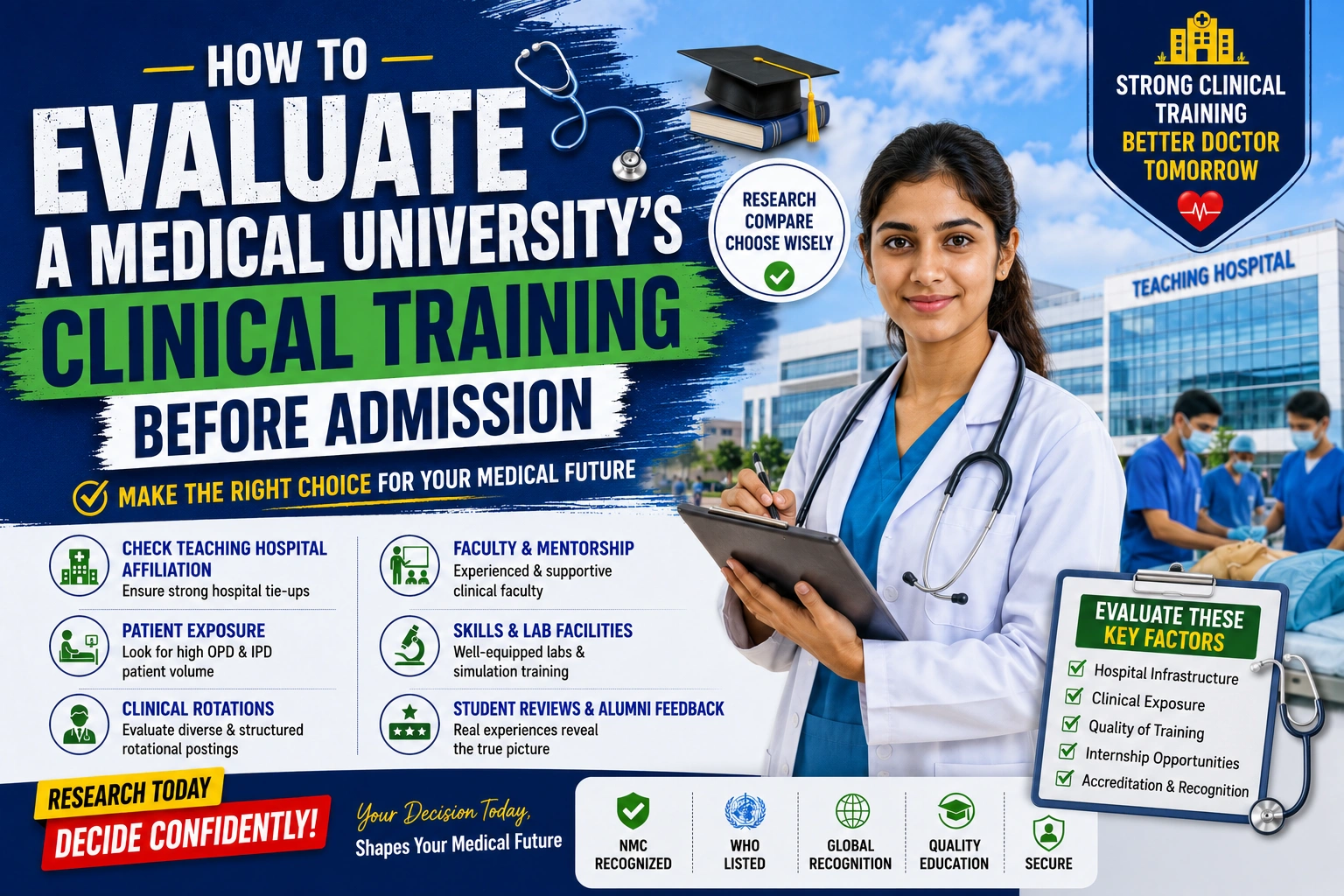
Selecting a medical university is a monumental decision in a student's life. While most people consider the financial cost, university rankings, and university facilities, the quality of clinical training is what shapes a student’s medical practice the most. Clinical training gives the medical student the opportunity to integrate theory with practice, build the confidence to interact with patients, and be ready to practice after graduation.
For Indian students opting to study MBBS Abroad, the analysis of clinical training of a university must be a priority. A university can have a wonderful classroom, but a university that has really good hospital connections, good-sized clinical faculty, good medical technology, and a diverse clientele will teach better clinical education than the university that has a good classroom.
For good admission information, students can visit MBBS Advisor, which provides the latest medical universities’ information, admission requirements, eligibility, and guides them according to medical destinations. If you are in the midst of NEET preparation or are assessing your chances of admission with the NEET Rank Predictor, it can be valuable before considering medical universities abroad.
Importance of Clinical Training in Medical Education
Medical education consists of more than just the lectures or theory. Physicians must have the ability to confidently diagnose, communicate, interpret, and perform various medical procedures. This is done mostly during medical school when the students are in clinical training.
A university that has good clinical training allows students to participate in the care of patients, guided by practicing physicians, learn the various protocols of a hospital, and learn about clinical medicine and how clinical care is done within the context of practice.
This sort of experiential learning equips students with knowledge and skills to practice medicine with confidence and pass their licensure exams.
Students who plan to study for the MBBS abroad should not consider a university just on the basis of their tuition or the appearance of their campus. Clinical education should always be one of the factors of primary importance in their decision.
Does the University Teach in Their Own Hospital?
Do universities run their own teaching hospitals? Or do they have good, long-term relationships with hospitals where students can attain clinical education?
Students get continuous clinical exposure while learning if hospitals are part of the university teaching system. The hospital(s) that a university owns or is affiliated with should offer:
- Interaction with Patients
- Teaching that is done at the bedside
- Participation in Emergency room activities
- Discussions about clinical cases
- Learning that is done through direct experience with the subject
An associated teaching hospital is one that is both operational and capable of caring for students across multiple medical specialties.
How Do You Assess the Usefulness of Clinical Education That Is Offered?
Consider the number and variety of patients who attend the teaching hospital.
The best teaching hospitals are those that admit thousands of patients every month. In addition to observing multiple medical conditions, students get to practice medicine on:
- General patients
- Children
- Surgical patients
- Those requiring orthopedics, obstetrics and gynecology
- Cardiology and neurology
- Patients who require an emergency medical services
Without sufficient patient exposure, students may graduate with limited practical experience despite completing the academic curriculum.
When Do Students Attain Clinical Education?
Different medical universities begin clinical education at different stages of the MBBS program.
Hospital exposure in some universities begins in the second year of medical school. Others wait until the students are in the third or fourth year.
Early exposure to clinical settings gives students the opportunity to engage in patient care early, thus integrating theory into practice.
Before admission, examine the university program to determine:
- The start date for the first clinical postings
- The length of the hospital rotations
- The total number of hours of practice
- The training departments
The presence of a well-structured program usually suggests an improvement in academic planning.
Verify Faculty Experience
Clinical education is mainly dependent upon the presence of medical faculty with adequate experience.
Students must ascertain whether the university teachers and clinical instructors engage in the practice of medicine or if they are solely teachers of the theory.
Practising clinicians have the ability to mentor students by elaborating on case studies, clinical reasoning, and therapeutics, thus helping students to improve their clinical skills and professional confidence.
Evaluate Student to Patient Ratio
Even if the hospital has a high patient number, it will not enhance the training of the students in the presence of an excessive number of students.
An overcrowded teaching hospital usually results in a lack of opportunities for learning.
An ideal student to patient ratio offers students the opportunity to:
- Observe procedures
- Take part in patient examinations
- Receive individualized instruction
- Pose clinical questions
- Engage in practice
- Work within a clinical setting
Formal education is also complemented by the presence of adequate laboratory and simulation resources.
Laboratory and Simulation Facilities
The contemporary learning of medicine is a fusion of exposure to the medical facility and an advanced simulation laboratory.
Before admission, ascertain that the university has:
- Anatomy labs
- Clinical simulation centers
- Skill labs for surgical practice
- Diagnostic labs
- Medical imaging labs
- Emergency simulations
Learning through simulations offers the student a safe environment in which to practice mastery of a skill before engaging with a live patient.
Look for International Clinical Standards
Medical universities that adopt an internationally accepted mode of instruction have a greater chance to provide students with superior clinical training.
Students must make sure their university is aligned with global medical standards set by organizations like the World Health Organization (WHO). Also, check if the university is listed in the World Directory of Medical Schools (WDOMS).
Having your medical school listed means you will have a qualified education, and it may help you with the process of licensing in other countries.
Check if the Medical School is Recognized by Medical Authorities
Indian students need to check if the medical school is in accordance with the latest regulations of the National Medical Commission (NMC).
Choosing a recognized medical school is essential for understanding the licensing process and making sure that you will be eligible to do your internship in India.
The latest regulations must be checked since the recognition may change while you have already enrolled.
Look into the Internship Opportunities
Internships are essential to the MBBS training process.
An adequate internship program covers:
- Internal medicine
- Surgery
- Pediatrics
- Community medicine
- Obstetrics and gynecology
- Psychiatry
- Emergency medicine
Internships are ideal if they allow active participation and are not passive. Students must check if the interns are given opportunities to help physicians perform hospital procedures.
Talk to Current Students
The best way to assess clinical training is to talk with those who are currently students.
Current students will talk about:
- Daily schedule in the hospital
- Quality of teaching at the hospital
- Quality of medical faculty
- What the work load is like
- What they learned
- What their internship was like
They may share insights that are not publicly available.
Look Into Graduate Outcomes
A medical school's alumni are a reflection of the quality of that school.
Check if alumni were able to:
- Obtain their medical license
- Begin their post-graduate studies
- Gain employment in reputable institutions
- Practice medicine in other countries
Graduates’ success typically involves the assessment of academic and clinical standard consistency.
Assess the Infrastructure of the Hospital
Today’s Modern hospitals begin to change the future of education.
Students should consider hospitals as Teaching facilities that have:
- Advanced Surgical Theaters
- Intensive Care Units
- Diagnostic Imaging
- MRI and CT facilities
- Modern Pathology Labs
- Digital Patient Records
Exposure to Modern Medical Technologies is of great importance in order to prepare students for the Contemporary Healthcare Systems.
Research Potential is Important
The clinical education the student received is perceived to be strong if the student participated in research.
Educational Institutions that promote undergraduate research give students the opportunity to develop their analytical skills and offer evidence based approaches and solutions.
Students should look for opportunities for:
- Clinical Research
- Workshops
- Research
- Scientific seminars
- Presentations
- Publishing
Participation in research is of great importance for students who intend to pursue postgraduate studies.
Evaluate Clinical Exposure by Country
Assessing the quality of clinical education among the countries that offer MBBS Programs is essential as education cost should not be the primary reason for country selection.
Consider:
- Hospital Infrastructure
- Diversity of patients
- Practical Curriculum
- Recognition by the Government
- Qualifications of Faculty
- Number of Clinical Hours
Trustworthy Guidance Systems such as MBBS Advisor, assist students in comparing various countries’ Universities so that students can make an informed decision.
Questions to Ask Prior to Admission
Every student has the right to ask the following from the admission officers.
- Does the Medical School have its own Teaching Hospital?
- How many patients visit the Teaching Hospital?
- When do students begin Clinical Rotations?
- What specialties are included in Hospital Training?
- What’s the duration of the Internship?
- Will students be allowed to engage in supervised Practical Training?
- Is the Medical School in compliance with the current NMC Regulations?
- Is the Medical School included in the WDOMS?
- How many students are assigned to each patient?
- Is there a Simulation Laboratory?
Questioning and being able to obtain answers allows for students to develop the ability to make the right decisions.
Common Mistakes Students Should Avoid
Typically, students focus on the finances related to fees and neglect the costs of actually obtaining a medical education. These costs commonly involve:
- Selecting universities based on low fees only.
- Lack of consideration for hospital facilities.
- Failure to confirm if the program has recognition.
- Internship opportunities are not considered.
- No research on the volume of patients.
- Too much reliance on advertisements.
Proper research can help avoid issues in both the professional and academic environment in the future.
Conclusion
The foundation for a successful career in medicine is clinical training. Furthermore, a school that is strong in academics but has weak hospital exposure cannot furnish the training one needs to be a successful doctor. Before students take admission, they should evaluate the teaching hospitals and also patient flow and faculty, internships, labs, recognition, and research opportunities.
Students who plan to do an MBBS Abroad should always use a combination of research and professional advice. An MBBS Advisor has recent information on medical schools, while NEET guidance and the NEET Rank Predictor are of use in assessing the probability of a student to gain admission. While checking recognition from WHO, NMC, WDOMS and NEET, using clinical training of the medical schools as the primary evaluation criteria helps students select a medical school that will prepare them to attain a successful and fulfilling career in medicine.