 Russia
 Belarus
 Georgia
 Kazakhstan
 Kyrgyzstan
 Uzbekistan
 China
China Nepal
Nepal Bangladesh
 Poland
 Romania
 Slovakia
 Hungary
 N. Macedonia
 Vietnam
 Canada
 Armenia
 UK
UK Australia
 USA
USA Ireland
 Germany
 New Zealand
 Italy
Italy France
 Singapore
 Netherlands
 Sweden
 Switzerland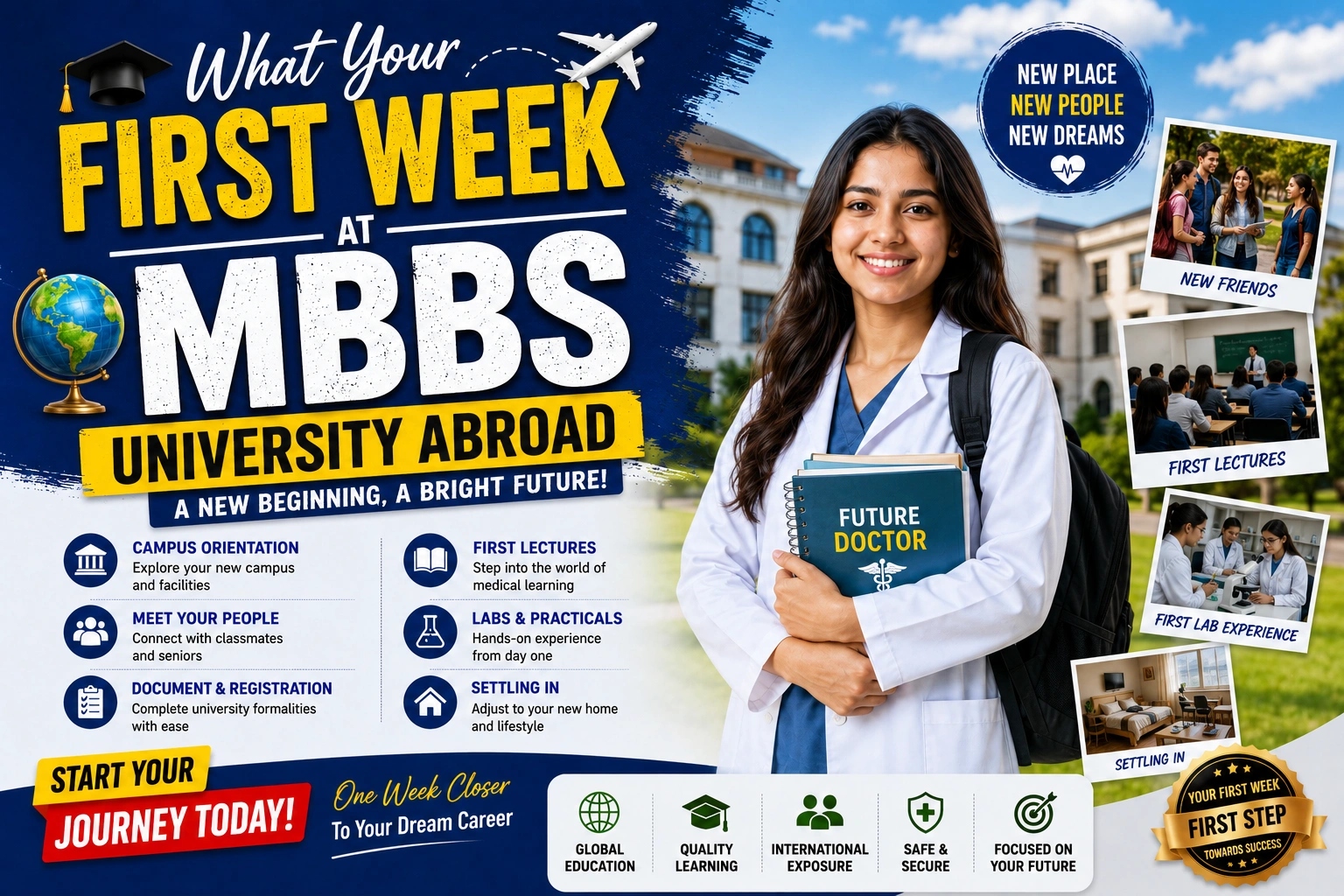
Each year, the opportunity to pursue an overseas medical education is a thrilling milestone for thousands of Indian students. The work continues even after students have received assistance with MBBS placement, booked their visas, and made arrangements for a flight. Studying at a foreign medical university means the Indian medical students should familiarize themselves with what happens beyond the enrollment procedures and the payment of tuition fees.
There is an important set of activities that take place in the medical university during the first seven days after students initially set foot on campus that determines the course of their education. These include the registration for the university, the allocation of a hostel room, orientation, verification of admission documents, and an opportunity to make new friends and socialize. It is important that students become acquainted with these activities to alleviate anxiety and aid the process of adjusting to a foreign country.
Although the final destinations of the students differ among Russia, Georgia, Kazakhstan, Uzbekistan, Nepal, and Kyrgyzstan, students pursuing their MBBS overseas are likely to have an almost identical initial experience of their overseas medical education.
Importance of the First Week of a MBBS Program
The first week is an important period that goes beyond simply relocating students to their university hostels. Students are introduced to the university's academic culture, rules and regulations, and the academic staff. The university is also dedicated to providing guidance to its international students prior to the commencement of classes.
During this time, students also undertake legal and academic formalities that are essential for the completion of their records. Omitting any of these formalities may cause preventable issues or difficulties.
In addition, this is the period when students finally meet and socialize with their future classmates and peers from various countries.
These partnerships many times carry on after both parties have left school, sometimes lasting throughout their respective careers.
Most universities offer an airport pickup service for incoming international students. A representative will meet students at the airport and transport them to their hostels or the university campus.
Typically, the international student office will provide an initial welcome. Their office will address student’s concerns regarding accommodation, food, transportation, and rules of the campus. This gesture greatly reduces the stress and anxiety for a student when they are unfamiliar with the country and the campus for the first time.
International students and their parents can have peace of mind knowing that most reputable universities have support teams specifically for international students.
Hostel Check-in and Room Assignment
The first official item of business is the assignment of rooms to students. An authorization process for the assignment of a room is completed and students are given instructions on the rules pertaining to the hostel.
Students during the hostel check-in are informed of:
- The assignment of a room to a hostel
- The time a hostel closes
- How to do laundry
- Internet connections
- Availability of a kitchen
- Security arrangements
- Emergency contact numbers
The rooms are typically allotted to students of the same gender.
Students are encouraged to report maintenance concerns regarding their room after they have thoroughly inspected the room.
Validation of Documents
The original documents submitted to a university are verified for each student. This is to validate the student’s eligibility for the university and to ensure the university is in compliance with its rules and regulations.
Typically, the documents for verification are:
- Passport
- Visa
- Admission letter
- Educational qualification certificates
- NEET qualification documents
- A few passport size photographs
- Medical fitness reports
Indian students should check to ensure that the NEET qualification does not lapse per the guidelines provided by the National Medical Commission (NMC).
Health Check-up and Medical Insurance
A health check-up for students may be a requirement of some Universities.
This health check validates the medical fitness of students to continue their education.
The assessment may include:
- General health check-up
- Blood tests
- Chest exam
- Vaccination record
- Basic physical assessment
Some countries also mandate health insurance for students before issuing residence permits.
These requirements allow universities to preserve a healthy campus.
University Registration and Student ID Card
After verification of documents, students complete the official registration at the university.
During this phase, students are issued:
- Student identity card
- Registration number
- Library access
- Credentials for campus login
- Email account
- Access to digital learning portal
The student ID is crucial for attending lectures and accessing university resources, library books, and labs.
Orientation Program for International Students
Practically all medical universities conduct an orientation session in the first week.
The orientation session familiarizes students with:
- University history
- Academic calendar
- Faculty members
- Examination system
- Attendance policy
- Campus facilities
- Research opportunities
- Student organizations
Students also gain information on academic integrity and university rules and regulations.
The orientation session greatly alleviates confusion and prepares students for the MBBS program.
Meeting Professors and Faculty Members
During this week, most students will meet a number of different professors for the first time.
Professors will explain:
- Teaching methodology
- Lab class schedules
- Practical class schedules
- Internal assessments
- Semester examinations
- Clinical exposure
Students are encouraged to ask questions and socialize with members of the teaching staff.
Numerous foreign universities keep their class sizes small for improved teaching staff and student interaction.
Understanding the Academic Curriculum
Medical education in other countries operates on a system of standards that are internationally recognized.
Students get clear information on the curriculum, the subjects, hands-on training, and details on the assessment.
Many universities organize the curriculum based on the international medical education standards of the WDOMS and the WHO when applicable.
Students are introduced to basic subjects like Anatomy, Physiology, Biochemistry, Histology, Medical Biology, and Medical Chemistry.
When students understand the curriculum, they can prepare for the new semester.
Campus Tour and Lab Familiarization
Most universities organize a guided campus tour for newly admitted students.
Students visit:
- Anatomy labs
- Simulation centers
- Libraries
- Lecture halls
- Cafeterias
- Sports facilities
- Activity centers
- Research labs
The campus tour helps students familiarize themselves with the academic locations before the classes start.
Opening A Local Bank Account
Some universities help international students in opening local bank accounts.
Having a local account helps students:
- Pay tuition
- Receive money from family
- Make online payments
- Use local debit cards
- Pay hostel fees
Students also need to understand local currency and banking in the first week.
Local SIM and Internet Set Up
The first priority for a lot of students when they arrive in a new country is to set up communication.
Universities help students set up:
- Local SIM cards
- Internet plans
- Mobile banking apps
- Communication groups
- Internet banking
Reliable Internet helps students stay in touch with their family and manage their studies.
Adapting to Local Culture
Living in an entirely different country means students need to adjust to an entirely different culture.
In the first week, students start getting accustomed to the different:
- Customs
- Food
- Public transport
- Weather
- Shopping areas
- Emergency services
- Safety regulations
Building Friendships with Students from Different Countries
Medical universities abroad attract students from numerous countries.
Diversity is present in a single classroom, with students from Africa, India, Nepal, Bangladesh, and the Middle East interacting with one another.
Multicultural interactions are the best way to develop communication skills and help create a diverse learning environment.
These initial days help form new and often life-long friendships.
Managing Homesickness During the First Week
During the initial days of a new experience, most people feel some degree of homesickness.
This may stem from missing family members, familiar foods, and the mundane routine of daily life.
The support provided by universities will aid newcomers in making the necessary adjustments.
The best way to ease homesickness is to chat with friends and family, join clubs to meet new friends, and participate in the many activities provided by the school.
Most students will adjust within a few weeks.
First Classroom Experience
The start of academic work occurs just days after newcomers go through a university orientation.
This will involve some of the following:
- Interactive lectures
- Demonstrations and Practicals
- Laboratory Exercises
- Group Work
- Digital Learning
Medical students will discover greater responsibility for their own learning as the need for regular attendance and self-discipline becomes the norm.
Important Tips for Your First Week Abroad
There are some practical considerations that students should remember in order to ease their transition:
- Keep original documents and important items organized.
- Attend all orientation and registration sessions.
- Comply with all hostel and university regulations.
- Familiarize yourself with the campus prior to the start of classes.
- Introduce yourself to classmates and teachers.
- If you are going to a country where English is not the main language, you should learn a bit of the local language.
- Be mindful of money during the first few days.
- Becoming independent doesn’t mean you won’t check in with your parents.
A lot of small habits can enhance the experience during the first semester.
How Does MBBS Advisor Help with Pre-Departure Preparation?
With the right preparation, the first week abroad can be easy. MBBS Advisor offers guidance through all the steps of the admission process, such as help in selecting the university, help with applications and documentation, visa steps, and pre-departure counseling and travel arrangements.
The MBBS Advisor also has a special NEET section, where students can track admission news. Students can also use the NEET Rank Predictor to see how likely they are to receive offers based on their exam performance. Students who want to develop their International Medical Education plans can see country-by-country analysis with MBBS Abroad to help with their decision-making process.
Conclusion
The first week of MBBS studies abroad is full of education and excitement, as well as lots of important administrative steps. There are many things to help students prepare for a successful start to medical studies, such as airport pick up and hostel assignments, as well as orientation and document checks, campus tours and meetings with faculty.
Relocating to another country is an overwhelming experience, but with proper preparation it can be a lot easier. Students who quickly adapt to their surroundings, who understand the academic requirements and who participate in the university activities have the best chances for the international career they desire. The first week of studies abroad is the best start for an international medical career with the right systems in place.