 Russia
 Belarus
 Georgia
 Kazakhstan
 Kyrgyzstan
 Uzbekistan
 China
 Nepal
 Bangladesh
 Poland
 Romania
 Slovakia
 Hungary
 N. Macedonia
 Vietnam
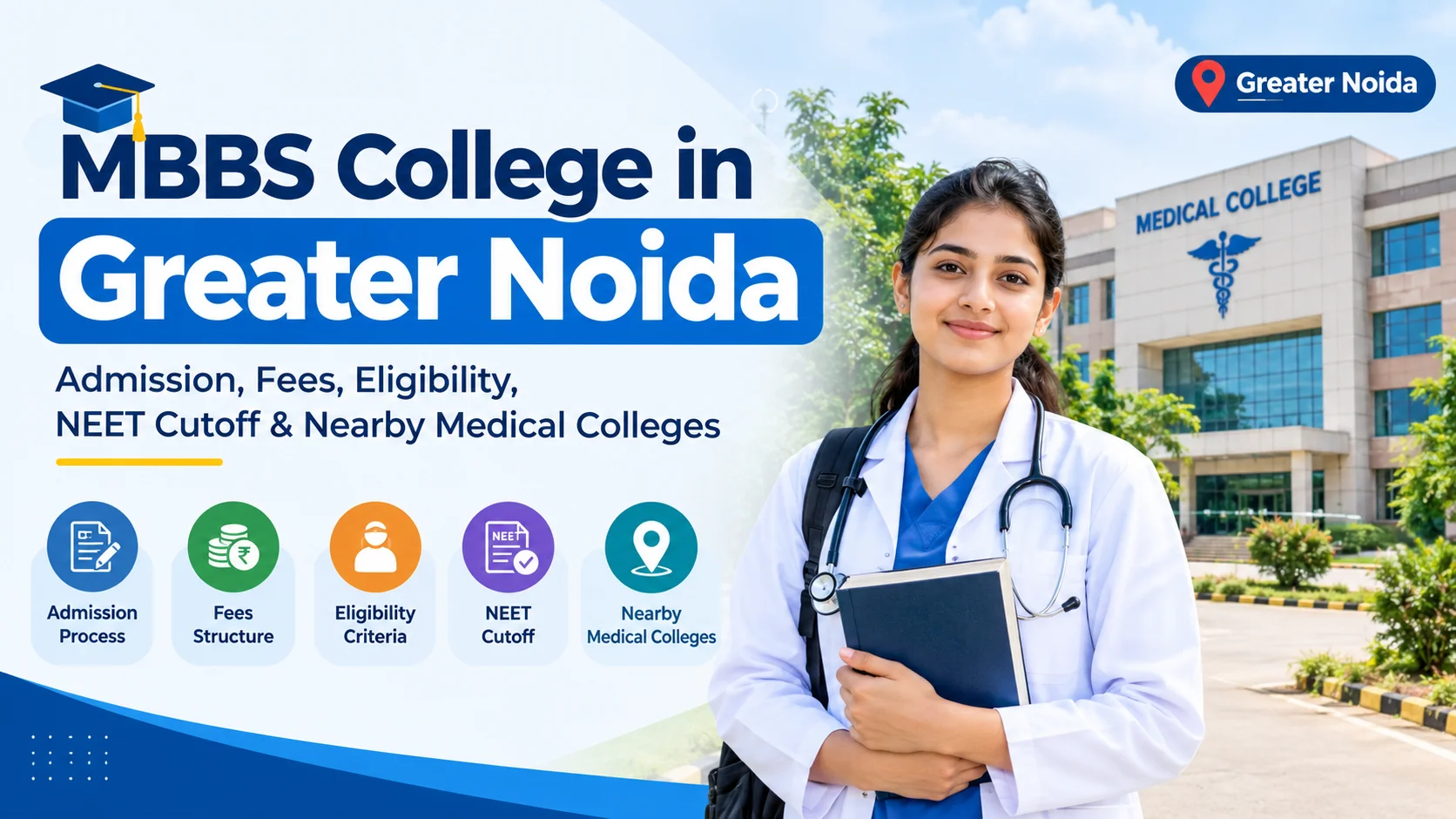
Finding the right MBBS College in Greater Noida isn't just about looking at a college name and checking whether it offers MBBS. There are a few things that really matter: NEET rank, counselling route, total fees, hospital exposure, seat availability and the rules attached to the admission. Miss one of these and the whole calculation can change.
Greater Noida has an interesting mix of medical institutions. The Government Institute of Medical Sciences, or GIMS, is the main government medical college in the city. Private options include the School of Medical Sciences & Research at Sharda University and Noida International Institute of Medical Sciences (NIIMS). These colleges don't follow the same fee model, and their admission routes and cutoff patterns can be quite different. GIMS has an MBBS intake of 100 seats in the NMC's published seat matrix, while Sharda's medical school has an established 150-seat MBBS intake. NIIMS has also received permission for 150 MBBS seats.
The course itself is generally 4.5 years of academic study followed by a one-year compulsory rotating internship. That's the standard structure students should expect, although individual institutional documents should always be checked before admission. And yes, fees matter. A lot. GIMS is a government institution and its published MBBS charges are far below the private-college figures. Sharda and NIIMS are much more expensive, so families need to calculate the entire course cost rather than looking only at the first-year tuition.
Key Highlights₹
|
Particular |
Details |
|
Location |
Greater Noida, Gautam Buddha Nagar, Uttar Pradesh |
|
Main Government College |
Government Institute of Medical Sciences (GIMS) |
|
Major Private Colleges |
Sharda School of Medical Sciences & Research, NIIMS |
|
Entrance Exam |
National Eligibility cum Entrance Test (NEET-UG) |
|
Course Duration |
4.5 years + 1 year internship |
|
Counselling |
UP NEET counselling and applicable national counselling |
|
Medical Regulator |
National Medical Commission (NMC) |
|
University Linkage |
Atal Bihari Vajpayee Medical University for GIMS |
Why Choose Greater Noida for MBBS?
Greater Noida sits in the National Capital Region, which gives medical students access to a large urban healthcare ecosystem. That's useful, especially later in the course when clinical exposure becomes more important than simply attending lectures.
GIMS is a government tertiary-care teaching institution and has expanded from its original undergraduate programme into postgraduate medical education as well. Its hospital infrastructure is therefore a significant part of the academic environment. The institute reports a large patient load and a 630-bed hospital, which can provide students with regular exposure to clinical cases.
Private colleges offer a different proposition. Sharda's School of Medical Sciences & Research operates alongside a large teaching hospital, while NIIMS has its own integrated medical and hospital setup. Students should still visit the campus or carefully inspect the hospital and clinical-material details before paying a large fee. Brochures can tell you plenty. Actual patient exposure tells you more.
Top MBBS Colleges in Greater Noida
There are three names students commonly encounter while researching an MBBS College in Greater Noida.
|
College |
Type |
MBBS Seats |
Course Route |
|
Government Institute of Medical Sciences (GIMS) |
Government |
100 |
NEET + counselling |
|
Sharda School of Medical Sciences & Research |
Private |
150 |
NEET + UP counselling |
|
Noida International Institute of Medical Sciences (NIIMS) |
Private |
150 |
NEET + UP counselling |
The seat figures above should be treated as sanctioned/intake information rather than a promise of availability in every counselling round. Seat matrices can change, so students should check the NMC and UP counselling portals before filling choices. The UP counselling list includes both NIIMS and Sharda's medical school.
NIRF Ranking: What Should Students Check?
NIRF doesn't provide a useful standalone medical ranking position for every Greater Noida MBBS college. Sharda University, however, appears in the NIRF university rankings, while the medical ranking table should be checked separately before using a ranking claim in college comparisons. The distinction matters because a university's overall NIRF position isn't the same thing as an MBBS medical-college ranking. So don't mix the two. It happens surprisingly often.
Government MBBS College
Government Institute of Medical Sciences, Greater Noida
GIMS is the major government option for students searching for an MBBS College in Greater Noida. It is an autonomous institute under the Government of Uttar Pradesh and is affiliated with Atal Bihari Vajpayee Medical University. The college began its MBBS programme with 100 students and has since expanded its postgraduate medical education.
The biggest attraction is the fee structure. GIMS publishes a first-year general-category fee of around ₹83,600 under its detailed fee schedule, with different amounts for reserved categories. Hostel, electricity and mess charges are listed separately. That doesn't mean the admission is easy. Quite the opposite.
Private MBBS Colleges
Sharda School of Medical Sciences & Research
Sharda University's medical school offers a 4.5+1-year MBBS structure and has an established 150-seat intake. Admission to MBBS is based on NEET-UG and the UP State Government's online counselling process. The fee is substantially higher than GIMS. Sharda's published fee information should be checked carefully because tuition, miscellaneous charges and hostel costs can form a large overall amount. Its medical campus is supported by a large teaching hospital and postgraduate medical departments.
Noida International Institute of Medical Sciences
NIIMS is another private medical institution in the Greater Noida region. Its published admission policy describes a 5.5-year MBBS programme and lists 150 MBBS seats under its NMC permission. Its published fee schedule is considerably higher than GIMS, and the institution states that hostel accommodation is compulsory. The published tuition was also described as provisional in the admission-policy document, which is exactly why students should verify the payable amount before making a financial commitment.
Eligibility Criteria for MBBS Admission
The basic eligibility for an Indian student generally includes:
- Passed Class 12 or equivalent with Physics, Chemistry and Biology/Biotechnology.
- Required qualifying marks in the relevant subjects according to the applicable admission rules.
- Qualified NEET-UG.
- Fulfilled the age and other conditions prescribed in the NEET information bulletin.
- Completed the required registration and counselling formalities.
The National Eligibility cum Entrance Test (NEET-UG) is the common entrance examination used for undergraduate medical admission in India. The official National Testing Agency portal publishes the current information bulletin and eligibility requirements. For regulatory checks, students can also refer to the National Medical Commission (NMC) and verify the college, course and sanctioned intake rather than relying only on an admission consultant's statement.
NEET Admission Process
The admission process is pretty straightforward on paper. In practice? It can get messy. First, appear for NEET-UG and obtain a qualifying result. After results, candidates register for the appropriate counselling process. Government and private MBBS seats in Uttar Pradesh are handled through the applicable counselling framework, while the exact quota determines where a candidate needs to register.
The basic sequence is:
- Appear for NEET-UG.
- Check the result and rank.
- Register for the applicable counselling.
- Add colleges and courses to the preference list.
- Participate in seat allotment.
- Download the allotment letter if a seat is allotted.
- Report to the designated centre or college with original documents.
- Pay the prescribed fee and complete admission formalities.
Sharda specifically states that MBBS admission is through NEET-UG and UP State Government online counselling. The official National Eligibility cum Entrance Test (NEET) portal should be your first reference for examination information, while UP NEET should be checked for state counselling updates. MBBS Advisor can also be useful for understanding the counselling process, but the final fee, seat and eligibility information should come from the official authorities.
NEET Cutoff: What Rank Is Needed?
NEET cutoff isn't one fixed number. It changes by category, quota, counselling round, number of seats and the preferences of candidates. For GIMS, recent counselling data shows how competitive the government seat can be. Published counselling records have shown General-category closing ranks in the low-thousands in several rounds, while reserved-category closing ranks can extend considerably further. For private colleges, the range can be much wider. Sharda's MBBS closing rank has varied significantly between counselling rounds, which is why using one number as a permanent cutoff would be misleading.
|
College |
Expected Cutoff Pattern |
What It Means |
|
GIMS Greater Noida |
Highly competitive |
Government seat; strong NEET rank generally required |
|
Sharda University |
Wider rank range |
Private-college counselling; round and category matter |
|
NIIMS |
Wider private-college range |
Depends on category, quota and counselling round |
These are not guaranteed cutoff scores. Check the official allotment data before locking choices.
MBBS Fee Structure
Fees are probably the first thing families compare.
|
College |
Approximate Fee Position |
Other Costs |
|
GIMS |
Government-level; published charges are relatively low |
Hostel, mess and other institutional charges |
|
Sharda |
Private; substantially higher than GIMS |
Tuition, miscellaneous and hostel |
|
NIIMS |
Private; high overall cost |
Security, hostel and miscellaneous charges |
GIMS publishes tuition of ₹18,000 per year for the general category for the academic portion, alongside other institutional charges. Its published schedule lists first-year total charges of ₹83,600 for the general category before separate hostel-related costs.
Sharda's published MBBS fee documents show a much higher private-college cost structure. NIIMS also lists tuition, a refundable security amount, miscellaneous fees and hostel charges. Don't calculate your budget using tuition alone. Hostel, mess, examination fees, books, instruments, travel and personal expenses add up over five-and-a-half years.
Return on Investment
ROI in medicine is tricky. There's no honest way to promise a particular salary immediately after MBBS.
|
College |
Fee Burden |
Clinical Setting |
ROI Consideration |
|
GIMS |
Lower |
Government tertiary-care hospital |
Lower educational cost can reduce financial pressure |
|
Sharda |
High |
Large private teaching hospital |
Higher investment; assess hospital exposure carefully |
|
NIIMS |
High |
Integrated private medical setup |
Compare total cost with clinical opportunities |
A student from GIMS may have a very different financial equation from someone paying several lakhs per year at a private institution. But money isn't the only variable. PG preparation, internship experience, clinical confidence and location all affect what happens after MBBS.
Internship & Placement Opportunities
MBBS isn't a conventional placement-driven degree. That's worth understanding before admission. The compulsory rotating internship is where students get more direct responsibility under supervision. Medicine, surgery, obstetrics and gynaecology, paediatrics, community medicine and other departments form the practical side of training.
GIMS has an established tertiary-care hospital, while Sharda operates with a large teaching hospital and a broad range of clinical departments. For internship quality, ask about patient volume, department rotation, emergency exposure and the actual duties interns perform. Those answers are much more useful than a brochure saying "excellent clinical exposure."
Top Recruiters
Medical colleges don't generally operate like engineering colleges with a fixed list of campus recruiters.
After MBBS, graduates usually look at:
- Government hospitals and health departments
- Private hospitals
- Corporate hospital groups
- Primary and community healthcare services
- Medical officer positions
- Clinical research organisations
- Defence and public-sector healthcare opportunities
- Postgraduate medical education through NEET-PG
Some graduates also prepare for postgraduate specialisation immediately after internship. That's common, and the college's academic environment can matter a great deal here.
Low-Cost MBBS Colleges Near Greater Noida
If budget is the deciding factor, GIMS deserves close attention. Its government fee structure is far below the private options in the area. Students can also widen their search beyond Greater Noida and compare government medical colleges across Uttar Pradesh. A slightly longer commute or a different city can sometimes make a huge difference to the total education budget.
Use the World Directory of Medical Schools (WDOMS) only as a supplementary verification resource for medical-school information, and check the World Health Organization (WHO) for broader medical education and health-system references. For Indian MBBS recognition and permitted seats, the NMC remains the key regulatory reference.
Documents Required
Keep several copies of the usual admission documents. Counselling authorities can specify additional paperwork.
- NEET-UG scorecard and admit card
- Class 10 certificate and marksheet
- Class 12 certificate and marksheet
- Domicile certificate, where applicable
- Category certificate, if applicable
- Identity proof
- Passport-size photographs
- Migration certificate
- Transfer certificate
- Medical fitness certificate
- Counselling allotment letter
- Fee payment receipt
- Other documents requested by the counselling authority
Sharda's published admission checklist, for example, includes the NEET scorecard, allotment letter, UP NEET registration, Class 10 and 12 records, migration/transfer documents and identity documents.
Career Opportunities After MBBS
An MBBS degree opens several paths, but the first decision is usually whether to practise after internship or prepare for postgraduate education.
Possible routes include:
- Junior Resident or Medical Officer
- Government healthcare services
- Private hospitals and clinics
- Community health services
- Public health programmes
- Medical research
- Hospital administration
- Postgraduate medical specialisation
- Academic and teaching roles after appropriate higher qualifications
Students planning to practise in India should always verify the applicable registration and licensing requirements with the National Medical Commission and relevant State Medical Council.
Conclusion
Choosing an MBBS College in Greater Noida comes down to more than the college's name. GIMS offers the government-college route with a comparatively low published fee structure and a tertiary-care teaching hospital. Sharda and NIIMS provide private alternatives, but the financial commitment is much higher. The sensible approach is simple: check recognition, sanctioned seats, counselling rules, total fees and hospital exposure before you decide.
And don't rely on a single cutoff number. NEET ranks move, counselling rounds behave differently, and categories matter. Check the official NMC, NEET and UP counselling information before paying any admission amount. MBBS Advisor can help you compare the broader admission picture, but the final decision should be based on verified college and counselling documents.
FAQs About MBBS College in Greater Noida
1. Which is the main government MBBS college in Greater Noida?
The Government Institute of Medical Sciences (GIMS), Greater Noida, is the principal government medical college in the city. It offers MBBS and postgraduate medical programmes and is affiliated with Atal Bihari Vajpayee Medical University.
2. How many MBBS seats are available at GIMS Greater Noida?
The published NMC seat matrix lists 100 MBBS seats for GIMS Greater Noida. Seat matrices can change, so candidates should verify the applicable counselling-year matrix before choice filling.
3. Is NEET compulsory for MBBS admission in Greater Noida?
Yes. NEET-UG is the common entrance examination for undergraduate medical admission in India, and the Greater Noida MBBS colleges discussed here use NEET-based admission and counselling.
4. What is the MBBS fee at GIMS Greater Noida?
GIMS publishes different charges by category. Its detailed fee schedule lists ₹83,600 for the first year for the general category, with hostel, electricity and mess charges shown separately.
5. Is Sharda University good for MBBS?
Sharda School of Medical Sciences & Research has an established MBBS programme, 150-seat intake and a large teaching-hospital environment. Students should compare its total fee, clinical exposure and counselling terms with other colleges before making a decision.
6. Does NIIMS offer MBBS?
Yes. Noida International Institute of Medical Sciences offers MBBS and has received NMC permission for 150 MBBS seats under its published institutional information.
7. What NEET rank is required for GIMS Greater Noida?
There isn't one permanent rank. The closing rank changes by category, quota and counselling round. Recent published data has shown very competitive General-category ranks, so candidates should check the current allotment results rather than relying on an old cutoff.
8. Is Greater Noida suitable for medical students?
Greater Noida offers access to government and private teaching hospitals, medical colleges and the wider NCR healthcare ecosystem. The real question is whether a particular college provides sufficient clinical exposure, academic support and value for its fee.
9. What is the duration of MBBS in Greater Noida?
MBBS generally consists of 4.5 years of academic training followed by a one-year compulsory rotating internship, making the full course approximately 5.5 years.
10. Where should I verify MBBS college recognition?
For Indian medical colleges, check the National Medical Commission (NMC) college and course information and the applicable counselling authority. NEET-related examination information should be checked on the official National Eligibility cum Entrance Test (NEET) portal. The World Directory of Medical Schools (WDOMS) and World Health Organization (WHO) can provide additional medical-school and health-system context. Always verify the current status before admission.