 Russia
 Belarus
 Georgia
 Kazakhstan
 Kyrgyzstan
 Uzbekistan
 China
 Nepal
 Bangladesh
 Poland
 Romania
 Slovakia
 Hungary
 N. Macedonia
 Vietnam
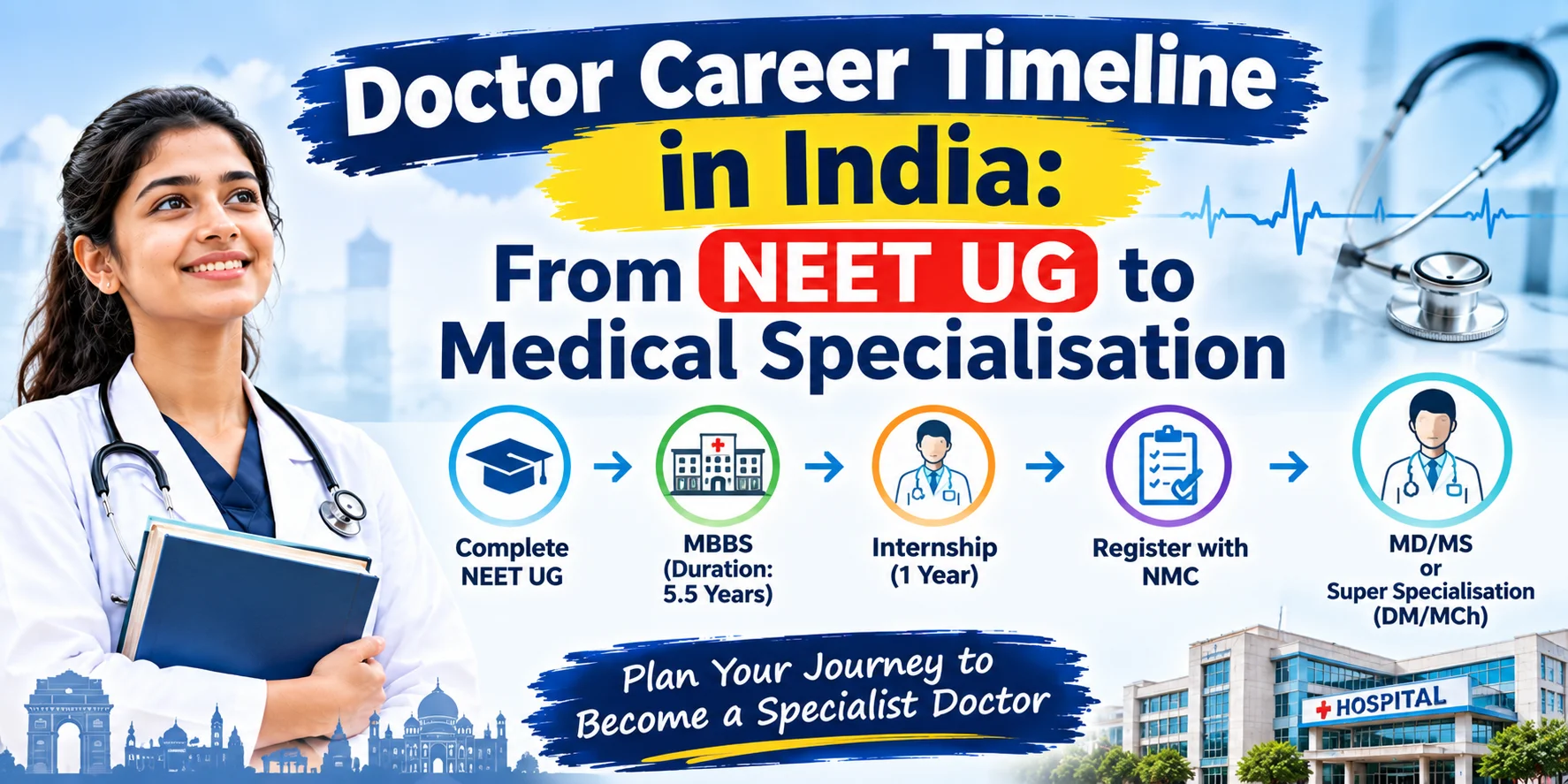
To become a doctor in India you will need to pass the NEET UG exam, get a place on an MBBS course, study for years, undertake clinical training and decide whether you want to be a general practitioner or specialise. However, the time taken will depend on your exam result, the college you are accepted into, when you finish your internship and your performance in your postgraduate exams.
Understanding the Doctor Career Timeline in India can help you plan your future. You will generally spend around 5.5 years undertaking your MBBS course. This can be followed by 3 years of studying for your MD/MS qualification and finally 2-3 years of studying for a super-speciality. If you intend to specialise, you will need to commit to a longer timeline.
How Long Does it Take to Become a Doctor in India?
Most students will spend at least 5.5 years completing their undergraduate medical studies if they go straight into MBBS after their class 12 exams.
|
Career Stage |
Timeframe |
Age Approx. |
|
Class 12 (PCB) |
Until 17-18 |
17-18 |
|
NEET UG Preparation & Admissions |
A few Months - 1 Year+ |
18-19 |
|
MBBS Course |
4.5 Years |
18-23 |
|
Rotating Clinical Internship |
1 Year |
23-24 |
|
MD/MS |
3 Years |
24-27 |
|
DM/MCh |
Generally 3 years after qualifying for postgraduate studies. |
27-30 |
These are rough estimates. Some students may take a gap year to prepare for their NEET UG exam. Others may take more time to prepare for their postgraduate entrance exams. This can affect how long it takes to get into a college.
1. Pass Class 12 & Qualify for NEET UG
Your medical career will start way before you are a trainee in a hospital. Generally you will need to have studied Physics, Chemistry & Biology/Biotechnology and English in your qualifying exams. Please check the current admission guidelines for the minimum marks and age requirements.
Typically you will require a minimum of 50% in your PCB exams to qualify if you are from a general background. SC, ST & OBC will generally require 40% in their qualifying exams.
Please visit the official National Testing Agency website for the latest information on the NEET UG information booklet, exam dates, eligibility & application process.
Many students underestimate how competitive this stage can be. Just because you qualify for the exams doesn’t mean you will get a place in a government medical college.
2. Pass NEET UG & Get a Place on an MBBS Course
NEET UG is the main entrance exam to get onto an undergraduate medical course. Your score, rank, category, state eligibility, number of places available and choices made during counselling will impact what college you get.
Generally the process will be:
- Take the NEET UG Exam & Register.
- Check your scorecard, rank & qualification.
- Register for the relevant counselling.
- Submit your college preferences.
- Attend the seat allocation process & document verification.
- Pay the relevant fees & attend the allocated college.
The counselling process changes every year. Government & private colleges will have different processes so please check the official guidelines.
If you are looking to compare medical education courses, you can find more information on MBBS Advisor. However, please ensure you check how many places are available and the admission guidelines from the relevant counselling body.
What Rank do I Need?
There is no set rank to guarantee you a place in any medical college. Government colleges can be very competitive. Private colleges will vary depending on your state, category, quota & round of counselling. Just because you qualify for NEET doesn’t mean you will get a place in your preferred college.
3. Study for 4.5 Years for your MBBS
Once you have got onto a course, you will enter the most intense part of your Doctor Career Timeline in India. During your MBBS you will undertake a mixture of theory, practical lab work & clinical placements.
During your studies you will cover topics such as Anatomy, Physiology, Biochemistry, Pathology, Pharmacology, Microbiology, Community Medicine, General Medicine, Surgery, Paediatrics, Obstetrics & Gynaecology and other necessary subjects.
You will generally progress through:
- Early years - Learning about the structure & function of the human body and basic medical sciences.
- Middle years - Disease processes, drugs, diagnostics & lab work.
- Clinical years - Attending hospital placements, observing patient management and developing your examining & communication skills.
- Final year - Bringing together your knowledge from clinical areas and preparing for your university exams.
The exact timetable will depend on the curriculum & academic calendar of your medical college. You will need to pass the required exams and complete the training. During your MBBS you will not just be learning from textbooks. You will need to learn how to take a patient’s history, examine them properly, interpret findings and know when they need urgent treatment.
4. Complete 1 Year of Compulsory Internship
Once you have completed the academic part of your MBBS, you will have to complete the required compulsory rotating internship. This is usually 12 months. During your internship you will rotate through different clinical areas. You will have supervision whilst completing tasks such as assisting with ward rounds, recording clinical information, assisting with emergencies and learning how to perform routine procedures within your authorised limits.
This is an important part of your career. Just because you have knowledge of a disease doesn’t mean you will know how to handle a patient. You will need to have supervision whilst practising. Once you have completed your academic requirements, internship and registration you can proceed with the relevant registration process.
5. Decide Whether to be a General Practitioner or Postgraduate
From here you can choose to start work in a role within medicine or prepare for your postgraduate studies. If you want to become a specialist then postgraduate studies will generally be the next big step.
MD/MS
These generally take 3 years to complete once you have finished your MBBS, internship & eligibility.
MD are commonly non-surgical specialties such as General Medicine, Paediatrics, Dermatology & Anaesthesiology.
MS are commonly surgical specialities such as General Surgery, Orthopaedics & Obstetrics & Gynaecology depending on the recognised course.
You will generally need to sit the NEET PG exam to get onto a course. Please visit the National Medical Commission website for information on medical education regulations and recognised qualifications. When choosing your speciality you should consider what the job actually involves. Will you enjoy the training? Will you have much patient contact? What are the hours like? What type of medical practice do you want to build?
How Long Does it Take to Specialise?
|
Qualification |
Timeframe |
Time from Class 12 (No Gap Year) |
|
MBBS + Internship |
5.5 Years |
5.5 Years (No delays in admissions) |
|
MBBS + MD/MS |
8.5 Years |
8.5 Years |
|
MBBS + MD/MS + DM/MCh |
11.5 Years |
11.5 Years |
Depending on the entry requirements for the course you want. DM/MCh are super-specialities so please check the eligibility requirements for the course you want. Some qualifications & training will vary depending on the current regulations.
6. Understand DM/MCh & Other Training
Doctors can undertake further training to become a super-specialist. This can take approximately 3 years once you have qualified for the relevant postgraduate qualification. For example, if you have a relevant postgraduate background you may want to undertake a super-speciality such as Cardiology, Neurology, Medical Gastroenterology or Cardiothoracic & Vascular Surgery. This will depend on the entry requirements for the course.
You may need to sit the NEET SS exam or other selection process. This is not a compulsory step for all doctors. You may have a postgraduate qualification which is enough for the type of clinical practice you want to do. If you are interested in a specific area of advanced practice then super-specialising makes sense.
Costs of Studying at a Medical College
Government MBBS colleges are generally much cheaper than private colleges. However, the exact cost will depend on your state, college & category.
|
Cost |
General Estimate |
|
Government MBBS Tuition |
Often a few thousand to a few Lakh per year. |
|
Private MBBS Tuition |
Can range from a few Lakh to over 20 Lakh per year depending on the college & category. |
|
Accommodation & Living Costs |
Often around 50,000 - 2 Lakh per year depending on location. |
|
Books, Equipment & Other Costs |
Varies between colleges & year. |
|
MD/MS Costs |
Varies greatly depending on the speciality, college & category of place. |
These are general estimates. Some private medical places can be very expensive. Government colleges may charge extra for accommodation, exams & other costs. Do not just compare the tuition costs of colleges. Ensure you look at the full costs, refund policy, accommodation costs, bond & any service requirements. If you are looking to study outside of India please ensure you check the recognition, eligibility for registration in India, clinical training & relevant foreign medical graduate requirements. You can use MBBS Advisor for initial research but should refer to official regulatory documents.
Recognition, Licensing & FMGE/NExT
To practise medicine you will need to have a qualification that meets the relevant regulatory requirements. The NMC has rules & official notices that are relevant throughout your education. Foreign medical graduates may have different requirements. Your qualification, college, course structure, clinical training & regulations will determine your eligibility.
The Foreign Medical Graduate Examination (FMGE) has been an important exam for eligible foreign medical graduates. NExT has also been discussed as part of the proposed medical licensing & postgraduate selection process in India. Do not assume that a new exam has replaced an existing requirement. Please check the latest official information.
The World Directory of Medical Schools (WDOMS) can be useful to check if the medical school is listed. However, this does not guarantee that the qualification will meet the requirements in India. The World Health Organization can provide more information on public health but should not be considered as the licensing body for an individual medical college. Recognition & Registration requirements are just as important as the length of the course.
Common Reasons for Delaying Your Medical Career
The timelines given assume everything goes to plan.
Common reasons for delaying your studies include:
- Gap year(s) to improve your NEET UG ranking.
- Not getting your preferred college in the first round of counselling.
- Repeat university exam or extension.
- Delayed completion of internship & registration requirements.
- Extra time to prepare for NEET PG or other relevant entrance exam.
- Preference for a specific postgraduate speciality/college.
Some students may take a gap year and this can lead to a better result. However, this should be a planned decision based on your preparation, realistic target colleges & family finances.
FAQs
1. How long does it take to become a doctor in India?
It usually takes 5.5 years to complete your MBBS including the 1 year compulsory rotating internship. This can be increased further depending on your postgraduate or super-speciality training.
2. Can I specialise straight after my MBBS?
No. You will need to complete the relevant postgraduate training & qualification. MD/MS courses generally take an additional 3 years.
3. Do I have to sit NEET UG to get onto an MBBS course in India?
NEET UG is the main entrance exam to get onto an MBBS course in India. Please check the latest information booklet for the exact eligibility & admission requirements.
4. How long does it take to become a cardiologist?
Generally you will complete your MBBS & internship, complete relevant postgraduate training and then super-speciality training in Cardiology. A common route will take around 11.5 years from class 12 (No delays in admissions).
5. Can I practise after completing my MBBS?
If you meet the relevant qualification, internship & registration requirements you can practise within the allowed medical roles. You may not need to complete your MD/MS.
6. Will I complete my studies quicker if I study medicine abroad?
Not necessarily. The course structure may be different. If you intend to practise in India you will need to meet the relevant regulatory, qualification & licensing requirements. Please check these before enrolling.
Conclusion
The Doctor Career Timeline in India can be lengthy but is clearly laid out. You will need to complete your class 12, qualify for NEET UG, get a place on an MBBS course, complete your course & internship and decide whether you want to complete postgraduate or super-speciality training. The standard route to becoming a MD/MS is around 8.5 years from class 12. A common route to becoming a super-specialist is around 11.5 years (No delays).
Start by understanding your eligibility, entrance exam plans, expected costs & desired medical career. Carefully compare colleges & ensure you are using the latest information from official sources. Ensure you are making your decisions based on the full training pathway. Visit MBBS Advisor for more information on planning further medical studies. Use official counselling & regulatory information to confirm your next step.