 Russia
 Belarus
 Georgia
 Kazakhstan
 Kyrgyzstan
 Uzbekistan
 China
China Nepal
Nepal Bangladesh
 Poland
 Romania
 Slovakia
 Hungary
 N. Macedonia
 Vietnam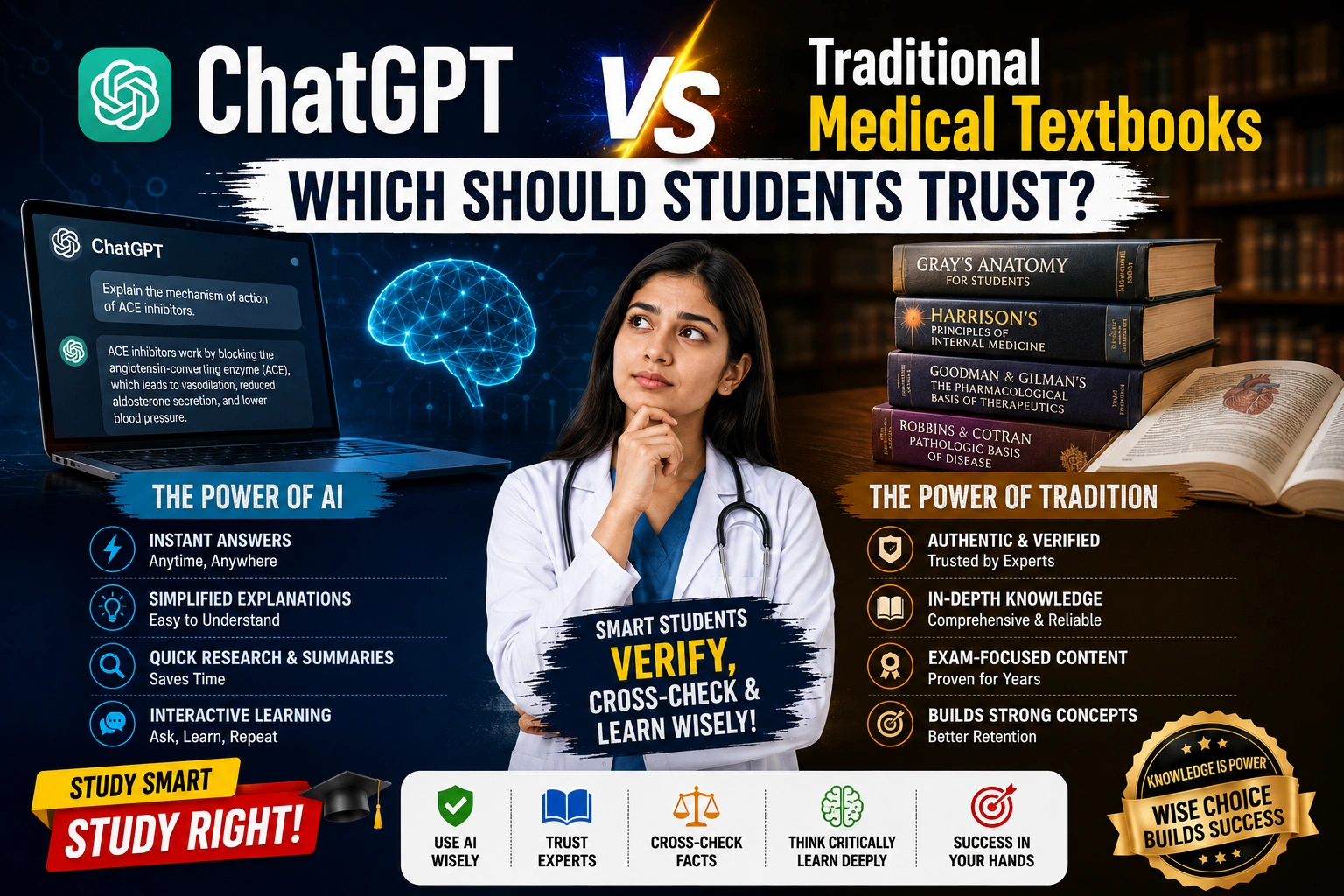
Medical school is a challenging experience that is going through rapid changes. Not long ago, medical students were dependent on lectures, professors, and traditional printed textbooks. However, artificial intelligence tools, especially ChatGPT, are revolutionizing the educational experience of students studying medicine across the world. From describing difficult medical concepts, providing summaries, and formulating sample questions, AI is being used for different educational tools by students across the world.
The question is, should medical students trust ChatGPT more, or less, than medical textbooks? Ideal scenarios, strengths, and limitations make the answer more complex than choosing one over the other for either resource.
This can be particularly important whether you are studying MBBS in India or abroad, or preparing for NEET.
For students searching for MBBS admission information, university information, comparisons, or guidance, you can find updated MBBS admission information for India and abroad on MBBS Advisor.
Why This Comparison Will be Important in 2026
Artificial Intelligence is a burgeoning resource that has made quick explanations and study aids much easier to access. So, many medical schools are implementing instruction that requires the use of AI.
Despite all of this, there are still great risks for imprecision in the practice of medicine. A minor misunderstanding could lead to a misdiagnosis, an incorrect course of treatment, and ultimately an error in an examination. Because of this, it is necessary to evaluate the reliability of all sources.
ChatGPT must be used in conjunction with sound educational medical resources. It is a tool for educational instruction that supplements, not replaces, medical textbooks.
Using ChatGPT as a Medical Learning Tool
ChatGPT has the ability to offer an answer or description of a medical concept, explain challenging concepts, and even create study aids, and all of this can happen in a matter of seconds.
Common uses of ChatGPT among medical students include:
- Comprehension of challenging anatomy concepts
- Description of physiological mechanisms
- Creation of mnemonics
- Summation of lengthy book chapters
- Practice of viva voce questions
- Creation of multiple-choice questions
- Instruction on clinical reasoning
- Review of material prior to an exam
ChatGPT’s most notable feature is its efficiency. Medical students are able to access a well-organized explanation without the need to reference multiple book chapters.
As an example, if a student is having difficulty understanding the cardiac cycle, ChatGPT is able to formulate a basic description, offer examples, draw the line between typical and atypical physiological functions, and provide study aids in the form of revision notes.
What Remains the Best Resources for Medical Education?
Medical literature and textbooks are, and always have been, the most important sources for medical education.
Books that are authored by professor and researcher elites undergo painstaking efforts to improve the science that supports them. Research studies serve as the scaffolding for the chapters, and the studies are accompanied by peer-reviewed publications and evidence-based medical practice guidelines.
Recommended study texts for anatomy, physiology, pathology, internal medicine, and other medical subjects have earned their place in the curriculum of medical schools for the accuracy of their science.
Medical textbooks back their content with citations, unlike content generated by AI.
When considering the accuracy of the content, medical textbooks are irrefutably the best source.
Medical textbooks are:
- Peer-reviewed
- Evidence-based
- Medical experts' updates
- Globally accepted by universities
- Included in licensing examinations
ChatGPT patterns-based responses lack the aforementioned credibility.
ChatGPT may produce correct explanations most of the time; however, students should note the following when relying on ChatGPT for study:
- Drug dosage
- Treatment protocols
- Emergency medicine
- Clinical guidelines
Official recommendations and guidelines should be sourced from reputable institutions (e.g., World Health Organization (WHO) and the National Medical Commission (NMC)).
Learning Speed: ChatGPT Takes the Lead
Medical textbooks can contain explanations that span hundreds of pages. While such descriptions can be necessary, they can also become tedious when preparing for an exam.
ChatGPT is capable of:
- Breaking down verbose explanations
- Constructing flow charts
- Summarizing information
- Creating tables
- Defining difficult terms
- Generating quick revision resources
For the semester exam, revisions can be significantly faster when using ChatGPT.
Students can review the most important concepts faster than reading the entire chapter on pathology.
Concept Clarity vs Detailed Knowledge
ChatGPT allows students to gain a good grasp of the basic (or high-level) concepts for most subjects.
Students may find learning from textbooks to be too technical on the first reading. AI can use real-life examples of the concepts and explain them in a simple manner.
As an example:
Textbooks may explain Starling's Law in a complicated way.
ChatGPT can describe the same concept in a simpler way by using the stretching of a rubber band as an example.
Detailed mechanisms involving pathologies, biochemistry, and microscopy can't be replaced by anything other than textbooks.
The best approach to learning the medical curriculum is the following:
- Use ChatGPT to learn and understand the concepts.
- Use textbooks to learn the details.
Understanding the Requirements of the Examination
Medical exams do not test the understanding of basic concepts.
Students must write structured answers and use appropriate scientific terminology and concepts as per the sanction of the university.
Traditional textbooks are the best sources of:
- Professional Definitions
- Long Answer Questions
- Clinical Correlations
- Diagrams
- Descriptions of Histology
- Standard Medical Terminology
- Standard Textbooks
ChatGPT becomes useful for:
- Quick Revision
- Self Testing
- Viva Practice
- Flashcards
- MCQ Practice
- Summaries
Students can use AI-based learning and standard reference books to cover the curriculum well and perform better in examinations.
Can ChatGPT Replace Medical Professors?
The short answer is no.
There are skills involved in the practice of medicine, such as dealing with patients and making ethical and clinical judgments, which cannot be developed by learning from AI.
Professors teach:
- Clinical demonstrations
- Teaching at the bedside
- Practical exams
- Surgical demonstrations
- Lectures on ethics
- Teaching from real patient experience
ChatGPT is unable to do this.
Risks of Relying Only on ChatGPT
ChatGPT is a good learning tool, but, like anything else, over reliance causes learning gaps.
Some of these gaps are:
- Explanation of concepts which are oversimplified.
- Lack of current recommendations from clinical practice.
- Missing context from clinical practice.
- Incorrect descriptions of rare diseases.
- Lack of reading habits regarding textbooks.
Important information must always be verified. This is especially true when writing exams and when information is concerning patients.
The best sources of this information are dedicated databases, official recommendations, and medical textbooks.
Those who want to study an MBBS program can use the MBBS Advisor to compare medical schools and their admission requirements and choose the most appropriate medical school for their needs.
How Medical Students Should Use ChatGPT Effectively
While some may perceive ChatGPT as a replacement for Medical textbooks, ChatGPT is meant to be integrated with the study routine.
This technique may include:
Morning Study
Read the complete textbook chapter.
Concept Building
Use ChatGPT to help understand topics which are hard to understand.
Revision
Make study notes and flowcharts.
Practice
Prepare MCQs and viva questions with the help of ChatGPT.
Verification
Textbooks and medical guidelines should be referenced for accuracy when fact checking.
This technique also facilitates memory recall and also helps maintain standards.
Role of AI in Future Medical Education
Medical education will use more AI assistance techniques but will avoid being reliant on AI.
AI’s role in:
- Customized Learning
- Virtual Patient Interaction
- Clinical Decision Aids
- Research Help
- Medical Note Writing
- Digital Libraries
Will be incorporated in many universities.
Most likely AI will be used extensively by future medical professionals during their practice, making the responsible use of AI during MBBS essential for most students.
Those students who are studying in foreign countries must also check to see if their chosen university is in the World Directory of Medical Schools (WDOMS) and that the university is following the guidelines of the National Medical Commission (NMC).
ChatGPT vs Traditional Medical Textbooks: A Quick Comparison
|
Feature |
ChatGPT |
Traditional Medical Textbooks |
|
Speed |
Excellent |
Moderate |
|
Accuracy |
Good but requires verification |
Excellent |
|
Evidence-Based Information |
Limited |
Excellent |
|
Easy Language |
Excellent |
Moderate |
|
Clinical Depth |
Moderate |
Excellent |
|
Research References |
Limited |
Comprehensive |
|
Examination Preparation |
Good |
Excellent |
|
Concept Revision |
Excellent |
Good |
|
Scientific Detail |
Moderate |
Excellent |
|
Long-Term Learning |
Supportive |
Essential |
Which One Should MBBS Students Trust?
They should trust both, but for different reasons.
- Traditional medical textbooks are the most trustworthy source of information because they have gone through the peer-review and validation process and are globally accepted by medical institutions.
- Textbooks and ChatGPT can be used complementarily, the former being the source of information and the latter being the revision aid.
- Students using textbooks and AI revision tools simultaneously develop a better understanding of concepts and retain information for a longer period of time.
- Textbooks and guidelines should be the primary source of information for significant medical choices, licensing exams, and when practicing medicine.
- Students can also improve their preparation for medical school entrance exams by using the NEET Rank Predictor to predict their chances of getting a college seat based on their likely score after the exam.
Conclusion
The analysis between ChatGPT and medical textbooks should not be seen as choosing one over the other. The focus should be identifying what resource to use where it is most effective.
ChatGPT is fast, readily available, and can provide interactive and simple revision aids, whereas traditional medical textbooks are still the most reliable source of scientifically validated and clinically accurate information.
The best medical students of the future will be those using both methods of studying. Textbooks will provide a solid foundation and gap filler that will aid learning in a more simplified and interactive way. To ensure the best medical education and career early medical students will also be using trusted academic resources along with the WHO, NMC, WDOMS, NEET and MBBS Advisor for medical education, admission and career pathways. This assures medical students both the academic and professional skills they need.