 Russia
 Belarus
 Georgia
 Kazakhstan
 Kyrgyzstan
 Uzbekistan
 China
China Nepal
Nepal Bangladesh
 Poland
 Romania
 Slovakia
 Hungary
 N. Macedonia
 Vietnam
 Canada
 Armenia
 UK
UK Australia
 USA
USA Ireland
 Germany
 New Zealand
 Italy
Italy France
 Singapore
 Netherlands
 Sweden
 Switzerland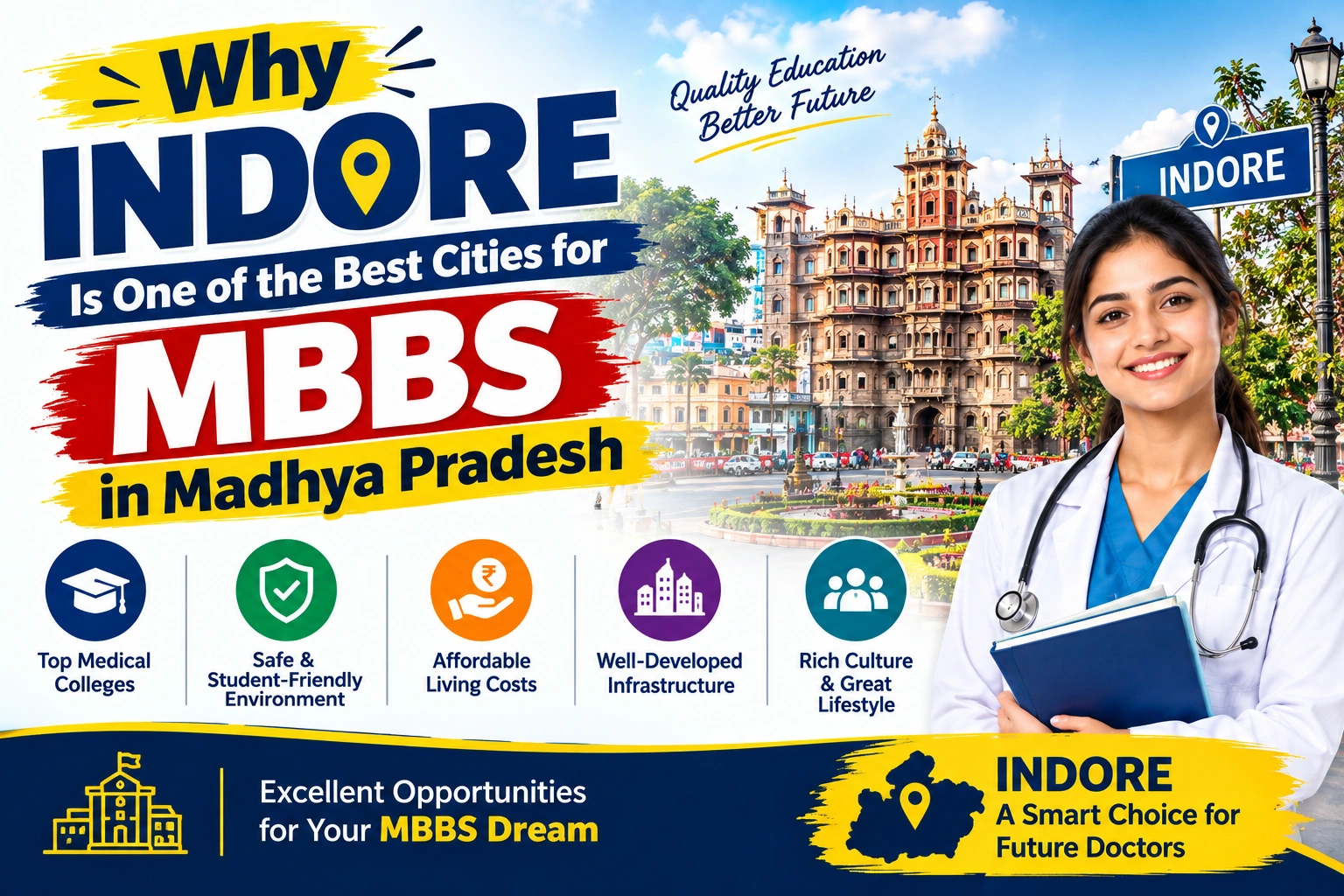
A medical college brochure can show polished laboratories, smiling students and a surprisingly empty hospital corridor. Real medical education is messier. Crowded wards. Long rounds. Patients with conditions you’ve only seen in textbooks. Indore offers plenty of that reality, along with the comfort of a well-connected city that doesn’t feel as expensive or overwhelming as Mumbai or Delhi. For many students, that balance is the real attraction. MBBS Advisor often recommends comparing a city’s hospitals, patient flow, living expenses and academic environment—not merely the college building. On those practical points, Indore makes a strong case.
A Serious Medical-Education Centre, Not Just a Popular City
Indore has one of Madhya Pradesh’s best-known government medical colleges, several established private institutions and large teaching hospitals serving patients from the city as well as nearby districts. That matters. A lot. Medical students need regular contact with actual cases, especially during clinical postings. A college may have excellent lecture halls, but weak hospital attendance can leave students underprepared. Indore’s position as a commercial and healthcare centre brings patients from Dewas, Dhar, Ujjain, Khargone and smaller towns across western Madhya Pradesh. The case mix can include common infections, trauma, maternal health concerns, diabetes, cardiovascular disease and complicated referrals. Honestly, this part doesn’t receive enough attention during college selection. Students compare air-conditioned classrooms. Doctors remember words.
Medical Colleges Students Commonly Consider in Indore
What choices do you actually have? Indore’s MBBS options range from a highly competitive government institution to private colleges with very different fee structures and campus settings.
|
Medical college |
Type |
Approximate annual tuition |
What students usually consider |
|
Mahatma Gandhi Memorial Medical College |
Government |
Roughly ?1–1.5 lakh |
Strong reputation, high patient exposure, competitive admission |
|
Sri Aurobindo Institute of Medical Sciences |
Private |
Often around ?13–17 lakh |
Large campus and attached hospital |
|
Index Medical College Hospital and Research Centre |
Private |
Commonly around ?12–16 lakh |
Residential campus and clinical facilities |
|
Modern Institute of Medical Sciences |
Private |
Often around ?11–15 lakh |
Indore location and private-college access |
|
Other newer private options |
Private |
Usually ?10–17 lakh |
Seats, recognition and hospital activity must be checked carefully |
These are planning ranges, not guaranteed 2026 fees. Tuition can change after state fee-regulatory decisions, and caution money, hostel charges, university fees or miscellaneous deposits may sit outside the quoted amount. Ask for a written, itemised fee sheet before paying anything. Seat numbers can also change. MGM Indore has appeared with an intake of around 250 MBBS seats in recent listings, while private colleges commonly offer about 150 to 250 seats. Check the current college and course details through the National Medical Commission before choice filling. MBBS Advisor also suggests confirming the permitted intake for the exact academic year, because an old screenshot isn’t proof. Not even close.
MGM Indore and the Clinical-Exposure Advantage
One thing becomes obvious when students talk about MGM: its attached clinical system is a major draw. Maharaja Yeshwantrao Hospital, commonly called MY Hospital, handles a substantial patient load and receives referrals from a wide region. Busy? Very. For a serious student, that can mean exposure to more cases during medicine, surgery, paediatrics, obstetrics and emergency postings. It doesn’t automatically make every student clinically skilled; you still have to attend postings, ask questions and practise under supervision. Yet access makes a difference. You can’t learn bedside medicine from slides alone. The downside is predictable. Government hospitals may feel crowded, hectic and less polished than private campuses. Some students find that intimidating during the early clinical years. Still, this is medicine as it is actually practised across much of India, and that experience can be valuable later.
NEET Eligibility and the Admission Route
The basic rule is simple: admission to an MBBS programme in Indore requires NEET-UG qualification. Students should monitor the official NEET website for the information bulletin, application dates, result notices and qualifying criteria. For NEET-UG 2026, the qualifying score was 213 for General and EWS candidates and 177 for OBC, SC and ST candidates. But don’t confuse qualifying with securing a seat. They are completely different things. Admission to MGM Indore is highly competitive, and the closing score or rank depends on category, domicile, quota and counselling round. It will normally sit far above the basic qualifying mark. Private-college closing ranks can extend lower, especially in later rounds, though annual fees are much higher. Students can use the MBBS Advisor NEET guide to understand the exam and counselling basics, but final decisions should always follow official allotment data.
The usual route looks like this:
- Appear for and qualify NEET-UG.
- Register for MCC counselling if seeking the 15% All India Quota seats in government colleges.
- Register with Madhya Pradesh’s designated counselling authority for state-quota and private-college seats.
- Complete document verification and choice filling.
- Check the allotment result and reporting deadline.
- Report to the allotted college, submit originals and pay the approved fees.
Missing a deadline can cost you the seat. Harsh, but true. MBBS Advisor recommends keeping scanned and printed copies of your NEET scorecard, admit card, Class 10 and 12 certificates, identity proof, domicile certificate, category documents and photographs ready before registration begins.
Course Duration and Academic Life
An MBBS degree in Indore follows the Indian medical curriculum: approximately four-and-a-half academic years followed by one year of compulsory rotating internship. Expect anatomy, physiology and biochemistry first, then pathology, pharmacology, microbiology, forensic medicine and community medicine, followed by heavier clinical subjects and hospital postings. The first year often shocks students. Anatomy alone can demand hours of dissection, diagrams and revision, while internal assessments arrive faster than expected. Later, the pressure changes rather than disappearing. Ward postings start. Case presentations matter. Attendance too. Indore helps because the city has a strong student ecosystem. Libraries, coaching centres, cafés suitable for study, bookshops and PG-entrance preparation options are fairly accessible. You won’t need to travel across a giant metropolitan area for every small requirement. That saves time. More than students initially realise.
Living Costs Are Manageable, Though Not Tiny
Here is the practical side. A student living in a college hostel may spend less than someone renting a private room near central Indore, while lifestyle choices can push the budget in either direction.
A reasonable monthly estimate is:
- Hostel or shared accommodation: ?4,000–?12,000
- Food and groceries: ?3,000–?7,000
- Local transport: ?1,000–?3,000
- Mobile, internet and utilities: ?800–?2,000
- Books, printing and personal expenses: ?1,500–?4,000
That puts a typical monthly budget near ?10,000–?25,000, excluding tuition and major travel. Private hostels with meals, air conditioning or single occupancy may cost more. Much more, sometimes. There are hidden expenses as well: instruments, apron, stethoscope, examination charges, security deposits, university enrolment, hostel mess advances and trips home. MBBS Advisor advises families to maintain an additional annual buffer of at least ?40,000–?80,000 beyond the advertised fee.
Connectivity Makes Student Life Easier
Indore is connected by air, rail and road to major Indian cities. The airport has direct or connecting services to several metropolitan centres, while Indore Junction and nearby stations support rail travel across the country. Students from other parts of Madhya Pradesh can also use regular bus connections. Inside the city, buses, app-based cabs and auto-rickshaws cover most student areas. Travel time still depends on where your hostel is located. A college advertised as “near Indore” may actually sit well outside the central city, so check the exact campus pin and hospital location before admission. That small check can prevent years of irritating daily travel. Food is another quiet advantage. Indore offers affordable vegetarian meals, hostel-friendly tiffin services and plenty of quick options. The city loves food, obviously. Still, medical students living on poha and late-night snacks for six years should probably reconsider the plan.
Recognition, Licensing and the FMGE Question
Here a little attention is necessary. For an Indian medical college, the main recognition check should be made through the NMC. Confirm the institution, permitted MBBS intake, course status and relevant academic year. Don’t accept “government approved” as a complete answer. Approved by whom? For which course? For how many seats? The World Directory of Medical Schools and resources published by the World Health Organization may be useful in international medical-education research, but they don’t replace NMC recognition or Indian counselling rules. A WDOMS entry by itself is not a promise of eligibility, quality or licensing rights. Students graduating from an NMC-recognised MBBS college in Indore don’t take FMGE, which applies to foreign medical graduates seeking registration in India. They must follow the internship, registration and licensing or exit-examination framework applicable to Indian graduates at that time. Since rules around NExT and related examinations may change, check current NMC notices rather than depending on an old coaching video.
Indore Versus Studying MBBS Abroad
Some families compare a private medical seat in Indore with lower-cost medical education overseas. Fair comparison. If a private programme costs roughly ?12–17 lakh in annual tuition, the complete Indian degree can become a major financial commitment after adding hostel and other expenses. An overseas option may advertise a lower total fee, but students must examine course duration, teaching language, local-language training, internship structure, clinical exposure and eligibility to practise in India. The MBBS Abroad guide explains these checkpoints in greater detail. Studying in Indore avoids immigration paperwork, foreign-language adjustment and the foreign-graduate licensing route. On the other hand, a recognised overseas course may remain financially attractive for some families. No universal winner. MBBS Advisor generally recommends comparing the full six-year expense and the eventual licensing path, not only first-year tuition.
The Strong Points and the Trade-Offs
A city can be excellent for medical studies and still have drawbacks. Indore is no exception.
Why Students Choose It
The good part first: multiple college choices, busy teaching hospitals, reasonable connectivity, a familiar Indian clinical setting and living costs below many large metros. Students also remain closer to family than they would overseas, and internship or registration procedures are easier to understand.
What Can Be Difficult
Private tuition is expensive. Government seats are intensely competitive. Some campuses are located away from central Indore, and hospital exposure differs sharply from one institution to another. Weather can also take adjustment; summers are hot, while winter mornings feel colder than many first-time students expect. Traffic around busy areas gets tiring. Small issues, perhaps, until they become daily issues. Before choosing, visit the campus if possible. Speak with current students without an admission representative standing beside them. Ask to see the teaching hospital on an ordinary weekday—not during a staged campus tour. Honestly, that single visit can reveal more than fifty promotional videos.
Questions Parents Should Ask Before Paying
Ask direct questions and insist on written answers:
- Is the MBBS intake permitted by NMC for the 2026–27 academic year?
- What is the complete annual fee, including hostel, mess, examination and university charges?
- Which hospital is attached to the college, and how many patients does it ordinarily handle?
- Is hostel accommodation guaranteed for first-year students?
- What refund policy applies if admission is cancelled or documentation fails?
- Are clinical postings conducted at the main hospital or scattered across distant facilities?
- What were the previous year’s category-wise closing ranks?
MBBS Advisor can help families organise these comparisons, but official documents should remain the final reference. Verbal assurances disappear quickly. Receipts and written policies don’t.
Frequently Asked Questions
Is Indore good for MBBS students?
Yes. The city combines established medical institutions, high patient flow, accessible transport and a student-friendly living environment. The quality of experience still depends heavily on the chosen college.
Which is the best government medical college in Indore?
Mahatma Gandhi Memorial Medical College is the city’s principal government medical institution and is widely sought after for its reputation and clinical exposure. Admission is through NEET counselling and remains highly competitive.
How much does private MBBS cost in Indore?
Private tuition commonly falls around ?11–17 lakh per year, though the approved amount varies by institution and year. Hostel, mess, deposits and university charges are usually additional. Verify the 2026 fee order before payment.
Can students get direct MBBS admission without NEET?
No. Indian MBBS admission requires NEET-UG qualification and participation in the authorised counselling process. Claims of guaranteed admission outside counselling should be treated as a warning sign.
Is Indore expensive for students?
Not excessively. A practical student budget may range from ?10,000 to ?25,000 per month, depending on hostel type, food habits and transport. Private accommodation in premium areas will cost more.
Does FMGE apply after completing MBBS in Indore?
No, not for graduates of an NMC-recognised Indian medical college. FMGE is meant for foreign medical graduates. Indian graduates must satisfy the internship, registration and examination rules in force when they complete the course.
Conclusion
Indore isn’t attractive merely because it is clean, lively or well connected. Its real value lies in the combination of recognised medical colleges, varied hospital exposure, manageable student life and access to patients from both urban and semi-rural communities. That’s a useful environment for learning medicine. Real medicine. The final choice should still come down to the college’s recognition, hospital workload, total fee, location and your NEET rank. Compare carefully. Visit if you can. And if two options look almost identical on paper, MBBS Advisor can help you examine the details that brochures tend to hide.