 Russia
 Belarus
 Georgia
 Kazakhstan
 Kyrgyzstan
 Uzbekistan
 China
China Nepal
Nepal Bangladesh
 Poland
 Romania
 Slovakia
 Hungary
 N. Macedonia
 Vietnam
 Canada
 Armenia
 UK
UK Australia
 USA
USA Ireland
 Germany
 New Zealand
 Italy
Italy France
 Singapore
 Netherlands
 Sweden
 Switzerland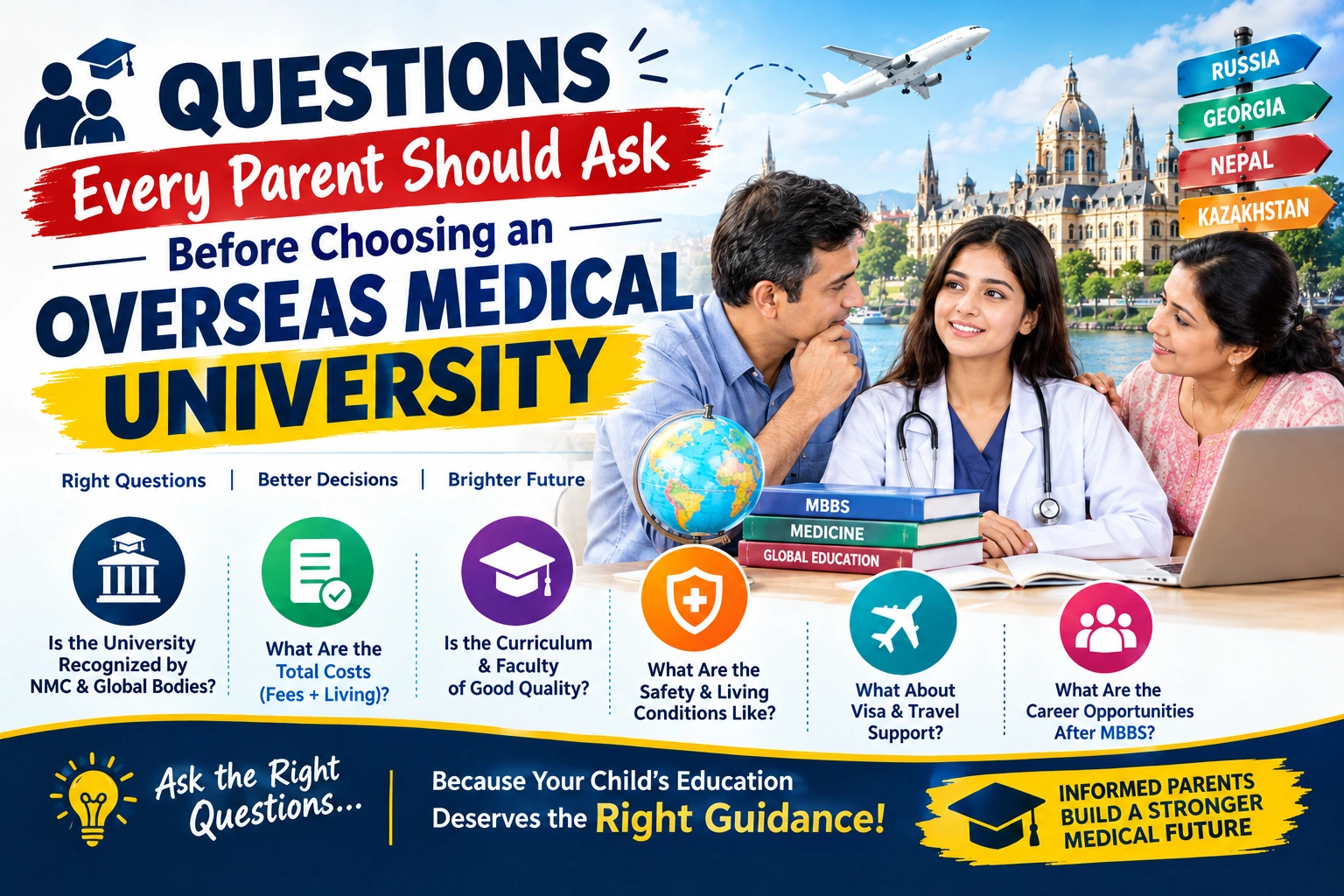
The counsellor has explained the fee. The brochure shows a modern campus. A student on video says the hostel food is fine. The admission letter can apparently arrive within three days. Everything sounds settled. It isn’t. Choosing an overseas medical university affects five or six years of education, several lakh rupees of family savings, and the student’s future licensing eligibility. Parents therefore need more than a list of “top colleges.” They need written answers about the course, internship, hospitals, teaching language, recognition, fees, safety, and what happens after graduation. At MBBS Advisor, we encourage families to ask difficult questions before paying. A genuine university and a responsible counsellor should be able to answer them.
Is the University Legally Recognised in Its Own Country?
Start here. Not with the hostel, weather, or airport pickup. The institution should be legally authorised to provide medical education in the country where it operates. Parents should verify its government recognition, programme accreditation, and authority to award the stated medical qualification.
Ask for:
- University licence or legal status
- Accreditation of the medical programme
- Degree-awarding authority
- Current accreditation validity
- Details of the national regulator
- Eligibility of graduates for local registration
A university can legally teach several courses without every programme having the same professional status. Check the specific medical course offered to international students. The phrase “government recognised” is a starting point. It isn’t the whole investigation.
What Is the Exact Course Duration?
How many months will the student actually study medicine? The answer should be more precise than “six years.” Some foreign programmes are advertised as five years, five-plus-one years, or six years. Parents must ask how much time is spent in academic teaching, clinical rotations, and internship. The National Medical Commission publishes regulations and guidance concerning foreign medical graduates. Relevant requirements include the prescribed duration of education, compulsory subjects, clinical training, internship, English-medium instruction, and eligibility to obtain a medical licence in the country awarding the qualification.
Request a semester-wise curriculum showing:
- Total teaching months
- Number of semesters
- Subjects taught each year
- Start of clinical rotations
- Internship duration
- Holidays and academic breaks
- Final degree title
Honestly, if a university can’t explain its own course duration clearly, that alone is worrying.
Is the Internship Included and Compliant?
The internship is often the vaguest part of an overseas admission package. “It will be arranged after the course” isn’t a sufficient answer. Parents should ask where the internship takes place, who supervises it, which departments are covered, how attendance is recorded, and whether it forms part of the official university programme.
Also confirm:
- Is the internship compulsory?
- Is it completed in the same country?
- Is it conducted by the same university or affiliated hospitals?
- Will the student receive department-wise records?
- Does it support local registration eligibility?
- Is there a separate internship fee?
- Is accommodation provided during the internship?
MBBS Advisor recommends obtaining the internship structure in writing before admission. Verbal arrangements tend to become strangely unclear five years later.
Can Graduates Obtain a Medical Licence in That Country?
This question often surprises parents. They assume the student only needs the degree and will return to India immediately. Under the applicable Indian foreign graduate framework, local licensing eligibility can be important. Ask whether an international graduate with that exact qualification can pursue registration or a licence in the country where the degree is awarded. Don’t ask only whether local students can register. International students may face different language examinations, citizenship rules, or professional conditions. Request the legal basis or official university statement. “Nobody stays there to practise” doesn’t answer the question. A degree and a right to enter the local licensing process are not always identical.
Is the Entire Programme Taught in English?
The brochure says English-medium. Fine. Now ask where English stops. Confirm the language used for lectures, textbooks, practical classes, written examinations, oral viva sessions, hospital case discussions, medical records, and internship assessments. Professors may teach in English while patients communicate entirely in Russian, Georgian, Kazakh, Kyrgyz, Uzbek, or another local language. Parents should ask whether structured local-language classes are included before clinical postings. Medical vocabulary matters: symptoms, pain, allergies, pregnancy, past treatment, medicine use, and examination instructions. Students don’t need perfect fluency. They need enough language to learn from patients. An English classroom with no workable patient communication creates a serious clinical gap.
Which Hospitals Provide Clinical Training?
A university website may show a large hospital without explaining whether international students regularly train there. Ask for the names and addresses of every major affiliated teaching hospital. Then ask when clinical postings begin and how many students attend one unit.
Useful questions include:
- How many hospital days are scheduled weekly?
- Are international students allowed to take histories?
- Can they perform supervised examinations?
- Do faculty members discuss cases in English?
- Are clinical logbooks maintained?
- How large are the bedside groups?
- Which departments conduct regular rotations?
- Is transport to hospitals included?
Speak with fourth-, fifth-, and final-year students. Freshers can review admission support and hostel rooms. They can’t assess advanced clinical medicine. Large hospital. Beautiful photograph. Still, what will the student actually do there?
How Large Is the International Medical Batch?
This number affects teaching far more than families expect. A large batch can mean crowded laboratories, limited faculty interaction, and too many students around one patient. Ask for the annual intake in the English-medium medical programme—not the total university enrolment. Then find out how students are divided for practical and clinical sessions. A batch of 400 can work if it is split into groups of 10–15 for clinical training. A batch of 100 may still struggle if 30 students attend one bedside demonstration. MBBS Advisor suggests asking current students for the real group size rather than relying only on official intake figures. The timetable tells one story. The hospital corridor sometimes tells another.
What Does WDOMS Listing Really Confirm?
A listing in the World Directory of Medical Schools provides useful directory information about a medical school and programme. WDOMS itself states that inclusion doesn’t constitute recognition, accreditation, or endorsement. Parents should therefore avoid treating WDOMS presence as a guarantee of Indian registration. It is one verification step among several.
Check:
- Correct university name
- Campus location
- Medical programme details
- Operational status
- Relevant programme notes
- Degree information
Names can become confusing after mergers, upgrades, or institutional restructuring. The name on the admission letter, transcript, and degree should form a clear record. A directory entry is useful. Not magical.
What Does “WHO Approved” Mean?
Here a little scepticism is healthy. The World Health Organization works on global public health, disease control, health systems, and international standards. It doesn’t issue the kind of individual medical college approval often implied in admission advertisements. A counsellor placing the WHO logo beside a university name has not automatically established that the degree is valid in India. Parents should ask which national authority accredits the programme, whether graduates can pursue local registration, and whether the course meets NMC conditions. These answers should come from official documents. “Globally recognised” also needs explanation. Recognised for what? Academic study, employment, postgraduate admission, or medical practice? Each country has its own licensing requirements.
Has the Student Qualified NEET?
Indian students seeking a primary medical qualification abroad generally need to qualify NEET-UG under the applicable regulatory framework if they plan to pursue registration in India. The category-wise qualifying cutoff changes each year. Parents should confirm the result directly through the official NEET portal rather than relying on a screenshot sent in a WhatsApp group. For NEET-UG 2026, the reported minimum qualifying score was 213 for General and EWS candidates and 177 for OBC, SC, and ST candidates. PwBD applicants should verify their exact category-specific range from the official NTA result notice. Additional planning information is available through the NEET guidance, but NTA documents remain the official source for examination results and cutoffs. Appearing in NEET isn’t the same as qualifying. Check the scorecard properly.
What Is the Full Six-Year Cost?
The first-year package is usually the least useful financial number. Parents need the complete cost. Depending on the destination and university, annual tuition may range from approximately USD 3,000 to USD 8,000 or more. Georgia and certain private programmes may cost more, while lower-cost options are commonly found in Kyrgyzstan, Kazakhstan, Uzbekistan, Tajikistan, and selected Russian regions.
Build a budget covering:
|
Expense |
What parents should confirm |
|
Tuition |
Fee for every year and increase policy |
|
Hostel |
Room type, deposit, utilities, and vacations |
|
Food |
Mess coverage and monthly charge |
|
Visa |
Initial issue and annual extensions |
|
Insurance |
Coverage and yearly renewal |
|
Travel |
Annual flights and baggage |
|
Academic costs |
Books, equipment, printing, and retakes |
|
Licensing preparation |
FMGE/NExT resources and examination costs |
|
Emergency fund |
At least two or three months of living costs |
MBBS Advisor recommends adding a 15–20% buffer to the initial full-course estimate. Currency rates, flights, and university charges won’t remain perfectly still for six years. Fees low. Very low. But every exclusion deserves attention.
Can Tuition Increase?
The honest answer is yes, unless the university provides an enforceable written fee commitment. Ask whether the tuition is fixed in dollars, euros, local currency, or another denomination. A fee that remains unchanged in dollars can still become more expensive for an Indian family if the rupee weakens.
Parents should also check:
- Clinical-year fee differences
- Examination charges
- Repeat-subject costs
- Late-payment penalties
- Internship fee
- Registration charges
- Bank and currency-conversion costs
- Refund policy
Don’t rely on “fees usually remain the same.” Usually it isn't a guarantee.
What Are the Hostel and Safety Arrangements?
A hostel should be assessed as seriously as the campus. Ask for a recent live video of the exact building allocated to international students. Check room occupancy, bathrooms, hot water, heating, kitchen facilities, Wi-Fi, laundry, wardens, CCTV in common areas, visitor controls, and emergency exits. Also calculate the distance to both the academic building and teaching hospitals. For female students, ask about women’s accommodation, female wardens, late clinical postings, transport, curfews, and harassment-reporting procedures. Speak directly with current female students. Parents should save the university’s emergency number, hostel address, and Indian embassy contact. The consultant’s number alone is not an emergency system.
Who Supports the Student After Arrival?
I’ve seen families receive excellent attention until the tuition payment is completed. Then every practical question is redirected to a student volunteer.
Ask who handles:
- Airport reception
- Hostel check-in
- Immigration registration
- Visa extension
- Medical insurance
- University enrolment
- Academic complaints
- Hospital allocation
- Emergency communication
- Passport or document loss
Get the name and official contact of the international student office. If support is provided through a consultancy, ask which services are included, how long support continues, and whether local staff are employed legally. Admission support should not disappear after the airport photograph.
What Is the FMGE or NExT Preparation Plan?
Foreign universities teach their approved national curriculum. They may not cover Indian public-health programmes, treatment protocols, legal provisions, or licensing-examination patterns in enough detail. FMGE remains relevant for eligible foreign medical graduates, while NExT-related implementation should be monitored through current NMC notices. Students beginning a long programme can’t safely predict the exact route that will apply at graduation.
Ask whether the university offers:
- Standard English medical textbooks
- Digital library access
- Clinical case discussions
- Skills laboratories
- Indian student study groups
- Optional FMGE-oriented sessions
- Quiet study facilities
- Proper documentation of rotations
Be cautious with claimed pass percentages. Ask for the examination session, number of candidates, and original data source. One topper’s photograph doesn’t describe an entire university.
What Happens if the Student Fails a Subject?
This question feels negative before admission. It becomes extremely practical later. Universities may charge for repeat examinations, remedial classes, subject re-registration, or an additional semester. Failure can also extend hostel, visa, insurance, and living expenses.
Ask:
- How many attempts are permitted?
- Does one failed subject delay the entire year?
- What is the repeat-exam fee?
- Can the student attend the next semester?
- How does an extended course affect the visa?
- Is academic counselling available?
Medical school is demanding. Planning for a difficult semester doesn’t mean expecting failure. It means understanding the rules.
Can the Student Transfer Later?
Parents sometimes treat transfer as an easy backup plan. It isn’t. Changing universities can affect academic credits, course duration, training location, internship, documentation, and regulatory compliance. A transfer accepted academically by two universities may still create licensing questions later.
MBBS Advisor advises students not to transfer without written confirmation from the institutions and careful review of the relevant Indian regulations. Choose the first university as if transfer won’t be available. That usually leads to better research.
What Should Be Written Into the Final Agreement?
Verbal promises should become written terms before payment.
The final file should include:
- Verified admission letter
- Complete fee schedule
- Refund and withdrawal policy
- Course duration
- Internship structure
- Teaching language
- Hostel details
- Services included
- Payment beneficiary
- Visa-support responsibilities
- Reporting date
- University contact details
Use official email wherever possible. Keep bank records, receipts, messages, and signed agreements. If a major promise can’t be written down, ask why.
Frequently Asked Questions
Is a low-cost foreign medical university always risky?
No. Several legitimate public universities charge reasonable fees. The problem is choosing by cost alone without checking programme structure, clinical training, accreditation, and licensing eligibility.
Does WDOMS listing guarantee practice rights in India?
No. WDOMS provides directory information. Indian eligibility depends on the student, qualification, course, internship, and current NMC requirements.
Should parents visit the university before admission?
A visit can be useful but isn’t always practical. Live campus tours, current student conversations, official documents, and independent verification can still provide meaningful evidence.
How many universities should a family compare?
Compare at least three serious options using the same criteria: duration, internship, hospitals, fees, teaching language, batch size, local registration, and student support.
Is NEET qualification enough for studying medicine abroad?
NEET qualification is one requirement for Indian applicants. The Class 12 criteria and complete foreign medical programme must also satisfy applicable conditions.
How much emergency money should a student keep?
A reserve covering at least two or three months of ordinary living expenses is sensible, along with access to a second lawful payment method.
Conclusion
Parents don’t need to become medical regulators. They do need to ask precise questions and insist on written answers. Check the university. Then check the programme, internship, hospitals, language, total fees, local licence eligibility, hostel, safety, and licensing pathway. Not one of these. All of them. Families comparing MBBS Abroad options can use MBBS Advisor to evaluate the academic and financial details before committing money. A difficult question may make an admission conversation slightly awkward. Good. It is much cheaper than an awkward discovery in the final year.