 Russia
 Belarus
 Georgia
 Kazakhstan
 Kyrgyzstan
 Uzbekistan
 China
China Nepal
Nepal Bangladesh
 Poland
 Romania
 Slovakia
 Hungary
 N. Macedonia
 Vietnam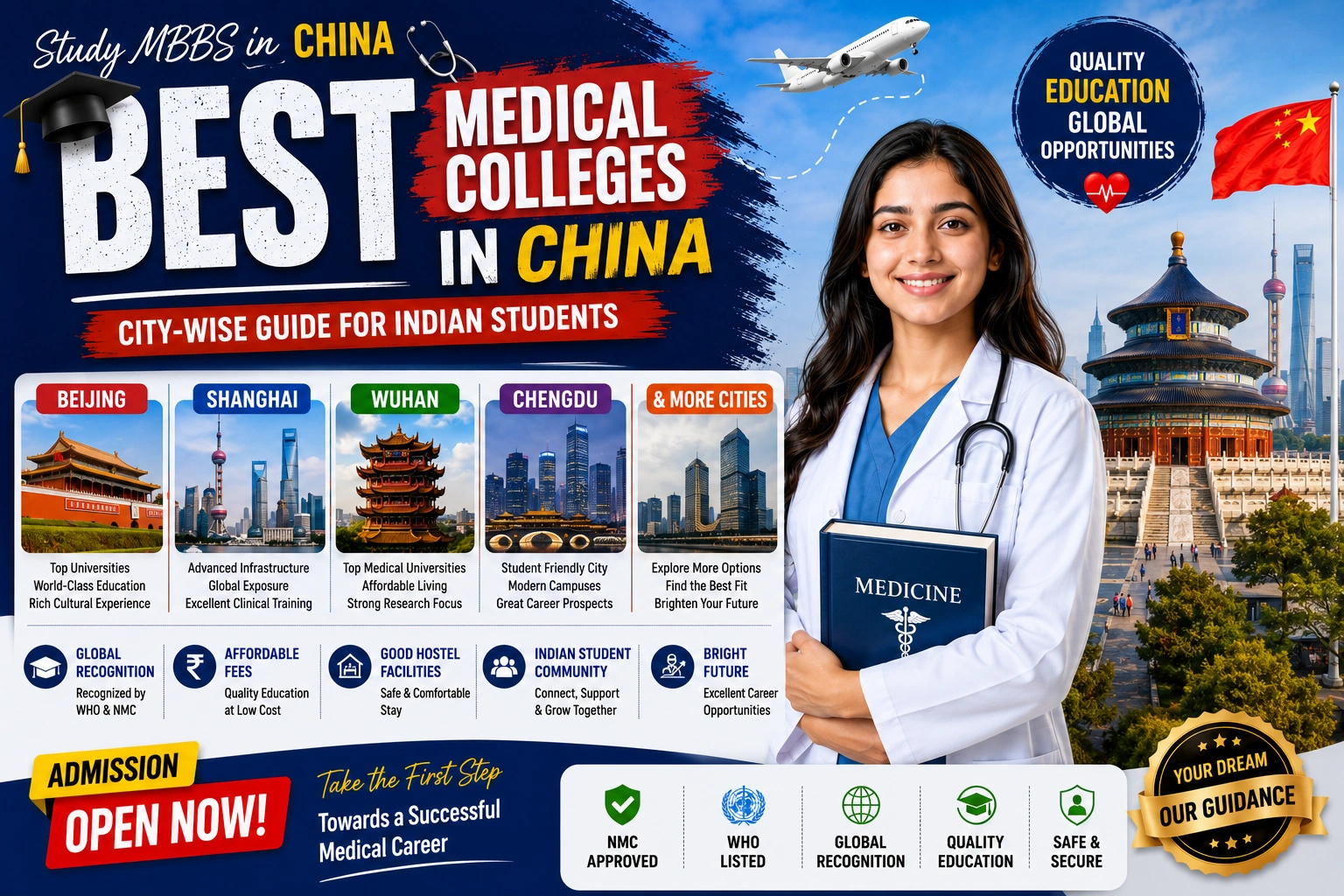
Deciding which medical university to attend is a hugely important decision for students to consider when they choose to study MBBS abroad. Chinese medical universities are popular among international students. They have access to big teaching hospitals, modern infrastructures and a diversified medical system. When deciding the best medical college, for students it can not just be about the college name and city. Students must compare the universities, their clinical exposure, their language of instruction, the hospitals and their services, the support for international students and also the licensing on the future prospects.
Choosing the right city can strongly impact Indian students when it comes to lifestyle, the academic environment and costs, as well as the distance to major hospitals. This city-wise guide covers a number of medical education locations in China which include Beijing, Shanghai and Wuhan as well as other medical education centers.
Indian students looking at medical colleges in China must also consider the requirements of the NEET exam as well as the guidelines set by the National Medical Commission (NMC) for foreign medical institutions. The World Directory of Medical Schools (WDOMS) is a reliable resource for verifying medical colleges and also provides information on the latest requirements for foreign medical graduates.
Beijing - Key Player in Medical Education and Health Services
Beijing is a focal point for one of the most developed healthcare systems in the world. There are many prestigious universities and advanced hospitals and research institutions. For students seeking an opportunity in a healthcare system as developed and as challenging as competitive, Beijing is one of the best options available.
The medical education system in Beijing integrates the healthcare system most effectively. Medical students in Beijing have the opportunity to visit most of the medical departments and learn about and understand various clinical cases. There are also a number of opportunities in the healthcare system to participate in research.
Beijing also has a number of advanced teaching institutions that provide good medical education. An example is Capital Medical University with good links to a number of hospitals, thus providing opportunities for students to undertake training in clinical medicine. Medical education is also provided by the Peking University Health Science Center and is complemented by an excellent research environment.
Beijing’s living costs are higher than those of most other cities in China including Beijing’s competition - Shanghai. When considering a move to Beijing to pursue medical education, students should budget their finances realistically.
Shanghai - A Modern City with a Well Integrated System
Shanghai is one of the most developed cities in China and has an enviable reputation for education and research, health and business. Healthcare students who prefer a more modern urban setting, may find pursuing medical education in Shanghai more attractive.
Fudan University and Shanghai Jiao Tong University are among the most recognized medical education institutions in Shanghai. Each of these universities have branches of their medical schools housed in major teaching hospitals and research centers. The combination of systems around the city provides access to advanced medical systems and a competitive academic.
Shanghai holds an advantage to those students who wish to learn medicine in a global city. This is especially true of the international student who will benefit from the abundant, modern public transportation systems and the vast, integrated healthcare systems that the city has to offer.
Students should also keep in mind the implications of higher costs of living in a highly developed city. There is usually a higher level of competition for student enrollment in these kinds of universities. Students should, therefore, analyze the academic requirements and structure of the medical program and the admission criteria before applying.
Wuhan: A Strong Medical Education Hub
Wuhan is considered to be one of the central city hubs of education and medical care in China. This is especially true for a city of its size and population. It has a number of very large teaching hospitals and universities, making it a very popular city for those who want to study medicine.
Wuhan University and Huazhong University of Science and Technology are good examples of leading institutions. Tongji Medical College is a part of Huazhong University of Science and Technology and has a very well-established academic and medical tradition.
Wuhan has large student populations and large teaching hospitals. This makes it easy to foster community and encourages students to mingle and learn from more diverse groups of people.
Wuhan likely has a lower cost of living compared to Beijing and Shanghai. However, the actual expense will depend on the type of housing, lifestyle choices, and spending. For students that want more exposure to clinics and want stronger medical training, and want to spend less than in Beijing or Shanghai, then Wuhan is definitely a good option.
Guangzhou and Southern China: Medical Education Opportunities Opening Up
Guangzhou is another major medical education hub in China. The city has an advanced healthcare system, large hospitals, and a great academic environment, thanks to Southern Medical University and other medical institutions.
The city also has an international business environment and a very diverse population. There is a large healthcare system connected to a big city, and so students have plenty of opportunities here.
However, students have to deal with the weather and learn the language. Since the academic training of the programme may be in English, students should be ready to learn some Chinese to communicate with patients and the staff in the hospitals where they will do their clinical training.
Nanjing and Jiangsu: Good Academic Standards and a Student-Friendly Location
Nanjing has several well-known and good universities and is an important educational hub in China. Nanjing Medical University is one of the better universities in medical education and for clinical studies and health-related subjects.
This region can attract students who are looking for a strong academic environment without the extremely high living costs found in some of the most populous international cities in China. One of the colleges in Zhenjiang is Jiangsu University, which is also famous for its international medical education programs.
Students interested in this region should assess the medical teaching hospitals of the university, as well as the curriculum, international student services, and the most recent modifications related to Indian students.
Chengdu and Sichuan: A Favorable Option for Medical Aspirants
Chengdu is an emerging hub for education, research, and health care. Sichuan University through its medical education system provides opportunities to work in a situated health care supportive system along with a sound academic system.
The city offers a lifestyle that is different from that of Beijing and Shanghai. Students might find the cost of living bearable depending on their individual needs. Chengdu is also known for its big health care system and growing academic ecosystem.
For students looking for non-conventional choices, Chengdu can also be included in MBBS Abroad.
Medical Colleges in Different Chinese Cities: A Comparison
The city’s reputation should not be the sole consideration when choosing a medical university. When selecting a medical university, a student should consider a number of academic and practical factors.
|
Factor |
Why It Matters |
|
University Recognition |
This aids students in ascertaining the institution's recognition and eligibility. |
|
Clinical Training |
This provides insight into the quality of the institution's hospital-based training. |
|
Language of Instruction |
This helps students comprehend lectures and assessments. |
|
Hospital Network |
This gives students access to real clinical cases. |
|
Support for International Students |
This assists students with accommodation, paperwork and adaptation. |
|
Cost of Living |
This affects the overall cost of studying. |
|
Language Environment |
Basic knowledge of Chinese may be helpful for hospital visits. |
|
Future Licensing |
This is essential for students who intend to work in India or other countries. |
Indian students must check the current regulations themselves before enrolling. The NMC has an official rulebook, and the regulations for foreign medical graduates may change. Students must not depend solely on the promotional information provided by agents or unofficial websites.
Why WDOMS and NMC Verification is Important
Proper verification must be done by students before applying to any medical university in China. Just because a university advertises online, does not mean it is ideal for every student's career aspirations.
Verification in WDOMS allows students to confirm the medical school's listing and some basic details about the medical school. Additionally, the most current and applicable regulations of the NMC should be consulted by Indian students, especially the foreign medical graduate regulations.
It’s important for students to understand the function of the World Health Organization (WHO). WHO does not provide a blanket approval of medical colleges. Thus, students should refrain from believing the claims made in advertisements that state “WHO approved universities” without verifying the actual sources and current regulations.
Which Chinese City Is Best for Indian MBBS Students?
There’s no one best city that can be recommended for every student. Beijing and Shanghai would suit students who want big city lifestyles, integrated healthcare systems, and competitive medical education. Other students may consider education and hospital presence in Wuhan. The combination of lifestyle, educational standards, and costs in Guangzhou, Nanjing, Chengdu, and other cities may also be evaluated.
The combination of educational preferences and the student’s long term career paths, budgets, and lifestyles will impact the best options. There is no merit in isolating the highly ranked universities, if there is no hospital presence, to be located in famous cities.
Conclusion
There are many options for students to get a medical education in China and each of the many cities will provide different lifestyle and educational experiences. Beijing is ideal for students who want an education with a heavy research component, Shanghai is preferable if students want a more global, modern education, and Wuhan has the best hospitals and teaching universities. International medical students will also find several important cities in Guangzhou, Nanjing, and Chengdu.
Once students have done their research and have located a university, they must look at the curriculum and the university’s plans for clinical training, along with the current state of regulations. Resources, such as the MBBS Advisor, will provide students with the best options when making a more informed choice for their medical education.
Choosing a medical university in China based on where the city is located, advertising, or where admissions is the easiest is not an option. As part of building a successful medical career, after thorough research on the university and appropriate regulatory checks, having a realistic understanding of the medical school and clinical training is part of the equation.