 Russia
 Belarus
 Georgia
 Kazakhstan
 Kyrgyzstan
 Uzbekistan
 China
China Nepal
Nepal Bangladesh
 Poland
 Romania
 Slovakia
 Hungary
 N. Macedonia
 Vietnam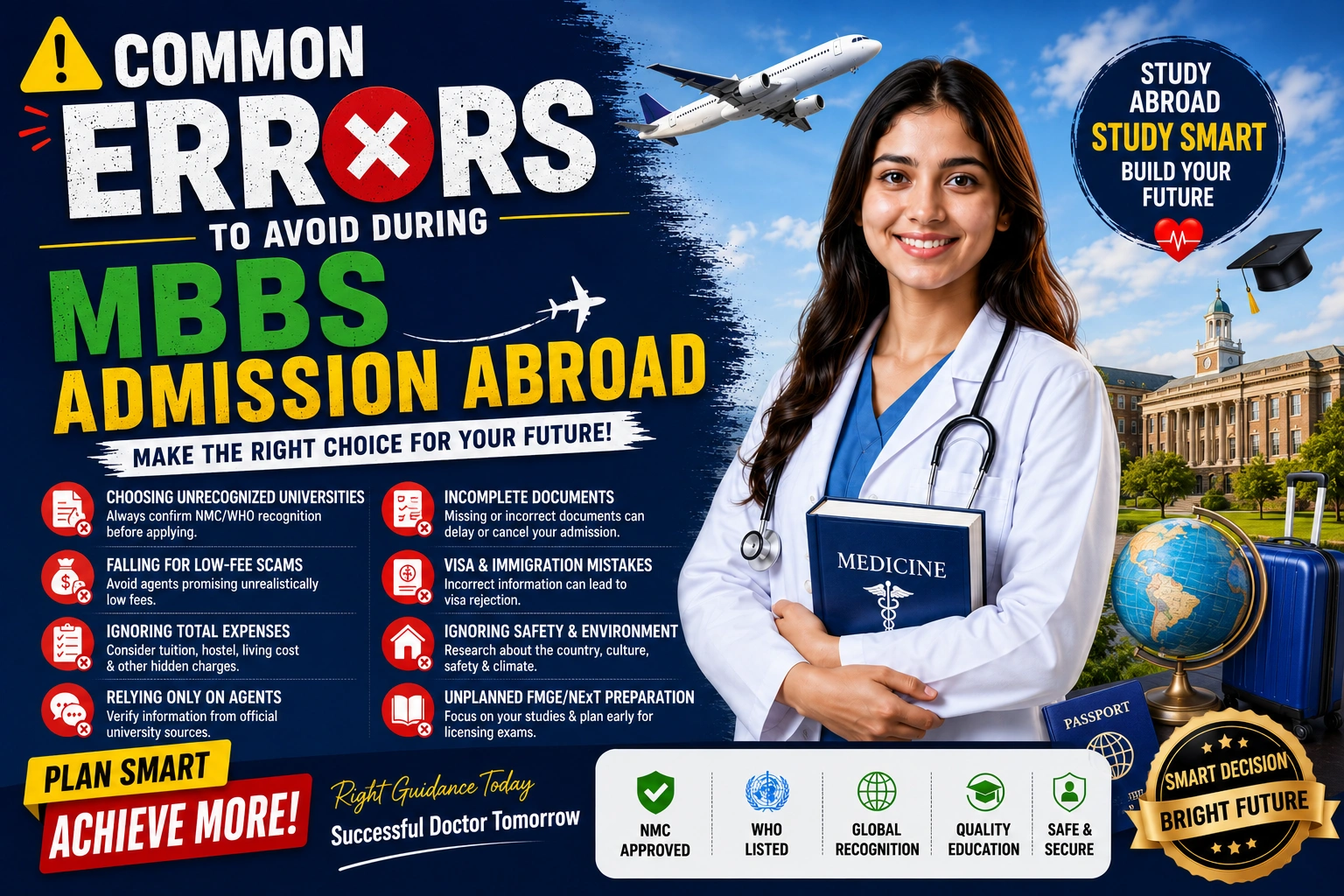
Studying MBBS abroad appears to be a good option for Indian students when getting admission in MBBS in India becomes difficult due to high competition, high cut-off, and the limited availability of government MBBS seats. However, studying MBBS abroad is a huge financial and academic commitment. Mistakes during the admission process can affect the student's education and the student's future career in medicine and the licensing of medicine.
Every year, students and parents make the wrong decisions about foreign medical universities by relying on incomplete information, attractive advertisements, unverified assurances, or by simply assuming things. Some of the most common problems include choosing a foreign medical university which is not suitable and ignoring the rules of the National Medical Commission (NMC). These problems create serious consequences in the future.
Therefore, students need to do some research to confirm the information, understand the admission process in its entirety, and most importantly, understand the consequences of the information posted online before applying to an MBBS program abroad. This guide presents the most common mistakes to avoid when planning medical studies abroad.
Choosing University Based on Low Fee Structure
One common mistake made by students when they apply to foreign universities to study MBBS is choosing a medical university because that university has the lowest tuition fee. While the cost appears to be a good factor to consider, a medical university that has the lowest tuition fee does not have to be a good option for medical students.
Students must consider:
- The university's recognition
- The university's curriculum and clinical training
- The university's teaching faculty
- Teaching infrastructure and support
- The medical universities' students
- The medical students' future eligibility
A medical university that has a slightly higher tuition fee may have better teaching and clinical facilities than a medical university that has a very low tuition fee.
Students should take a comprehensive approach when accounting for the cost of their education. This entails more than just the price of tuition; students should consider:
- Hostels
- Food
- Visas
- Travel
- Insurance
- Medical exams
- Paperwork
- Cost of living
Focusing only on the cost of tuition can result in a misleading projection of costs.
Neglecting NMC Requirements
Indian students should familiarize themselves with the NMC's rules and regulations when choosing a foreign medical university. One cannot rely solely on an agent's word that a degree will be valid in India when gaining admission to a foreign medical college.
Students should evaluate the current and relevant foreign medical education policies and regulations. The length of the course, the language of instruction, the modality of clinical training and internships, and other stipulations may be considered for future registration to medical practice in India.
This step is critical to the admission process. A university's popularity with Indian students does not imply that all students will fulfill the requirements for medical practice in India.
Not Verifying the Recognition and Listing Status of the University
Not properly confirming a university’s recognition and international status prior to admission is a grave mistake. Students should verify the university's status via their official website and international medical education databases.
The World Directory of Medical Schools (WDOMS) is a valid source of medical school information; however, students should know that being listed in a directory does not fulfill eligibility requirements for every country or licensing pathway.
Students should look at:
- The official university website
- The relevant government education agencies
- Applicable regulatory requirements
before making a decision.
Trusting Unsustainable Promises of Admission Agents
While admission agents offer useful insight into the application process, it is unwise to be overly trusting. Claims like guaranteed admission, guaranteed licensing, guaranteed high scores, or guaranteed job placements, are most appealing to students.
No credible agent or consultant can assure prospective students of their future examination scores or medical license. Therefore, prospective students are advised to demand and obtain written documentation on:
- Service fees
- Name of the university
- Admission requirements
- Refund policy
- Available housing
- Other related terms
Prospective students should also look at information provided by the consultant in light of the university’s official documents. This is especially important to do before making any large payments.
Neglecting the NEET Obligation
Indian students wishing to study medicine in other countries should be aware of the requirements that the National Eligibility cum Entrance Test (NEET) fulfills in the admission process. Passing the NEET may be a requirement for Indian students wishing to study medicine in another country, subject to applicable terms and conditions.
A typical oversight is to think that meeting only some criteria for admission to a foreign university will suffice for admission to that university. Students are advised to check their NEET status, as well as age, academic, and other prerequisites before proceeding with their application.
Students uncertain of their prospective rank or any other admission-related concern may also utilize other reliable resources to help them with their planning and decision making, like the NEET Rank Predictor.
Ignoring Duration and Course Structure
During their program selection, students tend to focus on university name and fees, while completely neglecting course structure. This may cause issues in the future, more so if the course structure does not meet the requirements for Indian medical graduates.
Students should evaluate:
- Total program duration
- Classroom versus hands-on training
- Clinical rotations
- Elective rotations
- Internship structure
- Examination pattern
The medical program structure can greatly vary between countries. It is unreasonable to expect that every medical program abroad will be modeled the same as the Indian MBBS structure.
Ignoring Clinical Exposure and Training
Medical education is beyond classroom study. Clinical exposure is an imperative component for developing skills such as the ability to interact and handle patients.
One of the biggest mistakes is selecting a university without considering hospital training. Students must find out:
- Where clinical training occurs
- When clinical training begins
- Number of patients available
- Exposure to all departments
While a university may have great infrastructure and modern classrooms, the quality of hospital exposure is of utmost importance. Therefore, when comparing universities, students must consider clinical training.
Not Knowing the Language of Instruction
For many students, language becomes a huge hurdle when studying medicine abroad. There are many universities that teach the core medical subjects in English but will still instruct students to interact with patients in the local language.
Students should know:
- The language criteria before enrollment
- Whether learning the local language is compulsory
- The language used during hospital postings
Disregarding this may make clinical training harder and may impact a student’s confidence in patient interaction.
Not Estimating the Full Costs of Studying MBBS Overseas
Students often only think through the tuition costs, while the other costs remain unaccounted, leading to a financial burden for the family after enrollment.
The full costs of studying abroad may include:
- Accommodation
- Food
- Transportation
- Travel
- Visa renewals
- Insurance
- Medical checkups
- Books
- Examination fees
- Local transportation
- Emergency funds
Students should aim to set a realistic budget covering all of these costs for the country of their choosing. It is a goal to bring financial clarity to a situation that often has hidden discrepancies for students during the course.
Students should bring in diverse resources to guide them with greater access to international medical education before deciding their destination for MBBS.
Paying Fees Before Knowing About Refund Policy
Another misstep is paying large sums while leaving the university refund and cancellation policy unread. Students and their guardians should understand costs associated with:
- Visa rejection
- Student cancelling admission
- Student terminating studies
Students should not transfer funds to personal accounts without documenting formal admissions through letters, agreements, or confirmations.
Transparent processes justify clear terms for payment timelines with the right to refunds.
Disregarding Accommodation and Student Safety
Accommodation forms one part of the international student experience. Students should establish if the university offers hostel facilities, the amenities provided, and if the accommodation is on or near the campus.
Students should also consider:
- Safety
- Food
- Transport
- Heating
- Internet
- Emergency services
Parents should also establish how the university will assist international students and their parents in the event of an emergency.
Not Researching the Country and the Climate
At times students choose their destination without knowing the country’s climate, culture, and eating and living habits. Some of the greatest challenges come from adjusting to life in a new country and can be the hardest in the first few months.
Researching:
- Climate
- Local lifestyle
- Transportation
- Food availability
can ease mental adjustment and help students adapt more comfortably.
Not Considering Licenses and Career Planning
Admission should not be seen as the end goal. What is planned for after studying this course should also be considered.
For students returning to India from abroad after studying medicine, permissible licensing and regulatory requirements should also be considered to practice medicine in India. Having an understanding of these supports the student in preparing for future licensing requirements and medical practice.
Generally, a student who understands licensing requirements for the entire career is in a better position than someone who has only considered admission.
Avoid Rushed Decisions
Rushed decisions come from pressure from relatives, friends, agents, or social media. For example, students should not select a university because a friend has enrolled or because of a rapidly filling advertisement.
Proper decisions come from:
- Comparison
- Verification
- Consultation
Students should take their time when comparing university options in relation to:
- Cost
- Recognition
- Clinical training
- Location
- Future career opportunities
Common Admission Mistakes and How to Avoid Them
One of the best ways to avoid the above mistakes is by following a systematic process.
Students should:
- Know their eligibility.
- Carefully check the NEET requirements.
- Verify the universities.
- Check the applicable regulations.
- Compare costs.
- Carefully read the admission documents.
This information should come from the official website of the universities and trusted regulatory authorities and not be based on social media and promotional advertisements.
Students should take professional advice from an experienced MBBS Advisor to have a clearer understanding of the admission process.
Conclusion
For eligible Indian students, medical education abroad can be a great opportunity. Careful planning is an absolute must. The low fee option is the reason chosen for many of these universities, but recognition is not given, the NMC requirements are not considered, unverified promises are trusted, clinical exposure is ignored, and the complete cost is not calculated.
Students should remember the admission process is the first step of many in their medical career. Quality education and training, as well as compliance and the licensing process, should be considered.
Students and parents should independently verify research, the World Health Organization (WHO), NMC, NEET, WDOMS, and other trustworthy sources, and understand all the conditions of admission before making a final decision.
With informed planning and research, students can avoid making a decision that can’t be changed and pick the best overseas MBBS option that aligns with their professional goals.
Frequently Asked Questions
What’s the most common mistake when students apply to an overseas University for an MBBS course?
Not researching the recognition of the university, the regulations of the country, the structure of the program, the clinical exposure, the licensing pathway, and future career opportunities is the most common mistake when selecting a university.
Are low fees the most important criteria when selecting an MBBS university?
No, the fees are just one of the criteria, and low fees do not justify selecting a university that is not recognized, has low academic quality, poor clinical exposure, or lacks the required facilities.
Should Indian students check NMC regulations before admission?
Yes, Indian students should be aware of the NMC regulations and other eligibility requirements before enrolling in medical programs in foreign countries.
Is it mandatory for Indian students to qualify the NEET exam to study MBBS overseas?
Indian students are required to complete the NEET exam and satisfy other eligibility criteria of the respective country to study MBBS overseas.
How do students verify information for foreign medical universities?
Students can verify information through:
- Official university websites
- Regulatory authorities
- Verified education sources
- WDOMS listings
Consultants should also be evaluated carefully before relying on their advice.