 Russia
 Belarus
 Georgia
 Kazakhstan
 Kyrgyzstan
 Uzbekistan
 China
China Nepal
Nepal Bangladesh
 Poland
 Romania
 Slovakia
 Hungary
 N. Macedonia
 Vietnam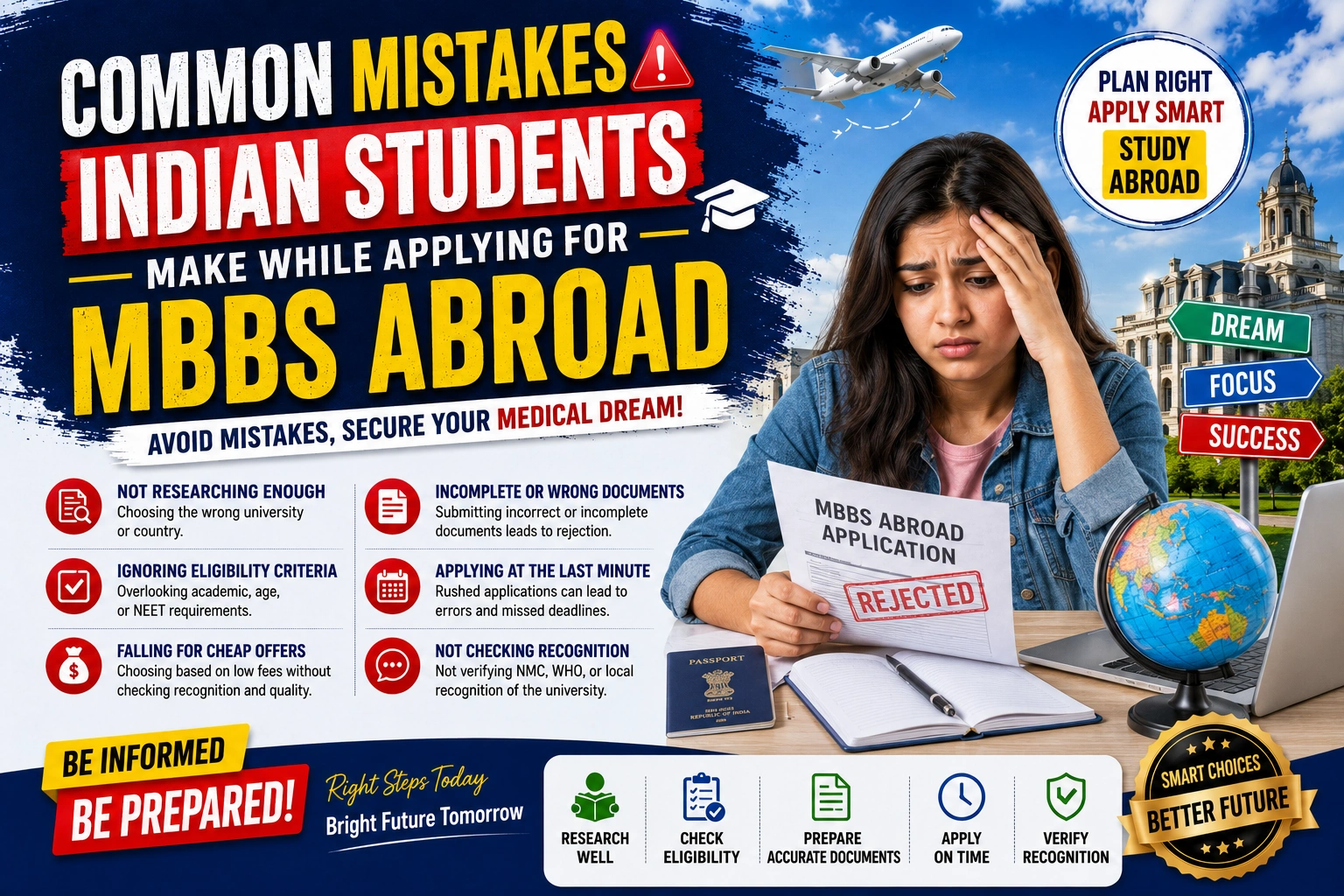
From India, pursuing an MBBS Degree From Abroad is gathering momentum rather quickly. Among thousands of such students, several international medical universities are chosen, as they offer affordable fee structures alongside modern infrastructure and clinically exposed staff. However, students do tend to make mistakes during the admissions process that come back to bite them during their studies as well as their future career and finances.
The majority of these mistakes tend to result from a lack of guidance, insufficient research, and most importantly, reliance on deception. One wrong decision can impact the admission process, visa, or the future practice of medicine.
This is why an aspiring student has to seek the help of MBBS Advisor, as this helps aspiring medical students understand the entire process before making enormous mistakes.
The Importance of Proper Planning When Applying to Study an MBBS Abroad
When studying medicine becomes an investment for long-term returns over time, medicine practiced from the wrong place can be an expensive exercise. It can trap practitioners in suboptimal conditions for the pursuit of specialist and postgraduate medical training and hinder practicing medicine.
Medical practitioners should consider every tiny detail and apply once they are satisfied that the medical degree will allow them to practice their profession. Proper planning allows students to manage their finances and visa procedures without unnecessary stress.
Mistake 1: Applying Without Qualifying NEET
Not qualifying NEET yet applying to study medicine abroad is one of the most common blunders amongst Indian students.
As per National Medical Commission (NMC) guidelines, students wishing to practice in India after completing their MBBS from a foreign country will have to qualify NEET. Serious issues are likely to be faced during the application process for medical registration in India, if the applicant has not qualified NEET.
To avoid the application blunder, students need to analyze their predicted performance in NEET using the NEET Rank Predictor and familiarize themselves with the recent eligibility norms.
Mistake 2: Ignoring University Recognition
A low tuition fee can be a tempting factor for students. However, students need to ensure that the university has recognition and is not applying to a university just for low tuition fees.
A medical university needs to have a listing on the World Directory of Medical Schools (WDOMS) and be compliant with the latest National Medical Commission (NMC) regulations. Recognition is one of the primary factors since it has an impact on licensing and opportunity to practice in the future.
Students also need to confirm that the university is aligned with the international education norms as prescribed by the World Health Organization (WHO).
These checks are necessary to avoid complications in the future.
Mistake 3: Choosing a University Based Only on Low Fees
Selecting a university that offers affordable education is necessary. However, one of the biggest blunders is opting for a university that has the lowest fees.
Students should consider a lot of things before making a decision like:
- The quality of education
- Faculty experience
- Clinical exposure
- Partnership with hospitals
- Infrastructure
- Hostel facilities
- Support available to students
- Opportunities for research
- Safety of international students
While choosing a university, the least expensive option is not always the best. There must be a balance to the comparison of the options available to ensure career benefits in the future.
Mistake 4: Not Adequately Researching the Country
Each country has its own version of a medical education system that provides vastly different environments. For each country that a student is considering for MBBS Abroad, students must consider the:
- Climate
- Culture
- Costs of living
- Food availability
- Languages spoken
- Transportation
- Safety
- Health care
- Indian student communities
Failing to review these will lead to students having a troublesome time adjusting for the first few years of school.
Mistake 5: Using Unauthorized Admission Consultants
Students have unreasonably relied on unauthorized agents by believing that the agents will guarantee admissions, provide fake scholarships and offer unreal fee structures.
While selecting Universities, using a reliable guide to prepare the documents and know the requirements for admission is a must.
Always use verified education portals like MBBS Advisor which help students to know the information regarding the Universities, eligibility, admissions, and documents with much clarity.
Mistake 6: Not Preparing for Hidden Costs
The total cost of studying abroad is much higher than just the tuition costs. The costs also include the:
- Hostel fees
- Meals
- Visa Fees
- Flights
- Health insurance
- Registration fees
- Transportation
- Books
- Residence Fees
- Permit Fees
- Other fees that may be needed to live
With a full cost of education plan, students won't have the costs overwhelm them after settling in.
Mistake 7: Applying Late
Not applying in a timely manner is the last major mistake students are making.
At times, students are known to procrastinate on collecting documents to apply for admission and this can lead to:
- Less choices of universities
- Increased costs for travelling
- Visa delays
- Less time to document for admission
- Application deadline may not be met
- Last minute documented challenges
Getting a head start on documenting admission applications allows students enough time to target preferred universities and document everything accurately.
Mistake 8: Failing to Check the Language of Instruction
Some universities offer advertised English-taught programs, but the clinical training is done in the local language.
Students have to check:
- The language of the classroom
- The language used for clinical training
- The language used for interaction with patients
- Is there an English speaking faculty member?
International students find learning a lot easier if the entire academic program is well designed for them.
Mistake 9: Not Considering the FMGE/NExT Preparations
Students should be concerned not just about earning the MBBS degree, but also the exams that will be required for licensure.
Students from India who plan on coming back after medical school need to know the latest National Medical Commission (NMC) requirements for licensing in India.
Select universities that have a well-designed and strong faculty and clinical training to enhance preparation for future licensing exams.
Mistake 10: Believing All Social Media Reviews
Social media can be a mix of honest reviews and deceptive advertisements.
Students should not make a decision based on promotions, YouTube videos or Instagram reels.
Instead, confirm the information via:
- The university website
- An MBBS Advisor
- Current students
- University admission offices
- Government sources
- Recognition lists
Making a decision based on accurate information is of utmost importance.
Mistake 11: Not Documenting Completely
Not documenting completely causes delays in the admissions process.
Prepare all your documents like:
- Academic credentials
- Passport
- Photos
- NEET qualification
- Medical certificates
- Other documents as required by different universities
A submission review of each document helps to avoid delays.
Mistake 12: Not Paying Attention to Visa Documentation
A lot of students underestimate visa documentation.
Errors or omissions in visa applications can cause travel delays.
Documents required include:
- Passport
- Admission letter
- Proof of funds
- Medical certificates
- Visa application paperwork
- Passport size photos
- Supporting documents
Applications should be beyond the deadline to eliminate stress.
How to Avoid These Mistakes
The admission process is easy to the student who is organized.
The student should:
- Be NEET qualified before the application.
- Use the NEET Rank Predictor for an admission estimate.
- Use only recognized and reputed MBBS Abroad options.
- Have NMC and WDOMS recognized universities.
- Be aware of the WHO guidelines.
- Do not focus only on cost when comparing universities.
- Have a well-planned budget.
- Apply as early as possible.
- Have all your documents verified before submission.
- MBBS Advisor is your best option for guidance.
Why Professional Guidance Matters
MBBS abroad admissions encompasses a number of steps. This includes selection of a university, verification of eligibility from that university, documentation and verification of admission, visa documentation and travel preparation, as well as on-ground support after travel.
Professional guidance gives students the ability to make their own decisions and avoid basing their admission on fraudulent and misleading advertisements.
Conclusion
For Indian students, pursuing an MBBS Abroad is a great opportunity. However, it requires careful decisions at every step in order to be successful. Small mistakes like not checking whether a university is recognized, being late with the application, waiting on unapproved consultants, or being careless with documentation, can have a huge impact later on.
Students must pass the NEET, assess where they would likely fall in the NEET based on an NEET Rank Predictor, conduct proper surveys on universities, and validate the recognition from the National Medical Commission (NMC), the World Directory of Medical Schools (WDOMS), and the World Health Organization (WHO). To get proper, transparent, and the most reliable admissions advice and support, students should reach out to MBBS Advisor before they embark on their MBBS overseas journey. By following this approach, students can greatly reduce their risk and have the confidence that they will be successful in establishing their medical career.