 Russia
 Belarus
 Georgia
 Kazakhstan
 Kyrgyzstan
 Uzbekistan
 China
China Nepal
Nepal Bangladesh
 Poland
 Romania
 Slovakia
 Hungary
 N. Macedonia
 Vietnam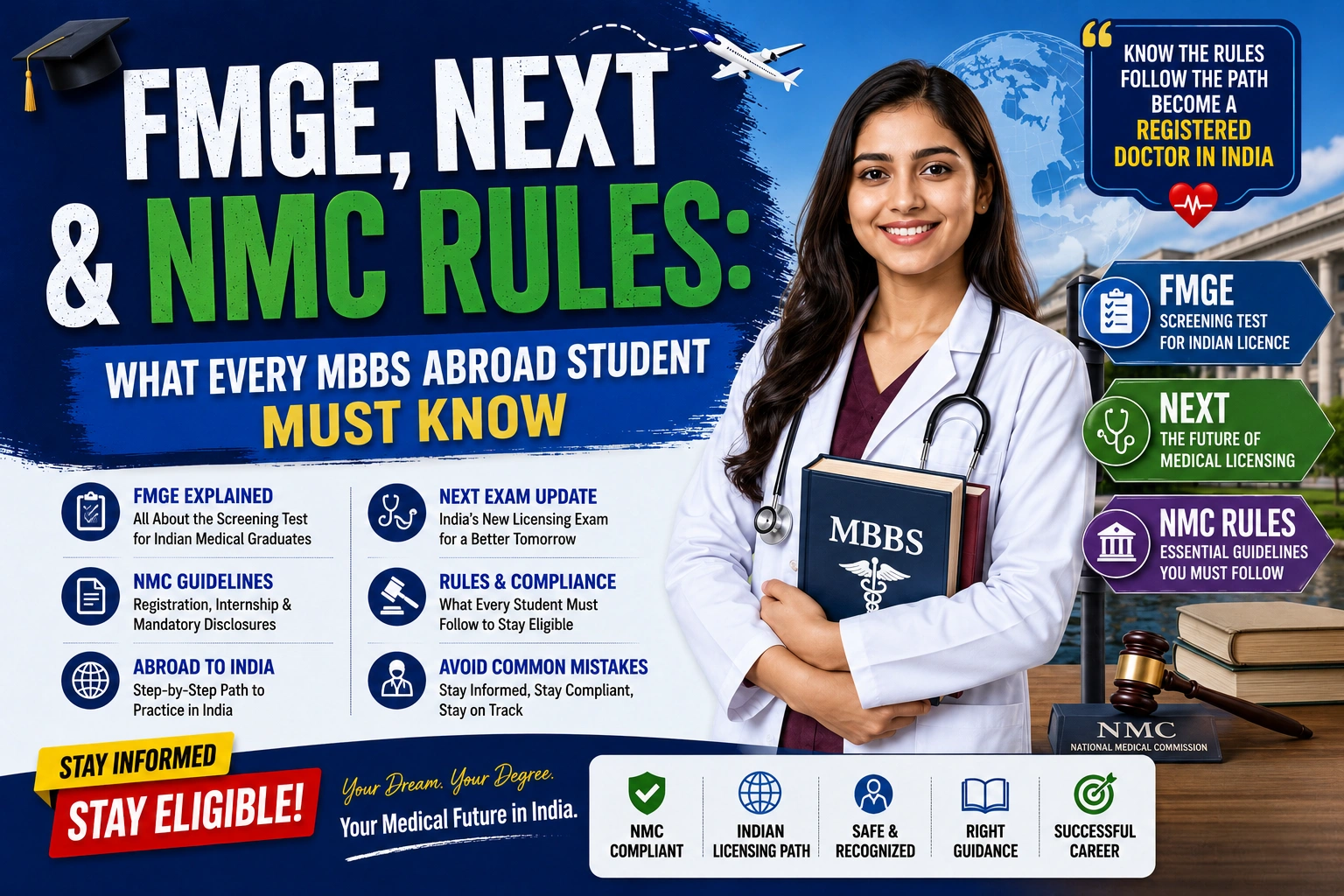
Medical studies abroad have attracted Indian students due to the increasing competition for limited medical seats in India, coupled with the presence of accredited medical universities worldwide. However, foreign MBBS students also need to consider the additional steps to be a licensed doctor in India. Students studying MBBS Abroad need to be aware of the rules and regulations dealing with FMGE, NEXT, and NMC, among others.
What students typically care the most about is which university to attend, the fees, and the admission procedures, while ignoring the requirements to obtain a medical license to practice in India. Awareness of these regulations allows students to make more educated decisions with a clear plan for a medical career in India.
Students can find detailed information and guidance on the medical education options available with MBBS Abroad, as well as current information concerning the education options available to them.
Know About FMGE for MBBS Students Abroad
The Foreign Medical Graduate Examination (FMGE) is a licensing exam for Indians who complete their medical studies abroad and is administered by the National Board of Examinations (NBE). This exam allows foreign medical graduates to register and practice medicine in India.
MBBS students who study abroad and wish to become practicing doctors in India need to clear FMGE, along with other qualifying criteria. The exam assesses foreign medical graduates’ medical knowledge and skills vis-à-vis Indian medical graduates.
FMGE is instrumental as the medical education systems, the pedagogy, and clinical teaching and practice varies significantly from country to country.
The examination guarantees that students from foreign medical universities do not fall short of required standards before they can treat patients in India.
FMGE Eligibility Requirements
Foreign medical graduates must meet certain eligibility criteria in order to take FMGE. Medical students must make sure that their medical university and course satisfy the requirements set forth by Indian authorities before they go abroad for studies.
The key eligibility requirements normally include:
- The applicant must receive a primary medical qualification from a medical institution that is recognized.
- The medical degree must be recognized in the student’s country of study.
- The applicant must meet the requirements established by the Indian medical authorities.
- The students must have valid evidence of medical education.
Students must check the recognition status of the foreign medical university from the official sources such as National Medical Commission (NMC) and World Directory of Medical Schools (WDOMS) before choosing the university.
NEXT Examination: The Future Licensing System for Doctors
NEXT is going to be the newer medical licensing examination which is going to be integrated for the uniformity of medical education and judgement in India. FMGE is going to be replaced by NEXT and it is going to be applicable for Indian medical graduates as well as the foreign medical graduates.
For students pursuing MBBS abroad, it is essential to understand NEXT since all the futuristic medical licensing is going to be based on this examination system. The purpose of NEXT is to assess medical knowledge, clinical skills, and competencies.
It will also assist in evaluating the preparedness of students for the demands of the postgraduate medical education and practice.
Importance of NMC Regulations for MBBS Students Going Abroad
The National Medical Commission (NMC) formulates the standards of medical education in India. For students going abroad to study medicine, it is mandatory to know the rules of the NMC as it will determine whether they will be licensed to practice medicine in India.
The NMC has established a number of provisions to guarantee that medical students studying abroad are properly educated and are given opportunities to receive clinical and other forms of training.
Some of the critical requirements of the NMC include the following:
- The total duration of the medical course should be of a prescribed length.
- The students should be given sufficient training in clinical practice.
- The medical school must be recognized and listed.
- The medium of instruction should be in a language where the students are able to master the medical concepts.
- The course must include the required internship or practical training.
Adhering to NMC regulations will safeguard students from hassles related to the registration and licensing processes after they complete their medical studies abroad.
Importance of NEET for Students Going Abroad for MBBS
The NEET has become a necessity for Indian students intending to pursue medicine abroad. As per the evolving rules, Indian students must clear the National Eligibility cum Entrance Test (NEET) to be eligible to enroll in medical schools outside India.
Clearing the NEET is an indication that students possess the required minimum academic eligibility to pursue studies in medicine.
The NEET is administered by the National Testing Agency (NTA) and for all the related updates, students are encouraged to visit the NEET Official Website.
For aspiring medical students, tools such as NEET Rank Predictor provide opportunities to assess probable NEET score and possible medical school options.
FMGE and NEXT: Implications for MBBS Abroad Students
Licensing exams are critical for MBBS Abroad students. Enrolling in an overseas medical school doesn’t give students the right to practice medicine in India.
Students need to focus on:
- Selection of an NMC-recognized medical school.
- Consistent academic excellence.
- Clinical skills and professional training.
- Early preparation for licensure exams.
Many students begin FMGE and NEXT preparation after completing their overseas medical degree. This is a sub-optimal approach. Familiarizing yourself with the syllabus, exam framework and clinical skills during your MBBS program is much better.
Choosing a Medical School Abroad
One of the most vital decisions for students pursuing medical education outside India is the choice of medical school. Selection should not take place for inexpensive schools or attractive promotions.
Students should assess:
- Recognition Status and Accreditation.
- Quality of teaching faculty.
- Availability of training hospitals.
- Clinical facilities and laboratories.
- Past graduates performance.
- NMC Compliance.
A carefully chosen school enhances the likelihood of successful completion of medical education and licensure preparation.
Top Errors of MBBS Abroad Students
Failing to properly research abroad options prior to enrollment is the source of many students' challenges.
Common mistakes students make when selecting a medical school include failing to confirm if the school's program is recognized, overlooking the importance of a school's clinical training facilities, and neglecting to research the country's medical licensing requirements.
Seeking opportunities based on the country with the lowest tuition is a mistake. Medical school is a large financial commitment. Students should seek the best education.
Also, students should not neglect the FMGE/NEXT exam preparation during their medical study program. Early and continuous preparation for the exam will offer a greater chance of success.
Importance of Proper Guidance for MBBS Abroad Admission
Choosing a medical study program requires the correct information and guidance. The most common areas of concern are:
- Selection of a university and its recognition.
- Eligibility for admission.
- Admission process.
- Assistance with required documents and submission.
- Knowledge of career opportunities after completing a medical degree.
MBBS Advisor offers students guidance and assistance on a wide range of medical career options and medical entrance exams.
Conclusion
Studying medicine abroad offers students a world of opportunities. However, the medical regulations of the Indian government should be considered when students make their plans.
While it is essential to fulfill the NMC's requirements, select an NMC-recognized institute, clear NEET, and prepare for licensing exams, only then can students hope to practice medicine in India.
Careful planning and the initiative to know the current medical regulations will ensure students have a successful medical career after studying abroad.
Students can also refer to the World Health Organization (WHO) for global healthcare information and medical education standards while planning their medical journey.