 Russia
 Belarus
 Georgia
 Kazakhstan
 Kyrgyzstan
 Uzbekistan
 China
China Nepal
Nepal Bangladesh
 Poland
 Romania
 Slovakia
 Hungary
 N. Macedonia
 Vietnam
 Canada
 Armenia
 UK
UK Australia
 USA
USA Ireland
 Germany
 New Zealand
 Italy
Italy France
 Singapore
 Netherlands
 Sweden
 Switzerland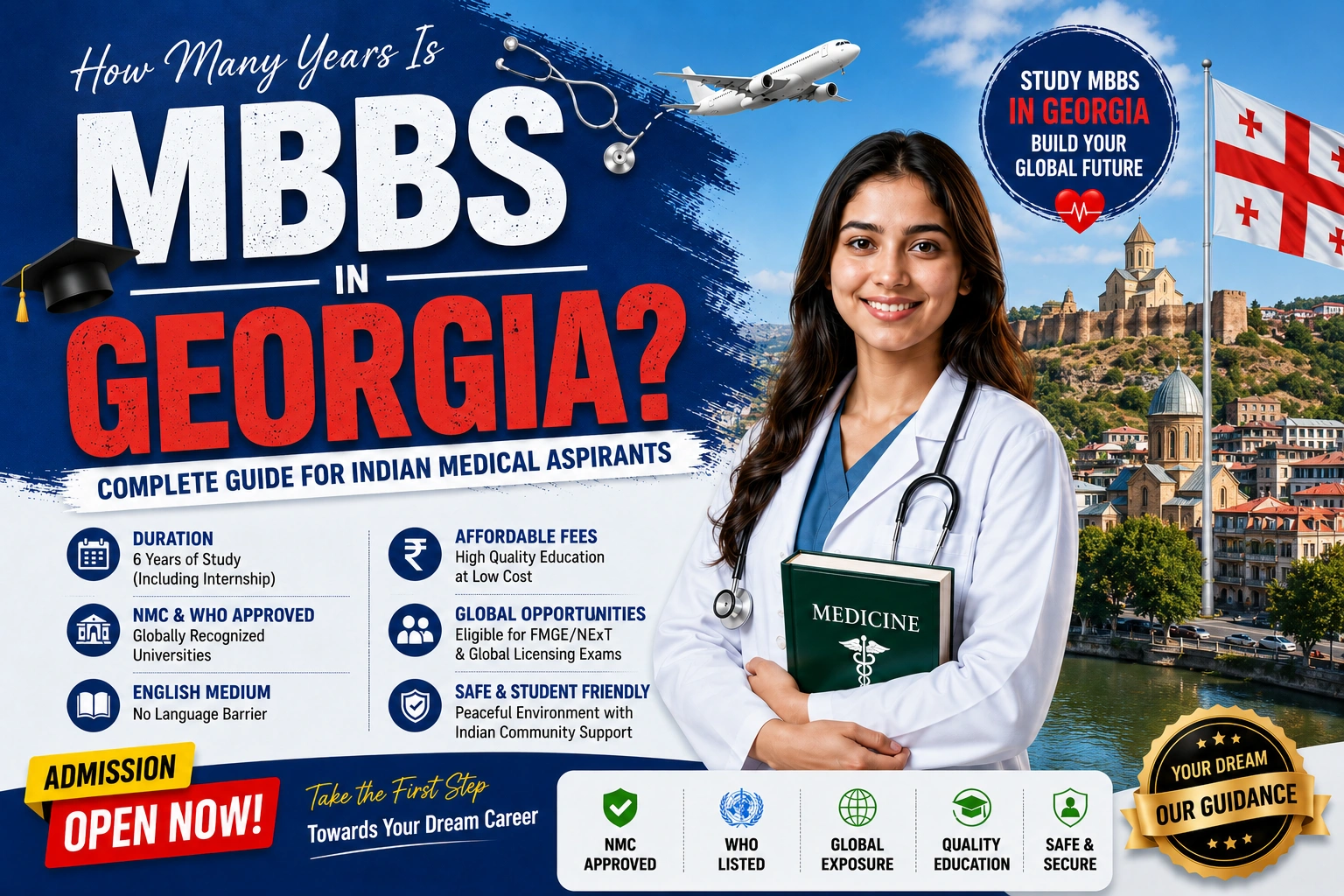
Georgia is one of the most sought-after places for pursuing higher education in medicine because it has all the appealing characteristics. These include modern medical universities, European-style medical training, English-medium instruction, and a multilingual student body.
How long does the MBBS course in Georgia really take? Indian medical students ask this question frequently, and the answer is that an MBBS course in Georgia takes six years on average. The six-year period covers all the theory, clinical, and practical training components of the medical education system. The degree that Georgia offers is MD, i.e., Doctor of Medicine, and this is equivalent to an undergraduate medical degree/MBBS from other countries.
Beyond the course duration, Indian students need to consider other aspects. The recognition of the medical university, the medical curriculum, clinical exposure, eligibility for admission, and the regulations of the National Medical Commission (NMC) that the university adheres to are all important factors that prospective students need to consider before finalizing their MBBS Abroad program.
How Many Years is MBBS in Georgia?
MBBS in Georgia is 6 years, combining medical education, clinical training, and internship. Based on the 360 ECTS system in Georgia, the 6th year is completely devoted to clinical training. Indian students must verify if the medical university and the program meet the eligibility requirements of the foreign medical graduates of India.
Has MBBS in Georgia Actually 6 Years?
Yes, Georgia undergraduate education in medicine is known to be 6 years. The 6-year structure of the MD program in Georgia is explained on the website of the Embassy of Georgia in India, stating that Georgian MD programs are for 6 years, have 360 ECTS credits, and comprise a graduating year internship.
One of the criteria of the program is that Georgia does not have formal medical practice education. A student therefore first learns the basic medical science and only thereafter learns the clinical subjects, does hospital practice, interacts with patients, and performs medical practice.
The 6-year structure of the MD program in Georgia, is progressive. The first part is devoted to the basic medical sciences and the remaining part is devoted to the clinical medical sciences.
Progressive Structure of MBBS in Georgia
Though the curriculum may contain some variations, the general structure of the 6 year Georgian medical program is structured in a progressive manner.
Years 1 and 2: Basic Medical Sciences
The first two phases of a typical medical program consists of the basic medical sciences. The student learns how the human body and its systems are structured and how they function.
The subjects that may be offered are as follows:
- Anatomy
- Physiology
- Biochemistry
- Histology
- Medical Biology
- Genetics
- Basic medical sciences
These subjects are the building blocks to medical education. The student will go on to learn about the pathology of the human body and the healing process.
Years 3 and 4: Pre-Clinical and Clinical Subjects
The middle years consist of the student learning the pathology of disease and clinical medicine. This phase consists of the art and science of medical diagnosis and treatment.
Courses that may be offered are as follows:
- Pathology
- Pharmacology
- Microbiology
- Immunology
- General Medicine
- General Surgery
- Community Medicine
- Clinical diagnostics
At this phase the student learns the effects of disease on the human body and the clinician's role in the process.
Years 5 and 6: Clinical Training and Internship
The final phase is almost entirely clinical teaching. The student learns the practice of clinical medicine and is exposed to numerous hospital departments.
The teaching may be offered in the following departments:
- Internal Medicine
- Surgery
- Paediatrics
- Obstetrics and Gynaecology
- Emergency Medicine
- Psychiatry
- Family Medicine
The final phase is a clinical internship where the student learns the practice of clinical medicine.
Does the Georgian MD Equate to MBBS?
The education conferred by Georgian institutes is usually referenced as MD (Doctor of Medicine). For the purposes of undergraduate medical education, this is, in fact, MBBS, in several other nations.
Indian students, however, must acknowledge that a foreign medical degree does not grant the recipient the right to practice medicine in India.
Indian students returning to India after training must fulfill the stipulations on foreign medical graduates. Since the regulations can change between the date the student is admitted and what regulations apply, it is suggested to check for the NMC provisional updates/revisions before the applicant is admitted.
To apply, students must confirm the medical school is listed in the World Directory of Medical Schools (WDOMS) and confirm the status prior to making any financial commitments to the school of medicine.
Eligibility Criteria of Indian Students
To gain admission, the chosen foreign Medical School of Indian students must meet their academic and regulatory criteria. This is not standardized for all medical universities.
Common requirements include:
- Completion of Higher Secondary Education
- Physics, Chemistry, and Biology
- Education Level Requirement for Medical Study for Indian Students
- Indian students who intend to practice medicine in India are also obligated to appear for the National Eligibility cum Entrance Test (NEET) as per Indian regulations
- A valid passport and the required academic documents
- Adherence to university requirements
NEET is an important criterion for Indian students who want to study medicine outside India and want to register to practice in India. Please check for any recent changes before decision making.
The MBBS in Georgia program is increasingly preferred by Indian students for a variety of academic and other practical reasons. One of the important reasons is the program's duration of six years.
Many universities offer medical courses in the English language, which benefits foreign students. The host country has also increased its population and many medical programs are based on the European higher education system.
More advantages include:
- Medical courses offered in English
- Medical education following the European system
- Modern laboratories and infrastructure
- Options for clinical education
- Presence of foreign students
- Universities with a straightforward admission process
Choosing a university based on agents’ claims of easy admission with low tuition fees is not advisable. The university and program should be assessed for infrastructure, clinical training, recognition and compliance with the regulations.
What do Indian Students Do After Completing Their 6-Year MBBS in Georgia?
Medical students who complete their studies outside the country and wish to practice medicine in India have to comply with the rules and regulations in India.
According to the Foreign Medical Graduate Licentiate Regulations, foreign medical graduates will be required to complete the prescribed clinical and internship training along with other licensing and examination requirements. The requirements will be contingent on the circumstances of the foreign medical graduate and the regulations of India.
As per the NMC requirements, the framework requires the foreign medical graduate to complete medical education and internship, have their competency assessed to practice medicine in the country of education, demonstrate proficiency in the English language and other subjects, and pass the licensing examination. Graduates are advised to refer to the official regulations and FAQs, instead of relying on education consultants, for the most accurate information.
The NMC has revised the Foreign Medical Graduate Regulations. Graduates should refer to this and other official documentation in detail before applying.
Upon completion of the requirements of the NMC, the graduate will be able to apply for medical registration in India and will be able to practice medicine in India.
Is MBBS in Georgia Better than Other MBBS Options Abroad?
There is no single definitive answer to the question of which country or university is the best to do an MBBS abroad. The best option for a MBBS student will be determined by the quality of education, finance, recognition of the university, support to students, clinical studies, and future licensing.
Students should examine the factors mentioned above before deciding to study MBBS in Georgia.
Factors to Consider When Choosing Georgian Medical Universities
- Course Length: Is there a minimum course duration defined by law?
- Offered Clinical Training: What patient exposure is offered?
- Medium of Instruction: Is the entire medical program offered in English?
- Recognition: What is the recognition of the medical school and medical program?
- Internship: What is the design, duration, and location of the internship?
- Licensing: What is the road to becoming a licensed medical doctor in India?
Future costs associated with pursuing licensing exams, travel, lodging, daily expenses, health insurance, and visas also need to be accounted for.
Things to Check Before Signing the Admission Agreement
Students need to meticulously check each document as this is a significant financial and academic decision.
When choosing a medical school in Georgia, students should look at the following:
- Name and Status of the University
- Offered Medical Program
- Course Duration
- Language of Instruction
- Recognition Status
- Medical Affiliated Teaching Hospitals
- Arrangements for Clinical Training
- Internship Information
- All Costs (including Tuition)
- Policies on Withdrawal and Refunds
Students should not believe statements such as “100% recognition” or “guaranteed registration.” These statements need to be verified by students’ own research.
Advantages and Challenges of a 6-Year Medical Course in Georgia
Owing to a well-integrated medical program, students in Georgia get an opportunity to study the medical sciences in detail, as well as gain an exposure to the clinical domain. The students have the opportunity to develop a more patient-centric view as a result of the inclusion of practical training in the program.
Medical education in other countries comes with its own set of challenges. A student may face an adaptation to a new climate, culture, and more importantly, a new/alien education and healthcare system. The student must be fluent in the local language to communicate with patients and clinic staff.
It is worth noting that one cannot practice in India with a medical degree from another country. The students must put in the time and effort for the respective licensing exam and the required internship in India.
Conclusion
How long is MBBS in Georgia? Usually, it is Six Years. The undergraduate medical program is generally awarded as an MD degree. The program aims to provide the essential medical education courses along with the pre-clinical and clinical training and the practical training thereafter.
For students coming from India, things like clinical exposure, the school’s reputation, courses recognition, and the NMC standards are more of a priority than the length of the program. Students are encouraged to thoroughly analyze various medical universities before making a choice.
MBBS Advisor can help students compare universities and understand the admission process for MBBS Abroad. MBBS programs in Georgia offer various options for Indian students looking to study abroad. Options include having a realistic goal and preparing academically, being cognizant of the licensing process, and selecting the correct institution. Indian medical aspirants can also consider the right university. In addition to the above, students must also consider information from the WHO, NMC, NEET, and WDOMS before their admission decision.