 Russia
 Belarus
 Georgia
 Kazakhstan
 Kyrgyzstan
 Uzbekistan
 China
China Nepal
Nepal Bangladesh
 Poland
 Romania
 Slovakia
 Hungary
 N. Macedonia
 Vietnam
 Canada
 Armenia
 UK
UK Australia
 USA
USA Ireland
 Germany
 New Zealand
 Italy
Italy France
 Singapore
 Netherlands
 Sweden
 Switzerland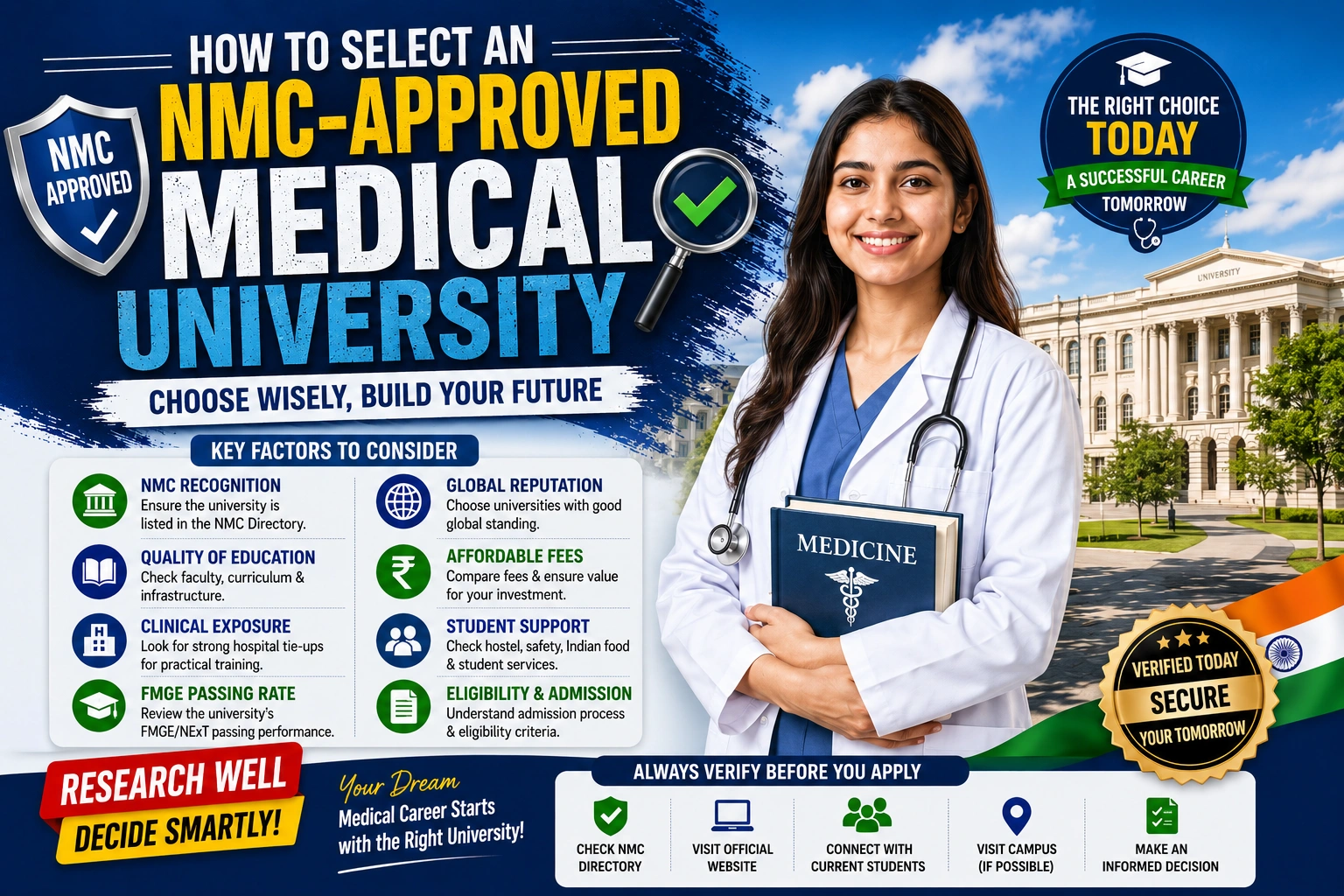
Studying medicine abroad has emerged as one of the most lucrative options for Indian students since the availability of medical seats in India is extremely competitive, and a medical degree obtained from a foreign university is recognized globally. Since quality medical universities abroad are limited, the first step in pursuing an MBBS degree abroad is to choose an education provider that offers quality medical education and adheres to the Indian medical practice standards.
There are several factors students must evaluate before selecting any medical university abroad, including recognition, accreditation, course curriculum and structure, clinical exposure, faculty, and job opportunities after graduation. The easiest way to ensure that your degree meets the standards to take medical licensing exams in India is to select an NMC-approved medical university.
Students interested in foreign medical universities and the related admission and eligibility criteria may browse through MBBS Advisor for reliable information.
Importance of NMC-Approved Medical Universities
The National Medical Commission (NMC) approves and regulates medical education in India. Indian students who complete their MBBS from foreign medical universities and want to practice in India must meet the NMC requirements.
There are many advantages to selecting an NMC-approved medical university abroad, including the following:
- The university offers a medical program that meets the requirements of the globally recognized medical education framework.
- Students can pursue the medical licensing process after degree completion.
- The institutional infrastructure and educational resources and support for clinical training are sufficient.
- There is greater recognition of the degree from other healthcare institutions.
Before applying, students must ALWAYS check if the university is recognized. Choosing an unrecognized university can lead to problematic and unsuccessful medical careers.
Check NMC Guidelines Before Choosing a Foreign Medical University
Before choosing a university, students must understand the most recent criteria laid out by the National Medical Commission. These guidelines have a specific focus on length of the course, the practical training, the internship, the medium of instruction, and the eligibility criteria among others.
Students must rely on official notifications and guidelines provided by the National Medical Commission (NMC).
An ideal foreign medical university (FMU) would have a medical course that gives the students the required education and boundaries to compete with their peers, and that pertains to the required standards.
Recognition and Global University Accreditation
Recognition is one of the most essential criteria while choosing an MBBS university abroad. A reputed medical university should be recognized by the medical authority of its own country and should have a listing in the global medical education databases.
Students must verify if the university is listed in the World Directory of Medical Schools (WDOMS).
A university that is recognized properly generally has:
- An approved Medical Curriculum
- Competent Faculty and Staff
- Well-equipped State-of-the-Art Labs
- Improved Clinical Training Infrastructures
- International recognition of the medical degree
Students must not choose a university merely based on the low fees. Recognition and education quality will contribute significantly to the success of their careers in the long run.
Assess the Quality of Medical Education and Curriculum
Every country has different medical education systems, students must scrutinize the curriculum offered by the university.
A good medical university must combine theory with sufficient practical clinical training. The following must be present:
- An up-to-date medical syllabus
- A good faculty comprising professors and practicing physicians
- A good laboratory
- Opportunities for research
- Patient contact during the clinical years
A good medical school lays a strong academic foundation for students in preparation for medical practice and licensure.
Consider Clinical Exposure and Facilities
Clinical training is a big component of medical education. Thus, students must choose universities that have well-equipped clinical training hospitals.
A good medical university must have:
- A teaching hospital
- Facilities for all the medical departments
- Contact with patients
- Opportunities for practical work
Students who undergo clinical work gain confidence and improve their ability to deal with medical situations.
Check the Medium of Instruction
Language can be a big barrier to foreign medical students. Many of the top graded universities abroad have their MBBS programs in English, thus making it easier to learn for Indian students.
Before applying, students must check:
- If the whole medical program is in English
- If there is a local language course in study
- The language of patient contact during clinical work
An English medium university has a great impact on the quality of education.
Compare MBBS Expenses Abroad
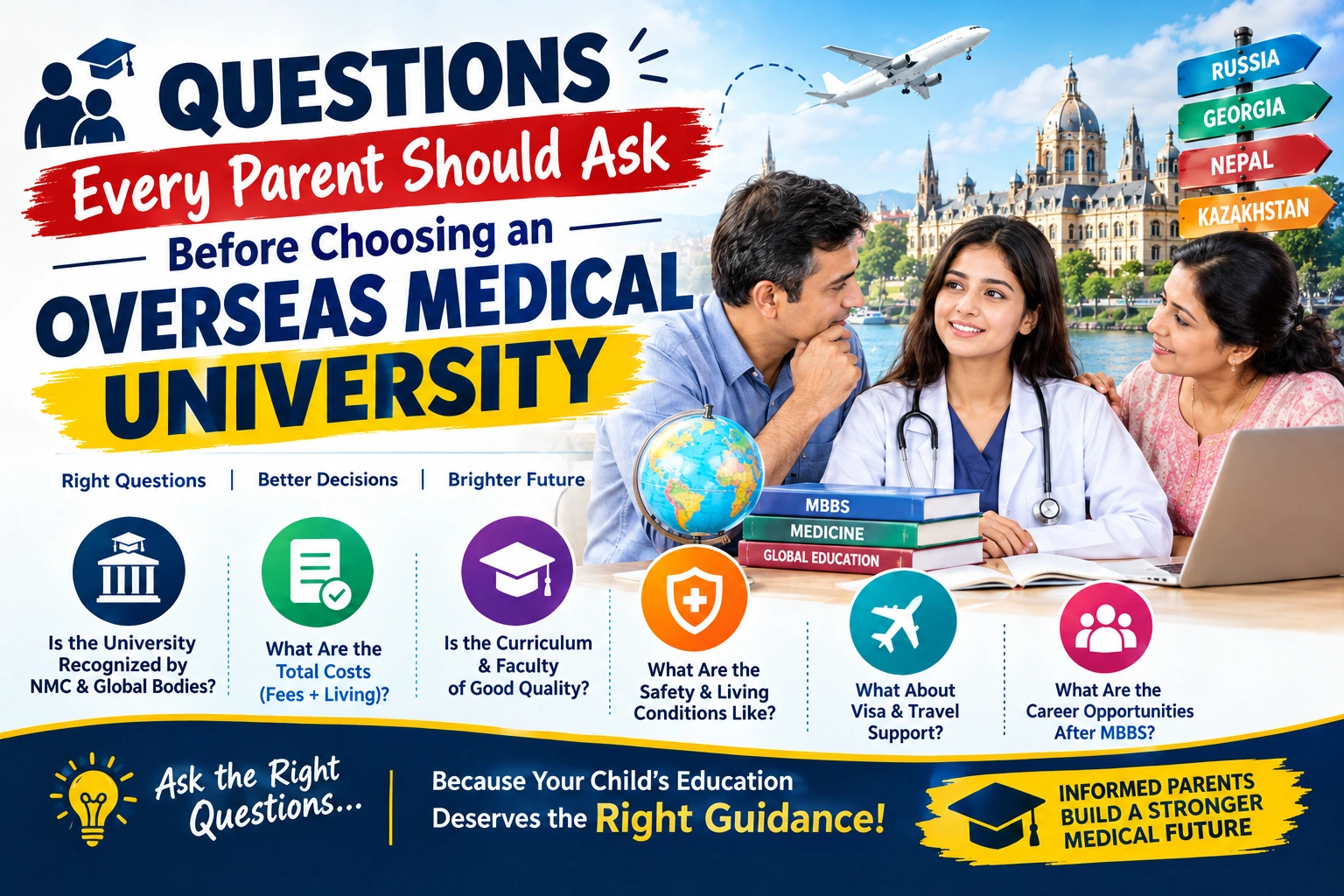
The cost of studying medicine abroad greatly differs among countries, universities, and at times among students. The total cost of studying medicine abroad must be inclusive of:
- Tuition fees
- Hostel charges
- Cost of living abroad
- Medical and visa insurance
- Personal expenses
Generally, the cheapest option is not the best. Students must compare medical universities based on the quality of education.
Long-term analysis shows value in education that is both affordable and properly recognized.
Review Admission Eligibility Standards
Medical universities have different admission requirements for international students. Generally, Indian students must meet eligibility criteria to proceed with the application.
These usually consist of:
- Education level requirements
- Minimum scores in Physics, Chemistry, and Biology
- NEET requirements
- Passport requirements
- University-specific requirements
NEET Information and Guidance also provides information and support regarding NEET and medical admissions.
Role of NEET Qualification for Studying MBBS Abroad
For Indian students aspiring to study MBBS abroad, passing NEET is crucial. NEET provides students the opportunity to study medicine outside India in compliance with the Indian medical education framework.
To assist students in estimating their rank for NEET and to plan their medical career, NEET Rank Predictor and similar tools may be used.
Knowing NEET requirements is important in selecting the medical universities in which admission will be possible.
Investigate Student Feedback and the University
To assist in the university selection process, feedback from students and an analysis of the university’s reputation is critical. Firsthand feedback is helpful in assessing the quality of the education, housing, the staff, and the support offered on campus.
When assessing universities consider:
- University ranking
- Active students’ feedback
- Alumni success
- Safety
- Support for international students
Universities that have a good reputation offer a good educational environment and good educational services.
Understand the Admission Process in Detail
Studying MBBS abroad requires a lot of advanced planning and documentation of the application process.
It is smart to begin the preparation well in advance to avoid last-minute hiccups.
This is usually what the process is like:
- Select an NMC-listed university
- Check to see if you meet the requirements
- Prepare your academic documents
- Submit your application
- Receive your offer of admission
- Complete your visa process
- Leave to study medicine
The process can also be completed accurately with help from trusted sources.
Check Safety, Accommodation, and Student Support
Advance planning is necessary when you will be living in a new country. You should check the accommodation options, the safety of the campus, food options, and the support services available for international students.
A university that is hospitable to students will have:
- Safe hostel facilities
- Access to Indian food
- International student assistance
- Medical support services
- Comfortable learning environment
A safe environment will assist students in concentrating on their medical studies.
Conclusion
The selection of an NMC-approved medical university abroad is a very important decision for all new doctors. It is not wise to select a university only because of low fees or good advertisements. Recognition, quality of education, clinical exposure, faculty, and infrastructure should be the primary decision influencers and opportunities for future career.
An appropriately chosen university can ensure the dreams of students in becoming successful medical practitioners are realized. The choice of a medical university abroad can be made with certainty after checking NMC guidelines, WDOMS recognition, NEET requirements, and comparing the options available.
Students can also refer to the World Health Organization (WHO) for information on global healthcare standards and medical education. MBBS Advisor is a platform to get complete information on university selection and medical education opportunities and helps students make an informed decision for their medical career.