 Russia
 Belarus
 Georgia
 Kazakhstan
 Kyrgyzstan
 Uzbekistan
 China
China Nepal
Nepal Bangladesh
 Poland
 Romania
 Slovakia
 Hungary
 N. Macedonia
 Vietnam
 Canada
 Armenia
 UK
UK Australia
 USA
USA Ireland
 Germany
 New Zealand
 Italy
Italy France
 Singapore
 Netherlands
 Sweden
 Switzerland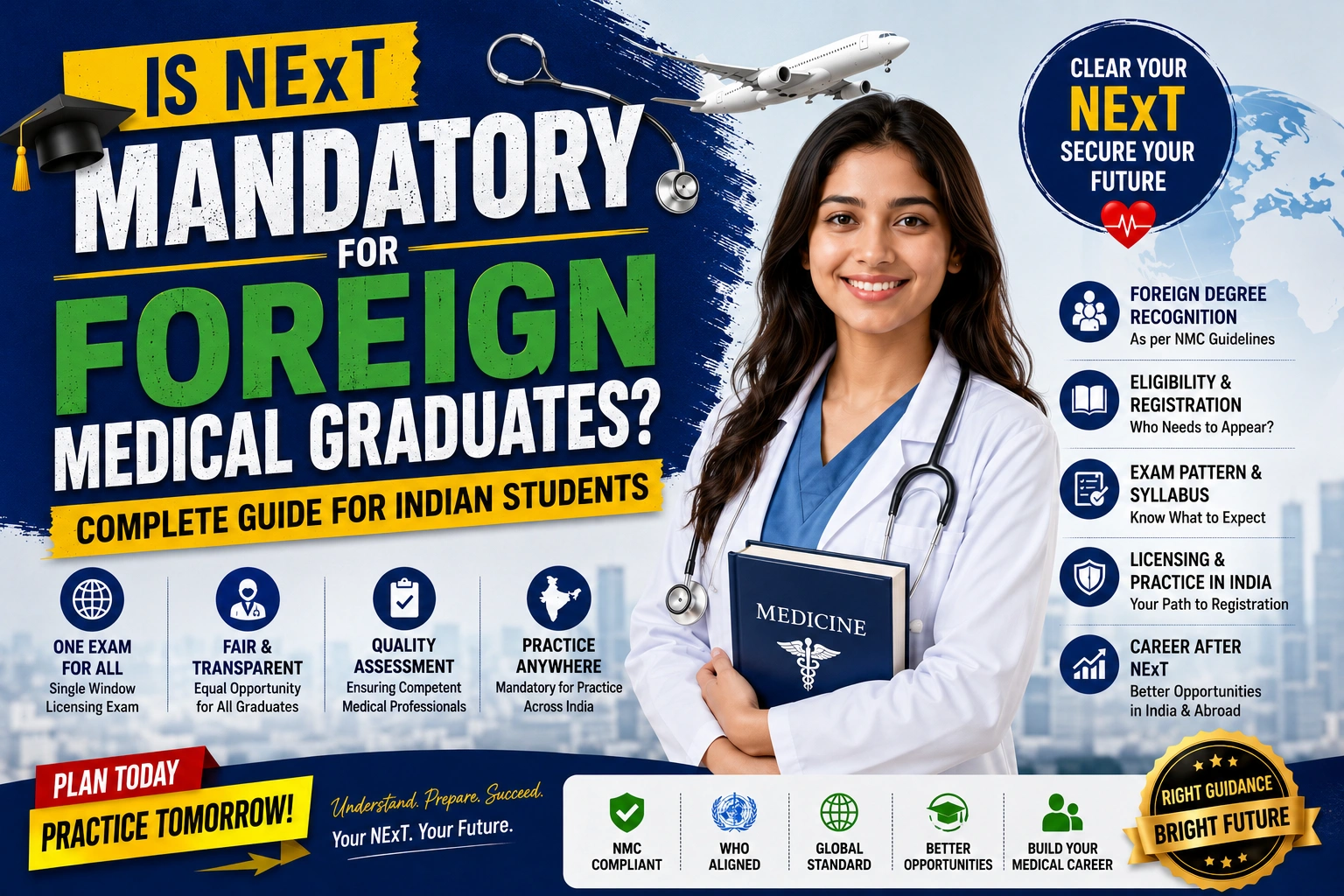
Introduction
For Indian students enrolled in medical programs overseas, licensure processes are as important as enrollment. Students can spend years in medical school abroad but must adhere to Indian statutes to return to India and practice medicine.
A question that has caused a lot of confusion for Foreign Medical Graduates (FMGs) is: Is NExT compulsory for foreign medical graduates?
This has become a pressing question for students who are currently planning to study medicine abroad. Students hear various things about whether the Foreign Medical Graduate Examination (FMGE) will persist, if NExT will be instituted in its place, and if the students who are currently enrolling in foreign medical schools will have to take NExT.
There is no simple “yes” or “no” to this question. It depends on existing regulations, the enforcement of NExT, and the specific regulations that apply to a certain cohort. Thus, students must differentiate the current system of medical licensing and the proposed national exit examination system before making any decisions regarding MBBS Abroad.
What Is NExT and Why Is It Important for FMGs?
The National Exit Test or NExT aims to establish a unified examination system for medical graduates. It will determine if a medical graduate has the knowledge and skills to a sufficient degree in order to be eligible to undertake further medical training and practice within the given regulatory framework.
For Indian medical graduates, NExT is part of a medical education and licensing system. For Foreign Medical Graduates, it is significant since this examination could become the pertinent licensing examination for graduates who obtain their primary medical qualification outside of India.
What is more pertinent is the difference between the examination system that has been proposed and the examination system that applies to the individual. A candidate of a foreign university should not automatically assume that the licensing process that is applicable to the batch of Foreign Medical Graduates will be the process that they are required to follow.
Regulatory bodies will set specific provisions with regards to licensing, eligibility, and transitional provisions and examination. The latest official announcements by the NMC will be of great value to the individual who wishes to pursue a medical career in India.
Is NExT Now Compulsory for All Foreign Medical Graduates?
The Practical Answer
There is no blanket answer that can be applied to all Foreign Medical Graduates irrespective of the year they were admitted or the year they graduated.
The licensing examination that applies to an FMG is the one that is supported by the regulatory and official provisions that are contemporaneous to that FMG. In the past, eligible foreign medical graduates have followed the FMGE-based screening pathway. NExT is designed to be a more comprehensive national exit and licensing examination system.
Thus, the most precise interpretation of the actuality is as follows:
NExT will likely become a highly relevant licensing exam for foreign medical graduates, once it is formally introduced for this purpose. However, students need to respect the rules and transition provisions of their specific cohort rather than making assumptions.
This differentiation is highly valuable, as a student who starts a six-year medical program today may complete it under a different set of rules to that of a student who completed the program several years prior.
FMGE and NExT: Why the Ambiguity?
The ambiguity exists as both FMGE and NExT deal with licensing of medical graduates; however, are two separate examinations.
FMGE has served as a screening exam for eligible Indian citizens or Overseas Citizens of India who have undertaken their primary medical qualification outside of India.
NExT is designed to be a national exam system for medical education and professional licensing, with a broader scope.
Thus, students are expected to not view NExT as essentially another FMGE. There may be various provisions and regulations that determine the way in which NExT impacts foreign medical graduates, including examination structure, eligibility and the implementation and transition provisions.
FMGE vs NExT Exam Comparison
|
Aspect |
FMGE |
NExT |
|
Basic Purpose |
Screening exam for foreign medical graduates |
National exit and licensing examination framework |
|
Main Relevance |
Foreign medical graduates |
Medical graduates under the NExT framework |
|
Applicability |
Current regulations |
Pending official implementation and regulations |
|
Student Concern |
Qualification for next stage of registration |
Qualification under the new licensing framework |
What Does This Mean for Students Planning MBBS Abroad?
NExT should not be the only influencing factor for students planning to study medicine abroad. In fact, it should make the selection of university all the more important.
A poor university with inadequate resources, hospital placements, or clinical training may expose students to difficulties with all formats of licensing exams. Be it the FMGE, NExT or any other pathway, the candidate must possess adequate medical knowledge and clinical skills.
While NExT and the FMGE may create challenges for students pursuing medical education abroad, students must prioritize the regulatory and academic standards of the university they select rather than the cost or speed of admission.
Before admission, students must thoroughly evaluate:
- The structure and duration of the course
- The quality of affiliated hospitals
- The amount of clinical training
- The structure of the internship
- The eligibility of Indian students under Indian regulations
- The documentation provided by the university
- The regulations of the student's year of admission
Students will find that resources like MBBS Advisor will help them evaluate the various pathways of medical education and will clarify major considerations for applications.
Is NEET Still Relevant for Foreign Medical Admissions?
Yes. Students looking to go abroad for undergraduate medical studies have to meet the applicable criteria, which include the NEET mandate.
Students going abroad should not take NEET lightly. Students are still advised to check the eligibility criteria published by the relevant authorities and the official conducting body.
The NEET-UG official website has information and updates regarding the examination. The admission and associated compliance requirements are subject to change and therefore students are advised to check for the most recent updates before making any admission decisions.
What Are the FMGL Requirements?
The Foreign Medical Graduate Licentiate Regulations, 2021, has established a formal system of regulations for foreign medical graduates. The regulations cover a number of areas concerning medical education, clinical training, internship and registration.
The requirements that will be applicable to a student will depend on the relevant regulations and their interpretations. The broader message that these requirements illustrate to students is that having a foreign medical degree does not guarantee that a student will be able to practice medicine in India.
Students need to ensure that the medical course and training that they complete will meet the requirements set by the applicable regulatory framework in India.
The Course Should Provide Adequate Clinical Training
There are major limitations to what a student can learn through lectures and book work. A student will need to have exposure to real-world medical practice and will need to interact with patients.
Students should be wary of medical programs that have poorly defined structures for clinical training and inadequate explanations about the pathways for students to receive practical training.
Internships Have Rules
Internships have become a common requirement in almost all forms of training around the world, so it is critical for students to learn about the internship rules including the setting, the duration, and any applicable laws.
It is better for students to have this knowledge before they graduate rather than discover after they graduate that their chosen internship does not meet the applicable rules.
Checking for Recognition and Eligibility
Due diligence prior to enrollment is critical for students. It is important to investigate the university, the courses, and any applicable additional information. The WDOMS is a resource for students when researching medical schools, but being listed in that directory is not a guarantee that graduates will be eligible for medical practice in India.
In the same way, students should not think that recognizing a medical school means that the Indian medical regulatory authorities will also recognize it.
Will Students Who Enroll in a Foreign Medical School Need to Take the NExT?
This question is most commonly asked by students and their parents.
The answer will be different based on the rules that will be in place when a student has completed their medical training and become eligible to take the licensing exam. Regulations are subject to constant change and therefore, students must be prepared to take the exam with an emphasis on clinical skills and problem solving.
Rather than just wondering if NExT will apply to my batch, students should consider whether:
- Will my choice of medical program equip me to meet the licensing requirements in India when I graduate?
This represents a more reasonable answer.
How Can Foreign Medical Graduates Get Ready for a NExT-Oriented Future?
Balance Learning and Understanding
Filling the gaps in your knowledge and understanding of the core components of the clinical and allied basics is necessary for answering context-based questions.
Integrate Clinical and Basic Medical Sciences
Medical and clinical sciences and their understanding should not be viewed as unrelated entities. Proper management and care of patients is a direct application of the basic medical sciences.
Get Genuine Clinical Exposure
Clinical training should be viewed as an integral and necessary component of medical education. Continuous contact with patients and guided clinical instruction forms the basis of a medical graduate's professional preparation.
Be Cautious of the Indian Medical System
Students should frequently look at the official updates and changes to the National Medical Commission and other relevant authorities. The standards for licensure and registration are bound to change and relying on obsolete information is sure to lead to confusion.
Keep Everything
Students should keep their proof of admissions, transcripts, mark sheets, documents pertaining to the university, certificates for internships, and any other relevant documents. Proper documentation will be important for possible future verifications and registrations.
NExT and FMGs: What Each of These Viewpoints Exemplifies
One of the viewpoints expressed is that all foreign medical graduates are already required to take NExT regardless of what the regulations state. Another of the viewpoints is that FMGE has ceased for all existing and future batches.
Making broad assumptions should be avoided. A pathway for licensing should be determined from formal provisions and notifications from the appropriate authorities. Another of the most common mistakes is to assume that inclusion of a university in any of the international medical directories means the medical school is eligible to practice in India. Inclusion in international directories and eligibility to practice in India are unrelated.
One also needs to be careful about promises of admission consultants. Claims such as “No exam will be needed after graduation” or “This university will be the guarantee of registration in India” should be treated cautiously.
Conclusion
The question of whether NExT will be obligatory for Foreign Medical Graduates will be answered after viewing the applicable legislation and the framework for its enforcement.
NExT will play a pivotal role in the Indian medical licensing and exit exam system. For Foreign Medical Graduates, NExT may be mandatory when the provisions come into effect. The specific requirements will depend on the student’s admission cohort, the date of admission and the date the system comes into effect.
For Indian citizens who want to pursue a career in medicine, the best option is to choose a university that is compliant with the professional requirements and offers the students genuine clinical training, maintain strong academic preparation, and follow official announcements.
Students should take the applicable NEET and also thoroughly research the university where they intend to study. The WHO is a global health authority and will provide information and resources on global health. The NMC is the central authority on medical education in India and will provide the rules concerning medical practice and registration in India.
Ultimately, future medical licensing systems will still need qualified doctors with knowledge and clinical skills. Medical students with a solid foundation during their medical education will be able to take the medical licensing exam regardless of the licensing system in place when they complete their training.