 Russia
 Belarus
 Georgia
 Kazakhstan
 Kyrgyzstan
 Uzbekistan
 China
China Nepal
Nepal Bangladesh
 Poland
 Romania
 Slovakia
 Hungary
 N. Macedonia
 Vietnam
 Canada
 Armenia
 UK
UK Australia
 USA
USA Ireland
 Germany
 New Zealand
 Italy
Italy France
 Singapore
 Netherlands
 Sweden
 Switzerland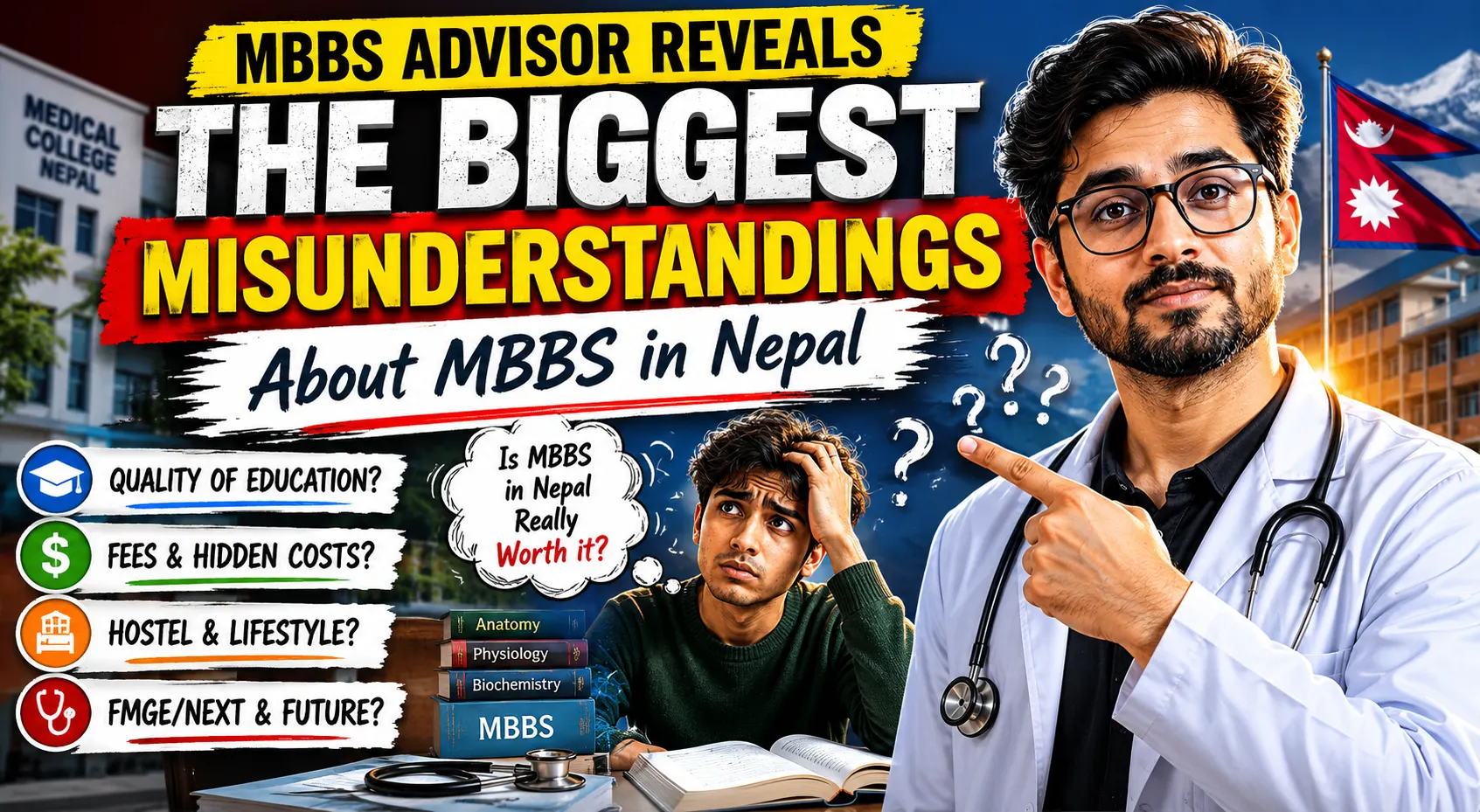
In recent years, Nepal’s MBBS program has become a mainstream choice for Indian medical school applicants. Its core attractiveness comes from geographical proximity, cultural similarities, and low tuition fees. Additionally, most cooperating institutions are recognized by India’s National Medical Commission (NMC). Every year, thousands of Indian students travel to Nepal to pursue medical degrees.
Despite the program’s continuous growth in popularity, a large number of misconceptions related to application eligibility, degree certification, tuition fees, language, and career development still circulate widely among Indian students and their parents. MBBS Advisor points out that most of these misunderstandings stem from incomplete information, online rumors, or outdated assumptions, which can trigger unnecessary decision-making chaos.
For this reason, this paper clarifies three core misconceptions one by one, to provide applicants with accurate factual references before enrollment.
Misconception 1: Nepal MBBS Degrees Are Not Recognized in India
This paper explicitly states that this claim is completely false. All Nepalese medical schools that comply with NMC regulations and are included in the World Directory of Medical Schools (WDOMS) are officially recognized by India. Their graduates can take the FMGE/NExT medical licensing exam in accordance with current regulations.
This paper also reminds applicants that they must verify the qualification compliance of their target school before making a selection.
Misconception 2: MBBS Education Quality in Nepal Is Poor
This paper refutes this view. All top-ranked medical schools in Nepal have affiliated teaching hospitals, and their curriculum, teaching modes, and examination systems are highly aligned with those of Indian medical schools.
Most institutions are equipped with:
- Advanced laboratories
- Experienced faculty
- Sufficient clinical practice opportunities
- English-medium instruction
- Modern infrastructure
They also meet the global medical education standards of the World Health Organization (WHO). Schools listed in the WDOMS are eligible for international qualification verification, with sufficient compliance.
Misconception 3: MBBS Tuition Fees in Nepal Are Extremely High
This paper clarifies that the total cost of studying at a Nepalese medical school, including accommodation, meals, and transportation, is far lower than that of private medical schools in India.
Although tuition structures vary across different institutions, the program remains a highly cost-effective choice for most middle-class Indian families.
MBBS Advisor hereby specifically reminds all Indian students and their parents who plan to pursue an MBBS overseas that when selecting schools and programs, they must prioritize the total cost of the full education cycle, rather than only using tuition levels as their core reference.
Language & Cultural Adaptation in Nepal
Next, we will clarify six common misconceptions about studying for an MBBS in Nepal one by one, to help everyone avoid information traps.
One misconception holds that Nepal’s language environment will become a major barrier to Indian students’ academic pursuits. In fact:
- The vast majority of local medical colleges use English as their official language of instruction
- Hindi has an extremely high local penetration rate
- The cultures and languages of Nepal and India share common roots
Indian students can usually adapt quickly to their study and daily life in Nepal.
Clinical Practice Opportunities in Nepal
Another circulating rumor claims that students pursuing an MBBS in Nepal do not have sufficient access to clinical practice opportunities, which is completely untrue.
Nepal’s top teaching hospitals maintain a high daily patient volume, and students can access four core categories of resources:
- Practice in interacting with physicians and patients
- In-hospital specialized training
- Full-department clinical rotations
- Hands-on skills training
Local medical education itself centers on cultivating students’ practical abilities.
International Recognition of Nepal MBBS Degrees
Many people mistakenly believe that an MBBS degree from Nepal lacks international recognition, which is a typical cognitive bias. Many Reddit users often confuse the concepts of institutional directories and official accreditation.
Currently, a number of Nepalese medical universities have been included in the WDOMS directory.
We remind all students that before enrolling, they must verify four core pieces of information:
- Whether the target institution is listed in the WDOMS directory
- Whether it holds relevant qualifications from India’s NMC
- Local internship rules
- Eligibility to sit for medical licensing examinations
MBBS Admission Process in Nepal
There is also a misconception that the application process for Nepalese MBBS programs is overly complicated, which is absolutely not the case for Indian students.
Applicants only need to prepare four categories of materials:
- NEET qualification
- Academic documents
- Passport-sized photos
- Basic identity documents
In addition, thanks to the friendly bilateral relationship between Nepal and India, the application process is far smoother than that of most other overseas study destinations, and MBBS Advisor can also provide end-to-end supporting guidance for the entire process.
Myth: Only Weak Students Choose MBBS in Nepal
Finally, we need to break the long-standing prejudice that “only students with poor academic performance choose to pursue an MBBS in Nepal.”
Many high-achieving Indian students select Nepal because of:
- Extremely fierce competition for India’s domestic medical school admission
- Limited number of public medical school seats
- Exorbitant tuition fees of private Indian medical colleges
Nepal offers high-quality education close to home, which is a pragmatic academic and economic decision, not a fallback option.
At present, the five core priorities that guide Indian students’ school selection are:
- Institutional recognition
- Clinical resources
- Safety
- Cost-effectiveness
- Future career prospects
Career Opportunities After MBBS in Nepal
This section first debunks two common myths about pursuing an MBBS in Nepal.
The first myth is the claim that “MBBS graduates from Nepal have no career development space”.
Graduates of Nepalese institutions accredited by India’s NMC can access 5 career paths:
- Practicing medicine in India after passing India’s national medical licensing exam
- Pursuing a Master of Medicine degree
- Applying for an international medical practice license
- Working at a formal hospital
- Engaging in medical research
The core determinants of career success are an individual’s level of dedication, clinical skills, preparation for licensing exams, and practical experience, which are unrelated to the country where they studied.
NMC Compliance Requirements for Nepal MBBS
The second major misconception is that studying medicine in Nepal fails to meet compliance requirements.
The NMC has repeatedly reminded Indian students planning to study medicine abroad that they must verify four dimensions before enrollment:
- Program duration
- Internship framework
- Clinical training
- Medium of instruction
As long as these meet the NMC’s regulations for foreign medical graduates, students maintain their eligibility as overseas Indian medical graduates, and online discussions among these graduates also confirm the importance of verifying NMC compliance.
Core Advantages of Studying MBBS in Nepal
Education experts from MBBS Advisor put forward 7 core advantages that drive Indian students’ preference to pursue an MBBS in Nepal:
- Similar food and culture
- No significant language barriers
- Low cost of living
- NMC-recognized institutions
- Sufficient clinical resources
- Short travel distance from India
- Highly adaptable living environment
Therefore, Nepal is one of the safest and most convenient overseas destinations for Indian students to study medicine.
Mandatory Verification Checklist Before Enrollment
Before enrollment, students must complete 5 verification tasks:
- Verify the institution’s enrollment eligibility with the NMC
- Confirm that the institution is listed in the WDOMS
- Research the infrastructure and patient volume of the institution’s affiliated teaching hospitals
- Clarify internship rules and eligibility for medical license applications
- Confirm full fee transparency to avoid hidden charges and unofficial commitments
Final Conclusion
Most misconceptions about pursuing an MBBS in Nepal stem from misinformation. Nepal has core strengths including:
- High-quality medical education
- Strong cultural adaptability
- Sufficient clinical resources
- Low education costs
- Recognition by India’s official medical authorities
It is recommended that students choose a trusted consulting platform such as MBBS Advisor to obtain accurate guidance on enrollment, qualifications, and career planning.
Students must always prioritize official information, focus on their long-term career goals, and exercise caution when selecting a school.