
 Russia
 Belarus
 Georgia
 Kazakhstan
 Kyrgyzstan
 Uzbekistan
 China
China Nepal
Nepal Bangladesh
 Poland
 Romania
 Slovakia
 Hungary
 N. Macedonia
 Vietnam
 Canada
 Armenia
 UK
UK Australia
 USA
USA Ireland
 Germany
 New Zealand
 Italy
Italy France
 Singapore
 Netherlands
 Sweden
 Switzerland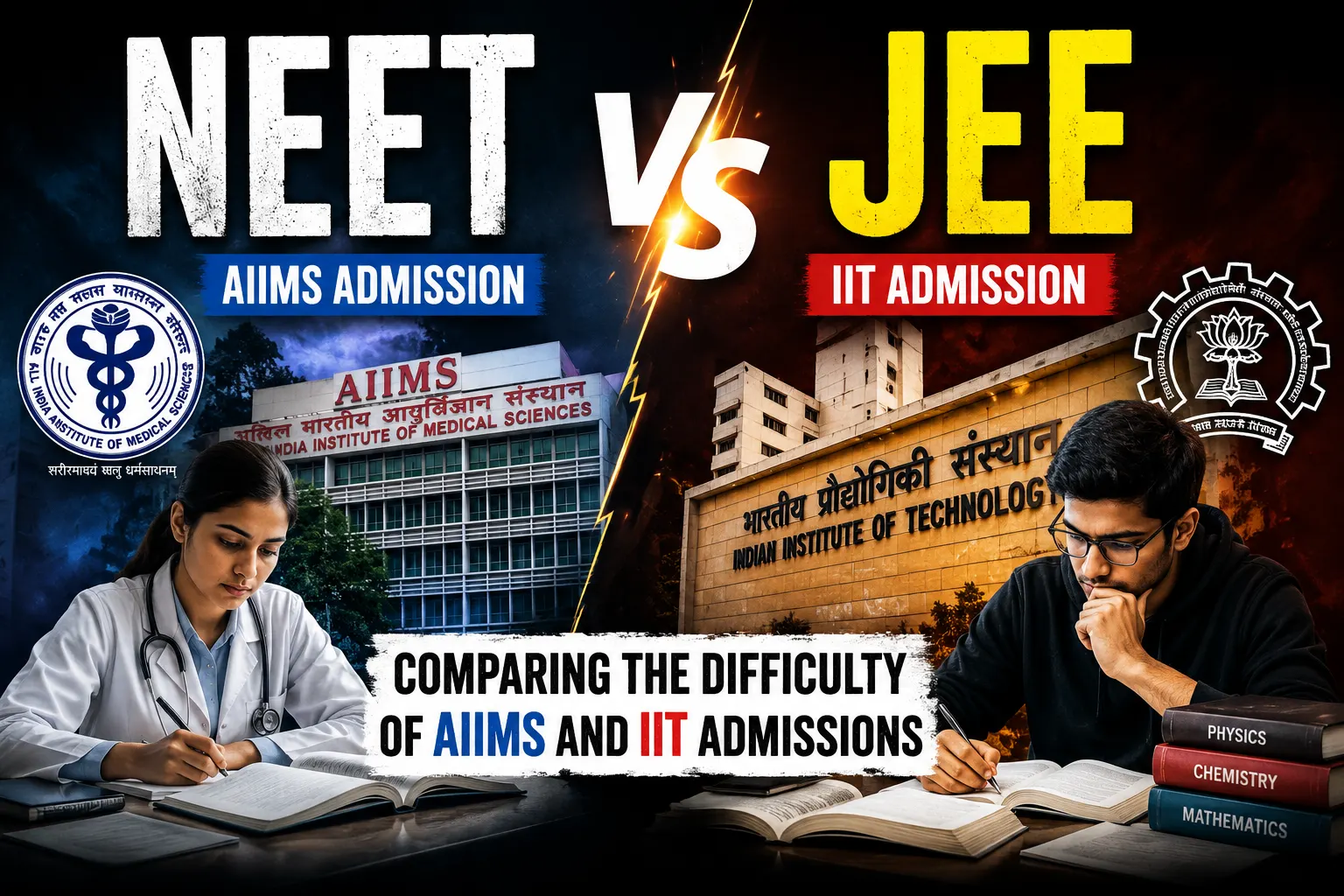
Each year, millions of aspiring medical students and engineering students alike take India’s two most popular entrance exams: the NEET UG and the JEE Advanced. These exams determine entrants into the country’s apex professional institutes: AIIMS for medical students and IITs for engineering students.
The age-old question of students, parents, and teachers alike is: which exam is more difficult – NEET or JEE Advanced? Likewise, many ask: is it more difficult to secure admission in AIIMS or in the IITs?
The difficulty of either exam cannot be easily measured. Both exams attract different student populations; therefore, the processes and the skills required for the two exams are entirely different. Knowing the distinctions between the two exams may help students identify their skills, interests, and career aspirations.
There are many online platforms like the MBBS Advisor which may help students seeking admission into medical programs with online expert consultants and step-by-step assistance during the medical admission process.
What are NEET and JEE Advanced?
Before the difficulty of NEET and JEE Advanced can be compared, their purposes must be understood.
What is the NEET UG?
NEET UG is the only entrance exam for undergraduate medical admissions in India.
The NEET exam provides entry into:
- AIIMS institutes
- Government medical colleges
- Private medical colleges
- Deemed universities
- JIPMER campuses
- ESIC medical colleges
NEET is conducted by the National Testing Agency (NTA).
India’s aspiring MBBS, BDS, and other allied health students must clear the NEET exam.
What is JEE Advanced?
The JEE Advanced exam is required to gain entry into Indian Institutes of Technology (IITs).
You must first qualify for JEE Main to be eligible to take JEE Advanced.
You can gain entry into the following IITs if you qualify for JEE Advanced:
- IIT Bombay
- IIT Delhi
- IIT Madras
- IIT Kanpur
- IIT Kharagpur
- IIT Roorkee
- Additional IITs
Joint Seat Allocation Authority (JoSAA) manages the admission process.
NEET vs JEE Advanced: The Numbers
The competition statistics are an easy metric to compare the exam challenges.
NEET Competition
NEET registration averages over 22 lakh every year.
The number of MBBS seats are limited within:
- Government colleges
- Private colleges
- Deemed universities
- AIIMS
Among these, AIIMS has the most prestigious seats, offering approximately 2,300 MBBS seats.
AIIMS admission is regarded as one of the most difficult among the seats offered through NEET.
Students refer to the MBBS Advisor to review cutoffs for AIIMS and their admission chances.
JEE Advanced Competition
JEE Advanced uses a two-step process.
First:
- 12 lakh to 15 lakh students take JEE Main.
Then:
- The top 2.5 lakh students qualify to take JEE Advanced.
Finally:
- There are 17,000 to 18,000 available IIT seats.
Even with a shrinking candidate pool, JEE Advanced is considered to be one of the most difficult exams.
Exam Pattern Comparison
NEET UG
NEET Contains:
- Physics
- Chemistry
- Biology (Botany and Zoology)
Characteristics:
- 180 Questions
- Predominantly Objective
- High weightage to NCERT
Biology contributes the largest share of marks.
JEE Advanced Pattern
The JEE Advanced exam tests knowledge in:
- Physics
- Chemistry
- Mathematics
Some characteristics of the JEE Advanced exam are:
- Multiple papers
- Questions asked in various forms
- Numerical questions
- Matrix matching
- Partial marking
- Greater unpredictability
The JEE Advanced exam is often described as a test of adaptability. In addition, the exam tests the conceptual knowledge of the student.
Which Exam Has the Tougher Questions?
Conceptual Difficulty
In terms of question complexity,
- JEE Advanced has tougher questions.
Students must:
- Creatively apply concepts
- Solve problems that are unfamiliar
- Integrate multiple concepts at the same time
- Cope with a question format that is often unpredictable
The questions often demand extreme levels of analytical thought.
- NEET, on the other hand, is less complex in comparison to the JEE Advanced exam, but is still very challenging.
Students must:
- Be accurate
- Avoid negative marking
- Cope with time constraints
- Memorize a large volume of Biology
Due to the high level of competition, small mistakes can greatly impact a student's rank.
AIIMS vs IIT: Which Admission Is Harder?
AIIMS Admission Difficulty
There are only around 2,200 MBBS seats across all the AIIMS institutions.
The best institutes, like AIIMS Delhi, require great NEET scores.
- The competition is fierce.
- There are very limited seats.
- Students often have very similar scores, and as a result, small differences in a student's score can greatly impact their rank.
For AIIMS counseling strategy and cutoffs, students often turn to MBBS Advisor.
IIT Admission Difficulty
Compared to AIIMS, IITs open more seats, but JEE Advanced is more difficult.
Only the best JEE Main performers gain eligibility to take the JEE Advanced.
In addition, JEE Advanced is much less predictable.
To pass the exam, students must have a great conceptual grasp of the subject.
Accuracy vs Problem Solving
One of the major differences between AIIMS admissions and IIT admissions is the skills being tested.
NEET Rewards Accuracy
NEET candidates develop skills:
- With great memory retention
- Precise execution
- Consistency
- Speed
Due to the weightage of Biology, the candidates are required to revise a lot.
JEE Advanced Rewards Creativity
JEE Advanced appreciates:
- Analytical skills
- Mathematical skills
- Creative thinking
- Adding and interlinking concepts
Relying on memorization is insufficient.
Syllabus Comparison
NEET Syllabus
Based mainly on:
- NCERT Class 11
- NCERT Class 12
Subjects:
- Biology
- Chemistry
- Physics
Biology is the main subject.
JEE Advanced Syllabus
Includes:
- Physics
- Mathematics
- Chemistry
Overall, much more depth and application are required due to derivation from Class 11 and 12.
Time Management Challenges
NEET
Problems faced include:
- Long Biology questions
- The ability to stay focused
- Minimizing careless errors
Precision is a must as many candidates score high.
JEE Advanced
Candidates face:
- Lengthy and difficult calculations
- Multiple problem-solving strategies
- Unpredictable questions
Time management is the main concern.
Psychological Pressure
Both begin to create psychological pressures.
NEET
Due to:
- The large number of applicants
- Limited government seats
- Family and personal pressures
For the AIIMS seats, the competition is the most fierce.
Most students seeking medical help first consult the MBBS Advisor for alternatives and counselling.
JEE Advanced
Includes:
- The two-stage exam
- The concept-based study
- The IIT brand
- Unpredictable papers
There are more mental challenges.
Coaching Culture: NEET vs JEE
Both have strong coaching systems.
NEET Coaching
Mainly focuses on:
- NCERT knowledge
- Biology study
- Mock tests
- Working on precision
JEE Coaching
Includes:
- Higher concepts
- Multiple ways of solving problems
- Mock tests
The preparation styles are very different.
AIIMS vs IIT: Career Thoughts
Should not be based mainly on the level of difficulty.
Students should consider their career aspirations.
AIIMS Graduates
AIIMS Graduates may pursue:
- Clinical Medicine
- Surgery
- Research
- Public Health
- Healthcare Administration
Lifelong learning matters.
Medical education standards and ethics in India are overseen by the NMC, while globally recognized medical institutions can be verified through the WDOMS.
Students who plan for a career in medicine and would like to gain counseling insights can sign up for MBBS Advisor.
IIT Graduates
IIT Graduates may pursue:
- Engineering
- Technology
- Entrepreneurship
- Consulting
- Finance
- Research
IIT Graduates have a much wider career flexibility.
Success Rates: A Comparative View
NEET to AIIMS
- NEET Students: 22 lakh+
- AIIMS Seats: ~2,200
Success Rate: Extremely low.
JEE Advanced to IIT
- JEE Main Candidates: 12–15 lakh
- JEE Advanced Candidates: ~2.5 lakh
- IIT Seats: ~18,000
Success Rates: Highly Competitive.
What do the Experts Say?
There is general agreement among educational experts that JEE Advanced is tougher on a conceptual level, whereas getting into AIIMS through NEET is tougher from a statistical point of view. This is the main reason why these comparisons may be subjective.
Memorization and Biology may lead some students to favor NEET, whereas analytical problem-solving may lead students to favor engineering.
Which Exam Should You Take?
Choose NEET if you:
- Want to become a Doctor
- Love Biology
- Prefer structured studying
- Are inclined toward studies that involve a lot of memorization
Choose JEE if you:
- Feel engineering is your calling
- Love conceptual challenges
- Enjoy mathematics
- Prefer studying with a focus on problem-solving
Making the right choice is more dependent on your inclination toward the profession rather than how difficult you perceive the exam to be.
Conclusion
The NEET or JEE Advanced debate is best categorized as having no correct answer. If one measures difficulty in terms of conceptual intricacies, then JEE Advanced is considered by most to be the tougher exam.
However, if difficulty is measured through how competitive the admissions are and how scarce the seats are, gaining admission to AIIMS via NEET is perceived to be even more difficult, as there are countless applicants vying for a miniscule number of seats.
Instead of asking who is tougher, students are supposed to ask themselves where their interests, strengths, and career goals lie.
Whether your dream is to win a white coat from AIIMS or an IIT campus, success is all about commitment, responsibility, and smart preparation.
For students hoping to enter the medical profession and are currently navigating through NEET preparation, the AIIMS cutoffs, and the counselling, MBBS Advisor is a useful guide and is informative about admission and planning strategies during this process.
International healthcare practices and public health initiatives are continuously shaped by the guidance of the WHO.