 Russia
 Belarus
 Georgia
 Kazakhstan
 Kyrgyzstan
 Uzbekistan
 China
China Nepal
Nepal Bangladesh
 Poland
 Romania
 Slovakia
 Hungary
 N. Macedonia
 Vietnam
 Canada
 Armenia
 UK
UK Australia
 USA
USA Ireland
 Germany
 New Zealand
 Italy
Italy France
 Singapore
 Netherlands
 Sweden
 Switzerland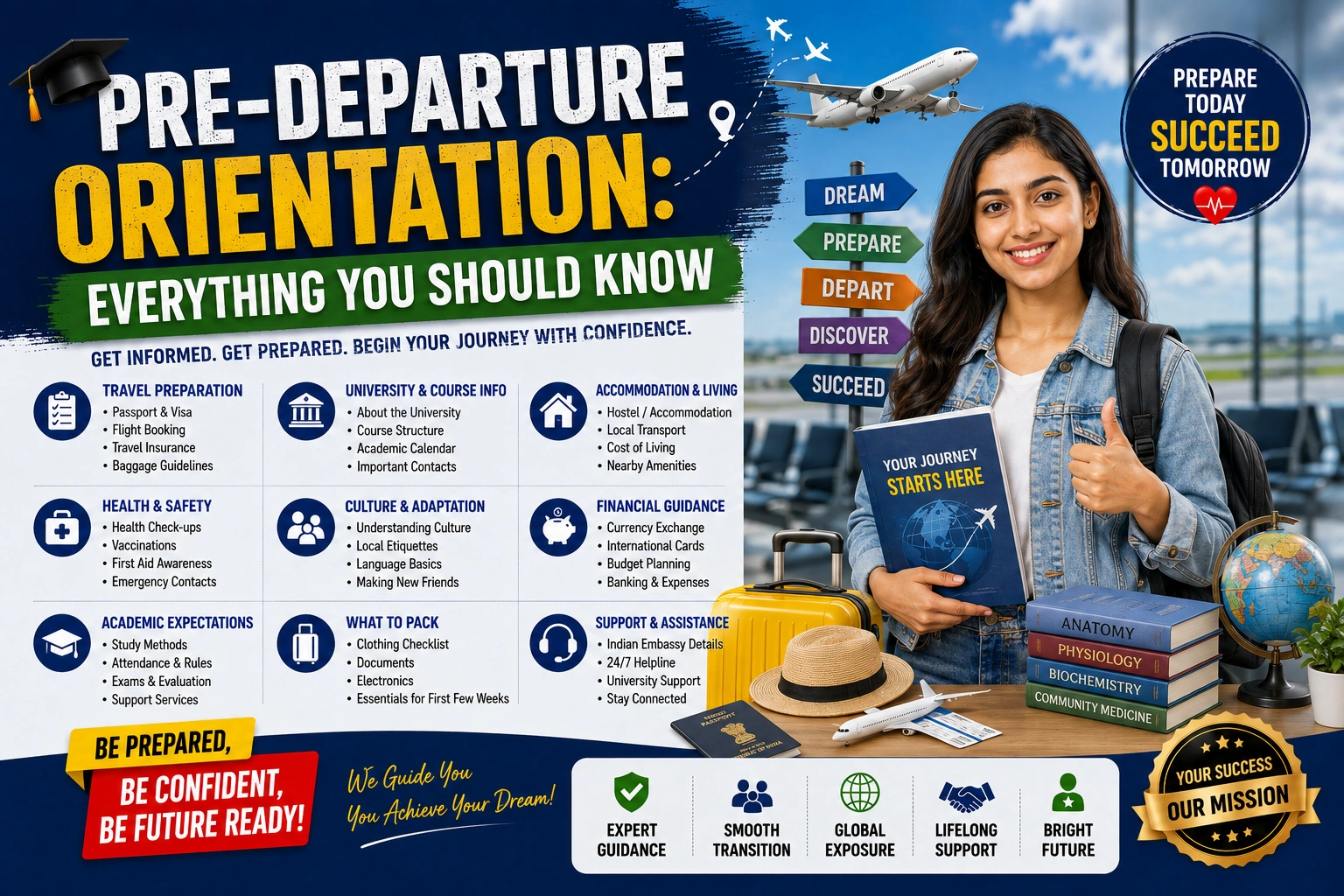
The prospect of studying MBBS abroad is an appealing opportunity for many of India's younger generations. Yet, the efforts of students do not conclude with the securing of admission. A student who does not have an adequate pre-departure orientation is unprepared for most of the challenges that lie ahead of them in a new country, new educational systems, and new lifestyles as they settle in.
Pre-departure orientations are used all over the world. Whether your destination is Russia, Georgia, Kazakhstan, Uzbekistan, Nepal, Kyrgyzstan, or any other country in the pursuit of your medical degree, pre-departure orientations help prepare students for the academic and personal challenges that lay ahead.
MBBS Advisor usually helps every student who arrives for educational services with an adequate pre-departure orientation that includes travel, packing, university reporting, logistics, currency, and domestic transportation. A good pre-departure orientation is a stress-free beginning of the students' MBBS journey.
What is a Pre-Departure Orientation?
A pre-departure orientation is a seminar open to students who are about to embark on the journey to attend a medical university abroad. The goal is to prepare students for the journey and their destination academically, mentally, legally, and in any other way they see fit.
Travel logistics and immigration are only a small part of what is covered in these orientations. Students are informed of university rules, hostel accommodations, local culture, food, climate, local health services, and emergency contact information along with the basics of financial planning.
Students are encouraged to ask any questions and voice any concerns to clear their minds of the apprehensions they hold of life abroad.
Why is Pre-Departure Orientation Important?
Many students think that when their visa is approved, there is nothing left to do. However, many things remain which affect their first days abroad.
From a good orientation students are able to:
- Learn about the university’s reporting procedures.
- Understand immigration and airport procedures.
- Learn how to pack documents in the correct order.
- Prepare for climate changes.
- Learn about the regulations and rules of the hostel and campus.
- Learn about the local transportation and the currency.
- Learn about the local culture and customs.
- Learn how to avoid the common international student errors.
Pre-Travel Preparation and Orientation helps students adapt to their new environment and culture.
Travel Preparations and Required Documents
Before departure from India, students have to keep the important documents safe in an appropriate order in individual file folders. Important documents are meaningless if they are lost or left behind in India. This can cause unnecessary problems when the student reaches a new country.
Important documents include:
- Original Passport
- Student Visa
- University Admission Letter
- Invitation Letter
- Payment Receipts
- Passport-size Photographs
- Academic Certificates
- Birth Certificate
- Medical Fitness Certificate
- Vaccination Certificates
- Travel Insurance
- Important Contacts
Students should keep digital copies of all documents in cloud storage and on their mobile device.
Before departure, students should also verify that all admission-related documents are complete to avoid missing important documents.
NEET Eligibility and Requirements
Before Departure, students should know that Indian students who are pursuing foreign medical education will be required to have NEET qualification. MBBS aspirants are advised to keep their NEET scorecard for the entire admission process.
NEET Rank Predictor predicts a student’s potential rank and the likelihood of gaining admission at certain universities, even when students have not yet finalized their likely scores.
Students must check NEET admission updates, including counseling and eligibility, whenever they need throughout the admission season.
Smart Packing Guide for MBBS Students
Students must smartly decide what items are essential and will not incur unnecessary costs, as these costs burden the student.
Students must consider the following:
Clothing
Students must carry clothing that accommodates the climate of the country where the destination of study is. Students traveling to Russia, Kazakhstan, or Kyrgyzstan must carry clothing to accommodate the winter, and students traveling to Nepal or Georgia must carry clothing that accommodates the climate of that country, season by season.
Medications
Students must carry all documented and alleged basic medicine from their doctors. Examples of basic medicines include fever, cold, and pain medicines, as well as stomach and allergy medicines, and vitamin supplements.
Kitchen Supplies
Students must consider that, initially, it may be helpful to have brought a pressure cooker, an electric kettle, utensils, and dry snacks and ready-to-eat foods.
Financial Preparations Before Traveling
This is a great concern of first-time medical students, as they must consider the payment schedule for tuition and hostel fees and plan for their monthly living, transportation, and SIM card expenses and health insurance costs. Students also must plan for an emergency fund.
Parents of students must ensure that students have their international debit or foreign exchange cards and a small amount of the foreign currency.
Budgeting for medical school is essential for managing expenses incurred for the duration of their medical studies.
Learn About Your Destination Country
Every country has its own set of cultural values, laws, and customs. It is important for students to learn about the country they will be studying MBBS in. Some of the things that should be taken into consideration are:
- Some basics of the local language
- Public transport
- Local food
- Religious customs
- Personal safety
- Climate of the country
- Local banks
- Emergency contacts
When students learn about the above things, they will be able to adjust to the new country and not offend the locals.
University Rules Every Student Should Know
Medical universities have their own set of rules that pertain to their specific universities about academics, attendance, exams and hostels.
Students should learn about:
- The attendance policy
- Classroom rules
- Lab rules
- Hostel rules
- Anti-ragging rules
- Exam rules
- Clinical training
If students do not follow the rules set by the university, they will suffer academically.
Airport & Immigration Guidelines
Many students are not familiar with the process of International travel.
Students are briefed about some travel tips during orientation.
Traveling Tips
- Know the baggage weight limits.
- Carry documents in hand luggage.
- Be at the airport 4 hours before departure.
- Have passport and boarding pass ready.
Immigration
Students should be ready to answer questions from the immigration officer about their trip, university and course, where they will stay, and how long they will be abroad. Having all your documents will make the immigration process faster.
Expectations About Hostels
Hostel life in other countries is very different from India. Students should prepare mentally to live an independent life.
Students may need to learn and prepare to:
- Cook
- Wash clothes
- Maintain a clean living space
- Share living space with international students
- Follow all rules of the hostel
This will prepare students to live independently and teach them how to better manage their time and be responsible.
Health and Medical Precautions
Before traveling, students are encouraged to complete a full health examination that includes the following:
- Dental exam
- Eye exam
- Vaccinations
- Blood tests if needed
- Health assessment
Students should familiarize themselves with the on-campus medical facilities as well as the health insurance policy.
Communication with Family
Students are encouraged to establish a communication system with their immediate family during the first few weeks of their stay in a foreign country. Students need to do the following:
- Purchase a local SIM card
- Download a messaging service app
- Save emergency contacts
- Share the address of their hostel
- Share the location of their university
Parents should also have the contact information of the International Student Office.
Understanding International Medical Education Standards
Medical students need to validate the accreditation of the medical school with which they plan on enrolling as well as the medical school's listing in the World Directory of Medical Schools (WDOMS).
Before enrollment, medical students also need to validate the accreditation of the medical school with the NMC.
Students should also be aware of the health and travel regulations and recommendations of the WHO.
It is essential to select an accredited medical school to be eligible to take medical licensing exams in India and other countries where the school is accredited.
Common Mistakes Students Should Avoid
First-time, international students are often guilty of the same, unprepared, mistakes. Some of the more common mistakes include:
- Inadequately preparing travel documents
- Neglecting baggage limits
- Exchanging too little currency
- Not learning a few phrases in the local language
- Forgetting essential medications
- Missing deadlines for reporting to the university
- Not understanding the visa regulations
- Neglecting to keep backup digital copies of essential travel documents
All of the mistakes listed above are easily remedied or avoidable with proper orientation.
How MBBS Advisors Supports Students Prior to Departure
The work done to study MBBS overseas doesn't start or stop with being granted admission. It is critical to have extra support for students until they actually get to the university.
MBBS Advisor provides support for students from:
- Choosing the university
- Advice on the admissions process
- Help with visa applications
- Assistance with required documents
- Support with planning flights
- Counselling for before departure
- Aid at the airport
- Advice on hostels
- Assistance with currency and travel
- Support after arrival
With all these services, students can begin their medical studies abroad ready and with a degree of confidence.
Conclusion
One of the most important things done along the MBBS abroad is offering a pre-departure orientation. It aids students in being ready for not only the overseas travel, but also the new academic and cultural environment most travelers will be subjected to. From helping students with the travel process, then helping them with regulations set forth by the new university all the way to helping them understand the new local culture, the orientation process prepares students for all the most important aspects of a successful travel and study experience abroad.
Students that are well prepared tend to encounter far less obstacles for the first few months that study abroad than students who are not well prepared and thus are able to concentrate on their studies from the very first moment.
Staying up to date with information and using the latest NEET Rank Predictor when needed, as well as MBBS Abroad, checking university recognition with NMC and WDOMS along with Global Health Guidance from the WHO, will help students start their journey to ultimately be successful in their medical career.