 Russia
 Belarus
 Georgia
 Kazakhstan
 Kyrgyzstan
 Uzbekistan
 China
China Nepal
Nepal Bangladesh
 Poland
 Romania
 Slovakia
 Hungary
 N. Macedonia
 Vietnam
 Canada
 Armenia
 UK
UK Australia
 USA
USA Ireland
 Germany
 New Zealand
 Italy
Italy France
 Singapore
 Netherlands
 Sweden
 Switzerland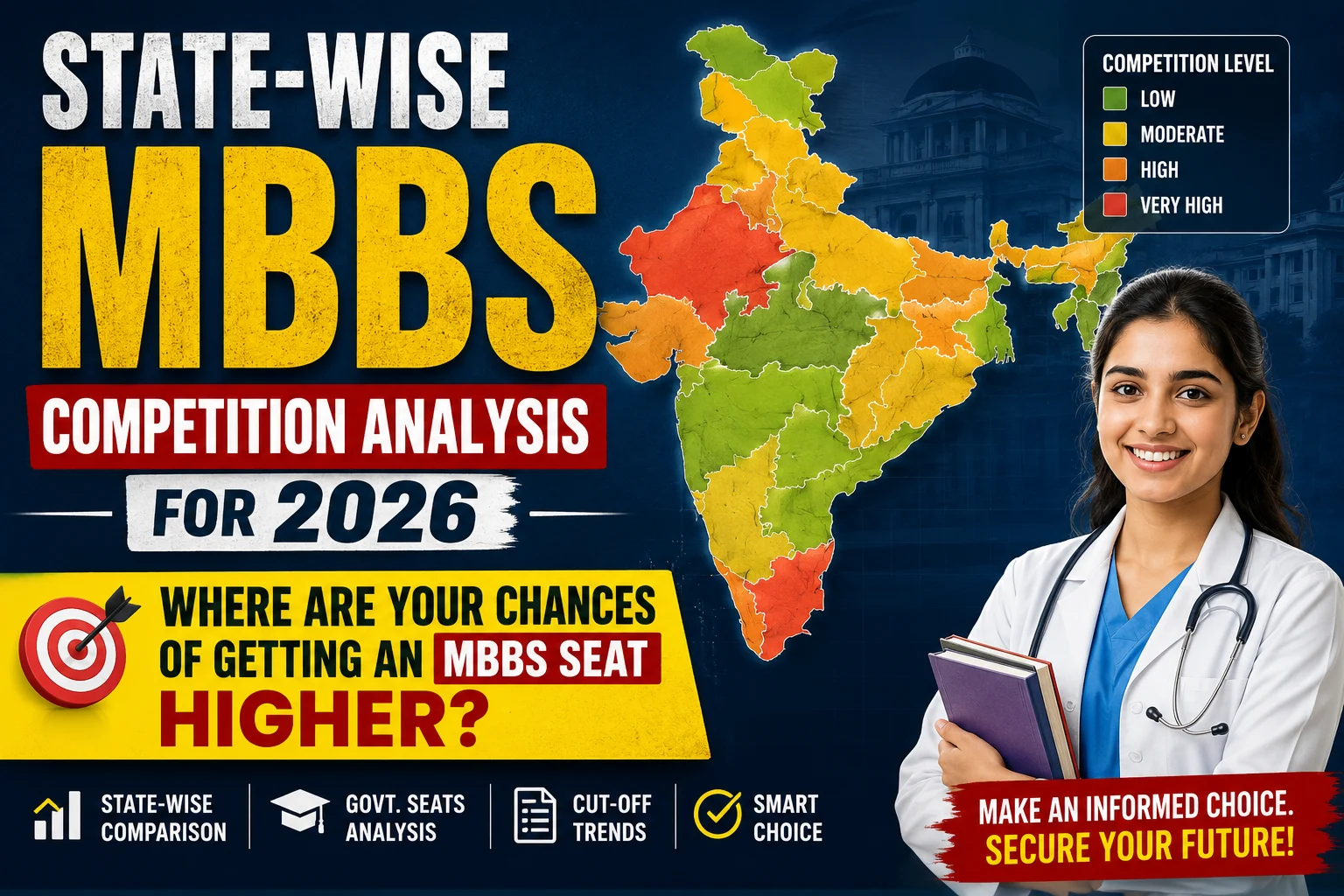
Admission competition for India’s 2026 Bachelor of Medicine, Bachelor of Surgery (MBBS) programs has entered a critical full-cycle strategic preparation phase.
Understanding the Reality of MBBS Admissions in 2026
For all candidates preparing to take the 2026 National Eligibility cum Entrance Test (NEET), the first cognitive misconception they must dismantle is the idea that they can plan their applications solely based on their own exam scores and all-India ranks, ignoring that state-level competition rules are the core variable that determines their likelihood of securing admission.
Currently, public and private medical colleges across India offer a combined total of 12,900 MBBS seats, covering all spots at the All India Institutes of Medical Sciences (AIIMS), state-run public medical colleges, centrally administered medical institutions, and private medical universities. These limited seats are contested by more than 230,000 NEET candidates. This extreme mismatch between supply and demand means the precision of an applicant’s strategy matters far more than minor gaps in test scores.
The current seat allocation framework is uniformly set by the Medical Counseling Committee (MCC). Of all seats at public medical universities, 15% are assigned to the All India Quota (AIQ) for competition among all eligible candidates nationwide, while the remaining 85% are fully integrated into the independent state quota system managed by each individual state. As such, the main competitive field for the vast majority of candidates is actually the local track within their home state.
There are seven core factors that shape an applicant’s chances of success at the state level:
- The size of each state’s state quota reserve
- Local domicile requirements for applicants
- The number of public medical colleges in the state
- The total number of private medical colleges
- The number of NEET candidates based in the state
- Reservation policies for specific groups
- Cross-state counseling application opportunities available in each state
Why State-Level Competition Matters More Than National Rankings
MBBS Advisor, a third-party professional consulting platform focused on providing guidance for Indian medical school admission applications, reminds 2026 NEET candidates that they must move beyond the narrow mindset of only focusing on test scores.
To secure an admission spot amid the extremely fierce competition for seats, candidates must develop an application strategy tailored to their own circumstances that incorporates all competitive factors of their target state.
For the vast majority of candidates applying for India’s Bachelor of Medicine, Bachelor of Surgery (MBBS) programs, state-level NEET admissions competition is often more decisive than national-level competition. The core variable that shapes the intensity of competition in each state is the total number of available seats in that state.
MBBS Seat Distribution Across Major States
The latest seat data cited in this paragraph is sourced from NEET’s official annual reports and statistics from frontline admissions counseling communities.
Among the eight Indian states with the largest total MBBS seat capacity, Karnataka leads the ranking with over 13,900 seats, followed sequentially by Uttar Pradesh with over 13,400 seats, Tamil Nadu with over 13,000 seats, Maharashtra with over 12,800 seats, and so on.
Next, we unpack the unique competitive logic of each region state by state.
Uttar Pradesh
Uttar Pradesh has more than 13,000 seats, a sufficient number of medical colleges, and well-developed private medical infrastructure.
However, as the state with the largest share of NEET candidates across India, its massive applicant pool pushes up competition intensity, leading to extremely fierce admissions races even though its total seat size ranks high.
Maharashtra
Maharashtra boasts high-quality public medical colleges, a mature education ecosystem, a large base of urban candidates, and a large influx of repeat test-takers; even with sufficient seat supply, demand for seats has always far outstripped availability.
Rajasthan
Rajasthan has over 7,000 seats and strong public higher education institutions.
Kota, a national test preparation hub, attracts candidates from all over India, and the clustering of high-scoring candidates leads to unusually fierce competition for state quota seats within the state.
Bihar
Bihar has a large population base and a high NEET participation rate, and its seat supply cannot keep up with the surging desire to study medicine; even high-scoring candidates struggle to secure a public college seat, so admissions counseling experts all recommend that candidates consider the underrated option of private medical colleges.
Karnataka
Karnataka is the top application choice for most candidates. Not only does it have the largest number of MBBS seats across India, it also has abundant private college resources, allows out-of-state candidates to apply, and runs a well-developed admissions system.
Many candidates use the MBBS Advisor tool to check information on seat distribution, admissions processes, and fee information.
Analysis of Tamil Nadu and Other Key Medical Education Regions
Next, we conduct a specific analysis of Tamil Nadu.
This paper’s authors map the full landscape of undergraduate medical (MBBS) admissions in India, adopting the analytical logic of first breaking down each core region individually, then supplementing details of cross-channel application opportunities, to sequentially analyze the seat volume, infrastructure level, and competition intensity of six core medical education regions.
Tamil Nadu
Tamil Nadu, India’s top-tier medical education hub, hosts a large number of public medical colleges, sees large increases in new seats, has well-developed medical infrastructure, and maintains continuously expanding medical education capacity.
Even with newly added MBBS seats, high local applicant participation keeps competition fierce.
Telangana
Telangana holds over 9,000 MBBS seats, with its medical education system centered on multiple public colleges and featuring deep participation from private education providers.
Andhra Pradesh
Alongside Andhra Pradesh, which hosts over 7,000 MBBS seats, these two states offer applicants a balance between seat supply and competition intensity.
Gujarat
Gujarat, an emerging medical education hub, has recorded consistent growth in its number of colleges and government investment, with robust infrastructure.
While competition remains fierce, growth in available seats has expanded application access for large numbers of test-takers.
Kerala
Kerala adheres to a quality-first development path, with standout educational and medical outcomes.
Most local applicants earn high scores on the National Eligibility cum Entrance Test (NEET, India’s national unified medical entrance exam), leading to extremely intense competition for public college seats, where admission almost always requires a very high NEET score.
Delhi
Delhi has an extremely small overall seat pool.
Combined with its high academic standards, concentrated national application demand, and applicants’ widespread preference for public institutions, its admission cutoffs rank among the highest in the country.
Factors That Influence State-Level Admission Advantages
The seat-to-applicant ratio in Karnataka, Telangana, Andhra Pradesh, Tamil Nadu, and some northeastern states is relatively more favorable.
However, application advantages in these regions are modulated by three core variables:
- Domicile eligibility
- Reservation category
- Application strategy
Applicants often rely on the third-party service MBBS Advisor to filter application regions that match their exam scores.
The Role of Private Medical Colleges
Private medical colleges contribute nearly half of all MBBS seats nationwide, most located in states such as Karnataka and Maharashtra.
These institutions provide an additional pathway for applicants whose scores fall slightly below the public college admission cutoff.
The admission systems of private medical colleges in Uttar Pradesh and Bihar are a core choice for cross-state applicants.
Common Mistakes That Cost MBBS Seats
To successfully secure admission eligibility for India’s Bachelor of Medicine, Bachelor of Surgery (MBBS) program, the importance of completing advance advising and application planning is self-evident, and this is exactly the core value of the professional consulting platform MBBS Advisor.
Every year, a large number of candidates who pass the National Eligibility cum Entrance Test (NEET) still fail to gain admission, falling victim to six common application errors:
- Flawed logic in program preference reporting
- Neglecting state-level application channels
- Missing the deadlines for various application batches
- Incomplete application materials
- College preference lists misaligned with one’s actual circumstances
- Insufficient pre-application research
Four Strategies to Improve Admission Chances
To improve admission chances, four actionable strategies can help candidates avoid unnecessary setbacks:
1. Analyze State-Level Competition Carefully
Conduct in-depth analysis of state-level competition dynamics, covering core dimensions including state quota trends, available seat inventory, reservation policies, and historical application data.
2. Participate in Multiple Counseling Channels
Participate simultaneously in multiple application channels, including regular applications under the All India Quota, state-level quotas, and private university quotas, as well as supplementary admission rounds and additional-seat supplementary admission rounds.
3. Build a Balanced College Preference List
Build a balanced, pragmatic tiered list of preferred colleges.
4. Seek Professional Guidance
Seek professional consulting support—MBBS Advisor can provide interpretation of application procedures, seat matrix analysis, and customized admission strategies tailored to candidates’ individual NEET scores.
Regulatory and Recognition Framework for MBBS Education
Candidates should also verify that their chosen medical colleges comply with standards established by the National Medical Commission (NMC) and maintain international recognition through the World Directory of Medical Schools (WDOMS). Additionally, global medical education benchmarks are often referenced through the World Health Organization (WHO).
Conclusion
Currently, India’s total number of MBBS seats exceeds 125,000, while annual NEET registrations surpass 2.3 million.
The states of Uttar Pradesh, Maharashtra, Rajasthan, and Bihar record the highest number of applicants, while Karnataka, Telangana, and Andhra Pradesh hold a more abundant supply of seats.
MBBS admissions for 2026 are no longer determined solely by exam scores; understanding state-level competition and implementing sound application strategies carry equal weight to exam preparation, and only by combining these efforts with rational, professional consulting can candidates significantly boost their odds of admission.