 Russia
 Belarus
 Georgia
 Kazakhstan
 Kyrgyzstan
 Uzbekistan
 China
China Nepal
Nepal Bangladesh
 Poland
 Romania
 Slovakia
 Hungary
 N. Macedonia
 Vietnam
 Canada
 Armenia
 UK
UK Australia
 USA
USA Ireland
 Germany
 New Zealand
 Italy
Italy France
 Singapore
 Netherlands
 Sweden
 Switzerland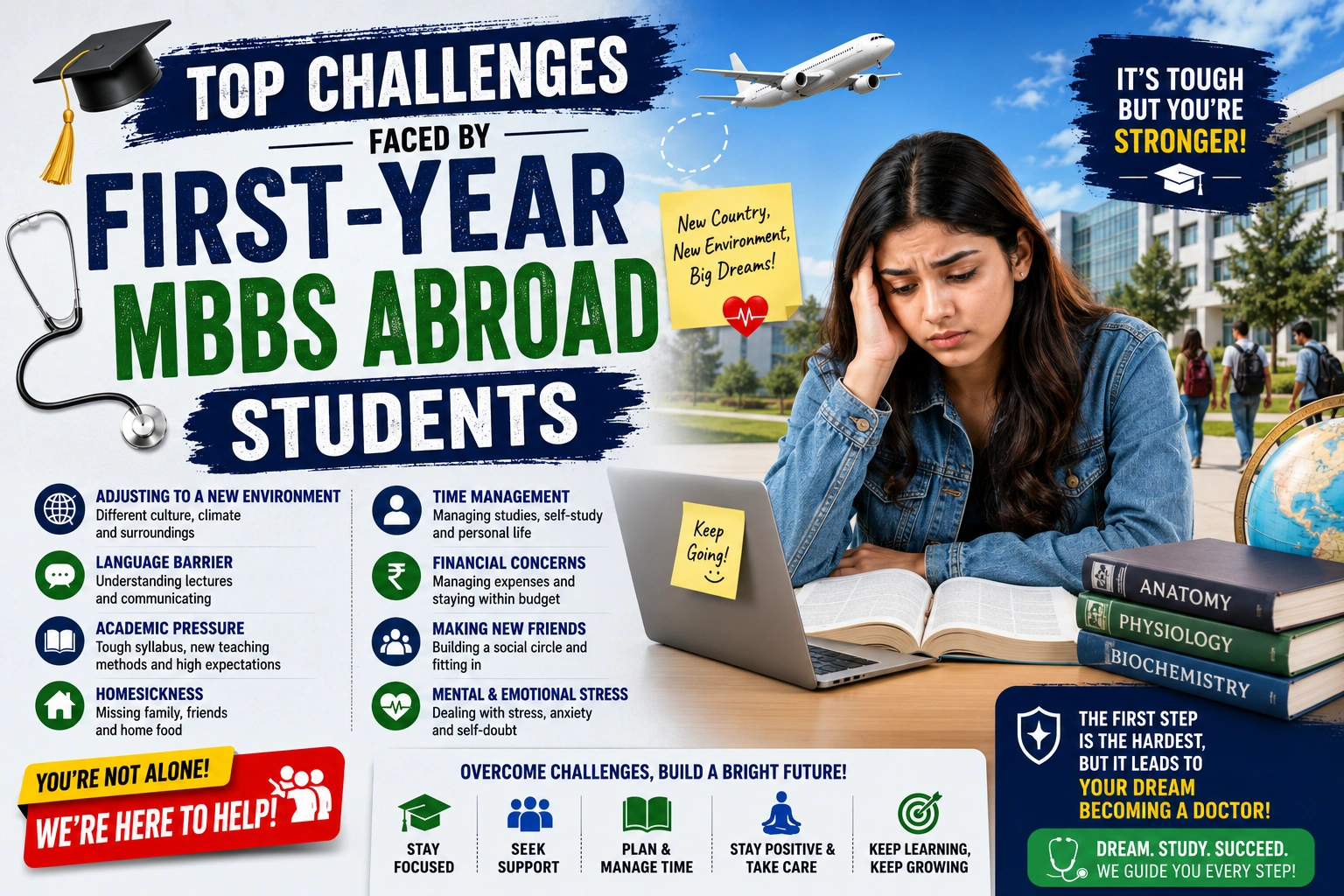
Indian students often aspire to pursue their MBBS abroad due to sophisticated medical training, affordable tuition, and globally endorsed degrees. Every year, students select Russia, Georgia, Kazakhstan, Uzbekistan, Kyrgyzstan, Nepal, and the Philippines to continue with their medical education. Unfortunately, the first year abroad continues to be the most daunting phase of all.
As difficult as the admission process is, the effort to adjust to the new environment, new academic setting, and new culture and language takes a greater level of commitment. Knowing what the challenges ahead are, help students with the likely scenarios that lead to avoidable mental stress that can aid in a seamless way to the new environment.
Students that seek guidance from MBBS Advisor for the university selection process are better equipped to confront the challenges of the first year. These students have better knowledge of the latest NEET guidelines and use the NEET Rank Predictor to assess their NEET admission chances. MBBS Abroad encourages students to explore multiple options when selecting the study location and career instead of relying on one study location or university, and offers a comparison with available career opportunities.
First Year Abroad and Pursuing MBBS Is the Most Challenging Phase
There is no doubt that the jump from an Indian school to a foreign medical school is a greater gap than students anticipate. In addition to learning a foreign language and the medical curriculum, students must adjust to a new culture and new people along with a multitude of changes to their everyday life.
MBBS education differs from school education in its need for consistent study, self-discipline, practical learning, and continuous evaluation. Coupled with the cultural and emotional adaptations that come with relocating, the first year of an MBBS program is undoubtedly the hardest.
Indian students who mentally prepare themselves prior to arrival in their host country perform better in their first year of the MBBS program.
Heavy Academic Pressures
The intensity of the medical curriculum catches many first-year students unawares.
Many medical schools do not emphasize rote learning. As a result, students are expected to have a thorough understanding of anatomy, physiology, biochemistry, and histology, and of the commonly used medical terms.
Foreign medical students face the following challenges during the first year of their medical program because:
- Medical terms are new.
- Subjects are revised on a continuous basis.
- There are numerous practical sessions.
- There are continuous internal assessments.
- Attendance is closely monitored.
Students should cultivate the practice of studying on a continuous basis, instead of cramming for a session. Continuous study is a far more effective practice than cramming prior to an academic session.
Language Barriers
Students may face language barriers beyond the classroom, even if the MBBS program is delivered in English.
For the first several months, students may face the following challenges:
- Interacting with local shopkeepers.
- Independent travel.
- Visiting hospitals.
- Public transportation.
- Government tasks.
Learning a few useful phrases in the local language can greatly enhance the quality of your day-to-day living.
Knowledge of the local language is also especially beneficial during the clinical years of the program, as it is common for patients to speak only the local language.
Homesickness and Emotional Stress
Homesickness is almost universal for international students.
For quite a number of Indian students, living away from their parents is a new experience. Missing family and close friends can affect mental well-being.
Some common emotional challenges include:
- Feeling lonely.
- Missing family functions.
- Difficulty in making new friends.
- Exam anxiety.
- No emotional support.
Gradually familiarization and making friends with students from other countries can decrease the emotional challenges.
Family members can stay in touch to give the student emotional support.
Different Learning Methodology
The learning methodology of the medical colleges of the Indian Subcontinent and other countries is very different.
Indian Medical Colleges depend mainly on lecture-based instructions and as such, are very passive.
Medical schools of other countries promote:
- Independent learning.
- Research-based assignments.
- Laboratory work.
- Group discussions.
- Clinical work.
- Observations.
Most students face a challenge in being active participants in the learning process, expecting faculty to cover every aspect of the requirement.
Adjustment of the learning methodology may take a few months. Once the student is successfully oriented to the new methodology the rest of the course becomes very easy.
Financial Responsibility
Another new experience for students is the need to manage their finances.
They must have a system in place to pay their tuition and also cover their day to day expenses.
Some of these expenses include:
- Food.
- Housing.
- Travel.
- Internet.
- Study supplies.
- Shopping.
- Medical expenses (unexpected).
Many students spend beyond their budget in the initial months as they learn to adjust to the new environment and local prices.
Many students devise a monthly budget to sustain their expenses over the duration of their course.
Food Changes Are Difficult
Indian cuisine is not easily available in many countries.
Initially, students may struggle with eating local food because:
- It tastes different.
- It may have little or no vegetarian food.
- It may have little or no spices.
- The meal times may not match.
Most universities now understand the needs of Indian students and have Indian mess facilities or allow hostel kitchens.
Learning some cooking skills can be beneficial.
Weather
Most countries that offer MBBS have different climates than India.
Students from India studying in Russia, Kazakhstan, Kyrgyzstan, or some regions of Georgia experience very cold winters for the first time.
Some of the challenges are:
- Excessive snowfall.
- Very short daytime.
- Very low temperatures.
- Dry skin.
Winter clothing and preparation for seasonal illnesses can help students during winter.
Cultural Differences
Every country has different customs and social etiquette.
Students can experience culture shock with differences in:
- How people greet others.
- How people behave in public.
- How people are in class.
- How people communicate.
- How people celebrate festivals.
- What people eat.
In the absence of a comparison of cultures, students should be mentally prepared and have the ability to appreciate and understand other people.
Managing Time Is Very Important
Medical education entails juggling a number of different responsibilities at the same time.
These responsibilities include lectures, practical classes, self-study, assignments and revision, and even the time needed to maintain physical health and attend to social responsibilities.
When the social and physical responsibilities are neglected, the pressure to perform academically increases.
Time planning with the aid of a physical planner or digital calendar can improve time management and consequently academic pressure.
Making New Friends
When students are hesitant to make friends from different countries, it is of great value because friends can help with notes, practicals, and even provide language help and exam tips, and the encouragement you need.
Participating in the different events and programs will help students in making new friends.
Learning the University Regulations
Every medical university has its own regulations for attendance, examinations, hostel rules, and academic performance.
There is a need to pay attention to the following policies:
- Attendance.
- Assessment.
- Hostel Behavior.
- Visa.
- Health Insurance.
- Clinical Training.
Policies must not be flouted. It may lead to unnecessary inconvenience later.
Not Being Able to Start Practice
Many students are disappointed at not being able to start hospital practice immediately.
This is because the whole of the first year is spent on the study of the basic medical sciences.
More clinical exposure is offered later, once sufficient knowledge of the theory is gained.
Patience is required for the academic process.
Coping with the Stress of an Exam
Medical exams conducted abroad are different in many respects from Indian board exams.
These may consist of:
- Oral Exams.
- Vivavers.
- Demonstrations.
- Lab Exams.
- Written Exams.
Consistent preparation throughout the semester is the best way to minimize the stress of an exam.
Staying Healthy
Students’ health tends to take a backseat during this time.
They face:
- Poor Sleep.
- Poor Diet.
- Less Exercise.
- Stress and Fatigue.
Routine Health Habits Improve Concentration and Performance.
Walking, drinking water, and eating well have positive effects.
Knowing Indian Medical Regulations
Indian students who have plans to return after completing their education must study the current medical education regulations.
They must look at the NMC (National Medical Commission) foreign medical education eligibility requirements.
They must also look at the World Directory of Medical Schools (WDOMS) to ensure their university has a listing.
They must also look at the NEET site for an update on other exams and the WHO for an update on global health.
This information will ensure clarity regarding licensing, practice, and employment.
How Students Overcome First-Year Problems
Students encounter lots of challenges in the first year. However, they can make the first year of studying MBBS abroad less difficult by developing the following habits:
- Attend lectures.
- Review topics daily.
- Learn basic local language phrases.
- Have a monthly budget.
- Keep in touch with family.
- Get involved in university activities.
- Make friends with classmates.
- Follow university rules.
- Take care of physical and mental health.
- Ask for help when needed.
Students following these habits gain confidence and improve academic performance.
Conclusion
Studying MBBS abroad is challenging. However, it lays the foundation of a successful medical career. Students overcoming the first year challenges of studying MBBS abroad are usually the students that are more self-disciplined and who have the most positive outlook.
There are many challenges in the MBBS abroad journey for a first year student, such as academic pressure, cultural adjustment, and homesickness. There are also challenges with finances and time management. Most of these challenges become easier with more experience. To ensure success, proper planning and continuous guidance are essential.
The reliable support system of MBBS Advisor will enable you to have a clear view of universities, understand the admission requirements, get the latest information regarding NEET, determine your NEET Rank, learn about the best MBBS destinations, and allow you to have less stress and worry with the first year journey of studying MBBS abroad.