 Russia
 Belarus
 Georgia
 Kazakhstan
 Kyrgyzstan
 Uzbekistan
 China
China Nepal
Nepal Bangladesh
 Poland
 Romania
 Slovakia
 Hungary
 N. Macedonia
 Vietnam
 Canada
 Armenia
 UK
UK Australia
 USA
USA Ireland
 Germany
 New Zealand
 Italy
Italy France
 Singapore
 Netherlands
 Sweden
 Switzerland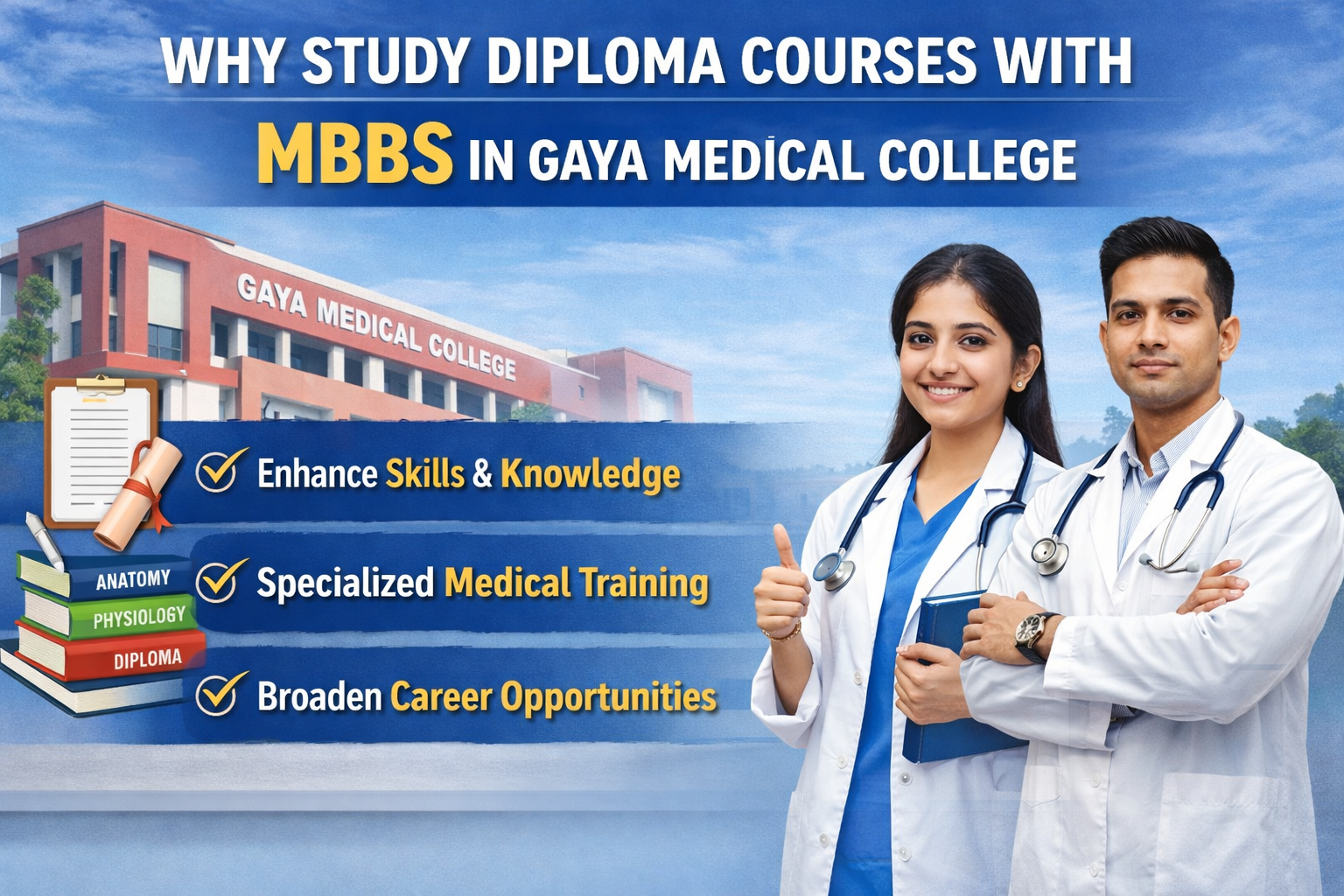
To get an MBBS degree is a challenging and gratifying experience that develops the most basic principles in medical science, as well as one-on-one patient contact. But given the competitive nature of today’s healthcare workforce, many students also find themselves seeking opportunities to beef up their resume before they’ve even finished their first degree. Studying any Diploma courses in Gaya Medical College as equivalent to MBBS can be beneficial for those who have further career plans and also helps one to get the more skills and uses of multiple types of technologies at an early stage.
Enhancing Practical and Technical Skills
The curricula in MBBS course is more on the theoretical side of the medicine along with a structured clinical training. Diploma is the minimum degree for becoming a doctor but Diploma courses tend to be more skill and practice oriented. They offer specialized training in areas of health care such as laboratory technology, anesthesia technology, radiology techniques, emergency care or public health support services.
Diplomas are good when chased along with MBBS, they give the feel of handling instruments, going through diagnostic reports and assisting in procedures. This will help students in developing a better know how of the technical aspect of medicine during clinical posting / internship. It also contributes to greater integration of theoretical learning with practical hospital life.
Broader Career Options and Flexibility
It is one of the favorite reasons to do MBBS and Diploma courses, career flexibility. A majority of MBBS graduates want to do post graduation (PG) specialization, but getting a PG seat is increasingly difficult. "Offering a second diploma ensures that students have an additional career pathway to choose from and prepare for the future."
In case the gap is one year between MBBS and PG admission, diploma degree will give them work in hospitals, diagnostic centers or other healthcare establishments.” This, in turn, promotes lifelong professional development in place of academic stagnation. In rural or semi-urban health care centres, doctors with diploma skills may be preferred as they can be multi tasked (Table 3).
Better Understanding of Healthcare Systems
Diploma courses provide healthcare informatics students with information on intricate medical official duties necessary in a hospital. Through diagnostics, anesthesia assistance, emergency response and laboratorial management, MBBS students are able to develop a comprehensive understanding of the entire health process.
A wider perspective gives future doctors insight into the role of allied healthcare professionals including lab technicians, radiographers and paramedical personnel.” Such collaborative learning is in line with contemporary healthcare practice and communication, with leadership developed by working as a team. Physicians who know these networks can better care for patients and make educated clinical decisions.
Alignment with Medical Education Regulations
Medical education in India is regulated by the National Medical Commission (NMC) and maintains standard of MBBS & Post graduation training. Students are needed to make sure that their focus is always on MBBS and the diploma course should not affect their required attendance, internship etc.
Additionally, for those students who may be interested in international practice or study overseas, having the relevant medical qualification entered in the World Directory of Medical Schools (WDOMS) is essential. This identification determines eligibility for licensing exams in other countries.
Furthermore, Indian medical students who intend to return home after attending abroad are also required to pass the Foreign Medical Graduate Examination (FMGE). Although its not exactly applicable on students in India, but it enlightens them and will make Students to know about such regulatory things to organize their long term career goals.
Early Exposure to Specialization Choices
The most challenging decision for MBBS students is to pick a postgraduate specialty. Certificate and diploma programs are early introductions to specialized areas of health care that might make the difference in a student’s decision for the future.
If the student chooses a diploma related to radiology or imaging, then they know if they like diagnostic areas. Likewise, a degree in emergency care can lead students toward trauma medicine or critical care. This early exposure minimizes the confusion later, and students select PG specialties based on true experience instead of a presumption.
Improved Employability and Professional Confidence
Upon graduating medical institutes are in need of professionals with well-rounded training. MBBS and diploma in technical or support area makes a professional more versatile and resource-wise. This is especially helpful in the setting of government hospitals or community health centers, where physicians may have to juggle multiple tasks at the same time.
Diploma training also fosters business confidence. It is an exposure where students grow to be at ease with medical devices, patient-communication and clinical processes. This sense of security persists through internships, postgraduate training and independent practice.
Guidance and Academic Planning
Harmonizing MBBS with diploma course needs due diligence and quality guidance. Students need to apply for diploma course in a way that will not interfere with the MBBS curriculum and studies or clinical posting.
Education portals like MBBS Advisor help you to get accurate details about the Medical courses, career and your destination plan. These are the platform that help them to look for diploma courses, criteria’s of it and what it can be merged with responsibly.
Conclusion
Pursuing Diploma courses in addition to MBBS from Gaya Medical College can be an excellent choice for the students who wishes to gain further knowledge, expand and specialize their career opportunities and have an early opportunity towards a particular field of interest in medicine. This dual pathway enhances practical experience, employability and choices for postgraduate study.
When the pursuit is well-planned and supported by trustworthy information like MBBS Advisor along with an understanding of regulatory bodies like NMC, WDOMS, and exams like FMGE students can build a holistic medical profile ready for the future. A proper blend of academics and skills: The integration of diploma education with MBBS is a strong move that would help in shaping a successful medical career that has flexibility at its core.