 Russia
 Belarus
 Georgia
 Kazakhstan
 Kyrgyzstan
 Uzbekistan
 China
 Nepal
 Bangladesh
 Poland
 Romania
 Slovakia
 Hungary
 N. Macedonia
 Vietnam
Introduction
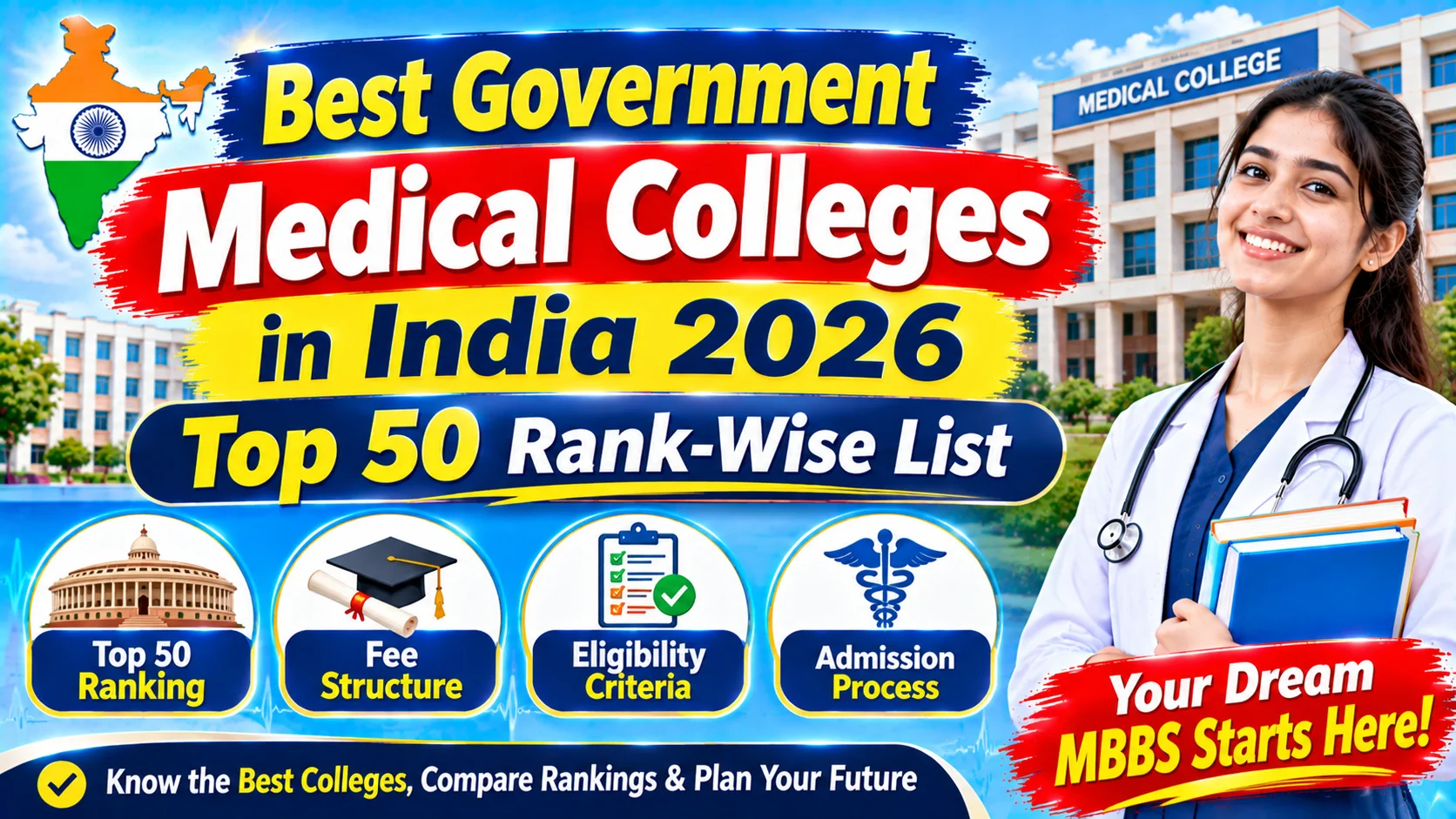
Choosing the right medical college is one of the most important decisions for students who want to pursue an MBBS degree. India has several reputed government medical colleges offering quality medical education, experienced faculty, modern infrastructure and excellent clinical training opportunities.Government medical colleges are popular among NEET aspirants because their MBBS fees are generally lower than those of private medical institutions. Many reputed government colleges also have well-established teaching hospitals, research facilities and experienced medical professionals.The best government medical colleges in India 2026 can be compared based on academic reputation, NIRF ranking, hospital facilities, patient exposure, faculty experience, research opportunities and admission competitiveness.In this article, we have covered 50 prominent government medical institutions and provided useful information about MBBS admission, eligibility, fees and the counselling process.
Top 50 Government Medical Colleges in India 2026 – Rank-Wise List
The following is an indicative list of prominent government medical institutions in India. It is not an official 2026 ranking. The order should not be treated as a verified national ranking because institutions may be evaluated differently under NIRF and other academic ranking systems.
|
No. |
Government Medical College |
Location |
|
1 |
All India Institute of Medical Sciences (AIIMS) Delhi |
New Delhi |
|
2 |
Jawaharlal Institute of Postgraduate Medical Education and Research (JIPMER) |
Puducherry |
|
3 |
King George's Medical University (KGMU) |
Lucknow, Uttar Pradesh |
|
4 |
Institute of Medical Sciences, BHU |
Varanasi, Uttar Pradesh |
|
5 |
AIIMS Jodhpur |
Jodhpur, Rajasthan |
|
6 |
AIIMS Bhubaneswar |
Bhubaneswar, Odisha |
|
7 |
AIIMS Rishikesh |
Rishikesh, Uttarakhand |
|
8 |
AIIMS Bhopal |
Bhopal, Madhya Pradesh |
|
9 |
AIIMS Patna |
Patna, Bihar |
|
10 |
Maulana Azad Medical College |
New Delhi |
|
11 |
University College of Medical Sciences (UCMS) |
Delhi |
|
12 |
Lady Hardinge Medical College |
New Delhi |
|
13 |
Vardhman Mahavir Medical College (VMMC) |
New Delhi |
|
14 |
Government Medical College and Hospital |
Chandigarh |
|
15 |
Madras Medical College |
Chennai, Tamil Nadu |
|
16 |
Stanley Medical College |
Chennai, Tamil Nadu |
|
17 |
Government Medical College, Thiruvananthapuram |
Kerala |
|
18 |
Government Medical College, Kozhikode |
Kerala |
|
19 |
Seth GS Medical College |
Mumbai, Maharashtra |
|
20 |
Grant Medical College |
Mumbai, Maharashtra |
|
21 |
B. J. Government Medical College |
Pune, Maharashtra |
|
22 |
Government Medical College, Nagpur |
Nagpur, Maharashtra |
|
23 |
Government Medical College, Chhatrapati Sambhajinagar |
Maharashtra |
|
24 |
Bangalore Medical College and Research Institute |
Bengaluru, Karnataka |
|
25 |
Mysore Medical College and Research Institute |
Mysuru, Karnataka |
|
26 |
Karnataka Institute of Medical Sciences |
Hubballi, Karnataka |
|
27 |
Government Medical College, Kottayam |
Kerala |
|
28 |
Government Medical College, Thrissur |
Kerala |
|
29 |
Government Medical College, Amritsar |
Punjab |
|
30 |
Government Medical College, Patiala |
Punjab |
|
31 |
Government Medical College, Jammu |
Jammu and Kashmir |
|
32 |
Government Medical College, Srinagar |
Jammu and Kashmir |
|
33 |
SMS Medical College |
Jaipur, Rajasthan |
|
34 |
Dr. S. N. Medical College |
Jodhpur, Rajasthan |
|
35 |
RNT Medical College |
Udaipur, Rajasthan |
|
36 |
Government Medical College, Kota |
Kota, Rajasthan |
|
37 |
Gandhi Medical College |
Hyderabad, Telangana |
|
38 |
Osmania Medical College |
Hyderabad, Telangana |
|
39 |
Kakatiya Medical College |
Warangal, Telangana |
|
40 |
Andhra Medical College |
Visakhapatnam, Andhra Pradesh |
|
41 |
Guntur Medical College |
Guntur, Andhra Pradesh |
|
42 |
Rangaraya Medical College |
Kakinada, Andhra Pradesh |
|
43 |
SCB Medical College |
Cuttack, Odisha |
|
44 |
MKCG Medical College |
Berhampur, Odisha |
|
45 |
Patna Medical College |
Patna, Bihar |
|
46 |
Darbhanga Medical College |
Darbhanga, Bihar |
|
47 |
Government Medical College, Haldwani |
Haldwani, Uttarakhand |
|
48 |
Government Medical College, Kozhikode |
Kerala |
|
49 |
Government Medical College, Thiruvananthapuram |
Kerala |
|
50 |
Government Medical College, Kottayam |
Kerala |
Important Note: The list contains 50 entries, but it is not a verified list of 50 unique institutions because some colleges appear more than once. Before publication as a definitive top-50 list, replace the repeated entries with other verified government MBBS colleges. Also, verify each institution's current MBBS course availability and approved intake through official sources. PGIMER Chandigarh has not been included as a regular MBBS college because it should not be treated as an MBBS admission option without verifying the current course offering.
Top Government Medical Colleges in India – Key Highlights
Some government medical colleges are particularly popular among NEET aspirants because of their academic reputation, hospital facilities and clinical training opportunities.
1. All India Institute of Medical Sciences (AIIMS), Delhi
AIIMS Delhi is one of India's most recognised medical institutions. It is known for medical education, advanced healthcare services, research and specialised hospital facilities.
Admission to its MBBS programme is based on NEET UG performance and the applicable counselling process.
2. Jawaharlal Institute of Postgraduate Medical Education and Research (JIPMER), Puducherry
JIPMER is a well-known medical institution offering undergraduate and postgraduate medical education. It has established teaching hospitals and provides students with clinical training opportunities.
Admission to its MBBS programme is conducted through NEET UG counselling.
3. King George's Medical University (KGMU), Lucknow
KGMU is a reputed government medical university in Uttar Pradesh. It offers undergraduate and postgraduate medical education, clinical training and research opportunities across various medical specialities.
4. Institute of Medical Sciences, BHU, Varanasi
The Institute of Medical Sciences at Banaras Hindu University is a recognised medical teaching institution. It provides academic education, research opportunities and clinical exposure through its associated hospitals.
5. Maulana Azad Medical College, Delhi
Maulana Azad Medical College is a prominent government medical institution offering undergraduate and postgraduate medical programmes. Its associated hospitals provide students with valuable clinical learning opportunities.
6. Madras Medical College, Chennai
Madras Medical College is one of India's established medical institutions. It is known for its academic history, teaching facilities and hospital-based clinical training.
Admission Process for Government Medical Colleges in India 2026
Admission to MBBS courses in government medical colleges is primarily based on NEET UG qualification and the counselling process.
The general admission procedure includes the following steps:
Step 1: Qualify NEET UG 2026
Candidates must appear for the NEET UG examination and meet the qualifying criteria announced by the National Testing Agency (NTA). Students can visit the official NTA NEET website for examination notifications, results and other important updates.
Step 2: Check Your NEET Rank
After the result is announced, candidates should check their All India Rank, category rank, score and qualifying status.
Step 3: Register for Counselling
Candidates must register through the appropriate counselling authority:
- Medical Counselling Committee (MCC): For applicable All India Quota seats and specified institutions.
- State Counselling Authorities: For state quota seats and other seats covered by state counselling rules.
Step 4: Select Your Preferred Colleges
Candidates should fill in their college preferences based on their NEET rank, category, eligibility, location and budget.
Step 5: Seat Allotment
Seats are allotted according to NEET merit, reservation policies, seat availability and the candidate's preferences.
Step 6: Document Verification and Admission
Candidates must report to the allotted college, complete document verification and pay the required admission fees within the prescribed deadline. Students who need additional information about medical college selection and admission guidance can explore MBBS Advisor.
Eligibility Criteria for MBBS Admission 2026
Students seeking admission to government medical colleges in India generally need to meet the following eligibility requirements:
- Must have passed Class 12 or an equivalent examination.
- Must have studied Physics, Chemistry and Biology/Biotechnology along with English as prescribed.
- Must meet the minimum qualifying examination marks applicable to their category.
- Must satisfy the prescribed age criteria.
- Must qualify NEET UG 2026.
- Must fulfil the eligibility conditions of the relevant counselling authority.
Candidates should check the official NEET information bulletin and counselling notifications for the exact eligibility requirements.
MBBS Fees in Government Medical Colleges
One of the biggest advantages of government medical colleges is their comparatively affordable fee structure. However, MBBS fees vary significantly between institutions and states. AIIMS institutions, central universities and state government medical colleges may have different fee structures.
|
Fee Component |
General Information |
|
Tuition Fees |
Varies by college and state |
|
Admission Fees |
Payable as prescribed by the institution |
|
Hostel Fees |
Depends on accommodation facilities |
|
Examination Fees |
Charged according to university rules |
|
Miscellaneous Charges |
May include library, laboratory and other charges |
Students should always check the latest official college prospectus for accurate 2026 fee details. They should also consider hostel, mess and other living expenses while calculating the total cost of MBBS education.
How to Choose the Best Government Medical College?
Choosing a medical college should involve more than checking its ranking. Students should consider several factors before making their final decision.
1. Academic Reputation
Check the college's academic history, teaching quality and overall reputation in medical education.
2. Hospital Facilities
Review the attached teaching hospitals, available medical departments and healthcare infrastructure.
3. Patient Exposure
Clinical training is an important part of MBBS education. A well-established teaching hospital can provide students with valuable opportunities to learn from real clinical cases.
4. Experienced Faculty
Consider the qualifications, teaching experience and academic support provided by the faculty.
5. Infrastructure
Check the availability of laboratories, libraries, lecture halls, hostels and other student facilities.
6. Location
Consider the distance from home, transport facilities, accommodation and overall living conditions.
7. Fees
Compare tuition fees, hostel charges and other expenses before selecting a college.
8. Recognition and Regulatory Requirements
Verify the institution and its MBBS course details through the National Medical Commission (NMC).
Students researching medical institutions internationally can also refer to the World Directory of Medical Schools (WDOMS). For general information about global health and medical education, visit the World Health Organization (WHO).
Please note that a WDOMS listing or WHO reference alone does not establish NMC recognition or eligibility for medical registration in India.
How to Check Government Medical College Rankings?
Students should use reliable sources when comparing medical colleges.The National Institutional Ranking Framework (NIRF), introduced by the Ministry of Education, provides an official ranking system for higher education institutions in India.Students should check the latest available medical-category rankings on the official NIRF website.It is important to understand that NIRF rankings and NEET admission closing ranks are different. NIRF evaluates institutions using academic and institutional parameters, whereas MBBS admission depends on NEET merit, counselling rules, category, quota and seat availability.Candidates can also visit the NTA NEET website for examination information and the official MCC website for applicable counselling updates.
Conclusion
India has several reputed government medical colleges offering MBBS education, clinical training and research opportunities. Institutions such as AIIMS Delhi, JIPMER, KGMU, IMS BHU and Maulana Azad Medical College are among the prominent choices for NEET aspirants.However, choosing the right medical college requires more than following a rank-wise list. Students should compare academic facilities, hospital exposure, fees, location, admission cut-offs and current regulatory requirements.Before participating in NEET UG 2026 counselling, candidates should verify the official seat matrix, college eligibility and latest admission notices. Careful research can help students select a medical college that matches their NEET rank, academic goals and budget.
Frequently Asked Questions (FAQs)
1. Which is the best government medical college in India in 2026?
AIIMS Delhi is widely regarded as one of India's leading medical institutions. However, the best college for a student depends on academic preferences, clinical exposure, location and the ranking criteria being considered.
2. How many government medical colleges are there in India?
The number of government medical colleges changes as new institutions become operational and receive approval for MBBS courses. Students should check the latest NMC college and seat information for an accurate count.
3. Is NEET compulsory for admission to government medical colleges?
Yes. NEET UG qualification is required for regular MBBS admission to government medical colleges in India.
4. Which government medical college has the lowest MBBS fees?
MBBS fees vary between institutions. Some government medical colleges have comparatively low tuition fees, but students should also consider hostel, admission and other charges.
5. Can I get admission to AIIMS Delhi through NEET UG?
Yes. Admission to the AIIMS Delhi MBBS programme is based on NEET UG performance and the applicable counselling process.
6. What is the difference between AIIMS and other government medical colleges?
AIIMS institutions are established under central legislation and have their own institutional structure. Other government medical colleges may be administered by state governments, central authorities or public universities.
7. Which government medical colleges offer good clinical exposure?
Several established institutions, including AIIMS Delhi, KGMU, IMS BHU, Madras Medical College and Maulana Azad Medical College, have teaching hospitals that provide clinical training opportunities.
8. Are government medical colleges better than private medical colleges?
Government colleges generally have lower tuition fees, and many offer extensive clinical facilities. However, academic quality and infrastructure vary between institutions, so students should compare individual colleges.
9. Where can I find official MBBS seat matrix information?
Candidates can find applicable All India Quota seat information through MCC and state quota seat information through the respective state counselling authorities. The NMC website also provides relevant information about medical colleges and courses.
10. Does NIRF ranking affect MBBS admission?
No. NIRF rankings are based on institutional evaluation criteria. MBBS admissions are determined by NEET UG merit, counselling rules, category, quota and seat availability.

 Step-by-Step Guide.webp)