 Russia
 Belarus
 Georgia
 Kazakhstan
 Kyrgyzstan
 Uzbekistan
 China
China Nepal
Nepal Bangladesh
 Poland
 Romania
 Slovakia
 Hungary
 N. Macedonia
 Vietnam
 Canada
 Armenia
 UK
UK Australia
 USA
USA Ireland
 Germany
 New Zealand
 Italy
Italy France
 Singapore
 Netherlands
 Sweden
 Switzerland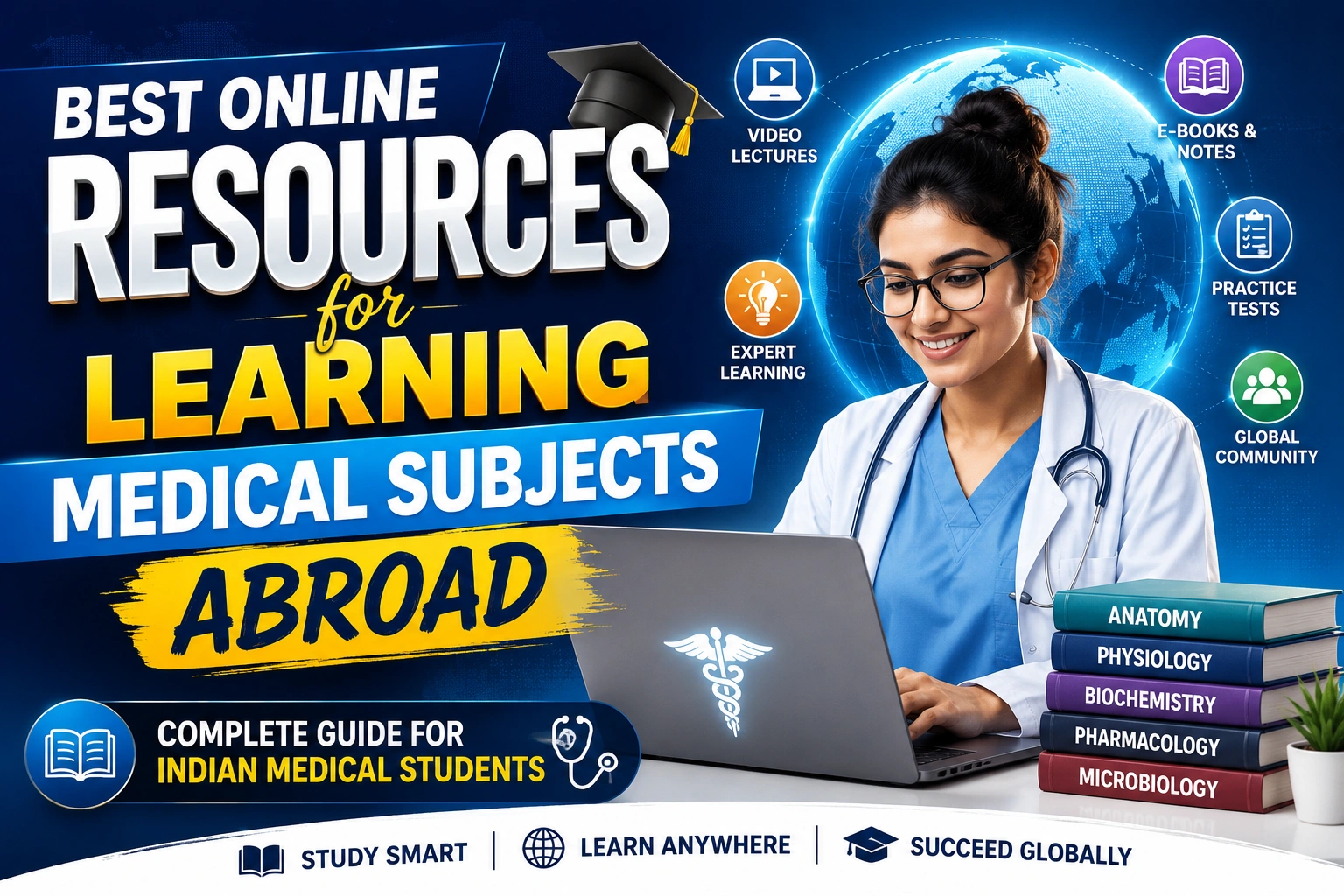
Given the low cost and high quality of education, an increasing number of Indian students are choosing to study medicine abroad. The numerous medical subjects such as Anatomy, Physiology, and Clinical Medicine, present their own difficulties. For the Indian students studying abroad, online resources are invaluable for concept clearing, lecture revisions, exam prep, and revised practice, along with keeping pace with the evolving field of medicine.
Any Indian student aspiring to study medicine abroad must choose the eligible university, but also choose the right educational resources. MBBS Advisor is one of the several online platforms that help students with medical educational resources and offers help with medical entrance exams.
Students who are preparing for the medical entrance exams will find NEET preparation resources and NEET Rank predictor resources to help them assess their rank and plan their medical career accordingly.
Role of Online Medical Resources for Students Studying Abroad
Overseas medical students are required to learn continuously for the entire duration of their degree, making medical education a never-ending task. Unlike conventional classroom education, online resources offer students extreme flexibility.
Most of the Indian students studying medicine in a foreign country face difficulties with different teaching styles, language, and the adjustment to different systems. Online education systems such as digital text resources, interactive medical questions, and video lectures along with participative resources such as medical drawing and illustrations seamlessly integrate education and practice.
These resources provide students pursuing an MBBS abroad an opportunity to gain a deeper understanding of medical concepts and provide means to prepare for university and licensing exams such as the FMGE and NExT.
Understanding Medical Concepts through Online Video Lectures
Video lectures rank among the most beneficial resources available to medical students as they break down complicated medical concepts into understandable visual explanations. Disciplines such as Anatomy and Physiology that rely heavily on the use of drawings, diagrams, and even the use of computer generated imagery and hands-on demonstrations, can be much more understandable through the use of educational videos.
Students may benefit from the lectures posted on premium educational websites during their free time to review difficult concepts and fortify their foundational concepts.
Video lectures are also a valuable resource for Indian students studying abroad. Indian students can tailor their preparation to the Indian medical entrance exam as they relate the coursework and syllabus in their foreign universities to the Indian medical entrance exam.
Digital Libraries and Medical Textbooks
Digital Libraries, unlike traditional medical libraries that require students to travel and be located in a specific place, help students research and study the continually evolving field of medical science and medical research. Digital Libraries also help students study the field of medicine using Classical and Contemporary literature.
Students are also encouraged to thoroughly study the information and research medical science from the resources provided by the WHO and other recognized medical research organizations. Research completed by these organizations helps students understand the evolution of medicine and the various diseases that exist in the world.
Mobile Technology for Medical Education
The advent of mobile technology has revolutionized how medical students use their time, providing resources such as flashcards, sample questions, clinical cases, and quick revision notes.
Mobile technology can be utilized during your daily commute, during breaks, and even during the minutes leading up to an exam.
For Pathology and Pharmacology, flashcards can be an effective method to retain drug classifications and important terminology in medicine and can facilitate the understanding of the mechanisms of disease.
Online Question Banks and Practice Tests
Practice is essential in the field of medicine, and online question banks are a great way to assess understanding and learn what areas need improvement.
For medical students studying abroad, online question banks and practice tests are an excellent way to prepare for university as well as the medical licensing exams. Practicing the art of answering multiple-choice questions is a great way to facilitate the understanding of clinical medicine.
Students who are preparing for the medical licensing exams need to be familiar with the guidelines released by the National Medical Commission (NMC) pertaining to eligibility, standards of medical education, and the examination guidelines.
Medical Simulation and Virtual Anatomy Tools
Anatomy is known to be one of the more difficult subjects for medical students to learn during the early years of medical education. Traditional teaching methods rely on the use of models and cadaver study, but anatomy has become a more engaging topic with the use of the internet.
With virtual anatomy, students can use 3D models of the human body to study all of the body’s organ systems, as well as all of the various tissues and systems.
These tools are especially beneficial for students studying at international locations, where the availability of materials may vary according to the resources of the university.
Medical Journals and Online Research
Because of the steady development of the healthcare sector, it is important for students to participate in ongoing studies. Research platforms offer the opportunity to stay updated with recent discoveries and clinical research.
In addition to studies, reading medical literature helps students develop their critical thinking and understand the concepts of evidence-based practices and research. Reading research literature helps students who wish to participate in research throughout their medical studies. It is important for students to verify the research information because the majority of research literature is published by verified research platforms.
Resources for the Growth of Clinical Knowledge
Online resources for clinical education help students understand the practical aspects of education. These resources include case studies, patient scenarios, and exercises which explain the process of diagnosis and treatment.
Resources for clinical education help students understand the way that doctors think about and analyze symptoms, as well as the way that doctors read and interpret medical charts in order to make a diagnosis and develop a treatment plan. This is especially useful for students who are preparing for clinical practice.
MBBS Advisor's Role in Medical Education
MBBS Advisor helps students interested in medical education abroad with the information that they need in order to select which university they plan to attend and understand the application process and entry requirements.
Resources related to NEET preparation, rank prediction, and offshore medical education help aspiring doctors make better career decisions.
How to Choose the Best Online Medical Resources
There are thousands of online medical resources, so knowing how to choose the legitimate ones is key to medical students’ success. Here are some things to look for:
- There is a medical professional behind the content.
- The content is up-to-date with the current medical curricula.
- There is a basis of science for the content.
- The content is regularly updated.
Cross-checking information against reliable sources, such as the WHO, NMC, and WDOMS, should be a practice.
Importance of Combining University Learning with Online Learning
University education is the primary source of instruction, while learning online is meant to complement, not substitute, university education. Students who combine the two develop a better understanding and are more confident.
University education and online resources together prepare Indian medical students for the international medical education system and the future practice of medicine, especially the requirement to be licensed.
Conclusion
Online learning is a major tool in the medical education and self-directed learning of those studying medicine outside of their countries. The range of online resources is extensive and includes everything from medical videos and e-texts, to medical apps, research and learning resources, and virtual medical education.
Students should thoroughly prepare before choosing to study medicine abroad. They should be careful when choosing their resources, make sure they use their time wisely and study regularly, and familiarize themselves with changes to the medical field and practice. Studying medicine is a long-term investment. All students wish to do well in medical school and eventually practice medicine. Proper guidance and support would improve their chances of doing so.
There are student assistance services like MBBS Advisor that help students navigate medical school and provide great advice in their NEET prep, MBBS abroad education, and career services. A great doctor is made with the help of many resources like coaching and esteemed online learning services.