 Russia
 Belarus
 Georgia
 Kazakhstan
 Kyrgyzstan
 Uzbekistan
 China
 Nepal
 Bangladesh
 Poland
 Romania
 Slovakia
 Hungary
 N. Macedonia
 Vietnam
Introduction
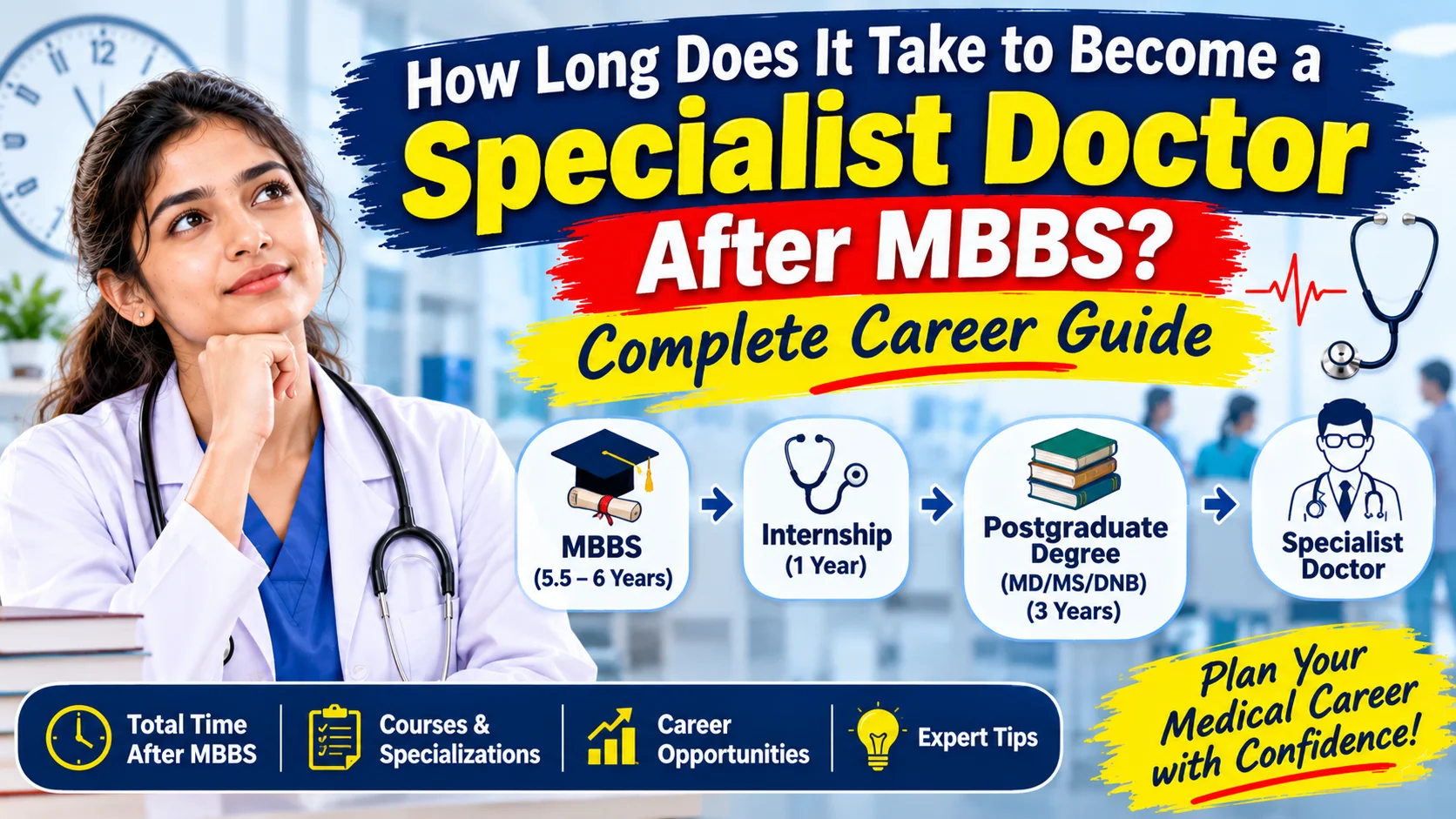
Becoming a doctor is a significant achievement, but for many medical graduates, completing an MBBS degree is only the beginning of their professional journey. Students who want to specialise in fields such as Cardiology, Neurology, Dermatology, Orthopaedics or Paediatrics need to pursue additional medical education and clinical training.One of the most common questions among medical aspirants is: How long does it take to become a specialist doctor after MBBS?In India, becoming a specialist doctor generally takes around 8.5 years from the beginning of MBBS. However, students who want to become super-specialists may need approximately 11.5 years, depending on their chosen medical field and postgraduate qualifications.The usual pathway includes completing MBBS, followed by postgraduate education such as MD or MS. Students interested in advanced specialities may continue their education through DM or MCh programmes.This guide explains the complete journey, course durations, postgraduate qualifications, entrance examinations and career opportunities available after MBBS.
1. How Long Does It Take to Become a Specialist Doctor After MBBS?
The time required to become a specialist doctor depends on the qualification and medical speciality a student chooses.
A typical pathway includes:
- 4.5 years of academic MBBS education.
- 1 year of compulsory rotating internship.
- 3 years of postgraduate education through MD or MS.
- Approximately 3 additional years for a common super-speciality pathway.
Specialist Doctor Career Timeline in India
|
Education Stage |
Duration |
|
MBBS Academic Course |
4.5 Years |
|
Compulsory Internship |
1 Year |
|
MD/MS Postgraduate Course |
3 Years |
|
DM/MCh Super-Speciality Course |
Generally 3 Years |
|
Total with MD/MS |
8.5 Years |
|
Total with MD/MS and DM/MCh |
11.5 Years |
The timeline starts from the beginning of MBBS and assumes students progress without admission delays or breaks. Students who need additional preparation time, wait for counselling or take a break between courses may require more time.
2. How to Become a Specialist Doctor After MBBS: Step-by-Step Process
Understanding the complete medical education pathway can help students plan their future studies and career goals.
Step 1: Complete Class 12 with PCB
The first step is completing Class 12 or an equivalent qualifying examination with Physics, Chemistry and Biology/Biotechnology, along with the required subjects. Students must satisfy the applicable eligibility requirements for medical admission in India.
Step 2: Qualify NEET UG
Students who want to pursue MBBS in India must qualify for the National Eligibility cum Entrance Test (NEET UG). The examination is conducted by the National Testing Agency (NTA). Admission depends on NEET performance, eligibility conditions, seat availability and the applicable counselling process. Students can check examination notifications, registration details and official updates through the NEET UG official website.
Step 3: Complete the MBBS Course
The MBBS programme generally takes 5.5 years, including four and a half years of academic education and one year of compulsory rotating internship.
During the course, students study several medical subjects, including:
- Anatomy
- Physiology
- Biochemistry
- Pathology
- Pharmacology
- Microbiology
- Community Medicine
- General Medicine
- General Surgery
- Paediatrics
- Obstetrics and Gynaecology
Students also participate in clinical postings and practical learning to understand disease diagnosis, patient care and hospital procedures.
Step 4: Complete the Compulsory Internship
After completing the academic phase, students undertake a compulsory rotating internship. During this period, they receive supervised clinical experience in different medical departments. It helps them understand hospital operations, patient management and practical medical responsibilities. Completing the required internship is an important eligibility requirement for progressing to postgraduate medical education.
Step 5: Qualify for Postgraduate Admission
After completing MBBS and satisfying the required internship conditions, eligible candidates can apply for postgraduate medical education. For many broad-speciality MD and MS programmes, admission is conducted through NEET PG and the applicable counselling process. Postgraduate medical programmes generally take three years to complete.
Step 6: Complete MD or MS
MD and MS are postgraduate medical qualifications that allow graduates to develop specialised knowledge and clinical skills.
- MD (Doctor of Medicine): Generally associated with non-surgical medical specialities.
- MS (Master of Surgery): Generally associated with surgical specialities.
After completing the required course and registration formalities, graduates can pursue professional opportunities in their chosen speciality.
Step 7: Pursue Super-Speciality Training (Optional)
Some doctors decide to continue their education after MD or MS to gain advanced expertise in a particular medical field.
The two common qualifications are:
- DM (Doctorate of Medicine): Advanced training in selected medical specialities.
- MCh (Master of Chirurgiae): Advanced training in selected surgical specialities.
These courses generally take three years, although duration and eligibility depend on the programme and applicable admission regulations.
3. Difference Between MBBS, MD, MS, DM and MCh
Medical students often find it confusing to understand the different qualifications available after MBBS. Each degree represents a separate stage of medical education.
|
Qualification |
Full Form |
Main Purpose |
|
MBBS |
Bachelor of Medicine and Bachelor of Surgery |
Basic medical qualification |
|
MD |
Doctor of Medicine |
Postgraduate medical specialisation |
|
MS |
Master of Surgery |
Postgraduate surgical specialisation |
|
DM |
Doctorate of Medicine |
Super-speciality medical training |
|
MCh |
Master of Chirurgiae |
Super-speciality surgical training |
Example of a Medical Career Pathway
A student interested in Cardiology may follow this route:
MBBS → MD in General Medicine → DM in Cardiology
Similarly, a student interested in Neurosurgery may follow a common pathway involving:
MBBS → MS in General Surgery → MCh in Neurosurgery
Some super-speciality programmes may have alternative entry routes, so students should check the current eligibility requirements before applying.
4. How Long Does It Take to Become Different Types of Specialist Doctors?
The total training period depends on the speciality and postgraduate qualifications required. Below are examples of common medical career pathways in India.
|
Speciality |
Typical Education Pathway |
Approximate Total Duration |
|
General Medicine |
MBBS + Internship + MD |
8.5 Years |
|
Dermatology |
MBBS + Internship + MD |
8.5 Years |
|
Paediatrics |
MBBS + Internship + MD |
8.5 Years |
|
Radiodiagnosis |
MBBS + Internship + MD |
8.5 Years |
|
General Surgery |
MBBS + Internship + MS |
8.5 Years |
|
Orthopaedics |
MBBS + Internship + MS |
8.5 Years |
|
Obstetrics and Gynaecology |
MBBS + Internship + MS |
8.5 Years |
|
Cardiology |
MBBS + Internship + MD + DM |
11.5 Years |
|
Neurology |
MBBS + Internship + MD + DM |
11.5 Years |
|
Neurosurgery |
MBBS + Internship + MS + MCh |
11.5 Years |
Note: These are examples of common training pathways. Some super-specialities have alternative entry routes or different course structures under current medical education regulations.
5. Popular Specialist Doctor Careers After MBBS
After completing MBBS, students can explore several medical specialities based on their interests, academic strengths and career goals.
1. Cardiologist
A cardiologist specialises in diagnosing and treating diseases related to the heart and circulatory system. Cardiologists work with patients experiencing different heart-related conditions and may practise in specialised cardiac hospitals.
Common education pathway: MBBS → MD in General Medicine → DM in Cardiology.
2. Neurologist
Neurologists specialise in disorders affecting the brain, spinal cord and nervous system. They diagnose and manage neurological conditions and work in hospitals, specialised centres and medical institutions.
Common education pathway: MBBS → MD in General Medicine → DM in Neurology.
3. Dermatologist
Dermatologists diagnose and treat conditions related to the skin, hair and nails. They may work in hospitals, dermatology clinics and specialised healthcare centres.
Common education pathway: MBBS → MD in Dermatology, Venereology and Leprosy.
4. Orthopaedic Specialist
Orthopaedic specialists focus on conditions affecting bones, joints, muscles and the musculoskeletal system. They may work in general hospitals, orthopaedic centres and surgical departments.
Common education pathway: MBBS → MS in Orthopaedics.
5. Paediatrician
Paediatricians provide medical care to infants, children and adolescents. They focus on childhood illnesses, development, preventive healthcare and general medical treatment.
Common education pathway: MBBS → MD in Paediatrics.
6. Radiologist
Radiologists use medical imaging technologies to help diagnose and monitor different health conditions. Their work involves interpreting medical images and collaborating with other medical specialists.
Common education pathway: MBBS → MD in Radiodiagnosis.
7. Neurosurgeon
Neurosurgeons specialise in surgical treatment involving the brain, spine and nervous system. They receive advanced surgical training to manage complex conditions.
Common education pathway: MBBS → MS in General Surgery → MCh in Neurosurgery, where applicable.
6. Which Entrance Exams Are Required After MBBS?
Students must qualify for the relevant entrance examination to pursue postgraduate or super-speciality medical education.
The main examinations include the following:
NEET PG
NEET PG is used for admission to many MD, MS and postgraduate diploma programmes in India, subject to the applicable admission regulations.Candidates should check the latest examination notification for eligibility, internship completion deadlines and counselling details.
INI-CET
The Institute of National Importance Combined Entrance Test (INI-CET) is used for admission to specified postgraduate medical programmes at participating Institutes of National Importance.Students should review the official examination information to identify the participating institutions and available courses.
NEET SS
NEET SS is used for admission to various DM and MCh super-speciality programmes under the applicable admission framework.Candidates should verify the latest official notification for examination dates, eligibility and counselling information.
Important: Medical entrance examination rules can change. Students should always check the latest notifications from the relevant examination and counselling authorities.
7. Is Becoming a Specialist Doctor Difficult?
Becoming a specialist doctor requires consistent academic effort, practical learning and long-term commitment. Students need to understand medical concepts, develop clinical reasoning skills and gain experience through supervised clinical training. Postgraduate entrance examinations can also be competitive because the number of available seats is limited in many specialities. However, a structured study plan can help students prepare for each stage.
Tips for Aspiring Specialist Doctors
- Build a strong foundation in medical science during MBBS.
- Attend clinical postings regularly.
- Revise important subjects throughout the course.
- Practise examination-style questions.
- Learn from clinical cases under supervision.
- Explore different specialities before selecting one.
- Research postgraduate course requirements.
- Stay updated with official examination notifications.
Students should select a speciality based on their interests, professional goals, training requirements and understanding of the work involved.
8. Career Opportunities After Becoming a Specialist Doctor
Completing postgraduate medical education can open several professional opportunities.
1. Hospital Consultant
Specialists can work in private hospitals, government hospitals, multi-speciality hospitals and specialised healthcare centres according to their qualifications and registration.
2. Government Medical Services
Eligible specialists can apply for government healthcare positions when recruitment notifications are announced.
The selection process and required qualifications depend on the recruiting organisation.
3. Private Medical Practice
Doctors who satisfy the required registration and professional conditions can establish or join a private clinical practice.
4. Medical Teaching
Specialists can explore academic careers in medical colleges and teaching hospitals, subject to the applicable qualifications, experience and appointment requirements.
5. Medical Research
Doctors interested in scientific work can participate in clinical research, medical studies and academic projects.
6. Super-Speciality Practice
Doctors who complete additional DM or MCh training can develop advanced expertise in a specific medical or surgical field.
9. Important Tips for Students Planning a Specialist Medical Career
Planning early can help students understand the education pathway and prepare for future opportunities.
Build Strong MBBS Fundamentals: A good understanding of medical subjects helps students during postgraduate preparation.
Explore Different Specialities: Clinical postings provide opportunities to understand the responsibilities and working environment of different departments.
Research Course Requirements: Check the entrance examinations, course duration and eligibility requirements for your preferred speciality.
Understand Admission Competition: Postgraduate admission depends on examination performance, seat availability, reservation rules and counselling guidelines.
Plan Your Finances: Consider tuition fees, accommodation, examination expenses and other costs associated with postgraduate education.
Follow Official Medical Guidelines: Refer to the National Medical Commission (NMC) for medical education regulations and recognised qualification information. Students can also use MBBS Advisor to explore medical education information and admission-related guidance. For general information about global health and healthcare systems, students can refer to the World Health Organization (WHO). The World Directory of Medical Schools (WDOMS) is another useful directory for researching medical schools. However, a WDOMS listing alone does not guarantee eligibility for medical licensing in another country.
Conclusion
Becoming a specialist doctor in India requires additional medical education and supervised clinical training after MBBS.A typical pathway involves completing MBBS in 5.5 years, including the compulsory internship, followed by three years of postgraduate education through MD or MS. Students who choose a common super-speciality pathway may undertake another three years of training through DM or MCh.Therefore, the total journey generally takes around 8.5 years from the beginning of MBBS for a broad-speciality qualification and approximately 11.5 years for a common super-speciality pathway.The actual duration depends on the chosen speciality, admission schedules, eligibility requirements and current medical education regulations.Students should focus on developing strong medical knowledge, gaining clinical experience and selecting a speciality that matches their interests and long-term professional goals.
Frequently Asked Questions (FAQs)
1. How long does it take to become a specialist doctor after MBBS?
Students generally complete three years of postgraduate education through MD or MS after MBBS and the required internship. A common super-speciality pathway requires approximately three additional years.
2. Can I become a specialist doctor immediately after MBBS?
MBBS is the basic medical qualification. To become a specialist in a particular field, graduates generally need to complete postgraduate medical education such as MD or MS.
3. How long does it take to become a cardiologist in India?
A common pathway includes 5.5 years of MBBS, three years of MD in General Medicine and three years of DM in Cardiology. The total duration is approximately 11.5 years from the beginning of MBBS.
4. How many years does it take to become a dermatologist?
Students generally complete 5.5 years of MBBS followed by three years of MD in Dermatology, Venereology and Leprosy. The total duration is approximately 8.5 years from the beginning of MBBS.
5. Is MD compulsory after MBBS to become a specialist?
No. Some specialities require MS rather than MD. The qualification depends on the medical field a student chooses.
6. What is the difference between MD and MS?
MD is generally associated with non-surgical medical specialities, while MS is generally associated with surgical specialities. Both are postgraduate medical qualifications.
7. Can I pursue DM directly after MBBS?
Some super-speciality programmes may offer direct-entry pathways, depending on the speciality and current admission regulations. Students should verify the latest eligibility requirements.
8. Which entrance exam is required for MD and MS admission?
NEET PG is used for admission to many MD and MS programmes in India. INI-CET is used for specified postgraduate courses at participating Institutes of National Importance.
9. Is NEET SS required for super-speciality courses?
NEET SS is used for admission to various DM and MCh programmes under the applicable admission framework. Candidates should check the latest official examination information.
10. Can I work while studying MD or MS?
MD and MS programmes generally involve structured clinical training and significant academic responsibilities. Work arrangements depend on the institution and applicable regulations.
11. What is the shortest common route to becoming a specialist after MBBS?
A common broad-speciality pathway includes MBBS, compulsory internship and a three-year MD or MS programme. This takes approximately 8.5 years from the beginning of MBBS.
12. Can an MBBS doctor become a professor at a medical college?
Eligible doctors can pursue teaching careers after completing the required postgraduate qualifications and meeting the applicable teaching experience and appointment requirements.