 Russia
 Belarus
 Georgia
 Kazakhstan
 Kyrgyzstan
 Uzbekistan
 China
China Nepal
Nepal Bangladesh
 Poland
 Romania
 Slovakia
 Hungary
 N. Macedonia
 Vietnam
 Canada
 Armenia
 UK
UK Australia
 USA
USA Ireland
 Germany
 New Zealand
 Italy
Italy France
 Singapore
 Netherlands
 Sweden
 Switzerland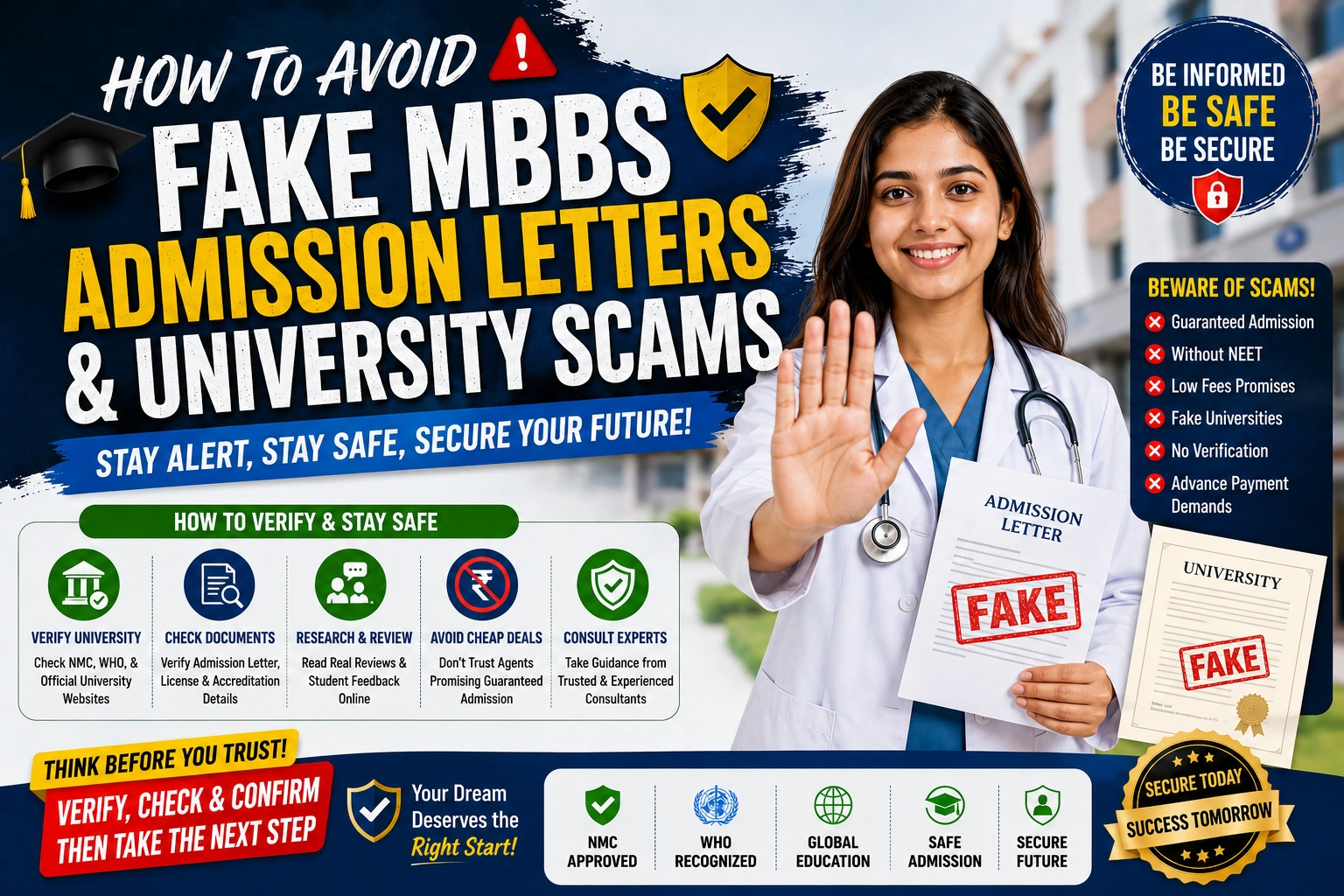
Every year, thousands of Indian students wish to pursue their ambition of becoming doctors through MBBS programs abroad. Due to the tough competition for government medical seats, students are now looking to study medicine in countries such as Russia, Georgia, Kazakhstan, Uzbekistan, Nepal, Kyrgyzstan, and Bangladesh, which offer comparatively affordable programs. Although there are many legitimate options, the demand has also led to a large number of fake admission letters, forged documents, unregistered agents, and fraudulent overseas education services.
Students lose millions of rupees after receiving fake admission confirmations and/or pay advance tuition fees to unregistered agents. In many instances, students find out about the scam after landing in the foreign country, or when they are unable to confirm their admission with the foreign university.
Trusted education services such as MBBS Advisor help students avoid these situations by educating them on the admission process, identifying legitimate universities, and helping them avoid costly mistakes that jeopardize their money and future.
This guide elaborates on how the MBBS fake admission scams operate, recognizing the warning signs, and explains how students can protect themselves when responding to admission offers.
Why There Has Been An Increase In Fake MBBS Admission Scams
The increased popularity to study medicine abroad has created opportunities both legitimate and fraudulent. Scammers take advantage of students that are under pressure immediately after NEET results are announced to secure admissions.
Unrealistic scholarships, guarantees of admission, direct admission without documentation, and extremely low tuition are schemes used by fraudsters. Many parents do not know the process to apply to foreign universities and so, fall victim to forged documents and false promises.
The use of digital technology has simplified the creation of bogus university websites, forged admission letters, fake Visa documents, and fabricated payment receipts that can look real.
Common Types of MBBS Admission Scams
To protect themselves, students should know the different types of fraud in the admission process.
Fake Admission Letters
Some agents create admission letters by using a university logo, a forged signature, and a fake registration number. Students think that they have obtained admission, while in reality, the university has no record of their application.
Fake University Websites
Scammers create websites that look almost identical to official university portals, and they can pocket the application and tuition fees.
Unauthorized Admission Consultants
Some consultants claim to represent foreign universities, but they operate with no authorization.
Fake Scholarships
Processing fees are collected with the promise of a 70–100% scholarship, but students later find out that no scholarship exists.
Visa Fraud
Invitation letters and Visa documents created by some agencies are not only fake, but lead to a rejection of the Visa.
Hidden Fee Scams
Some consultants advertise a low tuition fee, but later require payment for Hostel fees, Insurance fees, Documentation, Registration, and Visa Processing.
Suspicious Admission Offers
Students should look for red flags to identify fraudulent offers of admission.
A legitimate university admission letter has specific student details, authentic university data, document verification, and signatures. It is a cause for concern if there are spelling errors in the letter or the letter provides incorrect details about the university or the registration, and has vague payment instructions. Such a letter is a cause for concern and should be verified immediately.
An admission letter received in a few hours after applying is yet another warning sign. Most universities finish document verification and then issue confirmation letters.
It is also a cause for concern if tuition is requested to be paid to a personal bank account instead of the university’s account.
Verify If the University Is Recognized
An effective way to prevent fraud is to check the recognition of the university prior to applying.
Students should be wary if the medical university is not listed in the World Directory of Medical Schools (WDOMS). Medical schools listed in this directory are acknowledged for providing quality medical education.
The recognition and regulations of the National Medical Commission (NMC) should also be verified for medical universities in India.
The World Health Organization (WHO) has public health information across the globe. This information should also be consulted as international medical education has its own standards.
Failing to take these steps will most likely lead to studying at an institution that is unrecognized, and will also cause issues with licensing after graduation.
Verify Each Admission Letter with the University
Do not rely only on the assurances of the education consultants.
If you receive an admission letter, send an inquiry to the international admissions office of the university. You should use the contact information provided on the official university website.
Do this to verify with the university:
- Your application ID
- Admission reference ID
- Your passport info
- Your tuition payment status
- Hostel Accommodation Assignment
- Invitation Letter
Most genuine universities typically respond in a few business days and verify the authenticity of the admission letter.
Thoroughly Vet the Consultant
The wrong choice of a consultant is often the start of admission scams.
Students should ensure that the consulting firm has a history of successful admissions, has a physical office, has positive online reviews, and has operated for a substantial number of years before signing an agreement.
Trustworthy platforms such as MBBS Advisor provide potential students readily available information for multiple universities concerning admission processes and available medical courses.
Beware of consultants who refuse to provide a written agreement and official payment receipt.
Payments Should Not be Made Without a Verification
Financial fraud is a rampant crime during the process of gaining admission to study MBBS abroad.
Students should never send money:
- To an individual's bank account
- As cash payments without an official receipt
- Using unofficial and unsanctioned payment links
- Until there is proper communication from the university
Students should ensure that there are official Invoices, Receipts, and Payment Acknowledgements from the university.
If fraud needs to be prosecuted, the records should be retained.
NEET Eligibility Should be Verified Before Admission Abroad
Some admission fraudsters believe that it is possible for students to take up an MBBS abroad with no qualification in NEET.
Indian students should be aware that aspiring to practice medicine in India after MBBS abroad mandates compliance to the eligibility stipulations determined by the NMC with NEET qualification mandated.
Criteria imposed by the NMC should be verified to determine the students’ likelihood to gain admission to that university. Students who are uncertain about their admission to a university can estimate their rank using the NEET Rank Predictor.
This enables students to avoid false promises and, instead, make sound and realistic admission choices.
Compare Universities Before Making Final Admission
No one should make an admission decision based on a single advisor's recommendation.
Instead, look at the following when comparing universities:
- Status of recognition
- Tuition costs
- Hostel accommodations
- Clinical training opportunities
- Availability of English-medium instruction
- FMGE/NExT performance statistics
- Internships
- Reviews
- Safety of international students
MBBS Abroad has a wealth of information and comparisons, organized by country, that allow students to make comparisons and identify unadvisable choices.
What Genuine Universities Typically Request
Not all legitimate universities have the same processes, but genuine admission processes require some verification of documents.
Common document requests include:
- NEET Scorecard
- Class 10 Marksheet
- Class 12 Marksheet
- Passport
- Passport-size photographs
- Birth certificate (if required)
- Medical fitness certificate
- Student application form
- A valid email ID
Admission by an agency that does not verify any documents should be viewed as a serious warning sign.
What to Ask Before Making Any Payment
Before payment, the following should be asked of the university or the consultant:
- Is the university recognized?
- Can I verify my admission with the university?
- What does the tuition fee cover?
- Are hostel fees paid separately?
- What are the fees and conditions for a refund?
- Who will send the invitation letter?
- Will the payments be made to the university?
- Is there a verified student contract?
Legitimate consultants will answer all of these questions and will have supporting documentation.
If You Suspect Fraud
The admission letters or consultants you are working with may be fraudulent. You should make no further payments.
Check directly with the university to confirm your admission details. Save all emails, payment confirmations, receipts, WhatsApp conversations, agreements, and bank transactions. If fraud is determined, report to the appropriate cybercrime division and consumer protection agencies.
Taking action immediately can help protect you from losing more money as well as assist authorities in the investigation.
Conclusion
Studying MBBS abroad offers incredible opportunities, but requires thorough research and strong verification. Students should not let opportunities such as fake limited seat offers, fake huge discounts, or fake assured admission offers pressure them. Universities that really want to help students will have a clear admission system, check the documents with care, and will contact the applicants directly.
Before you do anything, check that the university is on the National Medical Commission (NMC) list, is in the World Directory of Medical Schools (WDOMS), and is in line with the World Health Organization (WHO) and standards of international medical education. Students should also check the requirements of NEET and then check offers using the NEET Rank Predictor, check verified MBBS Abroad offers, and use the trusted and verified platform MBBS Advisor.
Your education, future career as a doctor, and dreams are worth the verification.