 Russia
 Belarus
 Georgia
 Kazakhstan
 Kyrgyzstan
 Uzbekistan
 China
China Nepal
Nepal Bangladesh
 Poland
 Romania
 Slovakia
 Hungary
 N. Macedonia
 Vietnam
 Canada
 Armenia
 UK
UK Australia
 USA
USA Ireland
 Germany
 New Zealand
 Italy
Italy France
 Singapore
 Netherlands
 Sweden
 Switzerland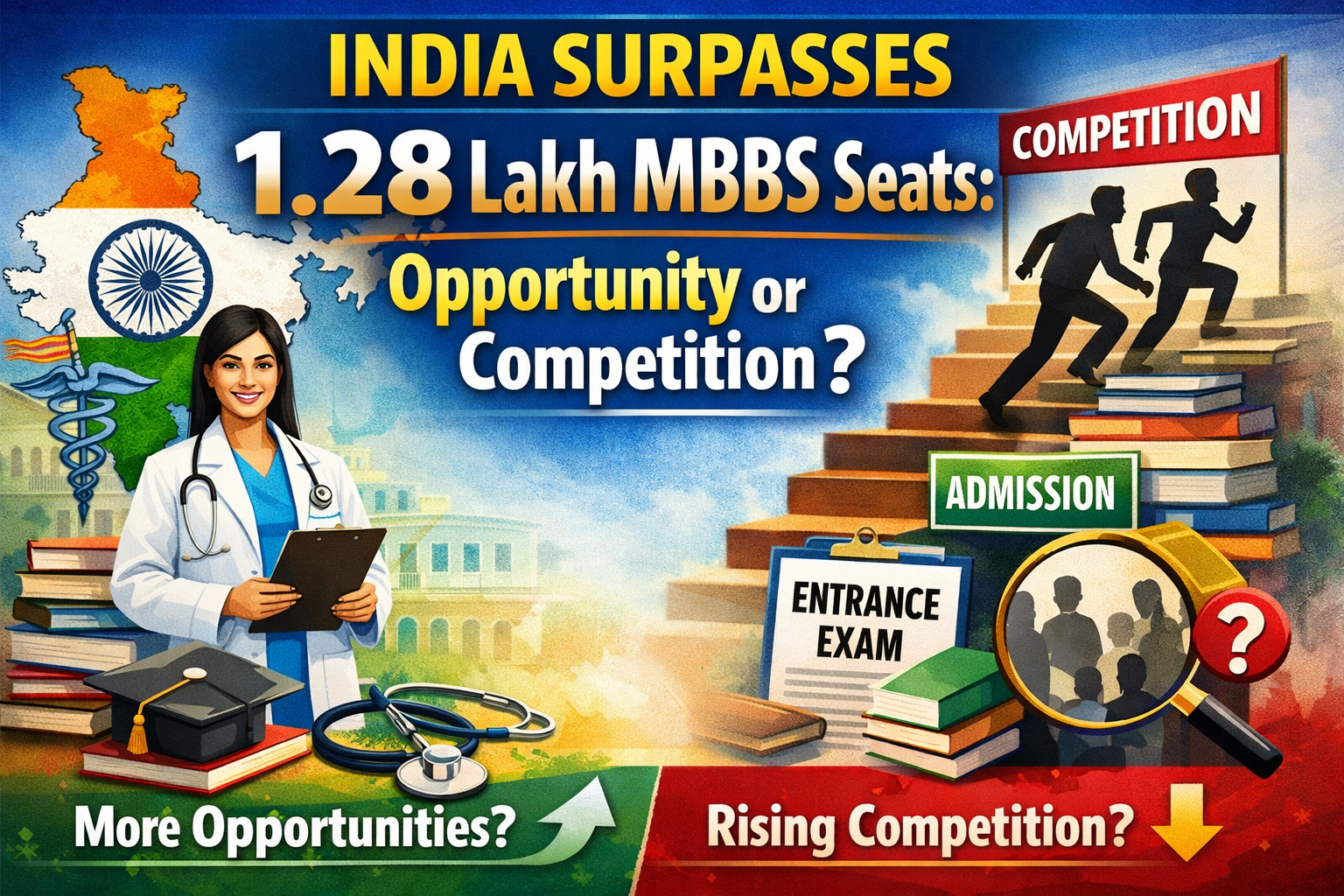
A significant milestone has been achieved in India’s medical education system, as the number of MBBS seats passes 1.28 lakh. The wide-ranging expansion represents a commitment to bolstering healthcare infrastructure and increasing the number of trained doctors in the country. As this development widens avenues for wannabes, the competition remains cut-throat because there are lakhs of students who apply to NEET every year.
Massive Growth Driven by Reforms
The significant hike in MBBS seats is the result of reforms effected by the National Medical Commission. The medical colleges are recognised and newly-formed institutions are approved across India by this regulatory body.
The expansion is also in line with global healthcare benchmarks set by the World Health Organization, particularly with respect to improving doctor–patient ratios.
Opportunity for NEET Aspirants
This increase in seats is advantageous to NEET-UG aspirants for the following reasons:
- Higher chances of admission
- More college options across India
- Less need for MBBS abroad study
The admissions process, though, remains complicated. Counselling, documentation and college selection assistance are provided to these students through platforms such as MBBS Advisor.
Competition Still Remains Intense
Even with more seats:
- NEET is attended by more than 20 lakh students
- There are only about 1.28 lakh seats available
- Many qualified students nevertheless miss the boat
- It also indicates that competition is still incredibly high.
- Government vs Private Colleges
- Government Colleges
- Low fees
- Very high cut-offs
- Limited seats
- Private Colleges
- High fees
- Lower cut-offs
- Limited affordability
So, while there are some more seats available, financial challenges remain.
Quality vs Quantity Debate
Which makes the rapid growth have gotten concerns too:
- Faculty shortages
- Infrastructure gaps
- Uneven clinical exposure
- The National Medical Commission will keep a check on the institutions to ensure quality education.
PG Bottleneck: A Future Challenge
Why supplementary rise in MBBS offers has put mobbing pressure on PG education:
- More MBBS seats than PG seats
- Higher competition in NEET-PG
- Greater importance of specialization
- To give your career a real kick start, you have to plan ahead.
- Strengthening Rural Healthcare
- New district hospital-linked medical colleges are aiding:
- Improve rural healthcare access
- Increase doctor availability
- The program conforms to the international standards of World Health Organization
Conclusion
India's achievement crossing 1.28 lakh MBBS seats It creates more opportunities but doesn’t lessen competition.
Through support from MBBS advisors and regulations from the National Medical Commission, students are able to decide and manage their future plans in a better way.
However, getting an MBBS seat is not the only thing after all—it is just the very first step and the ultimate goal is to succeed in a medical career.
India Surpasses 1.28 Lakh MBBS Seats: Opportunity or Competition
A significant milestone has been achieved in India’s medical education system, as the number of MBBS seats passes 1.28 lakh. The wide-ranging expansion represents a commitment to bolstering healthcare infrastructure and increasing the number of trained doctors in the country. As this development widens avenues for wannabes, the competition remains cut-throat because there are lakhs of students who apply to NEET every year.
Massive Growth Driven by Reforms
The significant hike in MBBS seats is the result of reforms effected by the National Medical Commission. The medical colleges are recognised and newly-formed institutions are approved across India by this regulatory body.
The expansion is also in line with global healthcare benchmarks set by the World Health Organization, particularly with respect to improving doctor–patient ratios.
Opportunity for NEET Aspirants
This increase in seats is advantageous to NEET-UG aspirants for the following reasons:
- Higher chances of admission
- More college options across India
- Less need for MBBS abroad study
The admissions process, though, remains complicated. Counselling, documentation and college selection assistance are provided to these students through platforms such as MBBS Advisor.
Competition Still Remains Intense
Even with more seats:
- NEET is attended by more than 20 lakh students
- There are only about 1.28 lakh seats available
- Many qualified students nevertheless miss the boat
- It also indicates that competition is still incredibly high.
- Government vs Private Colleges
- Government Colleges
- Low fees
- Very high cut-offs
- Limited seats
- Private Colleges
- High fees
- Lower cut-offs
- Limited affordability
So, while there are some more seats available, financial challenges remain.
Quality vs Quantity Debate
Which makes the rapid growth have gotten concerns too:
- Faculty shortages
- Infrastructure gaps
- Uneven clinical exposure
- The National Medical Commission will keep a check on the institutions to ensure quality education.
PG Bottleneck: A Future Challenge
Why supplementary rise in MBBS offers has put mobbing pressure on PG education:
- More MBBS seats than PG seats
- Higher competition in NEET-PG
- Greater importance of specialization
- To give your career a real kick start, you have to plan ahead.
- Strengthening Rural Healthcare
- New district hospital-linked medical colleges are aiding:
- Improve rural healthcare access
- Increase doctor availability
- The program conforms to the international standards of World Health Organization
Conclusion
India's achievement crossing 1.28 lakh MBBS seats It creates more opportunities but doesn’t lessen competition.
Through support from MBBS advisors and regulations from the National Medical Commission, students are able to decide and manage their future plans in a better way.
However, getting an MBBS seat is not the only thing after all—it is just the very first step and the ultimate goal is to succeed in a medical career.
India Surpasses 1.28 Lakh MBBS Seats: Opportunity or Competition
A significant milestone has been achieved in India’s medical education system, as the number of MBBS seats passes 1.28 lakh. The wide-ranging expansion represents a commitment to bolstering healthcare infrastructure and increasing the number of trained doctors in the country. As this development widens avenues for wannabes, the competition remains cut-throat because there are lakhs of students who apply to NEET every year.
Massive Growth Driven by Reforms
The significant hike in MBBS seats is the result of reforms effected by the National Medical Commission. The medical colleges are recognised and newly-formed institutions are approved across India by this regulatory body.
The expansion is also in line with global healthcare benchmarks set by the World Health Organization, particularly with respect to improving doctor–patient ratios.
Opportunity for NEET Aspirants
This increase in seats is advantageous to NEET-UG aspirants for the following reasons:
- Higher chances of admission
- More college options across India
- Less need for MBBS abroad study
The admissions process, though, remains complicated. Counselling, documentation and college selection assistance are provided to these students through platforms such as MBBS Advisor.
Competition Still Remains Intense
Even with more seats:
- NEET is attended by more than 20 lakh students
- There are only about 1.28 lakh seats available
- Many qualified students nevertheless miss the boat
- It also indicates that competition is still incredibly high.
- Government vs Private Colleges
- Government Colleges
- Low fees
- Very high cut-offs
- Limited seats
- Private Colleges
- High fees
- Lower cut-offs
- Limited affordability
So, while there are some more seats available, financial challenges remain.
Quality vs Quantity Debate
Which makes the rapid growth have gotten concerns too:
- Faculty shortages
- Infrastructure gaps
- Uneven clinical exposure
- The National Medical Commission will keep a check on the institutions to ensure quality education.
PG Bottleneck: A Future Challenge
Why supplementary rise in MBBS offers has put mobbing pressure on PG education:
- More MBBS seats than PG seats
- Higher competition in NEET-PG
- Greater importance of specialization
- To give your career a real kick start, you have to plan ahead.
- Strengthening Rural Healthcare
- New district hospital-linked medical colleges are aiding:
- Improve rural healthcare access
- Increase doctor availability
- The program conforms to the international standards of World Health Organization
Conclusion
India's achievement crossing 1.28 lakh MBBS seats It creates more opportunities but doesn’t lessen competition.
Through support from MBBS advisors and regulations from the National Medical Commission, students are able to decide and manage their future plans in a better way.
However, getting an MBBS seat is not the only thing after all—it is just the very first step and the ultimate goal is to succeed in a medical career.