 Russia
 Belarus
 Georgia
 Kazakhstan
 Kyrgyzstan
 Uzbekistan
 China
China Nepal
Nepal Bangladesh
 Poland
 Romania
 Slovakia
 Hungary
 N. Macedonia
 Vietnam
 Canada
 Armenia
 UK
UK Australia
 USA
USA Ireland
 Germany
 New Zealand
 Italy
Italy France
 Singapore
 Netherlands
 Sweden
 Switzerland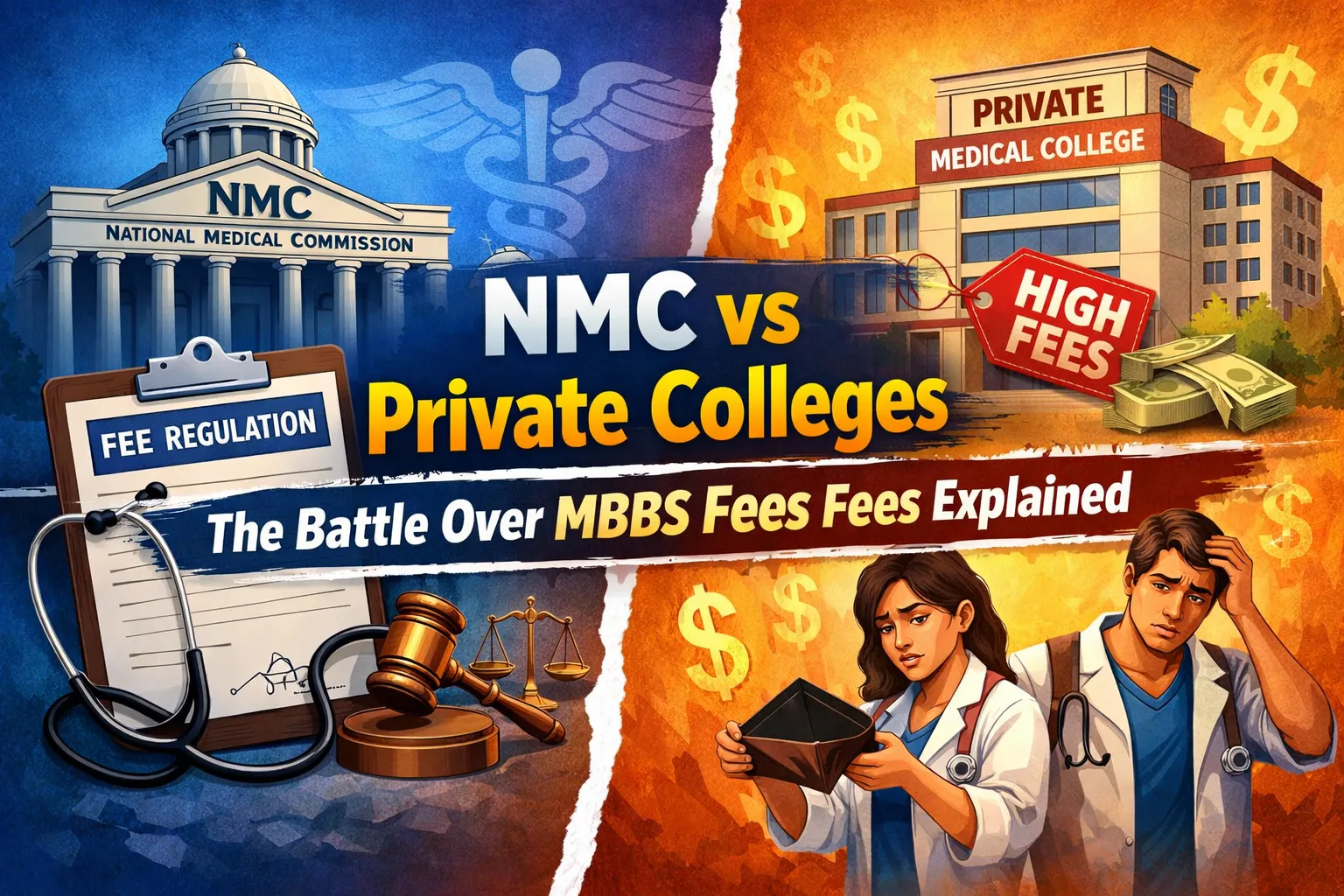
The increasing cost of medical education in India is a serious concern for these aspiring doctors and their families. In the last ten years, MBBS fees charged by private colleges have increased significantly, to the point where quality medical education is inaccessible for many deserving students. This ongoing battle between regulatory authorities and private institutions has caused what can be termed a “battle” over MBBS fees.
The issue here is that of the National Medical Commission, whose intention is to bring transparency, affordability and fairness in medical education. On the other side, are private medical colleges arguing for financial autonomy and sustainability.
Reason behind rise in MBBS fees at Private Colleges?
Private medical colleges are usually charging high fees for the following reasons:
- Expensive infrastructure and hospital setup
- Faculty salaries and operational costs
- Limited government funding
- Investment in modern medical technology
Consequently, the MBBS fees in most private colleges ranges from ?50 lakhs to above ?1 crore for entire course. This puts a huge financial strain on students[6].
A good mbbs advisor will help students chart the right path for taking a degree in an affordable price and also to higher reputable colleges that are easier to get admission into, be it in India or abroad.
What Is NMC’s Role With Regulating Fees
The National Medical Commission has come as a replacement of the Medical Council of India (MCI) and is intended to reform medical education.
Key Actions Taken by NMC:
- 50% seats in private colleges to have regulated fees
- Introduction of transparent admission processes
- Checking bhedh (capitation fees) and such unethical practices
- Ensuring merit-based admissions through NEET
These measures are taken to make MBBS education more accessible and equitable.
But private colleges say such regulations would make it harder for them to maintain quality and recoup the costs of operations.
Private Colleges’ Perspective
Private institutions feel that the stringent fee control impacts:
- Financial sustainability
- Infrastructure development
- Faculty recruitment and retention
A lot of schools also depend on student fees as their main source of income. They say that without enough income, maintaining global standards becomes harder.
How Does India Compare Globally: Too Costly?
When viewed globally, studying MBBS in India’s private colleges could even be costlier than abroad.
Georgia, Kazakhstan, and Uzbekistan are examples of countries that offer:
- Lower tuition fees
- Globally recognized degrees
- Modern infrastructure
- English-medium education
One such course is the MBBS in Georgia which is gaining popularity among Indian students for its cost-effectiveness and international acclaim.
Global Standards & Recognition
The challenges in medical education are not only national; they are global.
The World Health Organization (WHO) — plays an influential role in establishing a framework for the best practices and guidance of health care around the world.
Moreover, medical universities globally are entered in the World Directory of Medical Schools making sure that degrees are internationally recognized.
That is how many Indian students are now looking at global education opportunities as much as their domestic offerings.
The Central Conflict: Regulation vs Autonomy
So the primary concern really in NMC vs private colleges issue is:
NMC’s Goal:
- Affordable education
- Transparency
- Merit-based access
Private Colleges’ Goal:
- Financial independence
- Quality infrastructure
- Return on investment
There is merit to both sides, but the trick is finding a middle ground that accounts for students without ruining education in the process.
Impact on Students
It is students that lose the most amidst this battle.
Challenges Faced:
- High tuition fees
- Limited affordable seats
- Increased competition
- Financial stress on families
As a result, many students have either given up on their medical dreams altogether or been forced to find alternative routes such as going overseas.
Taking guidance for mbbs from a trusted advisor will enable students to take wise decisions considering financial constraints, career goals and international mechanism.
What Lies Ahead?
This is due to the need for a delicate balance between regulation and independence, which will ultimately shape the future of MBBS education in India.
Possible solutions include:
- Expanding government medical colleges
- Increasing fee transparency
- Public-private partnerships
- Scholarships and financial aid programs
By adopting a balanced approach, we can maximize the material access while maintaining performance in medical education.
Final Thoughts
There’s a déjà vu: Rk Shukla Jones — Other for HearingThe ongoing battle between the National Medical Commission and private medical colleges is indicative of an important policy aspect in the education system in India. Affordability is important but not at the cost of global standards.
Students now have great opportunities when it comes to studying in India or an MBBS in Georgia.
Being well-informed, making plans and decisions that are as much about your financial situation as they are your career ambitions is critical to navigating these murky times.