 Russia
 Belarus
 Georgia
 Kazakhstan
 Kyrgyzstan
 Uzbekistan
 China
China Nepal
Nepal Bangladesh
 Poland
 Romania
 Slovakia
 Hungary
 N. Macedonia
 Vietnam
 Canada
 Armenia
 UK
UK Australia
 USA
USA Ireland
 Germany
 New Zealand
 Italy
Italy France
 Singapore
 Netherlands
 Sweden
 Switzerland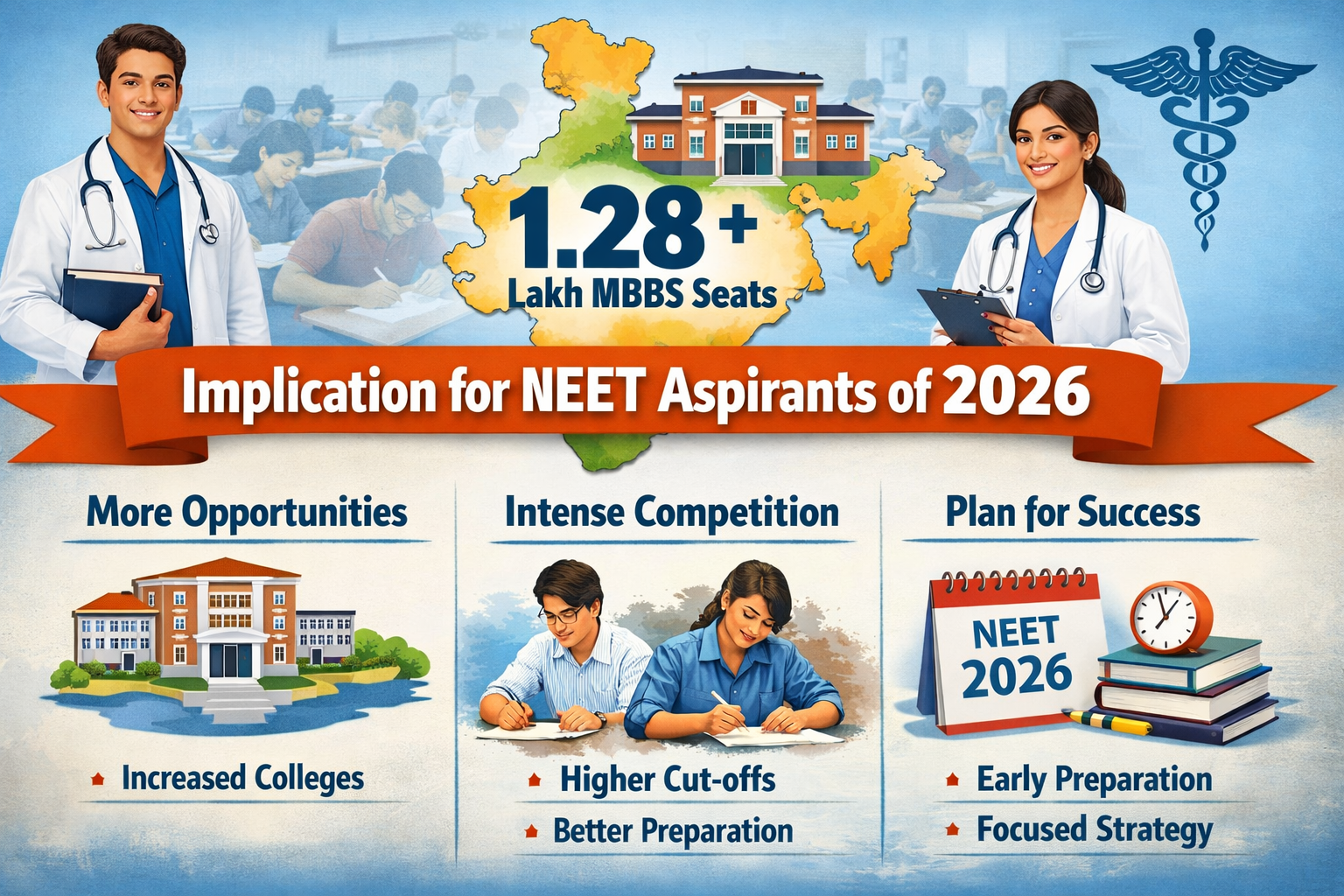
The advancement in medical education has achieved a substantial barrier in India as the count of MBBS seats nationwide?pushed beyond 1.28 lakh (128,000) in government and private medical colleges. This expansion has markedly transformed the scenario for NEET 2026 aspirants, creating a wide range of opportunities but with relentless competition.
The increase in medical seats has been facilitated by both the reforms in the regulatory framework as well as the opening of new colleges and expansion of existing institutions under the National Medical Commission which regulates medical education in India.
The Phenomenon of Exploding Number of Medical Colleges in India
India has pushed aggressively over the last ten years to construct more facilities and add doctors. The National Medical Commission has also granted permission for a number of new medical colleges and increased the seat capacity in many older institutions.
World Health Organization (WHO) global health recommendations target a balance of doctor-to-population ratio in countries across the world.
Today India has climbed to staggering heights:
- 700+ medical colleges
- Filling up more than 1.28 lakh MBBS seats
- Quick expansion of government health institutions
- MBBS Seat Distribution in India
- MBBS seats in India are offered by Allopathic medical colleges of various types.
- Category
- Approx Seats
- Key Highlights
- Government Medical Colleges
- 55,000+
- Affordable fees and high competition
- Private Medical Colleges
- 60,000+
- Higher fees but more availability
- Deemed Universities
- 13,000+
- Autonomous institutions
Government medical colleges have been the most opted for because of lower fee structure and a very good clinical exposure. Though, private medical colleges have also expanded their intake, increasing the number of seats available to become MBBS.
Students commonly seek counselling guidance, admission updates and college information with platforms like MBBS Advisor which gives ample knowledge for medical aspirants.
Implications for NEET 2026 Candidates
According to reports, while the number of MBBS seats is increasing year-on-year, NEET candidates are also growing with each passing year.
Increased Admission Opportunities
MBBS seats have increased, so more students can now get admission compared to earlier years. Previously, there were cases when students who scored well in the NEET examination, couldn't get a seat due to lack of availability.
Now aspirants have:
- You have more medical colleges to choose from
- Better chances of admission
- Dependence to study MBBS abroad reduced
- Platforms like MBBS Advisor provide guidance for students to understand the admission process and counselling practices.
- Growing Competition in NEET
So while the number of seats is up, thanks to the increase in law school applications, there remains a very high level of competition.
- Year
- NEET Applicants
- 2021
- ~16 lakh
- 2023
- ~20 lakh
- 2025
- ~24 lakh
NEET 2026 candidates would cross beyond 25 lakh (and) hence aspirants have no option to continue serious preparation for desirable ranks.
Better Chances Through State Quotas
85% of government MBBS seats in India are reserved under state quota and thereby benefit students from respective states. Recent years have seen states mushroom around new government medical colleges.
Expanded medical infrastructure in these states:
- Uttar Pradesh
- Rajasthan
- Madhya Pradesh
- Tamil Nadu
- These changes are part of the policies started by the National Medical Commission to strengthen medical education.
- Growth of Medical Colleges in Tier-II and IV Cities
The influx of medical colleges in tier-2 and tier-3 cities is yet another game changer. Until recently, most medical institutions were in the metros.
Benefits of this expansion include:
- Improved healthcare in rural areas
- Better clinical exposure for students
- Reduced migration of medical aspirants
- This approach also aligns with recommendations from the World Health Organization on healthcare workforce initiatives.
- More Mid-Range NEET Scores Options
Earlier, a student who scored somewhere between 450–550 marks used to have very limited chances of getting MBBS seats. However, with the proliferation of private colleges and newer institutions, admission has become easier than before.
Students now have:
- More counselling rounds
- Greater college options
- Increased management quota availability
The MBBS Advisor is one of the reliable guidance platforms that keep aspirants updated with counselling updates and admission opportunities.
Impact on India’s Healthcare System
This is also of great import in strengthening the country’s healthcare infrastructure. Doctor shortage is particularly acute in rural India.
Expanding medical education will help:
- Improve doctor-patient ratios
- Strengthen public healthcare systems
- Increase specialist training programs
- Support medical research and innovation
Global bodies such as the World Health Organization have consistently emphasized that medical workforce expansion is critical.
Challenges That Still Remain
Though even more seats became available, some hurdles remain:
- Bosom of private medical colleges with high tuition fees
- Differences in number of colleges per state
- Holes in infrastructure of some new institutions
- Need for experienced faculty members
These are regulated by the National Medical Commission to ensure that quality medical education is imparted in India.
Conclusion
The increase in MBBS seats beyond 1.28 lakh is a significant turning point in medical education system of the country. This growth translates into more opportunities, a wider selection of colleges, and increased access to medical education for aspiring NEET 2026 candidates.
But more applicants means stronger competition will persist. Students must remain aware of the seat allocation, counselling processes and admission trends.
Aspirants aspiring to study medicine can find a great help in exploring trusted resources like MBBS Advisor for making well-informed decisions and seamlessly juggling through the medical admission process.