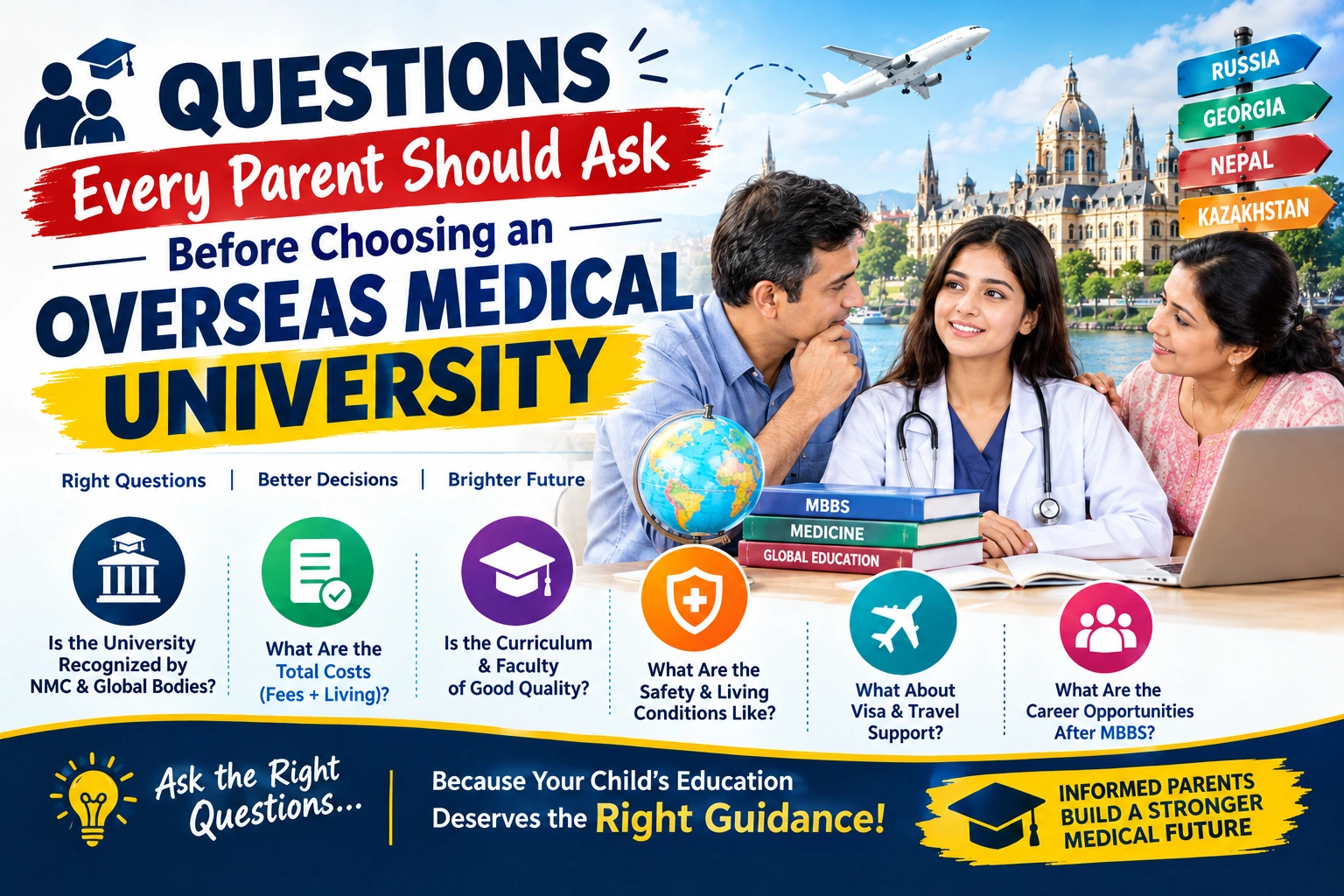
 Russia
 Belarus
 Georgia
 Kazakhstan
 Kyrgyzstan
 Uzbekistan
 China
China Nepal
Nepal Bangladesh
 Poland
 Romania
 Slovakia
 Hungary
 N. Macedonia
 Vietnam
 Canada
 Armenia
 UK
UK Australia
 USA
USA Ireland
 Germany
 New Zealand
 Italy
Italy France
 Singapore
 Netherlands
 Sweden
 Switzerland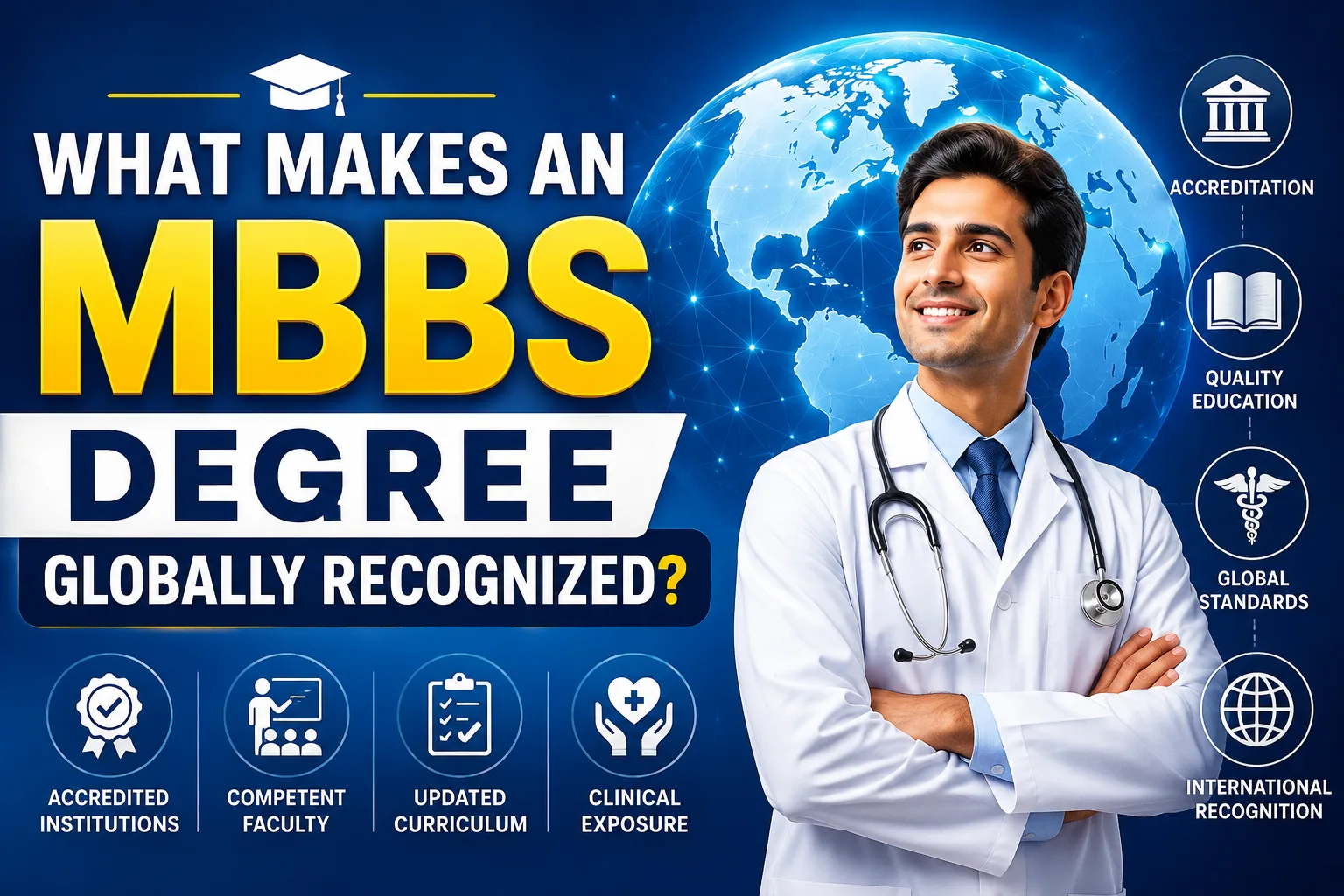
For students and their parents planning to apply to overseas medical schools, choosing which medical school to attend is one of the most critical life decisions for aspiring doctors at the outset of their entire careers.
A globally recognized MBBS degree is the core key that unlocks the prerequisite thresholds for:
- Applying for international medical licensing exams
- Pursuing advanced studies abroad
- Participating in cross-regional scientific research
- Meeting the preconditions to qualify for transnational medical practice
However, many applicants hold two common misconceptions:
- They mistakenly believe that all MBBS programs automatically receive global recognition.
- They incorrectly equate a degree’s global recognition with the ability to practice medicine directly in any region worldwide.
In reality, a globally recognized MBBS degree only meets the prerequisite educational requirements for medical practice applications in different regions, and candidates must still pass local licensing assessments to practice.
The Core Foundation of Global Recognition
The primary core element that underpins an MBBS degree’s global recognition is the issuing institution’s formal accreditation, as well as its inclusion in WDOMS (World Directory of Medical Schools).
Two leading authorities in medical education, WFME (World Federation for Medical Education) and WDOMS itself, have established a unified baseline entry standard for global medical education quality.
The MBBS Advisor platform, built specifically for applicants, can sort out institutional qualifications and support users in making school selection decisions.
Before investing large amounts of time, money, and energy into an overseas medical school, clarifying these core standards and qualification requirements is a necessary prerequisite to avoid common pitfalls and protect the value of your academic investment.
Common Misconceptions About WDOMS Listing
For medical students planning to pursue an overseas MBBS degree, many share a common misunderstanding about the significance of a school’s listing in the World Directory of Medical Schools (WDOMS).
They often equate a medical school’s inclusion in WDOMS with receiving an official, authoritative endorsement of its qualifications.
However, WDOMS explicitly states that a listing in the directory only confirms the relevant school is a real, existing institution, and does not constitute any form of accreditation, recognition, or official endorsement.
For this reason, inclusion in WDOMS can never serve as the sole standard to evaluate the credibility of an overseas medical school.
The professional team at MBBS Advisor also recommends that applicants conduct a comprehensive assessment that combines a school’s official accreditation status and its WDOMS listing, to avoid making incorrect school-choice decisions based on only one piece of information.
Four Core Assessment Dimensions
The following four core assessment dimensions will provide a practical, full-process qualification verification checklist, with all standards closely aligned to the core needs of students after they return to their home country: academic degree verification and medical practice registration.
1. Government Recognition and Legal Authorization
First is recognition of the school’s government-issued operation qualifications, which requires verifying four items:
- Approval from the host country’s ministry of education
- Authorization from the national health regulatory agency
- Qualification to award medical degrees
- Recognition of its physician training qualifications
2. Compliance with NMC Requirements
Second is compliance with the requirements of India’s NMC, rules exclusive to Indian international students.
This covers six verification items including:
- Program length
- Internship structure
- Clinical training
- Program equivalence
- Eligibility to practice medicine in the host country
3. International Academic Standards
Third is that program quality must meet international standards, covering:
- 12 compulsory foundational subjects
- 6 comprehensive competency requirements
4. Clinical Training Standards
Fourth is that practical proficiency in clinical training must meet required standards, including:
- 5 types of practice settings
- 4 core competency targets
All verification items align with the general requirements of global medical regulation, all core claims are supported by authoritative sources, and this framework can accurately fill the information gaps faced by overseas medical students.
International Licensing Eligibility as a Recognition Indicator
To assess the global recognition of a medical school, the core hard indicator is whether its graduates are eligible to sit for the world’s major international medical licensing exams.
Currently, the world’s four top destinations for international medical students each have clear requirements for their licensing access pathways.
United States
The United States requires international medical students applying to take the USMLE to first complete academic credential verification to meet the exam eligibility threshold.
United Kingdom
The United Kingdom requires compliance with relevant regulations of the GMC.
Australia
Australia requires meeting the standards of the Australian Medical Board.
Canada
Canada requires passing the credential verification and exam processes administered by its national competent authority.
Medical schools whose graduates can consistently access these pathways generally hold stronger international credibility.
Understanding the Role of WFME
The recognition assessment framework outlined in this paper specifically clarifies a common public misconception:
WFME only accredits national medical education accreditation bodies, not individual universities.
Its accreditation only reflects the quality of a country’s medical education accreditation framework and cannot directly guarantee consistent educational outcomes across all schools.
This distinction is a core prerequisite for accurately assessing a medical school’s global standing.
Additional Factors Influencing Global Recognition
Beyond this, there are three additional core influencing dimensions, each with clear sub-items.
Academic Reputation
The first dimension, academic reputation, has five supporting sub-items:
- Research publications
- Research funding
- International cooperation
- Faculty achievements
- Medical innovation
Faculty Quality and Educational Resources
The second dimension, faculty quality and educational resources, includes:
Faculty-Related Factors
- Senior professors
- Clinical specialists
- Researchers
- Educational technology professionals
Resource-Related Factors
- Advanced laboratories
- Simulation centers
- Digital libraries
- Research facilities
- Clinical skills centers
International Student Support System
The third dimension, the international student support system, has five service sub-items:
- Academic advising
- Language assistance
- Career counseling
- Visa support
- Mental health services
When students using the MBBS Advisor platform select a school, they simultaneously compare the school’s academic credentials and support services.
A well-developed supportive environment can effectively improve student academic performance and the school’s overall educational outcomes.
How to Evaluate a Medical School Effectively
If you are planning to apply for an overseas MBBS program, you must first clarify the core decision-making logic covering:
- The core criteria for school selection
- Common misconceptions about global degree recognition
- Practical verification processes
- The long-term career value of the degree
The core anchor for measuring a medical school’s education quality is the actual performance of its graduates.
You must proactively verify four core sets of data:
- The pass rate of national unified physician licensing exams
- The residency matching rate
- The graduate school admission rate for students pursuing further study
- Targeted employment outcomes within six months of graduation
Three core institutional strengths underpin these strong outcomes:
- Structured and effective teaching
- Solid and compliant clinical training
- Comprehensive institutional qualifications that meet international standards
These will help you quickly build a basic framework for evaluating high-quality medical schools.
Four Common Misconceptions About Degree Recognition
Among applicants, there are four widespread misconceptions about the global validity of medical degrees.
We will break down the flawed logic behind each misconception one by one to fill information gaps.
We have compiled five degree recognition verification processes that you can directly complete before enrollment, alongside a list of authoritative verification agencies and tools:
to provide you with clear, executable action guidance.
Career Opportunities Supported by a Globally Recognized MBBS Degree
A globally valid medical degree can support you in pursuing six cross-regional career development paths, which highlights the necessity of conducting verification in advance.
We have also forecast the global trend of increasingly strict regulation of medical degree credentials and matched this trend with the latest school selection recommendations.
All information aligns with applicants’ decision-making paths, is specific and actionable, and contains no vague, empty content.
Conclusion
Students who plan to apply for international medical programs must verify whether their target institution holds valid compliance accreditations recognized by:
before selecting a school.
They can use MBBS Advisor to evaluate institutions, compare their accreditations, and make reasonable choices that align with their career development needs.