 Russia
 Belarus
 Georgia
 Kazakhstan
 Kyrgyzstan
 Uzbekistan
 China
China Nepal
Nepal Bangladesh
 Poland
 Romania
 Slovakia
 Hungary
 N. Macedonia
 Vietnam
 Canada
 Armenia
 UK
UK Australia
 USA
USA Ireland
 Germany
 New Zealand
 Italy
Italy France
 Singapore
 Netherlands
 Sweden
 Switzerland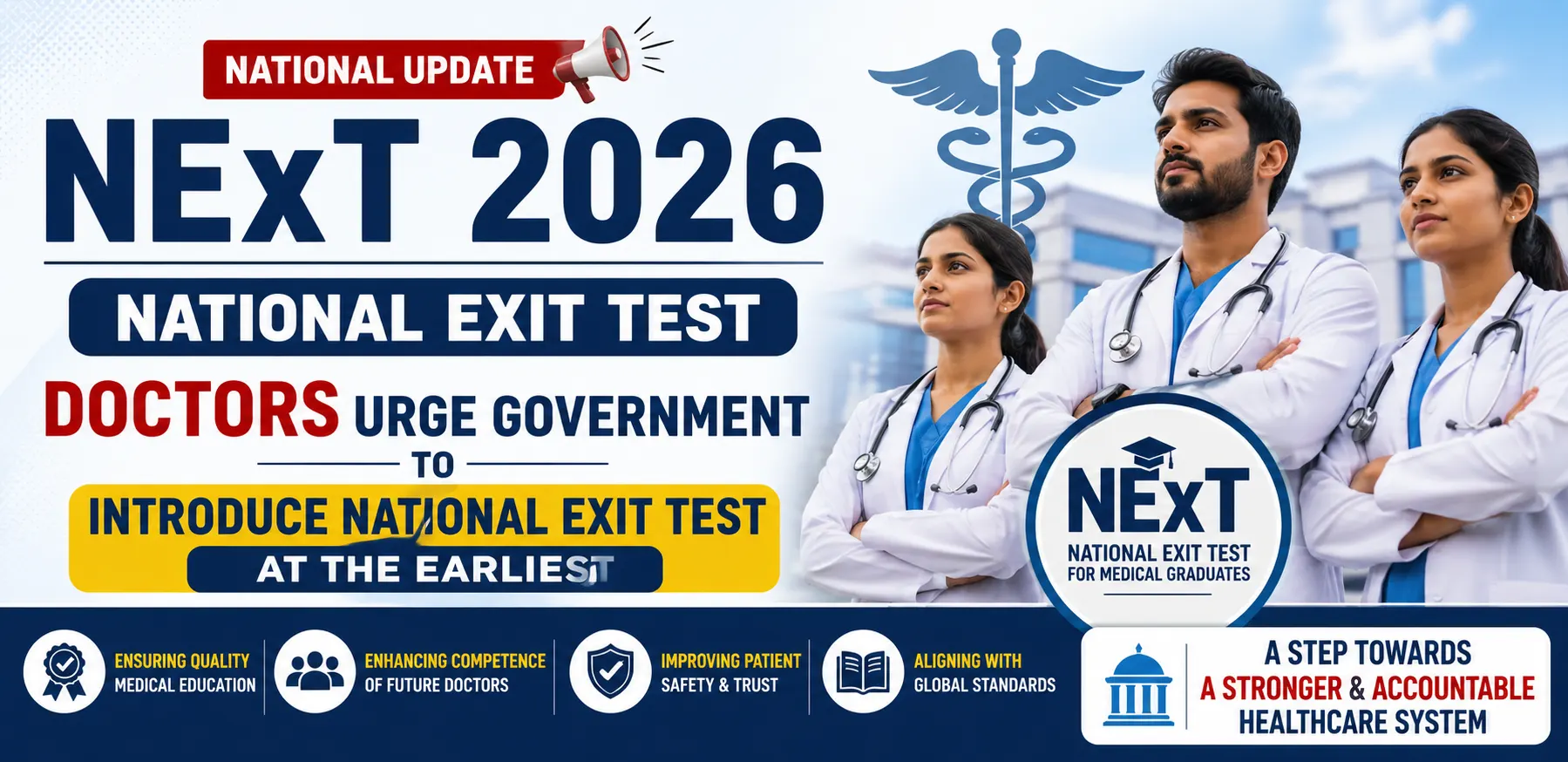
The NExT, an acronym for the National Exit Test, is back in news with respect to India`s medical education system. Increasing scrutiny around standards of medical assessments has led senior doctors and the medical faculty across the country to a near-unanimous call for NExT to be rolled out in 2026.
Back in September, top doctors from All India Institute of Medical Sciences (AIIMS) and other institutions stated that the introduction of NExT without any delay is essential to standardise the standards, transparency and improvement in patient safety in the health system.
Students seeking career guidance and admission pathways can access all necessary information about medical education, counseling and future opportunities from platforms like MBBS advisor.
Doctors' Are Asking for Immediate NExT Implementation
NExT was proposed following some controversy regarding inconsistent evaluation systems and revisions in cut-offs for NEET PG post a recent judgement. Doctors are concerned the current system is not uniform and could lead to a dilution in the standard of doctors entering the profession.
Notable concerns raised by doctors within the sector include:
- Every university has its own pattern of assessments
- Over-dependence on MCQ oriented exams like NEET PG
- Inadequate assessment of clinical skills
- Differing competency levels of graduates
In response to these issues, physicians are calling for a uniform national exam that tests both basic science and clinical skills.
NExT aims to serve as a substitute for various tests, such as final MBBS exams, NEET PG and FMGE ensuring the system is simplified and transparent.
What is National Exit Test (NExT)?
The proposed National Exit Test, a nationwide examination designed to be the only exit exam for MBBS students, was introduced under section 14 of the National Medical Commission Act, 2019.
It serves three major purposes:
- Licensing exam for medical practice
- PG entrance test
- Screening test for overseas medical graduates
The logic behind this single-exam is that every medical graduate should qualify in a minimum standard of competency to practice medicine in India.
Ongoing Issues in Medical Education
The huge demand for NExT has one of the most significant reasons, i.e., inconsistency in current medical assessments.
Experts have pointed out:
- University exams are subjective with varying standards
- PG entrance exams only test limited aspects of knowledge
- Multiple exams increase student stress
- Clinical skills are often under-evaluated
The disconnect between theory and practice raised questions about whether all graduates are well-prepared to deal with the realities of practicing medicine.
NExT, doctors say, will harmonize and rationalize medical education in India with an emphasis on clinical relevance.
NExT vs Current System
Current System
- Final Exam: University-based
- PG Entrance: NEET PG
- Clinical Skills: Limited evaluation
- Uniformity: Varies across colleges
NExT System
- Final Exam: National standardized exam
- PG Entrance: Integrated into NExT
- Clinical Skills: Dedicated practical assessment
- Uniformity: Same standard nationwide
It is expected that this transformation would help develop the quality of medical graduates and standards of patient care.
Global Standards & Recognition
Medical education reforms like NExT align with global healthcare standards.
The World Health Organization advocates competency-based medical education to ensure safe and effective healthcare delivery worldwide.
Additionally, institutions listed in the World Directory of Medical Schools follow globally recognized standards, making a uniform exam like NExT even more important.
The National Medical Commission is responsible for regulating medical education in India and ensuring quality and transparency.
Students also explore international pathways like MBBS in Georgia, which offer globally recognized education with modern infrastructure and affordability.
Timelines & Uncertainty with NExT
However, the implementation of NExT has been delayed multiple times due to policy debates, student concerns, and logistical challenges.
The exam was initially expected earlier but has faced repeated postponements, leaving MBBS students uncertain.
With increasing pressure from medical professionals, the government may take decisive steps soon.
Impact on MBBS Students
If implemented in 2026, NExT will significantly impact students:
- One exam replacing multiple tests
- Greater focus on clinical understanding
- Transparent and merit-based PG admissions
- Better preparation for real-world medical practice
Although the transition may seem challenging, experts believe it will ultimately benefit both students and the healthcare system.
Conclusion
The demand for early implementation of the National Exit Test highlights the urgent need for reform in India’s medical education system. With growing concerns about quality, transparency, and patient safety, NExT is seen as a crucial step toward standardization.
If introduced, NExT could unify the fragmented examination system and create a more competent and consistent medical workforce in India.
Staying updated through reliable platforms like MBBS advisor and exploring options such as MBBS in Georgia can help students adapt to these evolving changes in medical education.