 Russia
 Belarus
 Georgia
 Kazakhstan
 Kyrgyzstan
 Uzbekistan
 China
China Nepal
Nepal Bangladesh
 Poland
 Romania
 Slovakia
 Hungary
 N. Macedonia
 Vietnam
 Canada
 Armenia
 UK
UK Australia
 USA
USA Ireland
 Germany
 New Zealand
 Italy
Italy France
 Singapore
 Netherlands
 Sweden
 Switzerland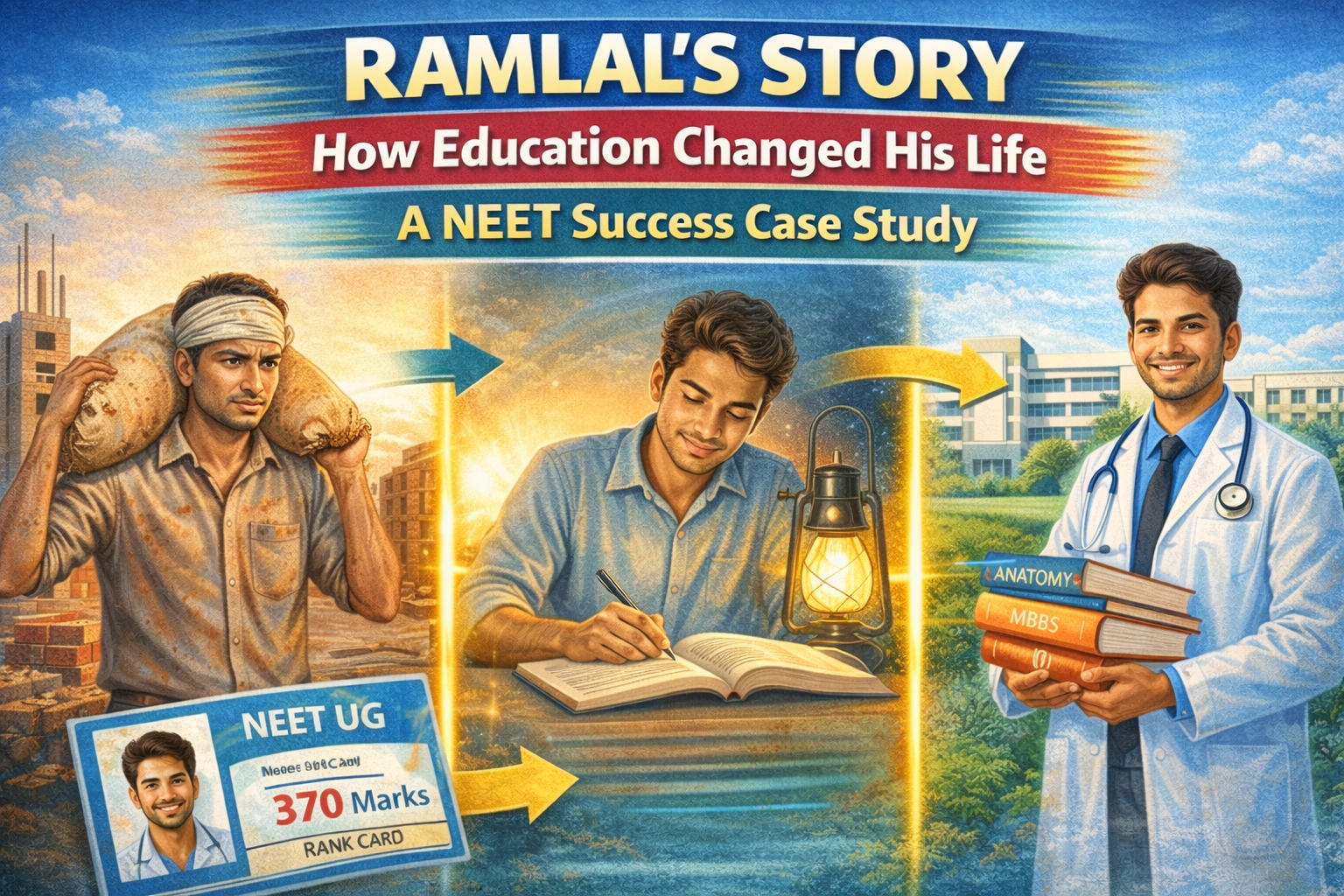
Ramlal was born in a small village where higher education was viewed as an aspiration rather than a practical aim. His family relied on daily wage work, and the majority of children in his locality dropped out of school early to contribute to household income. His life changed when his younger sister became sick, and the nearest hospital was several kilometers away. Witnessing the suffering caused by deprivation of medical care instilled a deep wish in Ramlal’s heart: he wanted to be a doctor and serve people like his family.
That’s true but Ramlal’s path to NEET was fraught with difficulties. His school had no modern laboratory, very few reference books and limited facilities. His family could not afford the coaching institutes in nearby towns. He then just studied on his own through NCERT books and materials lent by seniors. He researched admission procedure, counselling rules, and realistic cut off outlooks; guidance platforms like MBBS Advisor helped him understand how medical admissions really work.
Earlier, Ramlal thought medical colleges were meant only for well-off city dwellers. When he read about government medical colleges and merit-based admissions on MBBS Advisor, it dawned upon him that NEET had laid the foundation of equality among all students irrespective of their financial background. This awareness changed his attitude. He devised a rigorous study regime, allocating his time between Biology, Chemistry and Physics. His teachers recognized his commitment and started retaining him after school for additional revision and doubt sessions.
Preparation was not easy. Power cuts, household responsibilities and a lack of digital resources made studying challenging. Still, Ramlal stayed disciplined. He used to do multiple revisions of NCERT chapters and the previous year NEET questions. Rather than compare himself to the other city students, he took it one day at a time. He maintained a record of previous cut-off trends and seat availability, which helped him set realistic targets instead of chasing unattainable scores.
Leader: When the NEET results were released, Ram was nowhere near the top but managed a qualifying score that qualified to sit for counselling. This stage was crucial. Due to wrong choice filling or lack of awareness, many students miss their opportunities. With the information Ramlal had gathered from ';MBBS Advisor';, he understood how State Quota and All India Quota are different and applied as per his domicile eligibility. It was a strategic decision that made him more likely to get into a government college — with little fees.
Even before making his selections, Ramlal looked to see whether the colleges were on a list of warnings set out by the National Medical Commission, which regulates medical education in India. He also worked to list the institutions in the World Directory of Medical Schools, for international recognition of medical degrees. Guidance about licensing systems like FMGE helped him understand the long-term career pathways, in case he decided to study or train abroad later.
Later Ramlal was admitted to a government medical college. For his family, this represented more than an academic accomplishment; it was a social revolution. People who had dismissed education as a waste of time could now be overheard urging their children to study harder. His parents, who could never have dreamed of sending a child to medical college, came to represent the family’s hope in the community.
Education transformed Ramlal’s life not just because it offered him a professional trajectory but also in educating his worldview. In his MBBS training, he would work at health awareness camps and go to the villages speaking with them about hygiene, vaccination for the children and nutrition. He frequently visited his old school to inspire students, telling them that NEET is not meant only for rich or urban candidates. His message, however, was a simple one: given the right information and consistent work, anyone — even a village student — can convert into a doctor.
The success story of Ramlal throws three precious lessons. First, which is more important — access to accurate information or academic preparation? Tips on counselling rules and mushrooming colleges save from being cheated. Second, consistency matters more than coaching that costs a lot. Focused study can yield results, even with limited resources. Third, education has a ripple effect. A single student’s success can motivate an entire community to prioritize learning.
Today, Ramlal’s life is a testament that education has the power to break cycles of poverty and unlock possibilities for service and dignity. Therefore, you can get intuition by getting information for admission from sources like MBBS Advisor and the standard of education is already kept under the root of institutions regulated by the National Medical Commission. The World Directory of Medical Schools, and system awareness like FMGE provide long-term recognition for career security.
Ramlal’s story is not one of extraordinary talent, but ordinary effort done with clarity and purpose. This illustrates how education, especially when coupled with the right support, can not only transform an individual life but also the trajectory of entire generations of families and neighborhoods.