 Russia
 Belarus
 Georgia
 Kazakhstan
 Kyrgyzstan
 Uzbekistan
 China
 Nepal
 Bangladesh
 Poland
 Romania
 Slovakia
 Hungary
 N. Macedonia
 Vietnam
Introduction
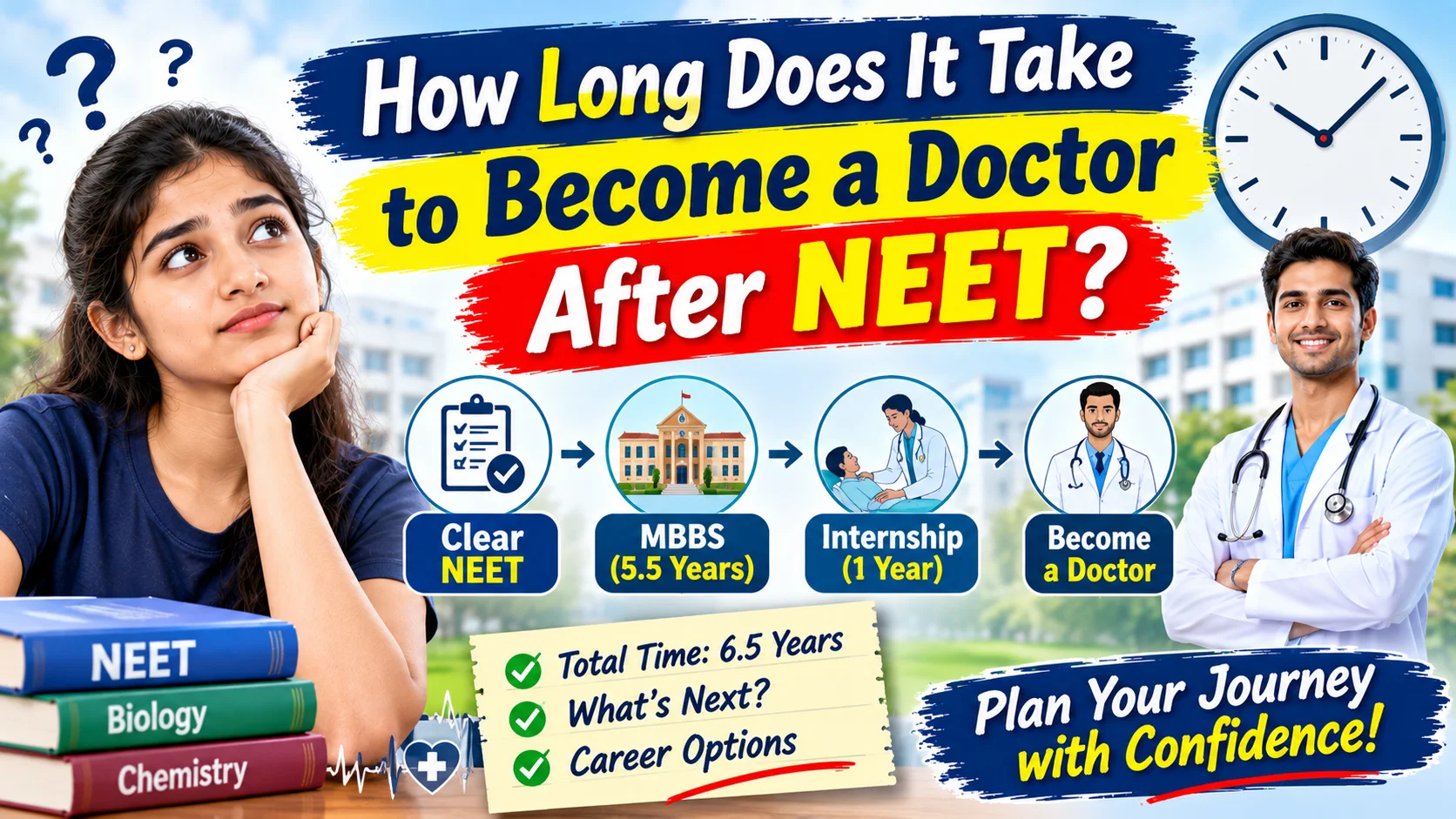
Becoming a doctor is a long-term educational journey that requires academic dedication, practical training and professional commitment. Every year, thousands of students appear for the National Eligibility cum Entrance Test (NEET UG) to secure admission to MBBS courses in India. However, qualifying for NEET is only the first step towards entering the medical profession.One common question among medical aspirants is: How long does it take to become a doctor after NEET?The duration depends on the medical qualification a student wants to pursue. Generally, students take around 5.5 years to complete MBBS, including the compulsory one-year rotating internship. After completing the required training, they must fulfil the applicable medical registration requirements to practise medicine in India.Students who wish to become specialists need additional postgraduate education. This usually increases the total duration to approximately 8.5 years or more after starting MBBS.Let's explore the complete timeline, from qualifying NEET UG to becoming a specialist doctor.
How Many Years Does It Take to Become a Doctor After NEET?
In India, the standard MBBS programme takes approximately 5.5 years to complete. This includes 4.5 years of academic education and one year of compulsory rotating medical internship.Students who want to specialise in a particular medical field must complete additional postgraduate training.
|
Medical Education Stage |
Duration |
|
NEET UG Preparation |
Varies by student |
|
MBBS Academic Course |
4.5 Years |
|
Compulsory Rotating Internship |
1 Year |
|
Total MBBS Duration |
5.5 Years |
|
MD/MS Postgraduate Course |
Usually 3 Additional Years |
|
Super-Specialisation (DM/MCh) |
Usually 3 Additional Years |
Step-by-Step Guide to Becoming a Doctor After NEET
1. Qualify for NEET UG
The first step towards becoming a doctor is qualifying for NEET UG. It is the national-level entrance examination used for admission to MBBS and other specified undergraduate medical courses in India.The National Testing Agency (NTA) conducts the examination. Students must fulfil the prescribed eligibility criteria and obtain the required qualifying marks according to their category.
NEET UG generally assesses candidates in three subjects:
- Physics
- Chemistry
- Biology (Botany and Zoology)
Students should regularly visit the official NEET NTA website for examination notifications, eligibility requirements, application dates, information bulletins and results.However, qualifying NEET does not guarantee an MBBS seat. Admission depends on the candidate's rank, category, counselling participation, college preferences and available seats.
2. Participate in MBBS Counselling
After qualifying for NEET UG, candidates must participate in the relevant counselling process to secure an MBBS seat.The Medical Counselling Committee (MCC) conducts counselling for All India Quota seats and specified central institutions and deemed universities. State counselling authorities manage the applicable state-quota and other state-level seats.
The counselling process generally includes:
- Registering on the relevant counselling portal.
- Paying the prescribed counselling fee and security deposit, if applicable.
- Completing document verification.
- Selecting preferred medical colleges.
- Participating in seat allotment.
- Reporting to the allotted college and completing admission formalities.
Before selecting a medical college, students should compare its infrastructure, hospital facilities, clinical exposure, tuition fees and accommodation options.For general information about medical colleges, admission guidance and MBBS opportunities, students can visit MBBS Advisor.
3. Complete the 4.5-Year MBBS Academic Course
After securing admission, students begin the MBBS programme. The academic course generally takes 4.5 years, followed by a compulsory one-year rotating internship.During this period, students study different medical subjects and develop the theoretical knowledge and practical skills required for patient care.
The MBBS curriculum covers several important areas:
|
Academic Area |
Major Subjects |
|
Foundation and Basic Sciences |
Anatomy, Physiology and Biochemistry |
|
Para-Clinical Subjects |
Pathology, Pharmacology, Microbiology and Forensic Medicine |
|
Community Medicine |
Public Health and Community Medicine |
|
Clinical Subjects |
General Medicine, General Surgery, Paediatrics, Obstetrics and Gynaecology, and other clinical specialties |
Students attend lectures, practical sessions, demonstrations and clinical postings. They also learn patient examination techniques, medical terminology, diagnosis and professional communication.Throughout the course, students must complete the prescribed theoretical examinations, practical assessments and clinical evaluations to progress academically.The National Medical Commission (NMC) provides information about medical education regulations and standards in India. Students can refer to its official website for relevant updates about medical education.
4. Complete the One-Year Compulsory Internship
After completing the required MBBS academic training and examinations, students must undergo a compulsory rotating medical internship.The internship generally takes one year to complete. During this period, graduates gain practical experience in different hospital departments under the supervision of qualified doctors.
Common internship departments include:
- General Medicine
- General Surgery
- Paediatrics
- Obstetrics and Gynaecology
- Community Medicine
- Emergency Medicine
- Orthopaedics
Interns gain exposure to patient care, clinical assessment, hospital procedures and healthcare management.The internship helps students apply their classroom knowledge to practical medical situations. Completing the prescribed internship is also an important requirement for fulfilling the applicable medical registration conditions.
5. Obtain Medical Registration
After completing MBBS and the compulsory internship, graduates must fulfil the applicable medical registration requirements.They generally need to register with the relevant State Medical Council or the appropriate authority under the prevailing medical regulatory framework. Registration is necessary to practise medicine legally in India, subject to applicable rules.After completing the required formalities, graduates can explore different career opportunities, including:
- Working as a medical officer, subject to recruitment requirements.
- Joining hospitals and healthcare institutions.
- Working in community health services.
- Pursuing postgraduate medical education.
- Preparing for relevant medical recruitment examinations.
At this stage, graduates have completed their basic medical qualification. Those interested in becoming specialists can continue their education through postgraduate courses.
How Long Does It Take to Become a Specialist Doctor After NEET?
Students who want to specialise in a particular branch of medicine must complete postgraduate medical education after MBBS. For most MD and MS courses, candidates need to qualify through NEET PG or the applicable postgraduate admission process under the rules in force for that admission year. Most MD/MS programmes generally take three years to complete.
|
Medical Qualification |
Duration |
|
MBBS Academic Course |
4.5 Years |
|
Compulsory Internship |
1 Year |
|
MD/MS |
3 Additional Years |
|
Total Duration from Starting MBBS |
Approximately 8.5 Years |
Popular MD and MS Specialisations
Students can select from several postgraduate medical branches according to their interests and career goals.
|
Specialisation |
Degree |
|
General Medicine |
MD |
|
Paediatrics |
MD |
|
Dermatology |
MD |
|
Radiodiagnosis |
MD |
|
Psychiatry |
MD |
|
General Surgery |
MS |
|
Orthopaedics |
MS |
|
Obstetrics and Gynaecology |
MS |
|
Ophthalmology |
MS |
|
ENT |
MS |
Students who want advanced training can pursue super-specialisation through courses such as DM or MCh. These programmes generally require an additional three years after the relevant postgraduate qualification, subject to eligibility and admission rules.
Full Timeline to Become a Specialist Doctor
The following table provides a simple overview of the time required at each stage of medical education.
|
Stage |
Approximate Duration |
|
Qualifying NEET UG and Securing Admission |
Depends on the admission cycle |
|
MBBS Academic Course |
4.5 Years |
|
Compulsory Internship |
1 Year |
|
Medical Registration |
Depends on the process |
|
MD/MS |
Additional 3 Years |
|
DM/MCh |
Usually Additional 3 Years |
As a general estimate:
- Basic medical qualification: Approximately 5.5 years for MBBS and internship.
- Postgraduate specialist qualification: Approximately 8.5 years from the start of MBBS.
- Super-specialist qualification: Approximately 11.5 years or more from the start of MBBS.
These estimates exclude any additional time spent preparing for entrance examinations, waiting for admission or completing delayed academic requirements.
Factors That Can Affect How Long It Takes to Become a Doctor
Although the standard MBBS course duration is defined by the applicable regulations, several factors can affect the overall time required to become a doctor.
1. NEET Preparation
Some students qualify for NEET UG on their first attempt, while others may need additional preparation time before securing an admission opportunity.
2. Admission and Counselling
The time required to secure an MBBS seat depends on counselling schedules, seat availability, allotment results and college reporting dates.
3. Academic Progress
Students must pass the prescribed examinations and complete the required academic and clinical training. Any delay in fulfilling these requirements may affect the overall timeline.
4. Postgraduate Admission
Getting an MD/MS seat depends on the relevant entrance examination, rank, counselling process, eligibility and available seats.
5. Choice of Specialisation
Students pursuing super-specialisation need additional years of education after completing their postgraduate qualification.
Conclusion
Becoming a doctor after NEET requires several years of academic education and practical medical training. In India, students generally take 5.5 years to complete MBBS, including the compulsory one-year internship. After fulfilling the applicable medical registration requirements, they can begin their professional careers.Students who want to become specialists must pursue further postgraduate education, which usually requires another three years for MD or MS. Those interested in super-specialisation may need approximately three additional years.Therefore, the total time depends on the career path a student chooses. Understanding the complete medical education timeline can help NEET aspirants plan their studies and make informed decisions about their future.
Frequently Asked Questions (FAQs)
1. How Many Years Does It Take to Become a Doctor After NEET?
It generally takes 5.5 years to complete MBBS in India. This includes 4.5 years of academic education and one year of compulsory rotating internship.
2. Can I Become a Doctor in 5 Years After NEET?
The standard MBBS duration is 5.5 years, including the compulsory internship. Students must also fulfil the applicable medical registration requirements before practising medicine.
3. Do I Have to Complete an Internship After MBBS?
Yes. A one-year compulsory rotating medical internship is part of the standard MBBS training pathway in India.
4. Can I Practise Medicine After MBBS?
Graduates must complete the prescribed internship and fulfil the applicable medical registration requirements before they can legally practise medicine in India.
5. How Many Years Does It Take to Become an MD Doctor After NEET?
Students generally take 5.5 years to complete MBBS and internship, followed by three years of MD training. The total duration is approximately 8.5 years from the start of MBBS.
6. How Long Does It Take to Become a Surgeon After NEET?
The usual pathway involves 5.5 years of MBBS and internship, followed by a three-year MS programme in a relevant surgical specialty. Some advanced specialisations may require additional training.
7. Do I Have to Take NEET PG After MBBS?
NEET PG is the standard entrance examination for admission to most MD, MS and PG Diploma courses, subject to the applicable admission rules and notified exceptions.
8. Can I Become a Specialist Without Doing MD/MS?
A recognised postgraduate qualification is generally required for formal specialist training in many medical branches. The exact requirements depend on the specialty and applicable medical regulations.
9. How Many Years Does It Take to Complete MBBS and MD?
It generally takes around 8.5 years from the start of MBBS. This includes 4.5 years of academic education, one year of internship and three years of MD training.
10. Can I Pursue Super-Specialisation After MD/MS?
Yes. Eligible doctors can pursue super-specialisation through courses such as DM or MCh. These programmes generally take an additional three years after completing the relevant postgraduate qualification.


.webp)