
 Russia
 Belarus
 Georgia
 Kazakhstan
 Kyrgyzstan
 Uzbekistan
 China
 Nepal
 Bangladesh
 Poland
 Romania
 Slovakia
 Hungary
 N. Macedonia
 Vietnam
Introduction
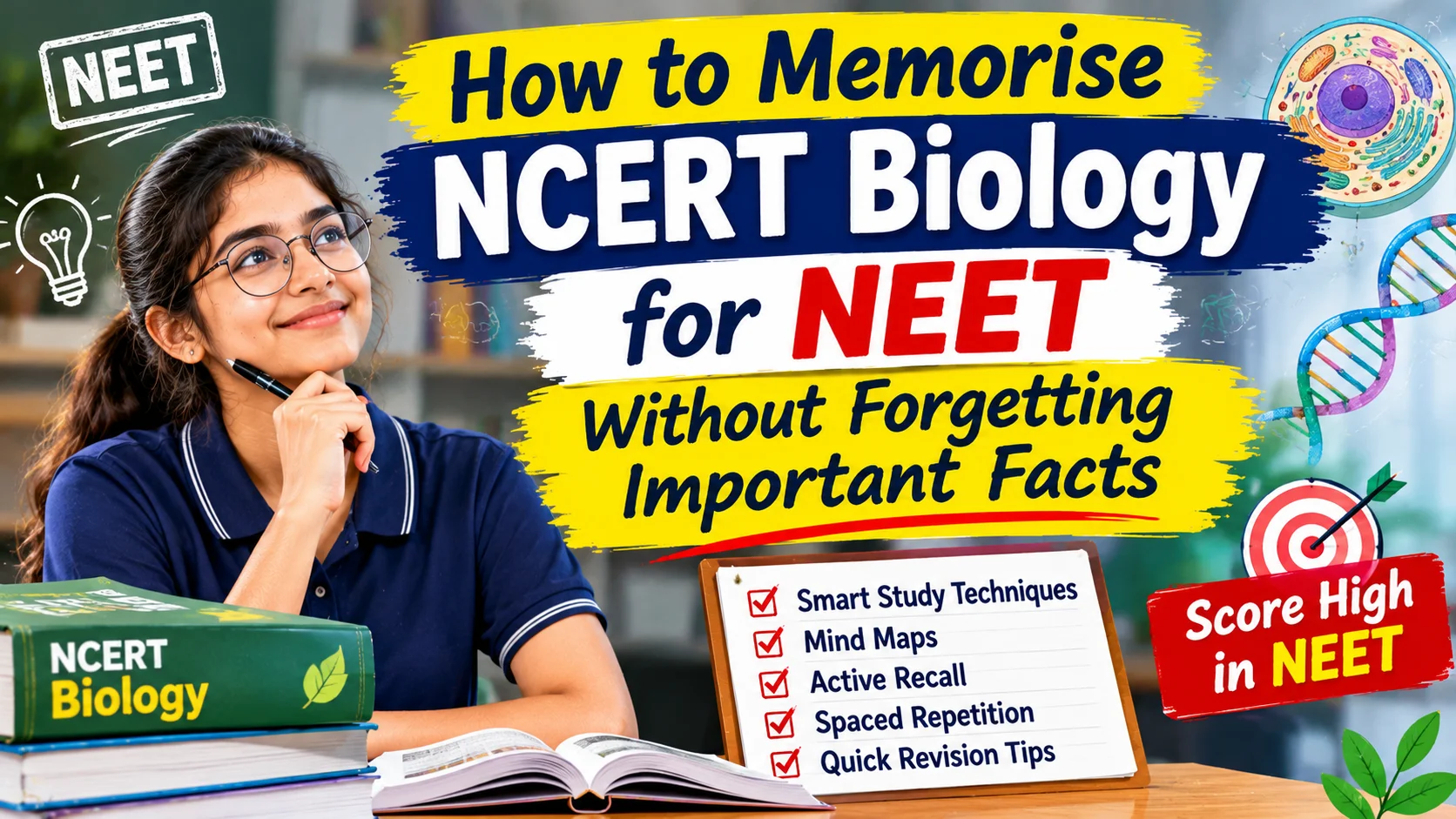
Biology is an essential subject for students preparing for the National Eligibility cum Entrance Test (NEET UG). A strong understanding of NCERT Biology can help students answer questions from both Botany and Zoology. However, remembering all the definitions, examples, diagrams, scientific names and important facts can sometimes be challenging.Many students read the same NCERT chapter repeatedly but still struggle to recall information during practice tests. This happens because reading alone is not always enough to develop long-term memory. Students need an effective revision strategy to understand concepts, remember important facts and recall information while answering questions.The best approach is to combine NCERT reading with active recall, regular revision, diagrams, short notes and MCQ practice.In this article, we will explain how to memorise NCERT Biology for NEET without forgetting important facts, along with effective study techniques, revision strategies and frequently asked questions.
1. Read NCERT Biology Line by Line
NCERT Biology should form the foundation of your NEET preparation. Instead of depending on multiple reference books, start by understanding the prescribed NCERT textbooks.
While reading each chapter, pay attention to:
- Definitions and important terminology
- Scientific names
- Examples of plants, animals and microorganisms
- Biological processes and their steps
- Important differences between concepts
- Diagrams, labels and captions
- Tables and highlighted information
Do not rush through a chapter just to complete it. Take your time to understand what each paragraph explains. For example, while studying human physiology, understand the functions of different organs and how they work together. This will make it easier to remember important facts.
2. Use Active Recall to Improve Memory
Active recall is one of the most useful techniques for improving memory. It involves trying to remember information without looking at your textbook.Students often get stuck reading the same chapter repeatedly because the information starts feeling familiar. However, recognising information while reading is different from recalling it independently.
Follow these steps to practise active recall:
- Read a small section of NCERT.
- Close your textbook.
- Recall the main points.
- Write down important facts from memory.
- Reopen your book and check what you missed.
- Revise the information you could not remember.
For example, after studying the characteristics of a particular plant group, try to recall its features, examples and reproductive structures without looking at the textbook.This method helps you identify which topics you understand and which require further revision.
3. Create a Spaced Revision Plan
A common reason students forget NCERT facts is that they do not revise regularly. Spaced repetition involves revisiting previously studied information at gradually increasing intervals. It can help strengthen long-term memory and make revision more effective.
Here is a suggested revision schedule:
|
Revision |
When to Revise |
What to Do |
|
First revision |
Same day |
Recall important facts |
|
Second revision |
After 1 day |
Review difficult topics |
|
Third revision |
After 3 days |
Solve related MCQs |
|
Fourth revision |
After 7 days |
Revise the complete topic |
|
Fifth revision |
After 15 days |
Test your memory |
|
Sixth revision |
After 30 days |
Review important points |
This is only a suggested schedule. You can adjust the intervals depending on how easily you remember a particular topic.The main objective is to revise information regularly rather than waiting until you have forgotten it.
4. Create Short Notes for Important Biology Facts
Short notes can make NCERT revision more organised and effective, especially after completing several chapters.However, avoid rewriting the entire textbook. Your notes should contain only information that helps you recall important concepts.
Include the following:
- Difficult definitions
- Important examples
- Scientific names
- Key biological terms
- Differences between similar concepts
- Commonly confused facts
- Important diagrams and flowcharts
For example, while revising plant tissues, you can prepare a comparison table showing the characteristics and functions of different tissue types.Keep your notes simple and easy to revise. You should be able to review a topic quickly without reading several pages.
5. Use Diagrams and Flowcharts
Biology includes many processes, structures and cycles that can be easier to understand visually.Instead of memorising every step as a separate sentence, use diagrams and flowcharts to understand how different stages are connected.
Some topics where diagrams can be particularly useful include:
- Human digestive system
- Human respiratory system
- Human heart
- Nephron
- Structure of a flower
- Embryo development
- Cell organelles
- Photosynthesis
- Human reproductive system
While studying a diagram, focus on its structure, labelling and functions.Try drawing important diagrams from memory. Then compare them with NCERT and correct any missing labels or details.Flowcharts are also useful for remembering biological processes that involve multiple stages.
6. Create Comparison Tables for Similar Concepts
Biology contains many concepts that appear similar but have different characteristics. Students sometimes confuse their definitions, examples and functions.Creating comparison tables can help organise this information and make revision easier.
For example:
|
Topic |
Important Comparison Points |
|
Mitosis and Meiosis |
Number of divisions, daughter cells and chromosome number |
|
Xylem and Phloem |
Transport functions and components |
|
DNA and RNA |
Structure, sugar and nitrogenous bases |
|
Arteries and Veins |
Direction of blood flow and structural differences |
|
C3 and C4 Plants |
Carbon fixation and photosynthetic pathways |
Tables allow you to compare related information in one place. They are also useful during revision because you can quickly identify the differences between concepts.
7. Practise NCERT-Based MCQs Regularly
Reading NCERT is important, but students should also practise questions to check their understanding. Once you have completed a chapter, attempt relevant NEET-level multiple-choice questions based on its concepts and facts.
Regular MCQ practice can help you:
- Identify weak topics
- Improve factual recall
- Understand how concepts are tested
- Recognise commonly confused options
- Improve accuracy while answering questions
After attempting questions, review both correct and incorrect answers. If you answer a question incorrectly, return to the relevant NCERT paragraph and understand the correct concept. Avoid memorising answer keys without understanding the explanations. For official NEET UG examination updates, eligibility information and notices, students can visit the National Testing Agency's NEET website.
8. Pay Attention to Examples and Scientific Names
Examples and scientific names are important parts of Biology. Students sometimes focus heavily on lengthy concepts and overlook smaller factual details.
While reading NCERT, maintain a separate revision list for:
- Examples of plants and animals
- Scientific names
- Important discoveries
- Researchers mentioned in the syllabus
- Diseases and their causative organisms
- Hormones and their functions
- Important groups of plants and animals
Try grouping related facts together instead of learning them randomly. For example, prepare separate lists for plant examples, animal examples and microorganisms. Review these lists during short revision sessions. You can also use flashcards or short quizzes to test your memory.
9. Take Regular Practice Tests
Practice tests help students understand how well they can recall information and apply their knowledge. After completing a chapter or a group of chapters, attempt a relevant test.
Once the test is complete, analyse your performance and take note of:
- Questions answered incorrectly
- Questions answered by guessing
- Facts you could not remember
- Concepts you misunderstood
- Questions that took too much time
Create an error notebook where you record the topic and the reason for each mistake. For example, if you repeatedly confuse two biological processes, write down their differences and revise them again. Regularly reviewing mistakes can help you identify weak areas and improve your preparation.
10. Create a Consistent Daily Biology Revision Routine
A consistent study routine can make NCERT revision easier to manage. You do not need to revise every chapter in one sitting.
Here is an example of a daily Biology study routine:
|
Activity |
Suggested Time |
|
Read a new NCERT topic |
40 minutes |
|
Active recall |
15 minutes |
|
Revise an older topic |
20 minutes |
|
Practise MCQs |
30 minutes |
|
Analyse mistakes |
15 minutes |
You can adjust the timings according to your school schedule, preparation level and other subjects. The important thing is to include both new learning and revision in your routine. For additional guidance on medical education and NEET-related preparation, you can explore MBBS Advisor.
Common Mistakes to Avoid While Memorising NCERT Biology
Some common study habits can make Biology preparation less effective. Avoid these mistakes while revising:
1. Reading Without Testing Yourself: Repeated reading can create familiarity, but it does not always improve recall. Test your memory after completing each topic.
2. Ignoring Diagrams: Diagrams contain important information about biological structures and processes. Understand their labels and explanations.
3. Making Excessively Long Notes: Copying everything from NCERT takes time and makes revision difficult. Prepare concise notes instead.
4. Ignoring Incorrect Answers: Every mistake can show you which concept needs more attention. Analyse your errors before moving to another topic.
5. Using Too Many Study Materials: Switching between multiple books and notes can create confusion. Keep NCERT as your primary resource and use additional material only when needed.
6. Skipping Revision: Completing a chapter once does not mean you will remember it permanently. Revise older topics regularly.
How to Stay Focused During NEET Biology Preparation
Apart from choosing the right study techniques, students should develop a consistent approach to preparation.
Consider these simple suggestions:
- Set realistic daily study goals.
- Divide large chapters into smaller topics.
- Take short breaks between study sessions.
- Track completed chapters and pending revision.
- Review mistakes instead of ignoring them.
- Avoid comparing your preparation progress with others.
A balanced study routine can make preparation more manageable and help you remain consistent.
Conclusion
Learning how to memorise NCERT Biology for NEET requires more than repeatedly reading the same chapters. Students need a structured revision strategy that combines understanding, active recall, spaced repetition, diagrams, short notes and MCQ practice.Start by reading NCERT carefully and focusing on important examples, scientific names and biological terms. Test your memory after each topic, analyse your mistakes and regularly revisit difficult concepts.Most importantly, remain consistent with your preparation. A well-planned revision strategy can help you remember important Biology facts and improve your confidence while answering NEET questions.
Frequently Asked Questions (FAQs)
1. How can I memorise NCERT Biology for NEET?
Read NCERT carefully, use active recall, prepare short notes, revise regularly and practise chapter-wise MCQs. These techniques can help improve understanding and long-term memory.
2. Is NCERT Biology enough for NEET?
NCERT Biology should be the primary resource for NEET UG preparation. Students should understand the prescribed syllabus and practise relevant questions and mock tests to strengthen their preparation.
3. How many times should I revise NCERT Biology?
There is no fixed number of revisions for every student. Revise each chapter regularly until you can recall its important concepts, examples, diagrams and facts without constantly referring to the textbook.
4. What is the best technique to remember Biology facts?
Active recall and spaced repetition are useful techniques. Try recalling information without referring to your book and revisit the same topic at gradually increasing intervals.
5. Should I create short notes for NCERT Biology?
Yes. Short notes can help you revise difficult definitions, examples, scientific names, comparisons and important facts. Avoid copying the entire textbook into your notes.
6. How can I remember scientific names in Biology?
Group scientific names according to related organisms or chapters. Read them carefully, practise recalling them and test yourself regularly using flashcards or short quizzes.
7. Are NCERT diagrams important for NEET Biology?
Yes. Students should study NCERT diagrams, labels, captions and related explanations. Practising diagrams from memory can also improve understanding.
8. How can I stop forgetting Biology after completing a chapter?
Follow a spaced revision plan. Revise the same day and revisit the topic after a few days, a week and later intervals. Include MCQs and active recall in your revision.
9. Should I practise MCQs after every Biology chapter?
Yes. Chapter-wise MCQ practice helps you check your understanding and identify topics that need more revision. Always analyse incorrect and guessed answers.
10. What should I do if I keep forgetting NCERT Biology facts?
Identify the topics you frequently forget and revise them using active recall, comparison tables and short notes. Avoid simply rereading the chapter. Test yourself and regularly review missing information.



.webp)