 Russia
 Belarus
 Georgia
 Kazakhstan
 Kyrgyzstan
 Uzbekistan
 China
China Nepal
Nepal Bangladesh
 Poland
 Romania
 Slovakia
 Hungary
 N. Macedonia
 Vietnam
 Canada
 Armenia
 UK
UK Australia
 USA
USA Ireland
 Germany
 New Zealand
 Italy
Italy France
 Singapore
 Netherlands
 Sweden
 Switzerland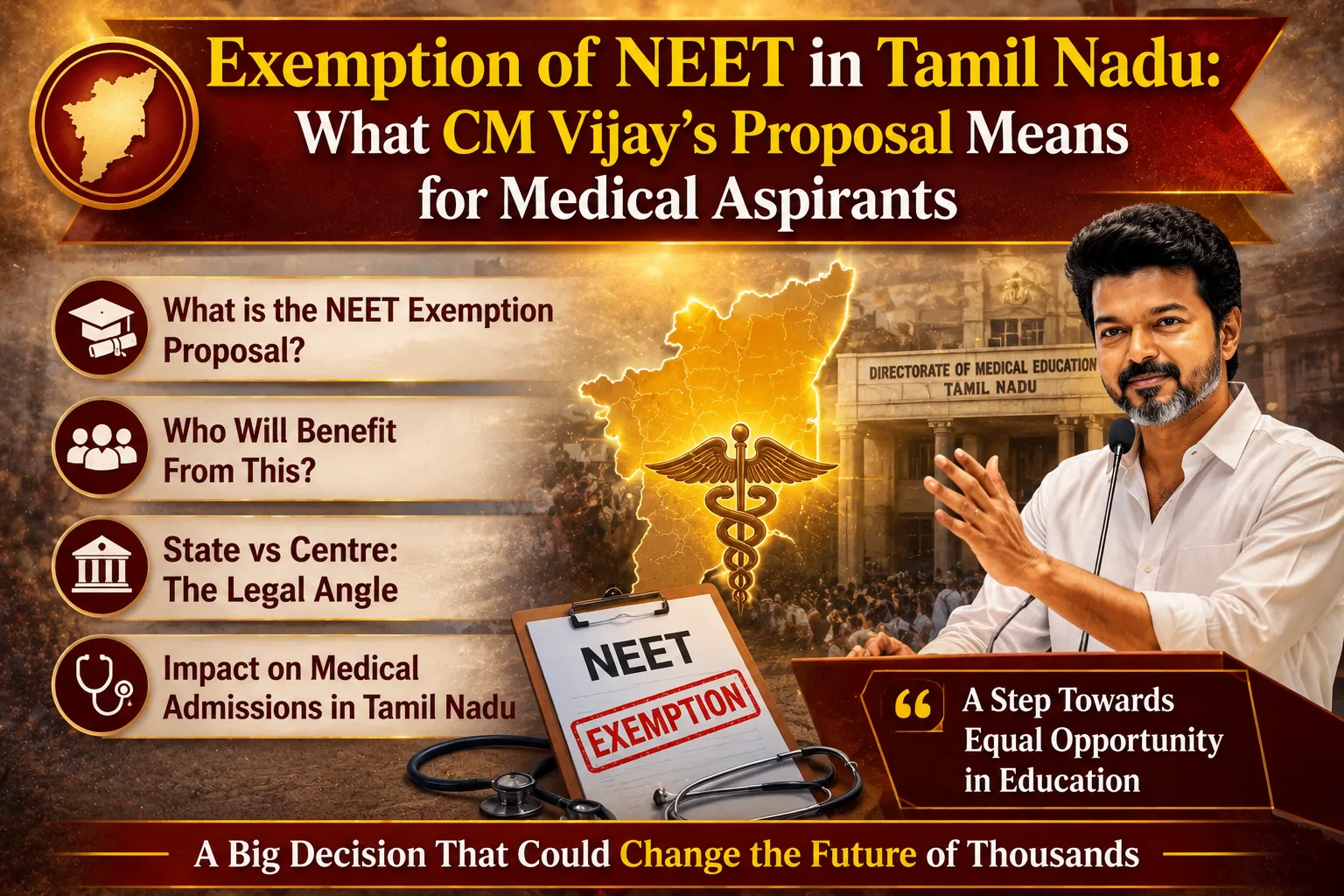
In the last decade, the NEET (National Eligibility cum Entrance Test) debate has generated controversy for education policy discussions in India. Particularly in Tamil Nadu, the government has continuously been anti-NEET, claiming that the system is inequitable to the rural and economically disadvantaged students when it comes to medical admissions.
In the most recent developments, Tamil Nadu’s Chief Minister C. Joseph Vijay has brought the anti-NEET movement to the national level and is advocating for NEET exemptions in the state. His proposals to the central government have once more shifted the focus to the aspiring students wanting to enter the medical profession.
There is a lot of speculation and analysis around the proposals of the anti-NEET movement from students who want to study MBBS, private coaching institutions, and professionals in the field of policymaking on the future of the medical profession in India.
In this article, we reference platforms like MBBS Advisor for students who are in need of guidance regarding admission options and opportunities.
What exactly did CM Vijay propose?
At the recent NITI Aayog Governing Council meeting, CM Vijay restated the long-time demand of the state of Tamil Nadu. This includes:
- Exemption of Tamil Nadu from NEET for admission to MBBS and BDS
- Permitting admissions based on Class 12 marks and not on NEET scores
- Reinstating state control over medical admissions
- Ensuring better opportunities for rural and government school students
As per reports, he said that NEET adversely impacts students from economically backward classes, and does not reflect students' performance during the two years of schooling.
He also asserted that Class 12 results comprehensively encapsulate students’ skills and abilities better than any single national entrance examination.
Understanding NEET and Its Role in Medical Admissions
In India, NEET is a centralized national-level entrance exam for admissions into:
- MBBS (Bachelor of Medicine and Bachelor of Surgery)
- BDS (Bachelor of Dental Surgery)
- AYUSH courses (in a number of states)
The examination functions within the legal framework of the National Medical Commission and makes obtaining admission into any medical college in India impossible without it.
Prior to the introduction of NEET, multiple admission examinations conducted by different states threatened the integrity of medical education in India. Now, in theory, NEET serves the purpose of:
- Admission processes that are transparent
- Admissions based solely on merit
- Admissions that use a fair and objective measure
- Admissions that no longer rely on illegal practices
However, opponents of NEET, including the leadership of Tamil Nadu claim that it encourages a learning process based on coaching institutes and negatively impacts students in rural areas.
What are the Reasons for the Tamil Nadu Outcry Against NEET?
As one of the most vocal states against NEET in India, The Tamil Nadu Government has cited the following arguments:
1. Urban vs. Rural Disparity in Access to Coaching
Urban students have access to coaching institutes while rural students do not.
2. Curriculum and Language Disparity
NEET is based on the Central Board of Secondary Education (CBSE) syllabus, which differs from the syllabus of several state boards.
3. Increased Anxiety and Pressure
A “single exam” system increases the level of pressure amongst students.
4. Effects on Social Equity
NEET has a negative impact on the representation of government school students in medical courses.
The Chief Minister, Mr. Vijay, has often highlighted that the system disproportionately impacts students from low-income backgrounds and the underprivileged.
What CM Vijay’s Proposal Actually Means
Fulfilling CM Vijay's promise means replacing NEET with a Class 12 marks-based medical school admission system. This promise is not simply administrative. This promise modifies the Tamil Nadu medical school admissions system at the core.
- NEET will no longer be a requirement for Tamil Nadu medical school admission.
- A Tamil Nadu state medical admission system will be implemented.
- Class 12 marks will be the primary selection criterion.
- Entrance Board Exams will be more integral for aspiring medical students.
What's in it for Aspirants?
MBBS Advisor MBBS aspirants should be excited about the promise.
Benefits (If this becomes a reality)
- Less reliance on NEET
- Less of a need for expensive coaching
- More options for state board students
- A more equitable admission system
Drawbacks
- Board evaluation standards
- System legitimacy
- National inconsistency in admissions
NEET is here to stay
As it stands, NEET is a national exam with a central system of governance. For Tamil Nadu to opt out of NEET, the state would need to go through the political process of amending the Constitution, the NEET Act, and obtaining a ruling from the Supreme Court that tacitly authorizes the opt out.
Thus far, the Supreme Court has ruled in favor of upholding the NEET Act every time the issue has come to the Court.
Supreme Court of India
Although Tamil Nadu may petition for exclusion, the actual process for removal or exemption is complicated and unpredictable.
What Do Experts Say About the Proposal?
Education experts have varying opinions on this matter.
Proponents of the Proposal Argue:
- 12th class marks are a reflection of a student’s long-term academic journey
- NEET leads to an increased dependency on coaching
- Educational inequity disadvantages rural students
Opponents of the Proposal Argue:
- Board exams lack a national standard
- NEET provides a uniform national merit system
- Medical education requires a high level of standardization
Reference: World Health Organization
Admission Systems for MBBS in India
India’s medical education system is heavily and stringently regulated, ensuring quality healthcare is maintained.
Students preparing for MBBS tend to analyze:
- NEET cut off trends
- Seats of government vs. private medical colleges
- MBBS opportunities abroad
- Admission consulting
An extensive number of students utilize MBBS Advisor to compare:
- MBBS opportunities in India
- MBBS opportunities abroad, specifically Russia, Georgia, Kyrgyzstan, and Uzbekistan
- Fee structures
- Eligibility criteria
MBBS Advisor will become especially significant in the advent of changes to NEET based admissions.
NEET vs Class 12 Based Admissions
- National Exam vs School Exam
- Extreme vs Moderate Competition
- High vs Low Coaching Dependency
- High vs Low Standardization
- Nationwide Uniform Accessibility vs State-Dependent Accessibility
Potential Outcomes of Class 12 Based Admissions in Tamil Nadu
1. Increased Value of the Tamil Nadu State Board
2. Lesser Coaching Industry Dominance
Demand for NEET coaching centers may decrease in the state.
3. Moving to Other States
Students from other states may pursue other ways for admission.
4. Legal and Political Struggles
Gaining approval from the central government will be required, which means there will be uncertainty in the implementation. MBBS Advisor
Consequences for the Future of Medical Education Policy in India
CM Vijay’s proposition may affect:
- Possible adjustments to NEET
- Reservation and admission policies
- State vs central education authority conflicts
- Access to medical educational discussions
It has the potential to impact ongoing conversations surrounding using a single national test to determine the future medical practitioners of this country.
What Should NEET Candidates Do?
1. Keep Preparing for NEET
NEET will still be the main test for MBBS access across a majority of the country.
2. Explore Other Avenues
Candidates should consider other MBBS opportunities abroad through consolidated platforms like MBBS Advisor.
3. Monitor Policy Adjustments
While there will be changes in policies, it will take time.
4. Focus on the Basics
Be it NEET or board exams, a strong foundation in the sciences will remain critical.
Conclusion
CM Vijay’s proposition to exempt NEET for Tamil Nadu represents the most contemporary discourse for political and educational reform in India. Although it raises issues regarding the fairness and access of the NEET, addressing the proposal will require considerable legal and constitutional changes.
Currently, the National Medical Commission oversees NEET as the only entrance test to gain admission to medical schools in India.
System developments can be confusing for students. The role of companies such as MBBS Advisor is to provide guidance, clarification, and up-to-date information to students.
Selecting aspiring doctors who are competent and committed to serve society is equally important regardless if it is done through NEET or through Class 12-based evaluation system.