
 Russia
 Belarus
 Georgia
 Kazakhstan
 Kyrgyzstan
 Uzbekistan
 China
China Nepal
Nepal Bangladesh
 Poland
 Romania
 Slovakia
 Hungary
 N. Macedonia
 Vietnam
 Canada
 Armenia
 UK
UK Australia
 USA
USA Ireland
 Germany
 New Zealand
 Italy
Italy France
 Singapore
 Netherlands
 Sweden
 Switzerland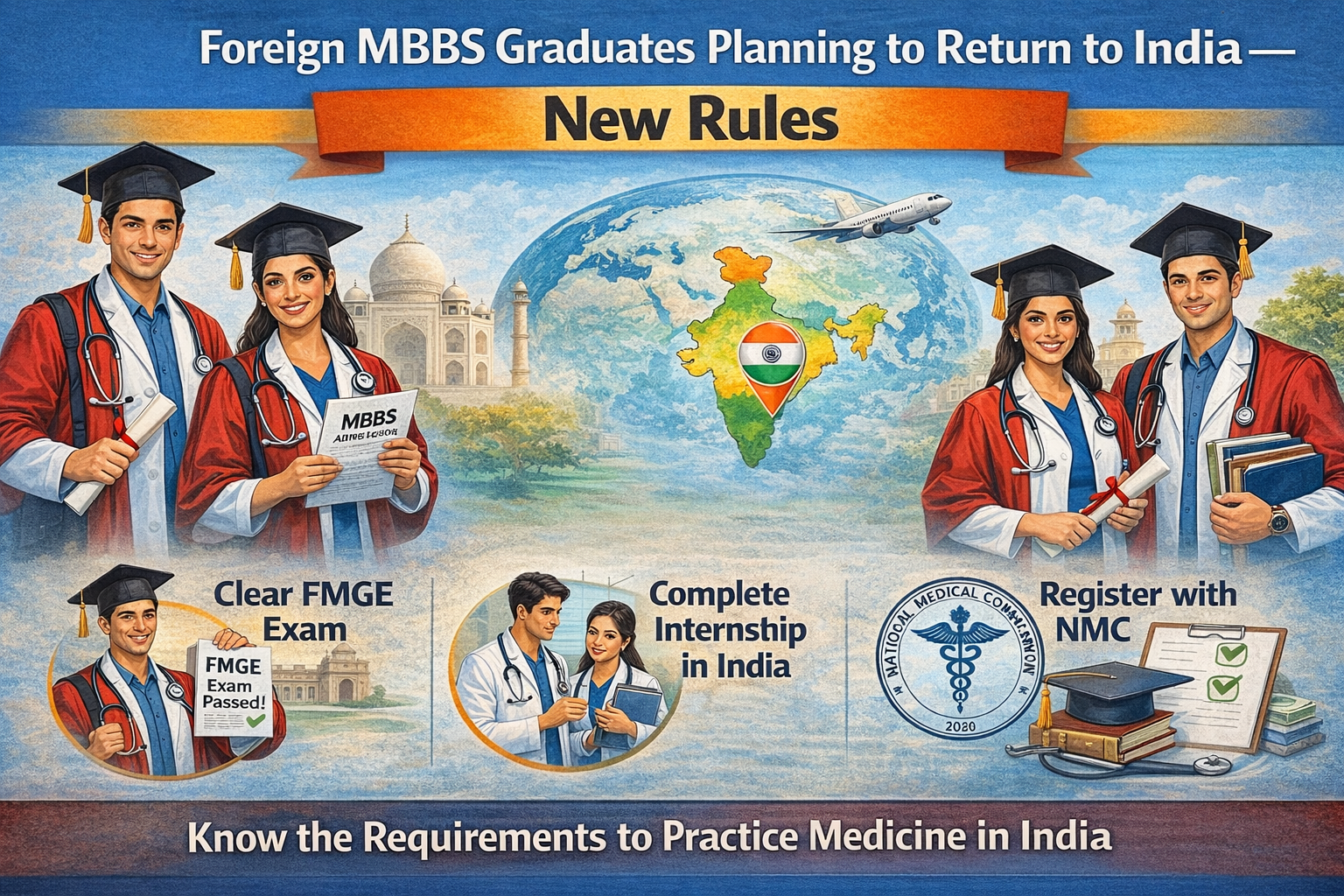
Because of the limited number of MBBS seats in India, thousands of Indian students are studying medical education abroad every year. Students who have completed their medical education outside the country but want to practice in India must comply with certain regulations. Revisiting the policies recently framed, the National Medical Commission has introduced and elucidated some crucial regulations for Foreign Medical Graduates (FMGs) coming to India.
These rules are expected to ensure that students pursuing medical degrees outside the country undergo training comparable to that in Indian institutes and become ably qualified to treat patients in India.
Why New Rules Were Introduced
In the last few years, there has been a rapid amount of increase in the number of students who want to go abroad for MBBS programs at places such as Russia, Georgia, Kazakhstan, Bangladesh, Kyrgyzstan and the Philippines. Nevertheless, some raised concerns regarding heterogeneity in quality of medical education, clinical exposure and training standards.
To rectify these problems, the National Medical Commission has implemented more stringent conditions as part of Foreign Medical Graduate Licentiate (FMGL) Regulations. The aim of these rules is to ensure that foreign medical graduates meet comparable academic and clinical standards as the students trained in India.
International agencies, such as the World Health Organization (WHO), understand that standardization of medical education is vital to ensure healthcare quality and patient safety across the globe.
Mandatory FMGE/NExT Examination
The FMGE or the upcoming NExT is the most crucial requirement for foreign medical graduates.
Students graduating MBBS from abroad are required to pass this licensing exam in order to get registration for medicine practice in India. The examination assesses whether or not the graduate has the medical knowledge at par with an Indian MBBS graduate.
Foreign nationals cannot obtain medical registration in India without passing this examination.
Compulsory Internship in India
Foreign medical graduates, who pass the screening test, will have to undergoCompulsory Rotating Medical Internship (CRMI) inIndia.
Foreign medical graduates who have been inducted for permanent registration must first undergo one year of internship at an approved medical institution, as clarified by the National Medical Commission recently. (www. ndtv. com)
He added, “The internship helps the returning students obtain clinical exposure in Indian healthcare systems and ensures that they are familiar with local medical practices and decency about patient care.”
Rules Regarding Online Medical Education
The other defining rule of the National Medical Commission for students who completed their MBBS course is online — BDS.
During the COVID-19 pandemic, many universities transitioned to online classes. However, the commission explained that clinical training cannot be satisfied through online education alone and requires practical exposure. (www. ndtv. com)
Students who received their classes online have to physically attend training or compensatory classes at their respective medical institutions to cover for the shortage of practical training. They will be eligible for registration in India only after fulfilling this requirement.
Foreign MBBS Courses: Duration and Structure
NMC Rules also lays down the minimum duration and architecture of foreign medical education.
Key requirements include:
- MBBS Course Abroad of Minimum 54 months Duration
- The clinical training and hospital exposure should be directly incorporated into the program
- The language in which the instructions_files are given his/her must be English
- Graduates with the degree should be able to continue practicing medicine in the country they studied in
- The degree may not be recognised for the purpose of medical registration in India if these conditions are violated.
Importance of Recognized Medical Universities
The university should be in compliance with the guidelines set by the National Medical Commission for students studying MBBS abroad.
Students must check before taking admission:
- Recognition of the foreign university
- Quality of hospital training
- Availability of clinical exposure
- Compliance with NMC regulations
Students often inquire about consulting confirmed admission to other medical universities abroad, so the latest regulations need clarification and are provided by MBBS Advisor.
Grammar and Syntax Boosters to Pass USMLE
Though many of these foreign medical graduates can find opportunities abroad, the transition back to India is often fraught with challenges.
Common difficulties include:
- FMGE examination being very tough
- Few internship opportunities are available in some states
- Differences in clinical training methods
- Delays in registration and documentation
The National Medical Commission's new rules, however, seek to establish a more systematic and clear process for foreign graduates who want to practice medicine in India.
Importance of Quality Medical Education
Well trained medical professionals directly impact patient safety and quality of care. Definite organizations, such as the World Health Organization, emphasise that doctors need to pass through strict academic and clinical training before beginning practicing medicine.
India, with such tough regulations in place for foreign medical graduates, makes certain its returning doctors have the right knowledge and clinical skills needed to practice safely.
Conclusion
The National Medical Commission's new regulations for foreign medical graduates are aimed at maintaining the quality of doctors in India. MBBS students studying abroad must strictly adhere to these rules, such as the FMGE or NExT exam, internship requirements and NMC standards for medical education, among others.
Students planning to do MBBS abroad or returning back to India post-graduation must be kept updated with the official regulations. Advisory sources like MBBS Advisor provide valuable insights into admission criteria, international medical education framework, and eligibility to practice in India.
Complying with these guidelines and selecting accredited institutions would help aspiring doctors succeed in their profession, which would also contribute towards building a better healthcare system for India.