
 Russia
 Belarus
 Georgia
 Kazakhstan
 Kyrgyzstan
 Uzbekistan
 China
China Nepal
Nepal Bangladesh
 Poland
 Romania
 Slovakia
 Hungary
 N. Macedonia
 Vietnam
 Canada
 Armenia
 UK
UK Australia
 USA
USA Ireland
 Germany
 New Zealand
 Italy
Italy France
 Singapore
 Netherlands
 Sweden
 Switzerland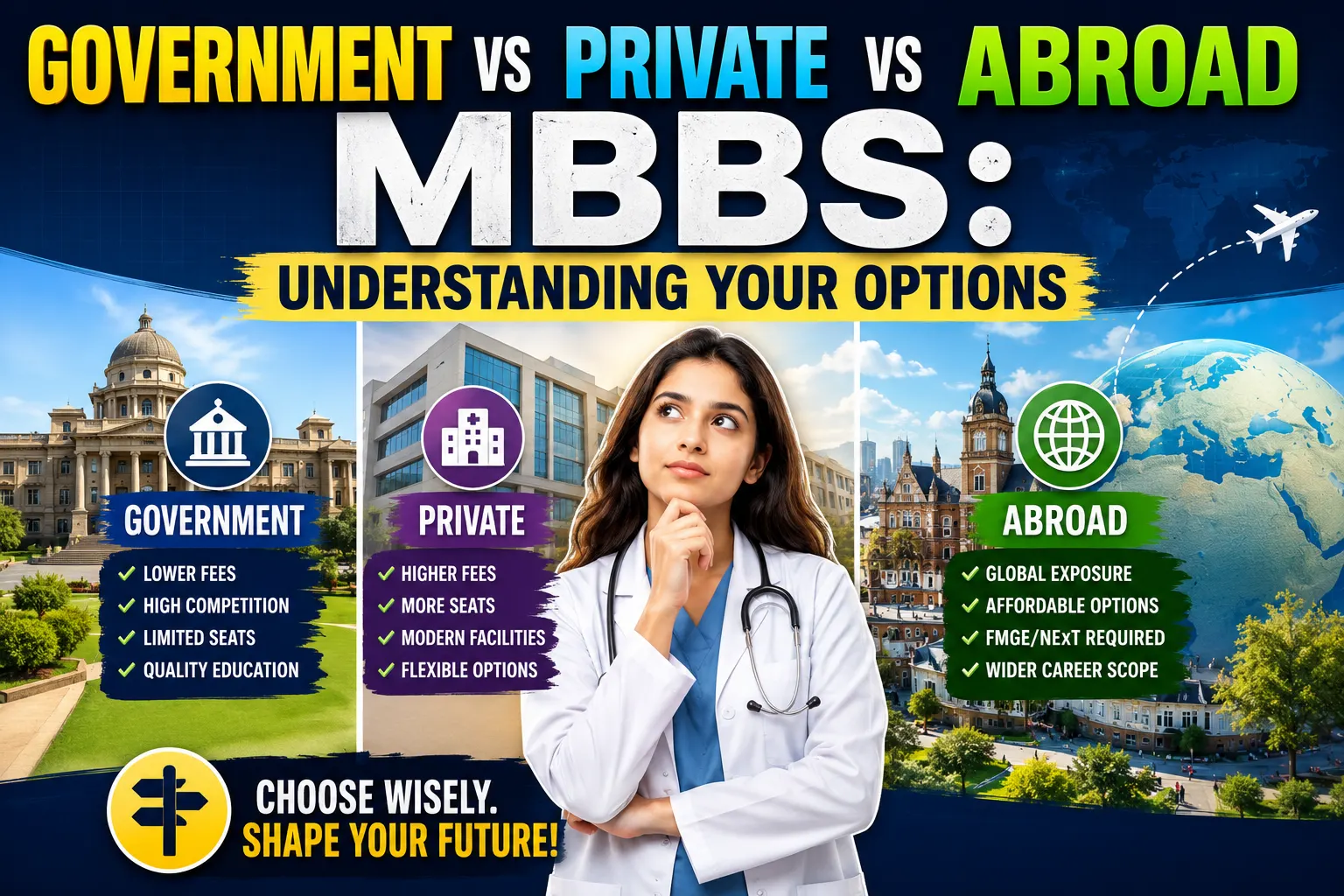
Pursuing your dream of finally becoming a doctor is no easy feat. One of the biggest hurdles is which course you should choose: government medical college, private medical college, or going the MBBS abroad route. With the influx of medical aspirants in India, this decision is becoming harder for aspirants than ever before.
Medical aspirants in their numbers have to sit for the NEET in the hope of finally being able to enter a prestigious medical college. With government medical seats extremely limited, currently, medical aspirants are being forced to consider both private medical colleges and colleges abroad.
As is the case with all options, private colleges and colleges abroad have their own limitations, costs, and risks. With all the options, consider your NEET score, the costs you and your family would have to incur, your aspirations and career goals, and your flexibility with new and different challenges that might come your way.
With so many options to choose from, you could consult MBBS Advisor, which is a highly recommended independent platform that allows students to analyze their choices for medical education in India and abroad based on both available options, which have different admission and admission processes.
To the best of your ability, consider the following when making your choices:
Government Medical Colleges
State or central funded and regulated medical colleges are almost completely subsidized. Because of this, they are the most affordable option.
Private Medical Colleges
Private Medical Colleges are colleges that are funded and regulated by private educational institutes. These colleges have more seats, but have a more expensive education.
MBBS Abroad
There are medical universities that provide international medical education. Russia, Kyrgyzstan, Kazakhstan, Georgia, and Uzbekistan are among the more popular countries for Indian students looking for affordable options.
With this information, students often go to the MBBS Advisers to compare options and choose the best option for them.
Government MBBS: The Most Competitive Option
Considering the popularity, NEET aspirants are more inclined towards Government Medical Colleges.
Advantages of Government MBBS
Affordable Tuition Fees
Government Medical Colleges are the most cost-effective option considering a Government Medical College might only cost you between ?10,000 to ?1,50,000 a year.
High Academic Standards
Quality education and faculty, well funded and equipped hospitals, and enriched clinical exposure.
Strong Clinical Experience
Government Hospitals cater to a large number of patients, providing excellent training to medical students.
Better Return on Investment
Since the educational cost is on the affordable side, the financial burden on students once they complete their MBBS degree is negligible.
Strong Reputation
Government Medical Colleges have a good reputation.
The Medical Counselling Committee (MCC) provides information regarding Government Medical Colleges and availability of seats.
Challenges of Pursuing Government MBBS
Tough Competition
The greatest challenge is the race for admission.
The Government MBBS seats are highly coveted and every year, millions attempt to secure them.
NEET Scores and Government MBBS
There is a stark contrast between the required NEET scores of Government and Private Medical Colleges.
Seat Constraints
The limited number of medical seats may also lead to the admission of other highly skilled candidates.
For students who are unable to secure Government medical seats, MBBS Advisor assists in choosing private colleges and international universities as a viable option.
Private MBBS: Accessibility vs Cost
In the last few years, private medical colleges have become more plentiful.
They offer more opportunities for students who qualify NEET and are unable to secure Government seats.
Benefits of Private MBBS
More Seats
The availability of medical seats in the private colleges is greater than in Government colleges.
More Opportunities as Private Colleges have Lower Admission Cut Offs
Students will have a mandatory NEET qualification to be eligible for medical college admission, but the cut off scores for private medical colleges tend to be lower.
Modern Infrastructure
Many private colleges have modern medical teaching and learning infrastructure.
More Admission and Counseling Opportunities
Students will have more opportunities to secure admission to private medical colleges due to lower cut off scores and more availability.
More families are relying on MBBS Advisor to compare private medical colleges to evaluate the costs and make a decision.
Disadvantages of Private MBBS
High Medical School Costs
The costs associated with medical colleges are a major consideration with the total cost of the MBBS exceeding ?50 lakh in some private colleges and greater than ?1.5 crore in others.
Additional Costs
There are certain additional costs students need to incur. These include:
- Hostel accommodation
- Examination fees
- Lab fees
- Other costs
Financial Pressure
For several families, funding private medical education takes significant financial preparation.
MBBS Abroad: Popularizing Alternative
In the last 10 years, Medicine as an Abroad Degree has gained a lot of popularity in India.
It's estimated that thousands of medical students go to Russia, Kyrgyzstan, Georgia, Kazakhstan, and Uzbekistan every year.
MBBS Advisor is frequently used to compare universities abroad and learn about the admission process of each country.
Benefits of Studying MBBS Abroad
Affordable Medical Education
Studying MBBS abroad can be made easy by limited finances.
Cost of MBBS abroad, including living expenses, can range from ?15 lakh to ?40 lakh.
This cost is undeniably lower compared to the Private Medical Colleges of India.
Exposure to Other Countries
Studying MBBS abroad helps students learn to live and study in a country with a different culture from their own.
This is helpful in gaining perspective, developing communication and other skills.
Infrastructure of Educational System
Several universities across the globe offer:
- Modern Laboratories
- Research
- Digital Classrooms
- Collaborations
- Programs in English
Many universities offer MBBS in English.
By using the World Directory of Medical Schools (WDOMS), students can find schools that offer MBBS.
Easier Admission
Admission is based on NEET and a student's grades, thus making the process a lot easier.
Less Tough Admission than India
Obstacles of Studying MBBS Abroad
Adapting to New Cultures and Educational Systems
Students must adjust to the different cultures and educational systems of other countries.
Language Barriers
Even though the course might be taught in English, it might be required to learn the local language for the clinical training.
Distance from Family and Emotional Resilience
Living abroad takes emotional resilience and independence.
Licensing Requirements
All graduates returning to India must adhere to the guidelines set out by the National Medical Commission (NMC).
Cost Comparison: Government vs Private vs MBBS Abroad
|
Category |
Government MBBS |
Private MBBS |
MBBS Abroad |
|
Tuition Fees |
?10,000–?1.5 lakh / year |
?10–25 lakh / year |
?2–6 lakh / year |
|
Total Course Cost |
?1–10 lakh |
?50 lakh–?1.5 crore |
?15–40 lakh |
|
Hostel Expenses |
Low |
Moderate |
Moderate |
|
Living Costs |
Moderate |
Moderate |
Varies by country |
|
ROI |
Excellent |
Moderate |
Good |
The data shows that many students consider going abroad when they have no options to get into a Government Medical College.
Academic Quality Comparison
Government Colleges
Strengths
- Faculty have many years of teaching experience
- Good exposure to patients
- Good reputation
Challenges
- Infrastructure varies
Private Colleges
Strengths
- Good Infrastructure
- Small class size
Challenges
- Very variable in quality
Foreign Universities
Strengths
- Good exposure to patients
- Modern infrastructure
- Good exposure
Challenges
- Very variable in quality
Always check the accreditation before choosing a university.
MBBS Advisor or similar platforms can help to evaluate accredited medical institutions and avoid sub standard options.
Clinical Exposure Comparison
Clinical training helps in learning an important aspect of the profession.
Government Colleges
Government Colleges tend to have the highest exposure to real patients.
Private Colleges
Private Colleges tend to have lower exposure to patients.
Foreign Universities
Foreign Universities tend to have variable clinical training based on the country and the university.
Always check the hospital exposure before enrolling.
Career Opportunities After Graduation
Success in the chosen pathway is largely determined by:
- How well you get ranked in your class
- Your clinical skills
- Your success in the Board exams
- What you choose to specialize in
This pathway can lead you to a career in:
- Private practice
- Research
- Public health
- Administration
- Working with international health organizations such as the World Health Organization (WHO)
Which Option is Best for Different Students?
Choose Government MBBS If:
- You have a high NEET score.
- You want to minimize your education costs.
- You want to study in India.
- You are okay with cut-throat competition.
Choose Private MBBS If:
- You take NEET and fail to clear the government cutoff.
- Your family can fund your private medical education.
- You want to stay in India.
Choose MBBS Abroad If:
- You want cheaper private medical institutions.
- You are okay with international exposure.
- You want to avoid expensive private medical colleges.
- You are okay with a culture shift.
Students seek MBBS Advisor to sort out which options are best based on their goals and other important factors.
What to Consider Before Choosing Private MBBS
You should consider the following:
- What is your NEET score?
- What is your family’s financial education budget?
- Do you prefer to study in India or abroad?
- Are you okay with the costs and exposure involved in relocating to a different country?
- What are your career goals?
- Do you know if the university has recognized accreditation?
- What are the licensing restrictions you think you may face?
Considering these may improve your options.
The Importance of Accreditation
Accreditation is very important.
Students considering studying in foreign universities should check the listings in:
- World Directory of Medical Schools (WDOMS)
- The National Medical Commission (NMC)
- National Regulatory Authorities
If students fail to check accredited institutions, they may run into difficulties in obtaining a medical practice license.
MBBS Advisor is one of a few consultancies that provides this service to students.
The Future of Medical Education
Medical education is evolving quickly.
The latest trends are:
- Digital learning systems
- Training with the help of simulations
- Training in telemedicine
- Collaboration between foreign institutions
- Incorporating artificial intelligence
Any student on the MBBS path must ensure chosen colleges use modern teaching practices.
Conclusion
Government MBBS, Private MBBS or MBBS abroad is a choice based on personal situations. Government medical colleges are the best option in terms of prestige and affordability, and are possible with high NEET scores. Private medical colleges are easier to enroll in, but carry monumental costs. MBBS abroad is a great option for an affordable international medical education with exposure and opportunities.
There is no best option. The best option is based on academics, available finances, personal choice, and future career preference.
Students who choose carefully based on research, inquired accreditations, compared prices, and who sought trusted information, usually made the best and chosen option. MBBS Advisor is an example of an option in the medical consulting field that provides sound advice and accurate information with the goal of giving students the best options in a field of many uncertain choices.
Your dedication, and commitment to patients as well as your clinical skills and lifelong education play a bigger role in what distinguishes you as a good doctor, in addition to the place you studied.