 Russia
 Belarus
 Georgia
 Kazakhstan
 Kyrgyzstan
 Uzbekistan
 China
China Nepal
Nepal Bangladesh
 Poland
 Romania
 Slovakia
 Hungary
 N. Macedonia
 Vietnam
 Canada
 Armenia
 UK
UK Australia
 USA
USA Ireland
 Germany
 New Zealand
 Italy
Italy France
 Singapore
 Netherlands
 Sweden
 Switzerland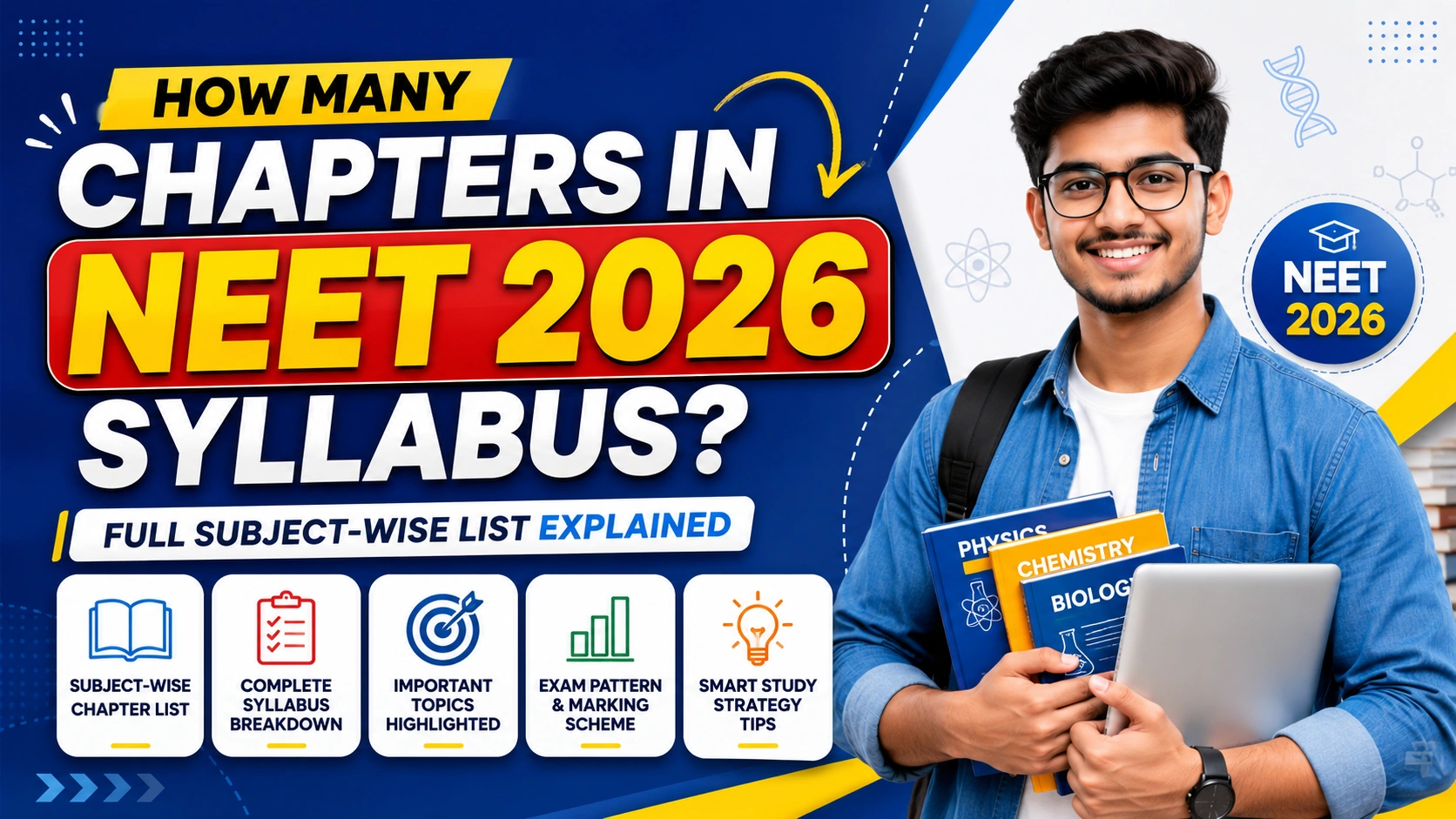
Introduction
NEET (National Eligibility cum Entrance Test) is India’s most competitive medical entrance examination for admission into MBBS, BDS, AYUSH, and other allied medical courses. Every year, lakhs of students appear for this exam, and one of the most frequently asked questions is:
How many chapters are included in the NEET 2026 syllabus?
Understanding the exact chapter structure is important for creating an effective preparation strategy. Since NEET is primarily based on NCERT Class 11 and Class 12 syllabi, students should clearly understand subject-wise chapter distribution to plan their studies efficiently.
Students can explore structured NEET updates, preparation guidance, and examination-related resources through the NEET section available on MBBS Advisor.
This article provides a complete subject-wise breakdown of the NEET 2026 syllabus, including Biology, Physics, and Chemistry chapters, along with preparation insights and examination relevance.
NEET 2026 Syllabus Overview
The NEET syllabus is derived from the NCERT curriculum of Classes 11 and 12. It is divided into three major subjects:
- Physics
- Chemistry
- Biology (Botany + Zoology)
The syllabus focuses on:
- Conceptual understanding
- Application-based learning
- Fundamental scientific principles
Total Chapters in NEET 2026 Syllabus
Although NTA does not officially publish a fixed chapter count, the syllabus based on NCERT books can be categorized as follows:
|
Subject |
Approximate Chapters |
|
Physics |
29 Chapters |
|
Chemistry |
30–32 Chapters |
|
Biology |
38–40 Chapters |
Overall Total
Approximately 95–100 Chapters
This number may vary slightly depending on NCERT revisions and syllabus clarification updates.
Biology Chapters in NEET 2026
Biology carries the highest weightage in NEET and is considered the most scoring section.
Class 11 Biology Chapters
Diversity in Living World
- The Living World
- Biological Classification
- Plant Kingdom
- Animal Kingdom
Structural Organisation in Plants and Animals
- Morphology of Flowering Plants
- Anatomy of Flowering Plants
- Structural Organisation in Animals
Cell Structure and Function
- Cell: Structure and Function
- Biomolecules
- Cell Cycle and Cell Division
Plant Physiology
- Transport in Plants
- Mineral Nutrition
- Photosynthesis in Higher Plants
- Respiration in Plants
- Plant Growth and Development
Human Physiology
- Digestion and Absorption
- Breathing and Exchange of Gases
- Body Fluids and Circulation
- Excretory Products and Their Elimination
- Locomotion and Movement
- Neural Control and Coordination
- Chemical Coordination and Integration
Class 12 Biology Chapters
Reproduction
- Reproduction in Organisms
- Sexual Reproduction in Flowering Plants
- Human Reproduction
- Reproductive Health
Genetics and Evolution
- Principles of Inheritance and Variation
- Molecular Basis of Inheritance
- Evolution
Biology and Human Welfare
- Human Health and Disease
- Strategies for Enhancement in Food Production
- Microbes in Human Welfare
Biotechnology
- Biotechnology: Principles and Processes
- Biotechnology and Its Applications
Ecology and Environment
- Organisms and Populations
- Ecosystem
- Biodiversity and Conservation
- Environmental Issues
Total Biology Chapters
Approximately 38–40 Chapters
Physics Chapters in NEET 2026
Physics is considered conceptually challenging and requires strong analytical abilities.
Class 11 Physics Chapters
Mechanics
- Physical World
- Units and Measurements
- Motion in a Straight Line
- Motion in a Plane
- Laws of Motion
- Work, Energy and Power
- System of Particles and Rotational Motion
- Gravitation
Properties of Matter
- Mechanical Properties of Solids
- Mechanical Properties of Fluids
- Thermal Properties of Matter
Heat and Thermodynamics
- Thermodynamics
- Kinetic Theory
Oscillations and Waves
- Oscillations
- Waves
Class 12 Physics Chapters
Electrostatics
- Electric Charges and Fields
- Electrostatic Potential and Capacitance
Current Electricity and Magnetism
- Current Electricity
- Moving Charges and Magnetism
- Magnetism and Matter
Electromagnetic Induction
- Electromagnetic Induction
- Alternating Current
- Electromagnetic Waves
Optics
- Ray Optics and Optical Instruments
- Wave Optics
Modern Physics
- Dual Nature of Radiation and Matter
- Atoms
- Nuclei
- Semiconductor Electronics
Total Physics Chapters
Approximately 29 Chapters
Chemistry Chapters in NEET 2026
Chemistry is a balanced subject consisting of both theoretical and numerical components.
Class 11 Chemistry Chapters
Physical Chemistry
- Some Basic Concepts of Chemistry
- Structure of Atom
- States of Matter
- Thermodynamics
- Equilibrium
- Redox Reactions
Inorganic Chemistry
- Classification of Elements and Periodicity
- Chemical Bonding and Molecular Structure
- Hydrogen
- s-Block Elements
Organic Chemistry
- Organic Chemistry: Basic Principles and Techniques
- Hydrocarbons
Environmental Chemistry
- Environmental Chemistry
Class 12 Chemistry Chapters
Physical Chemistry
- Solid State
- Solutions
- Electrochemistry
- Chemical Kinetics
- Surface Chemistry
Inorganic Chemistry
- General Principles and Processes of Isolation of Elements
- p-Block Elements
- d- and f-Block Elements
- Coordination Compounds
Organic Chemistry
- Haloalkanes and Haloarenes
- Alcohols, Phenols and Ethers
- Aldehydes, Ketones and Carboxylic Acids
- Amines
- Biomolecules
- Polymers
- Chemistry in Everyday Life
Total Chemistry Chapters
Approximately 30–32 Chapters
Importance of NEET Syllabus Structure
Understanding the syllabus structure offers several advantages:
- Helps in systematic preparation planning
- Improves time management
- Allows subject prioritization
- Enhances revision efficiency
- Reduces unnecessary study burden
Role of NCERT in NEET Syllabus
NEET is largely based on NCERT textbooks.
Key Importance
- Direct questions are frequently derived from NCERT lines
- Biology and Chemistry are heavily NCERT-oriented
- Concepts are aligned with NCERT structure
- NCERT forms the foundation of NEET preparation
Preparation Strategy Based on Chapters
A structured approach is essential for covering the NEET syllabus effectively.
Recommended Strategy
- Study each chapter from NCERT thoroughly
- Focus on conceptual understanding rather than memorization
- Maintain regular revision cycles
- Solve previous year questions consistently
- Attempt mock tests for performance assessment
Students can refer to MBBS Advisor and its NEET resources for structured preparation guidance.
NEET Rank Analysis After Preparation
After syllabus completion, performance analysis becomes crucial.
Students can estimate their expected rank using the NEET Rank Predictor, which helps in:
- College prediction
- Performance analysis
- Counselling preparation
Role of NMC in Medical Education
The National Medical Commission (NMC) regulates medical education standards in India.
Responsibilities
- Defining MBBS curriculum
- Approving medical colleges
- Maintaining academic standards
Role of WHO in Global Health Standards
The World Health Organization (WHO) establishes global healthcare guidelines.
Key Functions
- Disease prevention awareness
- Global health policy development
- Medical research support
Role of WDOMS in Medical Education Abroad
The World Directory of Medical Schools (WDOMS) helps verify international medical universities.
Importance
- Degree recognition verification
- Global licensing eligibility
- Institutional credibility assessment
Common Mistakes in NEET Syllabus Preparation
Students should avoid:
- Ignoring NCERT textbooks
- Lack of revision planning
- Random topic selection
- Poor time management
- Inconsistent practice
How MBBS Advisor Supports Students
MBBS aspirants can rely on MBBS Advisor for structured academic support:
- NEET syllabus updates and guidance
- Preparation strategies
- Admission-related information
- Examination planning resources
Conclusion
The NEET 2026 syllabus consists of approximately 95–100 chapters distributed across Physics, Chemistry, and Biology. Biology remains the highest-scoring section, while Chemistry and Physics require strong conceptual understanding and regular practice.
A well-structured preparation strategy based on NCERT textbooks, consistent revision, previous-year questions, and mock tests is essential for achieving a high NEET score.
Students should utilize reliable platforms such as MBBS Advisor, along with tools like the NEET Rank Predictor, to stay updated and improve performance. Understanding regulatory bodies such as the NMC, WHO, and WDOMS further strengthens awareness of the broader medical education ecosystem.
With discipline, consistency, and smart planning, students can effectively cover the entire syllabus and maximize their chances of success in NEET 2026.