
 Russia
 Belarus
 Georgia
 Kazakhstan
 Kyrgyzstan
 Uzbekistan
 China
China Nepal
Nepal Bangladesh
 Poland
 Romania
 Slovakia
 Hungary
 N. Macedonia
 Vietnam
 Canada
 Armenia
 UK
UK Australia
 USA
USA Ireland
 Germany
 New Zealand
 Italy
Italy France
 Singapore
 Netherlands
 Sweden
 Switzerland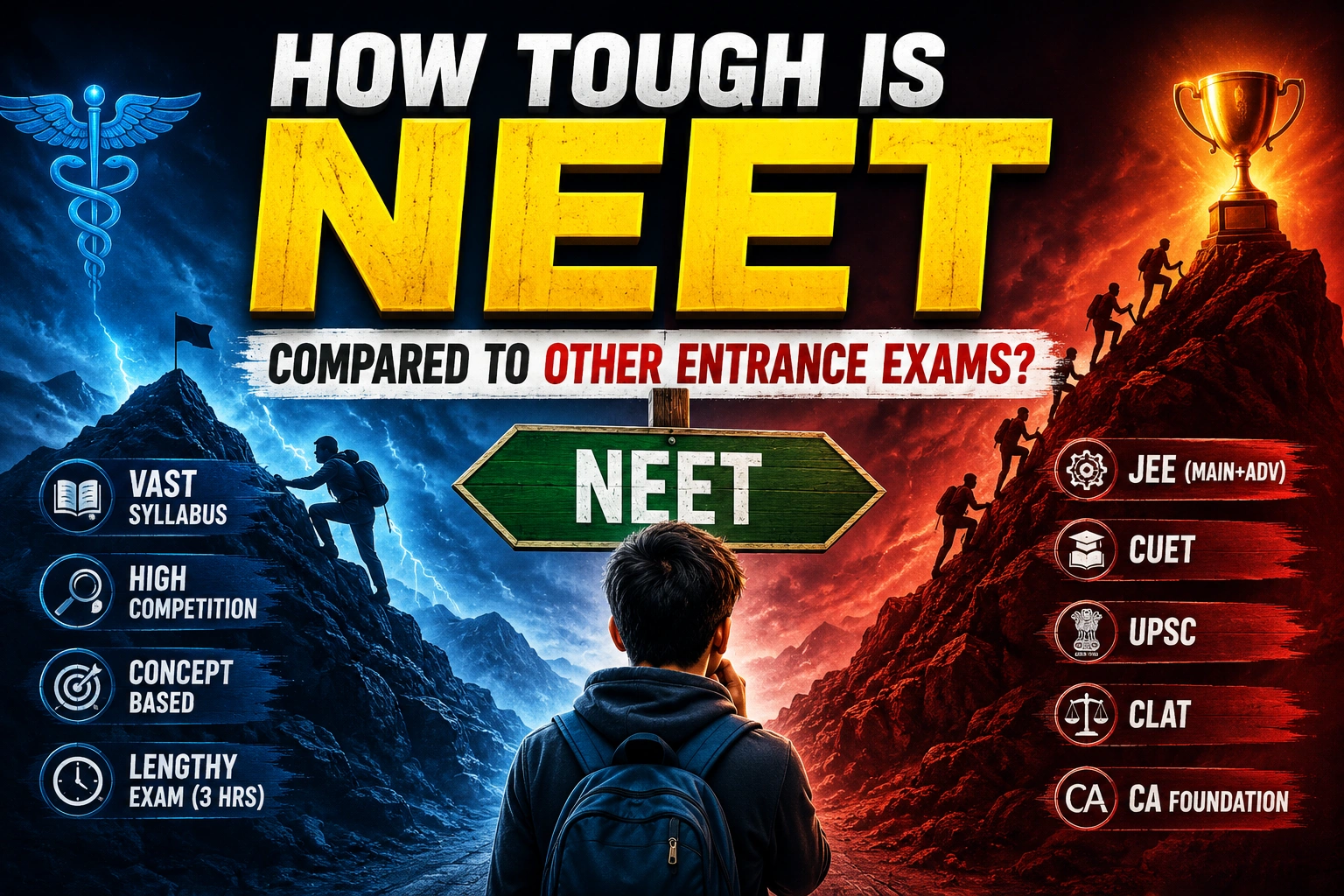
Introduction
NEET (National Eligibility cum Entrance Test) is the largest medical entrance exam in India. NEET is an examination for students who wish to study MBBS, BDS, AYUSH, and other medical courses. The examination is so popular that millions of students attempt the exam each year to gain admittance to the limited number of medical seats. Because of this, NEET is considered one of the most difficult entrance exams in India. Therefore, a common question of students and parents is, “How tough is NEET compared to other entrance exams?”
NEET is not an easy examination and this is not only due to the difficulty of the questions. NEET can be considered tough due to the need for a high score, limited government seats, and intense competition.
Educational platforms such as MBBS Advisor help medical aspirants by providing guidance on NEET preparation, admissions, counselling, MBBS colleges in India and abroad, and career planning. After the exam, NEET students use NEET Rank Predictor to estimate their expected rank and admission chances.
This guide explains NEET difficulty, comparison with other exams, preparation strategies, and the relevance of NMC, WHO, and WDOMS for medical aspirants.
Understanding NEET's Difficulty
NEET tests Class 11 and 12 Physics, Chemistry, and Biology. It is not impossible, but it requires strong conceptual clarity, revision, and consistent practice.
The exam is considered difficult mainly because of competition. Lakhs of students compete for a limited number of MBBS seats in India, especially government colleges.
What Makes NEET Difficult?
1. Expansive Syllabus
NEET covers a vast syllabus from Physics, Chemistry, and Biology (Class 11 & 12). Topics include Genetics, Human Physiology, Organic Chemistry, Mechanics, Electricity, and more.
2. Intense Competition
Every year, millions of students appear for NEET, including droppers and repeaters. The competition makes it harder to secure a top rank.
3. Limited Government Seats
Government medical colleges offer affordable education, so cutoffs are extremely high compared to available seats.
4. Time Pressure
NEET requires solving 180 questions in a limited time. Speed + accuracy is crucial, which makes practice and mock tests essential.
Is NEET Tougher Than JEE?
NEET and JEE are different exams with different skill requirements.
- JEE Advanced focuses more on deep mathematical problem-solving.
- NEET focuses on biology-heavy syllabus and speed-based accuracy.
JEE may be tougher in problem complexity, while NEET is tougher due to competition and high cutoff pressure.
NEET vs CUET
NEET is generally considered more competitive than CUET because:
- Medical seats are limited
- Biology-heavy syllabus requires deep memorization
- Higher competition level
NEET vs State-Level Exams
Before NEET, states had their own exams. Now NEET is a single national-level exam, increasing competition and difficulty significantly.
NEET vs Board Exams
Board exams test written descriptive knowledge, while NEET requires:
- MCQ accuracy
- Time management
- Speed-based performance
- Concept application
So high board marks do not guarantee NEET success.
Subject-Wise Difficulty
Biology
High scoring but memory-intensive. Mostly NCERT-based.
Physics
Often the toughest due to numerical problem-solving.
Chemistry
Balanced mix of theory, memory, and numerical concepts.
Can an Average Student Crack NEET?
Yes. NEET is not only for toppers. With proper strategy, an average student can succeed.
Key factors:
- Strong NCERT understanding
- Daily MCQ practice
- Mock tests
- Revision strategy
- Error analysis
Preparation Time Required
There is no fixed duration. Some start from Class 11, others take a drop year. Success depends more on consistency than duration.
Useful Tips to Crack NEET
- Focus on NCERT (especially Biology)
- Practice previous year papers
- Take regular mock tests
- Maintain revision schedule
- Avoid too many study materials
NEET Rank Predictor
After the exam, students can use tools like NEET Rank Predictor to estimate:
- Expected rank
- College chances
- Counselling strategy
How MBBS Advisor Helps NEET Aspirants
MBBS Advisor provides guidance for:
- NEET preparation strategy
- Counselling process
- MBBS college selection
- Study abroad options
It also offers a NEET Rank Predictor tool.
NEET, MBBS Abroad & NMC, WHO, WDOMS
Students who cannot secure MBBS seats in India often explore abroad options.
- NMC (National Medical Commission): NMC India regulates medical education and eligibility rules.
- WHO (World Health Organization): WHO supports global health standards.
- WDOMS (World Directory of Medical Schools): WDOMS lists globally recognized medical universities.
Students must ensure foreign universities are recognized before admission.
NEET Myths
- Expensive coaching is not mandatory
- NEET is tough but not impossible
- Self-study can also lead to success
Conclusion
NEET is one of the toughest competitive exams in India due to high competition, limited seats, and extensive syllabus. However, it is absolutely crackable with discipline, NCERT mastery, and regular practice.
With the right guidance from platforms like MBBS Advisor and tools like NEET Rank Predictor, students can better plan their medical journey.
Understanding NMC, WHO, and WDOMS is also essential for students considering MBBS in India or abroad.