 Russia
 Belarus
 Georgia
 Kazakhstan
 Kyrgyzstan
 Uzbekistan
 China
China Nepal
Nepal Bangladesh
 Poland
 Romania
 Slovakia
 Hungary
 N. Macedonia
 Vietnam
 Canada
 Armenia
 UK
UK Australia
 USA
USA Ireland
 Germany
 New Zealand
 Italy
Italy France
 Singapore
 Netherlands
 Sweden
 Switzerland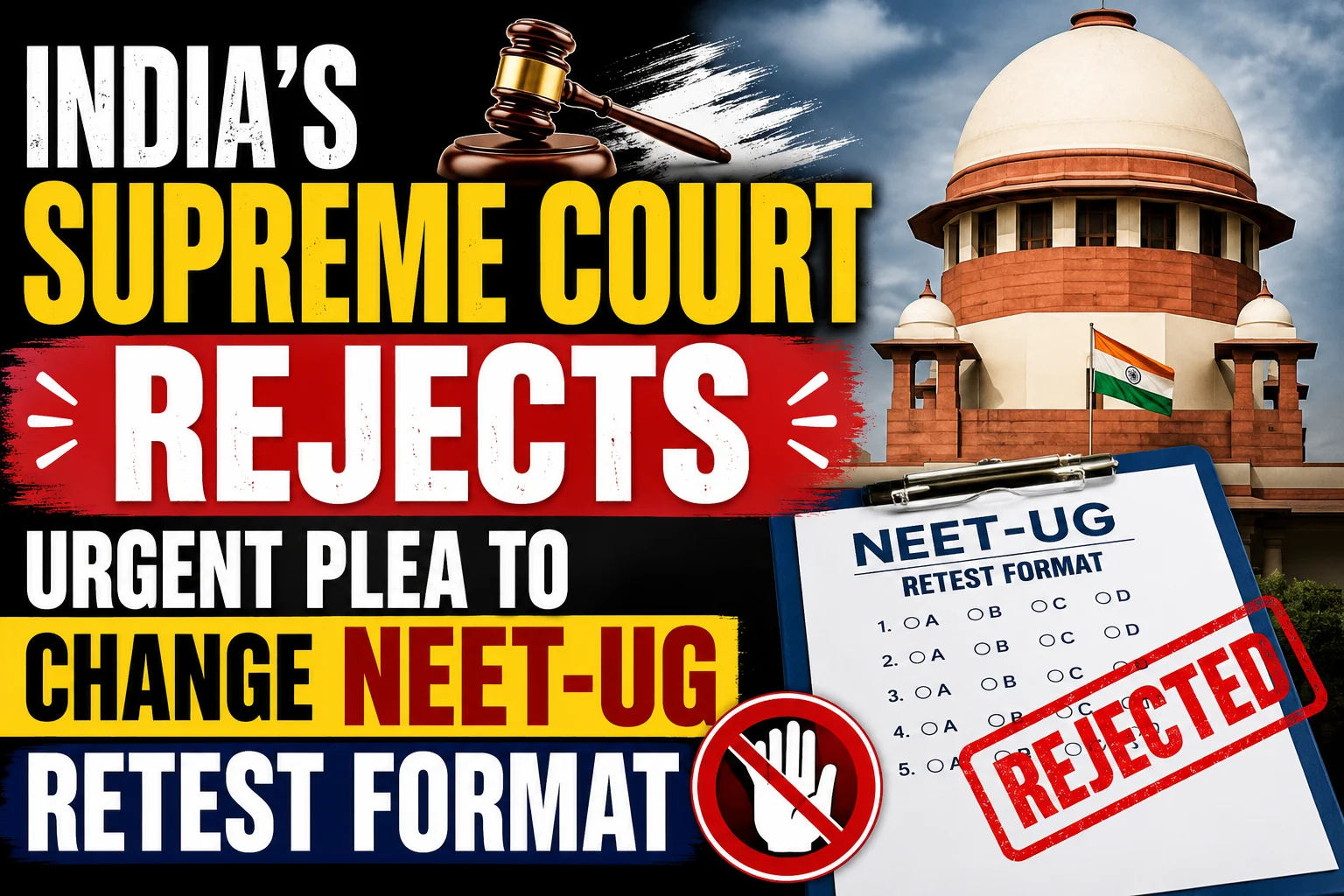
India’s Supreme Court (SC) recently dismissed an emergency hearing petition challenging the retake arrangements for the national medical entrance exam. This ruling immediately sparked widespread discussion among test-takers, parents, education practitioners, and policymakers, and pushed the 2026 leak scandal surrounding India’s MBBS Advisor to consult information on university admission, studying abroad, and career planning, in order to cope with the unclear timeline for their higher education progression.
Key Developments Surrounding the 2026 NEET-UG Re-Examination
Against the backdrop of the series of events surrounding the 2026 re-administration of India’s national medical entrance exam, the National Eligibility cum Entrance Test-Undergraduate (NEET-UG), which involve the positions of multiple stakeholders, judicial rulings, and policy plans, relevant developments are sorted and organized by core dimensions as follows:
Supreme Court Ruling
On June 1, 2026, a vacation bench of the Supreme Court of India comprising Justices P.S. Narasimha and Aravind Kumar issued a ruling on the urgent hearing application related to the exam re-administration.
The applicant had previously cited past exam reform proposals to demand stronger credibility for this medical exam.
The bench rejected the urgent application, citing three core reasons:
- The National Testing Agency (NTA), the exam’s organizer, faces excessive pressure to prepare for the June 21 re-administration.
- Disrupting the established exam process at such a late stage is inappropriate.
- Similar claims have been addressed in prior rulings.
The bench upheld the originally planned pen-and-paper exam format.
CBT Mode Demand
The applicant expressed dissatisfaction with the ruling. Its core original demand was to convert this re-administration to a Computer-Based Test (CBT) format, a request that stemmed from a prior question leak incident.
The applicant argued that CBT has four core advantages:
- Reducing physical circulation of exam papers to lower the risk of question leaks.
- Supporting advanced monitoring mechanisms equipped with real-time surveillance and audit trails.
- Enabling faster score release to reduce administrative errors.
- Creating a full record of the entire process to facilitate challenge verification.
NTA’s Stance
The NTA has implemented a series of rectification measures following the question leak incident:
- Established a high-level steering committee to audit all preparation work for the re-administration.
- Rolled out stricter exam hall monitoring.
- Optimized exam paper logistics.
- Upgraded full-chain security protocols.
The NTA stated that the core original purpose of holding the re-administration is to protect test-takers’ rights and sustain public trust in India’s national-level exams.
Future Transition Plan
The NTA has laid out a clear long-term plan: starting in 2027, NEET-UG will fully adopt the CBT format.
In addition, MBBS Advisor, an education platform that continuously releases updates on MBBS admissions in India and overseas, has also tracked all the latest developments related to this incident.
Government Push for Digital Examination Reform
India’s federal health and education departments have recently formally recognized the dual value of end-to-end digital examination systems: they deliver cost reduction, efficiency improvement, and exam question leak prevention.
The departments are advancing the transition of the National Eligibility cum Entrance Test for Undergraduates (NEET-UG), India’s national unified medical undergraduate entrance exam, from the traditional paper-and-pencil format to a fully online digital model.
Regarding this exam’s transition process and the series of long-standing disputes surrounding it, core relevant information is sorted by module as follows:
Supreme Court Concerns Module
The Supreme Court of India has raised clear inquiries over issues that may emerge from the digital transition, including:
- Network outages.
- Identity verification loopholes.
- Unequal equipment access across urban and rural exam centers.
It has required policy makers to submit a complete risk prevention and response plan.
Impact on Test-Takers Module
Among the roughly 1.8 million candidates who registered for the 2024 NEET-UG, over 40% are from rural and remote areas, and lack stable internet access and the necessary equipment to take the exam.
A hasty rollout of the transition plan would directly worsen inequity in access to higher education.
Call for Reform Module
Organizations including the Indian Medical Association and the All India Students Union have jointly called to pause the digital transition.
They urge authorities to first implement a multiple supplementary exam mechanism for the paper-and-pencil format, to resolve the core current issues of frequent question leaks and score disputes plaguing the existing single-exam setup.
Alternative Higher Education Pathways Module
Candidates who are temporarily unable to pursue medical admission through NEET-UG may apply to 12 private universities in India that offer pre-medical programs, or enroll in partner medical schools in Nepal and Bangladesh.
They can then return to India to take the national physician licensing exam under a mutual qualification recognition agreement.
Security Measures for the June 21 Re-Examination
Regarding the exam paper leakage controversy surrounding India’s 2026 NEET-UG medical entrance exam, the full chain of subsequent developments related to all involved parties has gradually come into clear view.
To ensure the security of the rescheduled exam to be held on June 21, the Government of India has rolled out a set of actionable security measures:
- Senior officials are assigned to oversee the entire exam administration process from start to finish.
- Discussions are underway to use national defense infrastructure to build a confidential exam paper transportation mechanism.
- The Minister of Education has publicly stated that all individuals involved in exam-related violations will face severe penalties.
- All these measures apply only to this 2026 rescheduled exam.
Expert Recommendations for NEET Aspirants
For the large group of students preparing for the exam, education experts have put forward 5 core action recommendations:
- Follow official announcements from the NTA.
- Avoid misinformation on social media.
- Maintain a structured study plan.
- Prioritize protecting mental health.
- Regularly check for exam updates.
Experts have also recommended MBBS Advisor, a reliable educational resource platform.
Medical Education Compliance and Recognition
Students considering medical education pathways in India or abroad should regularly verify guidelines issued by the World Directory of Medical Schools (WDOMS) and follows internationally accepted standards.
Global medical education quality frameworks are also influenced by recommendations and policies issued by the NEET official portal for the latest examination notifications and policy announcements.
Conclusion
India’s Supreme Court previously rejected an application for an emergency hearing that requested this rescheduled exam be switched to Computer-Based Testing (CBT), confirming that the pen-and-paper format will be used for this exam.
The current controversy has exposed three core problems:
- Exam security.
- Administrative accountability.
- The structural framework of the national medical entrance exam system.
The exam organizer, the NTA, has revealed that NEET-UG may transition to the CBT format starting in 2027.
This section reaffirms the core exam preparation priorities for test-takers, and again notes that MBBS Advisor can provide transitional guidance for students planning to study medicine both domestically and abroad.