 Russia
 Belarus
 Georgia
 Kazakhstan
 Kyrgyzstan
 Uzbekistan
 China
China Nepal
Nepal Bangladesh
 Poland
 Romania
 Slovakia
 Hungary
 N. Macedonia
 Vietnam
 Canada
 Armenia
 UK
UK Australia
 USA
USA Ireland
 Germany
 New Zealand
 Italy
Italy France
 Singapore
 Netherlands
 Sweden
 Switzerland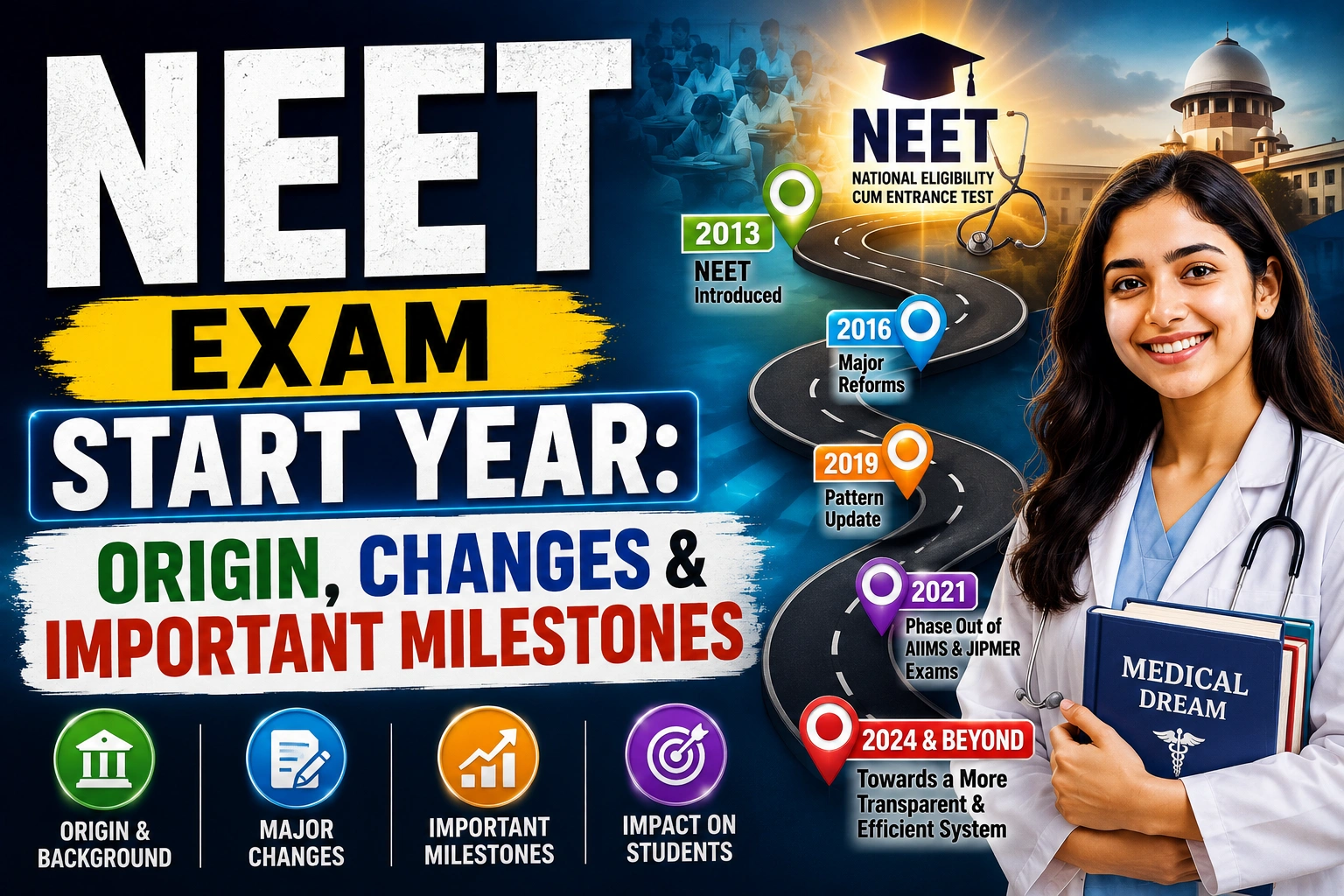
The NEET examination (National Eligibility cum Entrance Test) is today the single most important medical entrance exam in India. It decides admission into MBBS, BDS, AYUSH, and other undergraduate medical courses across government and private colleges. But NEET was not always the only gateway for medical education. Its journey includes decades of reforms, legal battles, policy changes, and major milestones that shaped India’s modern medical admission system.
In this detailed guide, we will understand the origin of NEET, its start year, major changes, important milestones, and its role in modern medical education, along with relevant insights from organizations like the World Health Organization (WHO), the National Medical Commission (NMC), and global medical directories like WDOMS (World Directory of Medical Schools).
We will also explore how digital tools like MBBS Advisor and NEET Rank Predictor help students today in understanding admission possibilities and career planning.
Introduction to NEET: Why It Was Introduced
Before NEET, medical admissions in India were highly fragmented. Each state conducted its own entrance exams, and private universities had separate tests. This created inconsistency, unfair competition, and even malpractice in some cases. Students had to prepare for multiple exams simultaneously, increasing stress and financial burden.
To solve this issue, the idea of a single national-level medical entrance exam was proposed. The aim was simple:
NEET would ensure merit-based, transparent, and uniform admission across India.
This reform was aligned with global education standards recommended by the WHO, which emphasizes standardized medical education systems for better healthcare outcomes.
NEET Exam Start Year: When It All Began
The NEET journey officially started in 2013, when the Supreme Court of India approved the exam as a common entrance test for MBBS and BDS courses.
However, its implementation was not smooth.
In 2013, NEET was introduced as a replacement for multiple exams like AIPMT and various state-level medical entrance tests. But due to legal challenges raised by private institutions and state governments, the exam was temporarily scrapped.
Later, NEET was reintroduced in 2016, and since then it has become the only valid entrance exam for MBBS/BDS admissions in India.
From 2016 onwards, NEET has been conducted annually and is now managed through the official examination framework available on the official NEET Portal.
Evolution of NEET: Key Milestones
1. Pre-NEET Era (Before 2013)
Before NEET, India had multiple medical entrance exams such as:
- AIPMT (All India Pre-Medical Test)
- State PMTs (Pre-Medical Tests)
- Private university exams
Each state had different syllabi, difficulty levels, and admission policies. This created inequality among students.
2. First Introduction of NEET (2013)
In 2013, NEET was introduced to unify all medical entrance exams under one system. However, it faced strong opposition from some states and private colleges, leading to legal challenges in the Supreme Court.
3. Cancellation Phase (2014–2015)
The Supreme Court initially cancelled NEET, allowing states to continue their own entrance exams. This period again created confusion among medical aspirants.
4. Permanent Implementation (2016)
NEET was reintroduced in 2016 and made compulsory for all medical admissions. From this year onward, it became the only entrance exam for MBBS and BDS in India.
This was a historic turning point in Indian medical education.
5. Digital Transformation (2018 onwards)
With advancements in technology, NEET registration, admit cards, and results became fully online.
During this period, platforms such as MBBS Advisor and NEET Rank Predictor started helping students analyze colleges, cutoffs, and expected ranks.
6. NEET During COVID-19 (2020–2021)
The pandemic caused major disruptions in education. NEET was postponed multiple times but eventually conducted with strict safety protocols.
This period also highlighted the importance of digital learning platforms and online counseling systems.
7. NEET UG Under NTA Control
Since 2019, NEET has been conducted by the National Testing Agency (NTA), improving transparency and efficiency in exam management.
The role of the National Medical Commission (NMC) became more prominent in regulating medical education standards and seat allocation policies.
Role of WHO, NMC & WDOMS in Medical Education
WHO Guidelines and Global Standards
The World Health Organization (WHO) plays an important role in setting global standards for medical education. NEET aligns indirectly with WHO recommendations by ensuring that only qualified and merit-based candidates enter medical colleges.
WHO emphasizes:
- Standardized medical training
- Ethical admission systems
- Quality healthcare education
National Medical Commission (NMC)
The National Medical Commission (NMC) replaced the Medical Council of India (MCI) and now governs medical education in India.
NMC is responsible for:
- Setting MBBS curriculum standards
- Approving medical colleges
- Regulating admission policies through NEET
- Ensuring quality doctors in India
NEET is now directly linked with NMC guidelines.
WDOMS and Global Recognition
The World Directory of Medical Schools (WDOMS) is an international database that lists recognized medical universities.
For Indian students planning MBBS abroad, WDOMS is extremely important because:
- It confirms whether a foreign university is globally recognized
- It ensures eligibility for exams like FMGE/NExT in India
- It helps students choose safe and approved medical universities
NEET Exam Structure and Its Modern Format
NEET is conducted once a year and includes questions from:
- Physics
- Chemistry
- Biology (Botany + Zoology)
The exam is based on NCERT syllabus and follows an objective MCQ pattern.
Over time, NEET has become more competitive due to:
- Increasing number of applicants
- Limited government seats
- Rising awareness among students
Today, even small score differences can significantly impact rank and college admission.
Role of Digital Tools in NEET Preparation
MBBS Advisor Platforms
Modern platforms like MBBS Advisor help students understand:
- College predictions
- Fee structures
- Country comparisons for MBBS abroad
- Admission guidance
These tools have become essential for students planning medical careers.
NEET Rank Predictor Tools
A NEET Rank Predictor helps students estimate their rank based on expected marks.
Benefits include:
- Early college planning
- Admission probability analysis
- Counseling preparation
- Reducing uncertainty
Such tools make NEET preparation more strategic and data-driven.
Impact of NEET on Indian Medical Education
NEET has completely transformed the medical education system in India.
Positive Impacts
- Transparent admission process
- Equal opportunity for all students
- Reduction in corruption and donation-based admissions
- Standardized competition at national level
Challenges
- Extremely high competition
- Pressure on students
- Limited government medical seats
- Coaching dependency
Despite challenges, NEET remains the most reliable and fair entrance system in India.
NEET and Future of Medical Education in India
The future of NEET is expected to evolve further with:
- Digital counseling systems
- AI-based rank prediction tools
- Integration with global medical education systems
- Possible transition toward NEXT exam structure in coming years
Medical education in India is continuously improving under NMC regulations, making it more aligned with global healthcare standards.
Conclusion
The NEET exam, which officially began its journey in 2013 and became fully established in 2016, is one of the most significant reforms in Indian education history. It replaced multiple fragmented exams and introduced a single, standardized system for medical admissions.
With support from regulatory bodies like the NMC and global guidance from WHO and WDOMS, NEET continues to shape the future of thousands of medical aspirants every year.
At the same time, digital platforms such as MBBS Advisor and NEET Rank Predictor are making the admission journey more informed, structured, and student-friendly.
NEET is not just an exam—it is a gateway to India’s healthcare future.