
 Russia
 Belarus
 Georgia
 Kazakhstan
 Kyrgyzstan
 Uzbekistan
 China
 Nepal
 Bangladesh
 Poland
 Romania
 Slovakia
 Hungary
 N. Macedonia
 Vietnam
Introduction
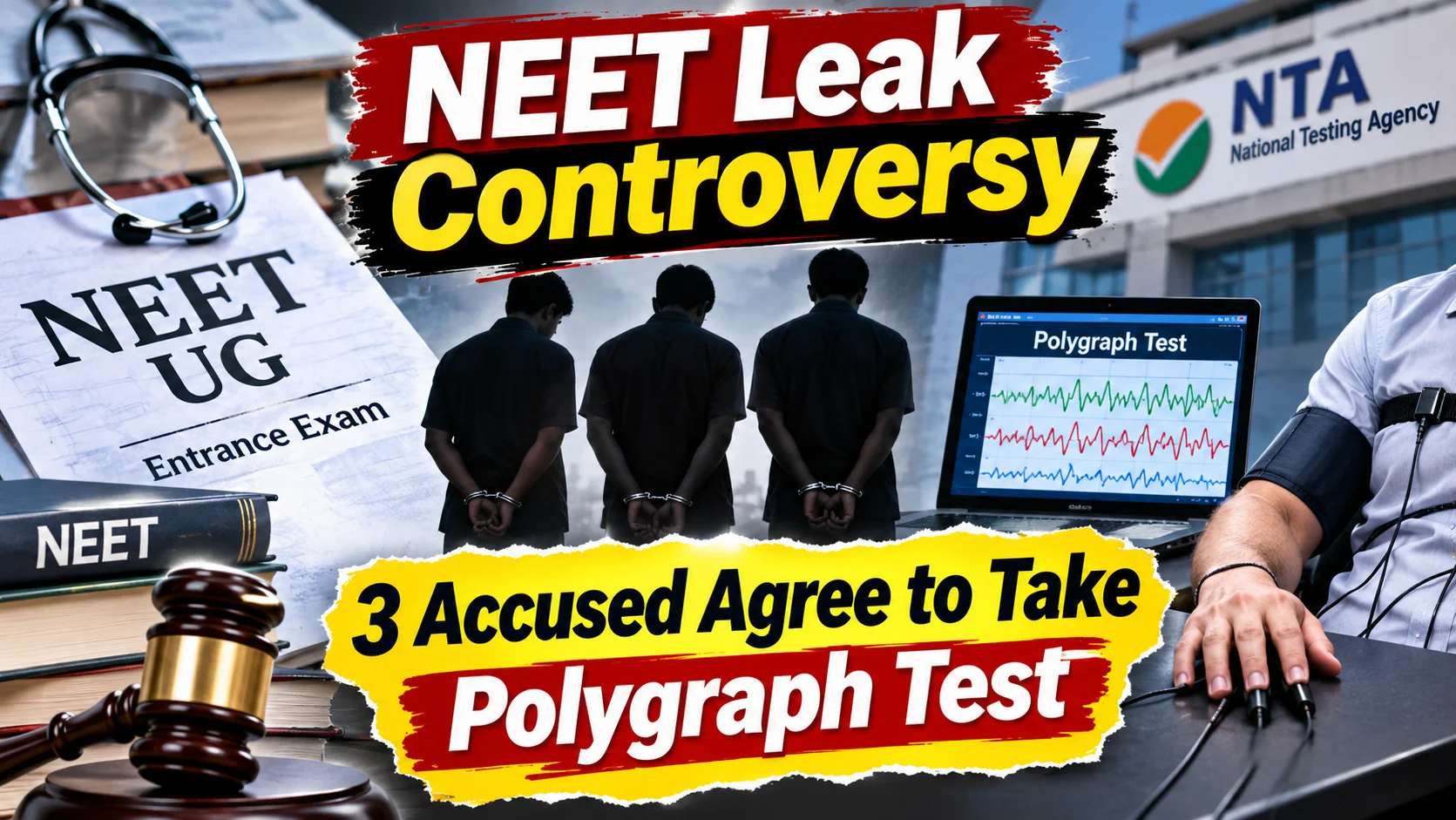
The National Eligibility cum Entrance Test (NEET UG) is one of the most important medical entrance examinations in India. Every year, lakhs of students appear for the examination with the aim of securing admission to medical colleges. However, allegations of question paper leaks and examination irregularities have raised concerns about the security, transparency and fairness of the NEET examination. A recent development in the controversy involves three accused individuals reportedly agreeing to undergo a polygraph test as part of the investigation. This has attracted attention because investigators may use the test as an additional method of gathering information. But what exactly is a polygraph test? Why would investigators want to conduct one? Does agreeing to take the test mean that someone is guilty or innocent? What happens after the test? This article explains the issue, the purpose of polygraph testing and why a fair investigation matters to medical aspirants.
1. Understanding the NEET Paper Leak Controversy
NEET UG is the national-level entrance examination for admission to undergraduate medical courses in India. It is conducted by the National Testing Agency (NTA). Because NEET is highly competitive, allegations of examination malpractice can create serious concerns among students and their families.
The main questions surrounding paper leak allegations include:
- Whether examination questions were accessed before the scheduled examination.
- Whether confidential examination information was shared illegally.
- Whether any candidates received an unfair advantage.
- Whether individuals or organised groups were involved.
- Whether students who followed the examination rules were affected.
- Whether the examination process provided equal opportunities to all candidates.
A fair and secure examination is essential because students spend considerable time, money and effort preparing for NEET. Candidates should follow official announcements and updates through the NEET UG website, which is maintained by the National Testing Agency.
2. What Has Happened Recently?
According to the reported development, three accused individuals have agreed to undergo polygraph testing in connection with the NEET paper leak investigation. This development may help investigators gather additional information while examining the allegations. However, agreeing to take a polygraph test does not establish whether an individual is guilty or innocent. A polygraph test, commonly described as a lie detector test, measures certain physiological responses while a person answers questions.
The test may record changes in:
- Heart rate.
- Blood pressure.
- Breathing patterns.
- Sweating or skin conductivity.
These measurements may be examined by a trained professional. However, they cannot independently establish whether a person is telling the truth. It is also important to distinguish between reported developments and officially confirmed details. The identity of the individuals, the exact questions, the scheduled test date and the legal status of the proceedings should be confirmed through reliable reporting or official statements.
3. What Is a Polygraph Test?
A polygraph test is an investigative technique that records physiological responses while a person answers a series of questions. It is commonly known as a lie detector test, but this description can be misleading. A polygraph does not directly detect lies. Instead, it records physical responses that an examiner may interpret during the testing process.
The measurements generally include:
|
Measurement |
What it records |
|
Heart rate |
Changes in the person's heartbeat. |
|
Blood pressure |
Changes in blood pressure during questioning. |
|
Respiration |
Breathing rate and patterns. |
|
Skin conductivity |
Changes associated with sweating and skin responses. |
The basic idea is that a person's physiological responses may change when they experience stress or emotional reactions. However, there are limitations. A person may become nervous even when answering truthfully. Similarly, physiological responses can be affected by several factors unrelated to dishonesty. Therefore, polygraph results must be interpreted carefully and cannot be treated as conclusive proof of guilt or innocence.
4. Why Would Investigators Want to Use a Polygraph Test?
In a complex examination-related investigation, authorities may need to establish how confidential information was accessed, who may have been involved and whether the allegations are supported by evidence.
Investigators may want to explore questions such as:
- How was confidential examination information allegedly accessed?
- Was any information shared before the examination?
- Who may have been involved in the alleged activity?
- Were there any financial transactions connected with the allegations?
- Did the individuals communicate with other people?
- Do the statements made by the accused match the available evidence?
A polygraph test may be considered an additional investigative tool, subject to applicable legal requirements and consent.
It cannot replace conventional investigation methods. Authorities may also need to examine:
- Phone records and communications.
- Digital evidence.
- Financial transactions.
- Documents and examination-related records.
- Witness statements.
- Other relevant material collected during the investigation.
The objective should be to establish what happened through reliable evidence and a fair legal process.
5. Does Agreeing to Take a Polygraph Test Mean Someone Is Guilty?
No. Agreeing to undergo a polygraph test does not mean that a person has committed an offence. It also does not establish that the person is innocent. An accused individual should not be considered guilty simply because their name appears in news reports or because they have agreed to participate in an investigative procedure. The principle of presumption of innocence is an important part of the criminal justice system. Guilt must be established through the appropriate legal process. Investigators must examine the available evidence, follow applicable laws and allow the legal process to take its course. Therefore, the reported agreement of three accused individuals to take a polygraph test should be understood as one development in the investigation, not as a final conclusion.
6. What Happens Before a Polygraph Test?
In India, the use of polygraph testing is subject to constitutional safeguards and legal requirements. An important Supreme Court judgment on this issue is Selvi v. State of Karnataka (2010). The judgment considered the constitutional implications of involuntary narco-analysis, polygraph examinations and brain-mapping techniques. The Court held that the involuntary administration of these techniques violates constitutional protections, including the right against self-incrimination and personal liberty.
The process generally involves the following considerations:
A. Obtaining Consent
The person's consent is essential. A polygraph test cannot simply be imposed against the person's will.
B. Explaining the Procedure
The person should be informed about the nature of the test, how it is conducted and the relevant legal safeguards.
C. Following Legal Requirements
Authorities must follow the applicable constitutional and legal guidelines. The procedure must respect the individual's rights.
D. Conducting the Test
Where legally permitted and valid consent has been obtained, the test may be conducted by appropriately qualified professionals.
E. Preparing the Findings
The examiner prepares findings based on the recorded physiological responses and the testing procedure. The exact process depends on the circumstances of the investigation and the applicable legal requirements.
7. What Happens After the Polygraph Test?
After the test, investigators may examine the findings alongside other information collected during the investigation.
The possible next steps include:
A. Reviewing the Findings
The investigation team may examine the examiner's report and understand what information it provides.
B. Comparing Previous Statements
Investigators may compare the findings with statements previously given by the individuals involved.
C. Examining Other Evidence
Authorities may review relevant digital records, financial information, communications, documents and witness statements.
D. Asking Further Questions
If additional clarification is required, investigators may question individuals in accordance with the applicable legal procedure.
E. Continuing the Investigation
Authorities may investigate other people, locations, communications or activities connected with the allegations.
F. Considering Further Legal Action
If sufficient legally admissible evidence is available, authorities may take further action under the applicable law. A polygraph test alone does not determine the outcome of a criminal investigation. The next steps depend on the overall evidence and legal process.
8. Why Is the Investigation Important for NEET Students?
The NEET controversy is not only about the individuals facing allegations. It also affects the confidence of students who depend on the examination for admission to medical colleges. Candidates often spend years preparing for NEET. Many attend coaching institutes, purchase study materials, travel to examination centres and follow demanding revision schedules. When allegations of paper leaks or examination irregularities arise, students naturally become concerned about whether the examination process is fair.
Their main expectations include:
- A fair examination for every candidate.
- Strong examination security.
- A transparent and impartial investigation.
- Timely and reliable communication from authorities.
- Appropriate action against proven wrongdoing.
- Protection of genuine candidates from unfair consequences.
- Equal opportunities during the admission process.
A trustworthy examination system helps students and parents feel confident about the medical admission process.
9. Role of the National Testing Agency (NTA)
The National Testing Agency conducts several important entrance examinations in India, including NEET UG. Its responsibilities include organising examinations, managing candidate registration, issuing examination-related instructions and publishing results and official updates. When allegations of examination irregularities arise, the relevant authorities must investigate them through the appropriate legal channels. The examination authority should also provide accurate and timely information to candidates. Students should avoid relying on unverified social media posts and should check official announcements. For examination-related information, candidates can visit the official NEET UG website.
10. What Challenges Can Investigators Face?
Investigating an alleged examination paper leak can be complicated. Authorities may need to examine multiple individuals, locations, communications and financial records.
Some of the challenges may include:
- Identifying where confidential examination information was allegedly accessed.
- Establishing how the information was shared.
- Determining whether any candidates received an unfair advantage.
- Checking the accuracy of statements made by different individuals.
- Collecting reliable digital and documentary evidence.
- Establishing whether financial transactions are connected with the allegations.
- Ensuring that innocent candidates are not unfairly affected.
Investigators must follow the law, examine evidence carefully and avoid reaching conclusions without sufficient support. A thorough investigation may take time, but accuracy and fairness are essential.
11. Can a Polygraph Test Determine the Outcome of the Case?
No. A polygraph test cannot independently determine the outcome of a criminal investigation or establish someone's guilt. There is an important difference between an investigative technique and evidence that can legally establish an offence. The Supreme Court's judgment in Selvi v. State of Karnataka (2010) is particularly important when discussing polygraph examinations in India. The judgment protects individuals against the involuntary use of techniques such as polygraph testing and recognises important constitutional safeguards. Even where a person has consented to a test, the findings must be interpreted within the applicable legal framework. Investigators must consider other evidence and follow the proper legal procedure. Therefore, the reported agreement of three accused individuals to undergo polygraph testing should not be treated as proof of guilt or innocence.
12. What Should NEET Aspirants Do During the Controversy?
During a major examination controversy, students may encounter different claims through television reports, websites and social media. It is important to stay informed without accepting every circulating claim as fact.
NEET aspirants should:
- Follow official NEET announcements.
- Check examination updates published by the NTA.
- Avoid sharing unverified allegations or rumours.
- Read reports from reliable news organisations.
- Wait for confirmed information before reaching conclusions.
- Continue preparing for their academic and career goals.
Students looking for additional information about medical education and admission guidance can visit MBBS Advisor.
For information about medical education regulations and international health matters, students can also refer to:
- National Medical Commission (NMC) – information about medical education regulations and professional standards in India.
- World Directory of Medical Schools (WDOMS) – a directory for researching medical schools around the world. A listing does not by itself guarantee recognition or eligibility for registration in India.
- World Health Organization (WHO) – information about global health, healthcare systems and public health initiatives.
These resources can help students understand different aspects of medical education and healthcare.
Conclusion
The NEET paper leak controversy has raised important questions about examination security, transparency and fairness in India's medical admission system. The reported development that three accused individuals have agreed to undergo polygraph testing has attracted attention. However, a polygraph test cannot independently establish whether someone is guilty or innocent. The findings must be considered carefully alongside other relevant evidence and within the applicable legal framework. The investigation should follow constitutional safeguards and ensure that the rights of everyone involved are respected. For NEET aspirants, the most important expectations are a secure examination system, a transparent investigation and equal opportunities for all deserving candidates. Protecting the integrity of NEET is essential not only for students who have worked hard to become doctors but also for maintaining public confidence in medical education and admissions in India.
Frequently Asked Questions (FAQs)
1. What is the NEET paper leak controversy?
The NEET paper leak controversy concerns allegations that confidential examination questions or information may have been accessed or shared before the examination, potentially giving some candidates an unfair advantage.
2. Why have three accused reportedly agreed to take a polygraph test?
The reported agreement is part of the investigation. Investigators may consider polygraph testing as an additional method of gathering information, subject to legal requirements and consent.
3. What is a polygraph test?
A polygraph test is an investigative technique that measures physiological responses such as heart rate, blood pressure, breathing patterns and skin conductivity while a person answers questions.
4. Does a polygraph test prove whether someone is lying?
No. A polygraph does not directly detect lies. Physiological responses can be affected by stress, nervousness and other factors, so the findings cannot independently prove guilt or innocence.
5. Can investigators force someone to take a polygraph test in India?
The Supreme Court's Selvi v. State of Karnataka (2010) judgment held that involuntary administration of polygraph and certain other investigative techniques violates constitutional protections. Consent and applicable legal safeguards are essential.
6. Does agreeing to take a polygraph test mean an accused person is guilty?
No. Agreeing to undergo the test does not establish guilt or innocence. Any allegation must be examined through the proper legal process.
7. Can polygraph results be used as the only evidence in a criminal case?
No. A polygraph result cannot independently establish guilt. Investigators must examine the wider evidence and follow applicable legal requirements.
8. Who conducts NEET UG in India?
NEET UG is conducted by the National Testing Agency (NTA). Students can access official examination information through the NEET UG website.
9. Why is a fair NEET examination important?
A fair examination ensures that candidates compete under equal conditions. It protects the interests of genuine students and supports confidence in the medical admission system.
10. Where can students find official medical education information?
Students can refer to the NMC, WHO, WDOMS and MBBS Advisor for relevant medical education and healthcare information. For NEET examination announcements, they should use the official NTA NEET website.